The Sovereign Shift: A 90-Day Action Plan for Rural Industrial Autonomy
1. The Philosophical Pivot: From Consumer to Developer
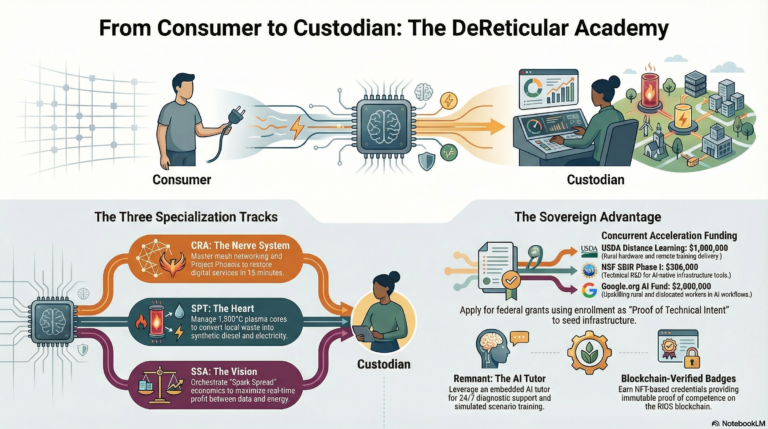
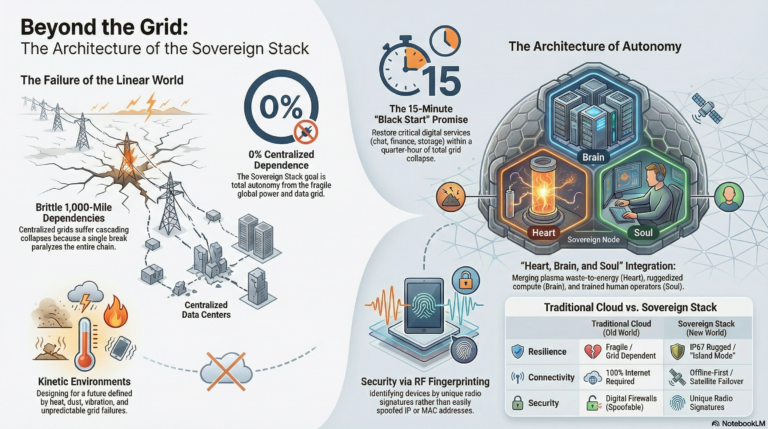
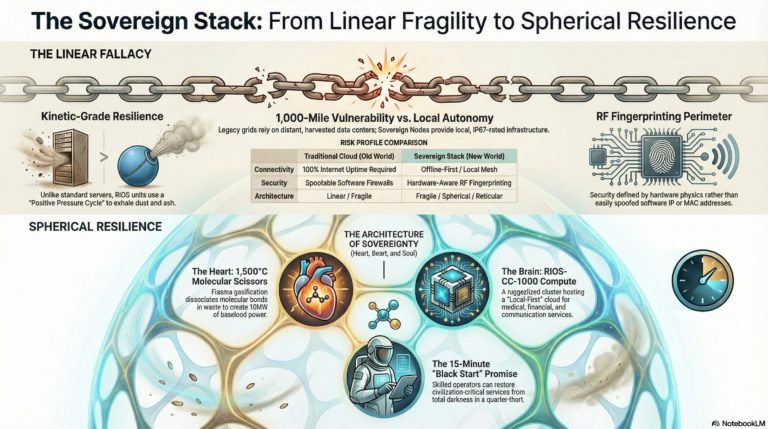
The transition “Above the Line” is the fundamental strategic hedge for the modern rural entrepreneur. Centralized, linear systems—the high-tension power lines, global supply chains, and hyperscale cloud providers—are structurally fragile and prone to “Capital Flight.” Moving from a “Consumer Mindset,” defined by passive utility dependency, to a “Developer Mindset,” focused on nodal asset optimization, is the only viable path to “Spherical Resilience.” In this model, the node functions as a self-contained industrial orb capable of generating power, fuel, and intelligence in “Island Mode.” This pivot creates a “Contextual Moat” that centralized Goliaths cannot cross; while Big Tech commoditizes generic intelligence, they lack the “Inference Density” and physical presence in the soil to manage the complex, localized biological and industrial variables that the sovereign developer controls.
white paper
The Sovereign Shift: A 90-Day Action Plan for Rural Industrial Autonomy
Mindset Inversion
| Feature | Consumer Mindset (Linear Dependency) | Developer Mindset (Spherical Resilience) |
| Financial Focus | Overhead: “How do I lower my bills?” | Asset: “How do I maximize power-per-acre?” |
| Resilience | Passive Dependency (Trusts the Line) | “Island Mode” (Active Resilience/0ms Latency) |
| Market Position | Commodity Trap (Selling raw crops) | Refinery Advantage (Selling Green Compute & ASF™) |
| Capital Flow | Capital Drain (Payments leave the community) | Capital Retention (Spark Spread reinvestment) |
This psychological shift from a “Price Taker” to a “Market Maker” is the prerequisite for deploying the physical architecture of the Sovereign Node.
video
2. Technical Architecture: The Sovereign Node Hardware Stack
To bypass the 4–7 year grid interconnection queues that currently paralyze industrial development, the Sovereign Node utilizes a hardware stack designed for immediate “Behind-the-Meter” deployment. This architecture transforms a parcel of land into a high-density “Digital Refinery” and multi-fuel hub, reaching operational status in 6–12 months.
- Micro-GTL (Gas-to-Liquids) Units: These transportable, modular reactors utilize Plasma Gasification at temperatures exceeding 1,500°C to dissociate molecular bonds in “negative-cost assets” such as manure, hemp, scrap tires, and plastics. Integrated NIR Spectroscopy analyzes feedstock in real-time to synthesize high-grade Agra Synthetic Fuel (ASF™) and Syngas.
- Vertical Agrivoltaics: This “Dual-Harvest” system utilizes N-Type bifacial cells mounted on vertical frames with a strict 7-meter tractor clearance for John Deere 8R/9R compatibility. AI-governed Linear Actuators adjust panel angles in 15-minute windows to balance peak energy harvesting, optimal Photosynthetically Active Radiation (PAR) for crops, and structural load shedding during wind events.
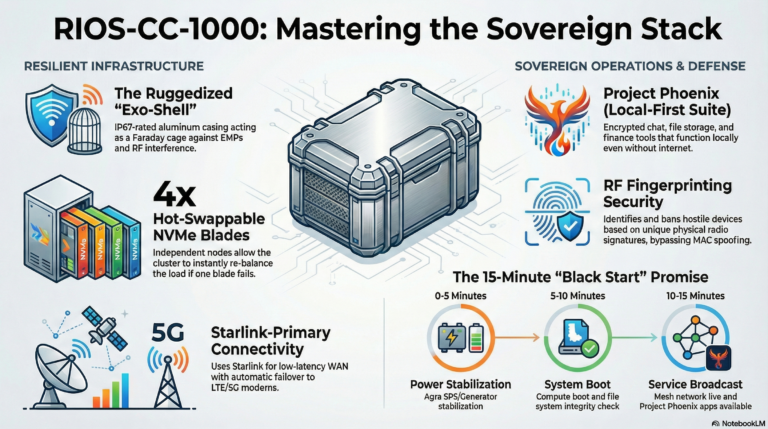
- RIOS-CC-1000 Server Clusters: Housed in NEMA 4X rated cabinets, these liquid-cooled hardware racks are submerged in dielectric cooling fluid. These clusters are air-gapped and host localized model weights, ensuring that critical industrial AI operations continue with 0ms latency even during total global cloud outages.
By generating baseload power and high-margin compute locally, “Island Mode” capability ensures operational continuity while treating energy as a virtual by-product of the digital refinery process. This hardware foundation is governed by a kernel-level intelligence system.
podcast
3. The Digital Brain: RIOS and Agentic Automation
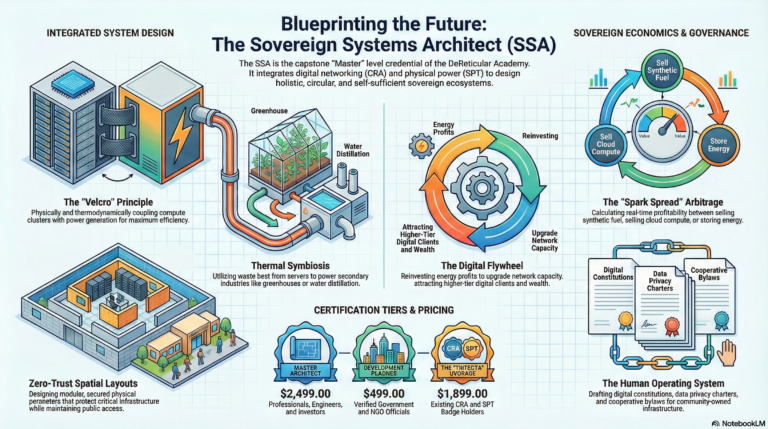
The Rural Infrastructure Operating System (RIOS) serves as the kernel-level logic governing the Sovereign Node. It treats the farm as a dynamic operating asset, constantly calculating the “Spark Spread”—the real-time algorithmic decision to allocate energy toward electrical power, synthetic fuel condensation, or high-margin edge compute hosting. Automation follows the “70/30 Rule,” where autonomous agents handle 70% of routine preparatory and maintenance tasks.
The “Agentic Workflow” is executed by a specialized suite of agents:
- Field Foreman: An autonomous robotic chassis that manages chemical reactor maintenance, biological digester health, and equipment diagnostics.
- Vault Warden: Utilizing high-mounted, rotating LiDAR, this agent maintains 360-degree perimeter security and protects “Secure Data Vaults” with 2mm precision.
- Industrial Foreman: The “Right to Repair” specialist, this agent uses local AI overrides and diagnostics to bypass proprietary OEM software locks on essential machinery.
- Field Medic: An air-gapped, HIPAA-compliant diagnostic engine providing community healthcare and medical data sovereignty.
To insulate these agents from global internet interruptions, the Nomad Link mesh canopy utilizes Wi-Fi 6E and LoRaWAN to create a miles-wide private intranet. This ensures uninterrupted “Agent-to-Agent” (A2A) communication and total data integrity, setting the stage for a rapid execution timeline.
4. The 90-Day Implementation Roadmap
Scaling rural industrial autonomy requires a phased rollout to manage complexity and bridge the “Deep Moat” of initial capital placement.
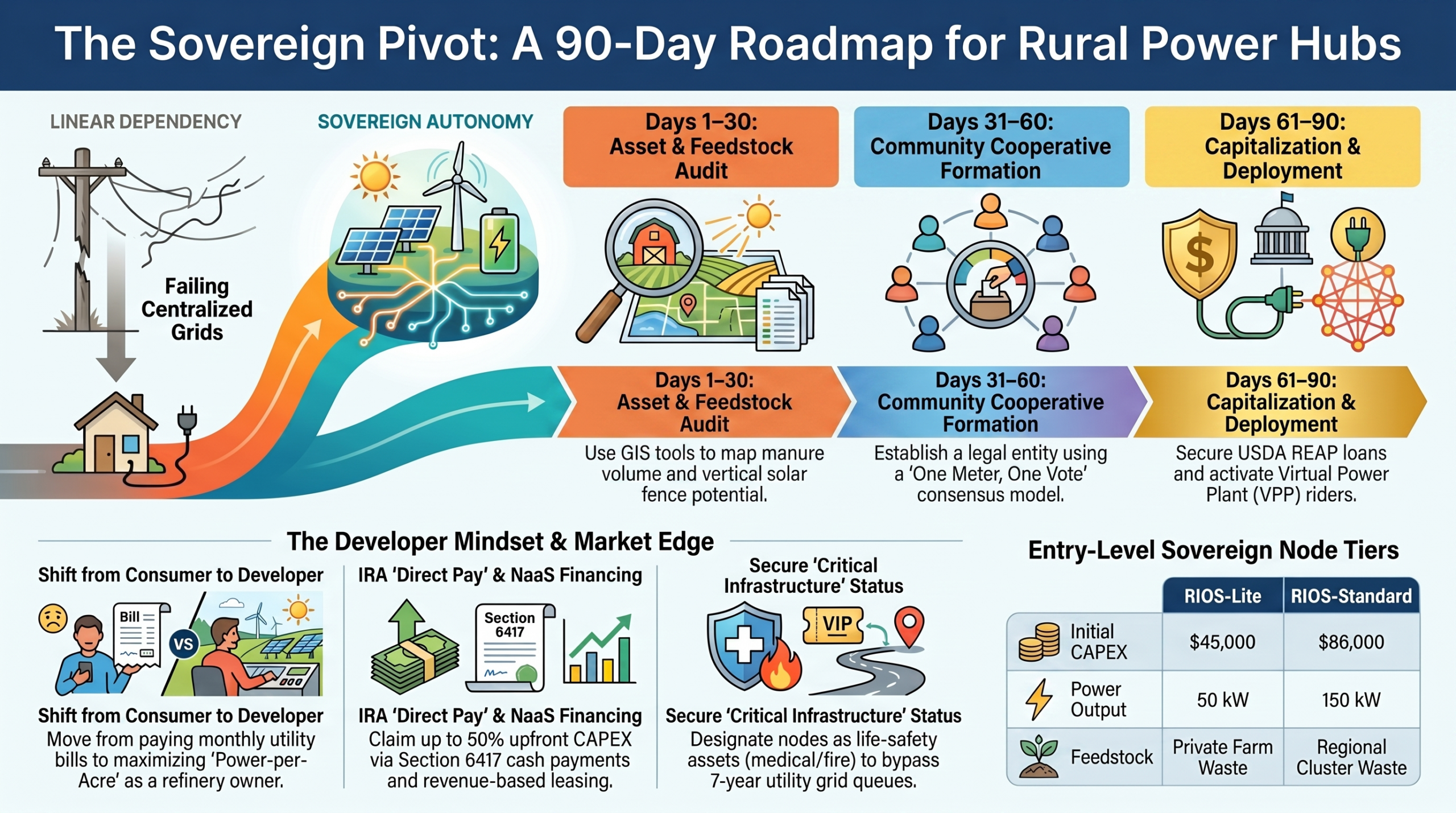
- Phase I: Asset Audit (Days 1–30): Use GIS mapping to identify vertical fence potential and quantify “Biological Brain” capacity. So What? AI-driven feedstock logistics can boost methane yield by 30–43%, turning waste into a predictable power-generation asset.
- Phase II: Entity Formation (Days 31–60): Form a community energy cooperative and establish “One Meter, One Vote” consensus. So What? This creates the legal framework for P2P trading and enables the “Agentic Coop” to function as a singular market entity.
- Phase III: Capital & Setup (Days 61–90): Finalize the capital stack by selecting between RIOS-Lite (45,000)** or **RIOS-Standard (86,000) tiers. So What? Activating USDA REAP loans and Section 6417 “Direct Pay” mechanisms allows cooperatives to claim 30–50% of project costs as upfront cash from the IRS.
This phased approach reduces risk by validating the resource base before committing to hardware deployment.
5. Financial Innovation: Bypassing the CAPEX Hurdle
Traditional bank debt is often structurally unsuitable for high-density industrial AI assets. Sovereign infrastructure is funded through “Revenue-Based Financing” (RBF) and decentralized mechanisms that align interests between investors and operators.
- Node-as-a-Service (NaaS): This model places the hardware via lease-to-own agreements, with a 10–20% share of the “Spark Spread” revenue returning to the financier until recovery goals are met.
- IRA Direct Pay (Section 6417): Non-profit cooperatives and local municipalities can claim elective cash payments for up to 50% of project costs, effectively acting as non-dilutive equity.
- Locutus Ledger: This P2P settlement layer creates “Energy-Backed Tokens,” allowing neighbors to invest in local energy/compute production and receive ASF™ or electricity as interest.
The arbitrage logic is clear: with a production cost of $0.04/kWh versus utility retail rates of $0.12/kWh, the node generates a massive “Spark Spread.” Compute revenue from the RIOS-CC-1000 further amortizes the hardware, effectively making energy a free by-product for the owner.
6. The Community Energy Cooperative: Scaling the Mesh
The ultimate goal of the Sovereign Node is the creation of a community-scale energy mesh that bypasses the “operational sclerosis” of centralized utilities. The “Agentic Coop” manages distribution without a large administrative team, using Deep Reinforcement Learning (DRL) to govern P2P exchanges.
Through the Agent-to-Agent (A2A) model, surplus energy is traded instantly. If a farm node identifies a 20% power surplus while a neighbor’s irrigation system is under high load, the AI agents execute a direct transfer via the Locutus Ledger. This occurs “Behind-the-Meter,” avoiding utility transmission fees and capturing 3x higher credit rates through intelligent export timing.
To ensure long-term protection from utility lobbyists, these nodes are designated as “Strategic Resilience Zones.” By providing essential services—power for fire suppression and HIPAA-compliant healthcare through the Field Medic node—the cooperative secures a regulatory hedge that classifies them as critical infrastructure. Through this shift, the rural entrepreneur is no longer a passive producer at the end of a line; they are a Market Maker and the operator of a high-density Digital Refinery at the heart of the decentralized era.