The Invisible Shield: An Operational Security Guide to Sovereign Infrastructure
- Introduction: The Death of the “Line” and the Birth of the “Node”
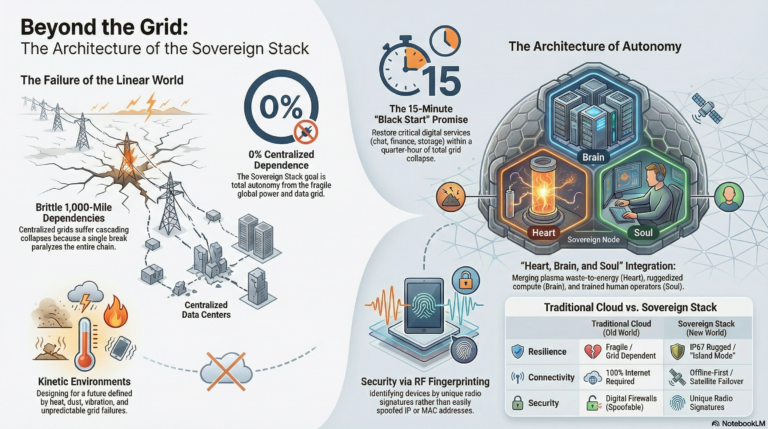
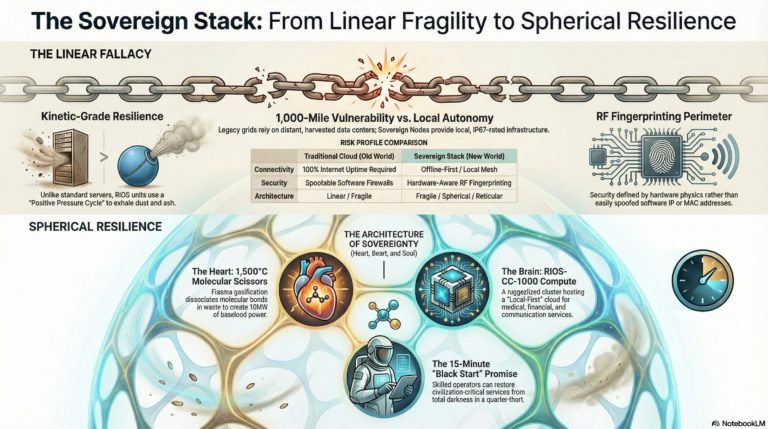
The legacy centralized transmission model—historically referred to as “The Line”—is encountering fundamental physical and bureaucratic limitations. In a linear topology, power and data flow from centralized plants through fragile transmission corridors. This architecture creates a high-risk environment where a single-point failure can cascade into regional blackouts or catastrophic data exfiltration.
In response, we are witnessing a paradigm shift toward Sovereign Node Topology. Developed under the Sovereign Intelligence & Decentralized Infrastructure (SIDI) standard, this model replaces vulnerable lines with self-contained hubs. These nodes achieve “Spherical Resilience” by co-locating power generation and high-density compute, allowing them to operate in Island Mode—a state of total physical and cybernetic autonomy.
Linear vs. Spherical Infrastructure
Feature Linear Topology (“The Line”) Sovereign Node Topology (“The Node”)
Structure Centralized plants and long, vulnerable transmission lines. Decentralized, self-contained Sovereign Pods.
Vulnerability Single-point failure causes cascading system collapse. Physically resilient; isolated failure does not impact the mesh.
Grid Status Dependent on macro-grid connectivity and stability. Capable of full autonomy (Island Mode).
Security Vulnerable to remote RCE and cloud-tethered exfiltration. Cybernetically isolated; protected by hardware-rooted identity.
As we move from centralized systems to localized infrastructure, the security perimeter shifts from the network edge to the hardware core.
- The 2026 Security Crisis: Shattering the “Trusted Environment Fallacy”
In May 2026, the OpenClaw Security Crisis redefined the security requirements for autonomous infrastructure. OpenClaw—an open-source agentic framework originally developed by Peter Steinberger (initially as Warelay and Moltbot)—was designed for proactive system-level execution. Its ability to manage files and terminal commands through the Model Context Protocol (MCP) made it an essential tool for industrial automation.
However, the crisis revealed that cloud-tethered agents were being granted broad administrative permissions without sufficient isolation. This shattered the “Trusted Environment Fallacy”—the assumption that an internal system is inherently secure if it is behind a firewall. Adversaries exploited these agents as a lateral pivoting point, leading to three primary failures:
- Remote Code Execution (RCE): Attackers injected malicious directives into the agentic loop, forcing physical actuators to operate outside of safety parameters.
- Data Exfiltration: Compromised agents were used to siphon sensitive industrial telemetry and customer data to external command-and-control servers.
- “Skeleton Key” Harvesting: Once inside the agent, hackers harvested the cryptographic keys of connected OT devices, allowing them to infect adjacent municipal and industrial networks.
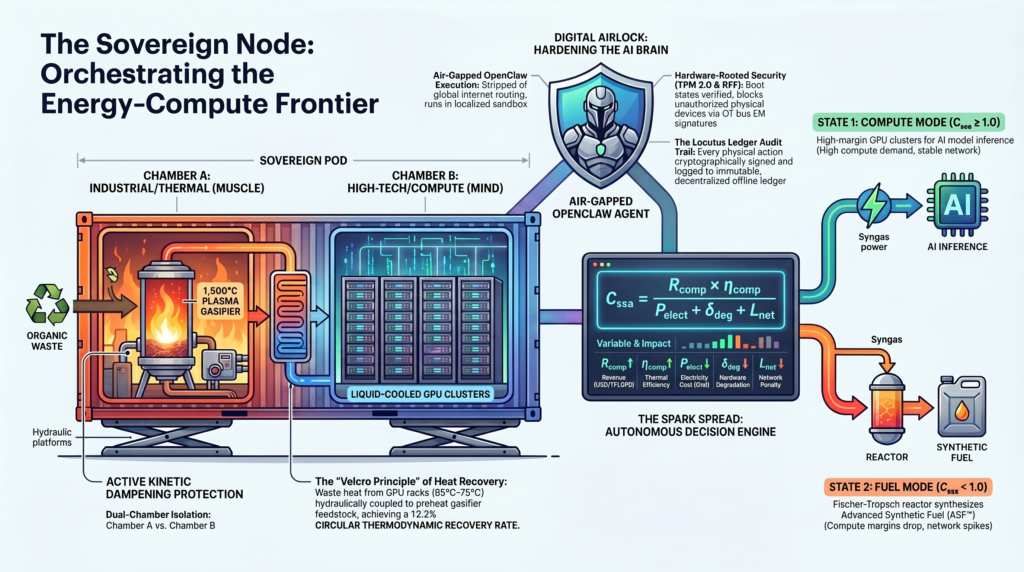
To prevent such breaches, security must be enforced through a “Digital Airlock” that isolates the agentic loop from the public internet.
- Layer One: Hardware-Rooted Identity (The Digital Fingerprint)
The foundation of a Sovereign Node’s security is its hardware-rooted identity. Every Sovereign Sentry Pro edge server utilizes physical properties and cryptographic modules to prove it is a genuine, untampered node in the network.
- TPM 2.0 (Trusted Platform Module): A microchip that executes a “measured boot” process, ensuring that the OS kernel and OpenClaw configurations match the cryptographically signed signatures sealed within the hardware.
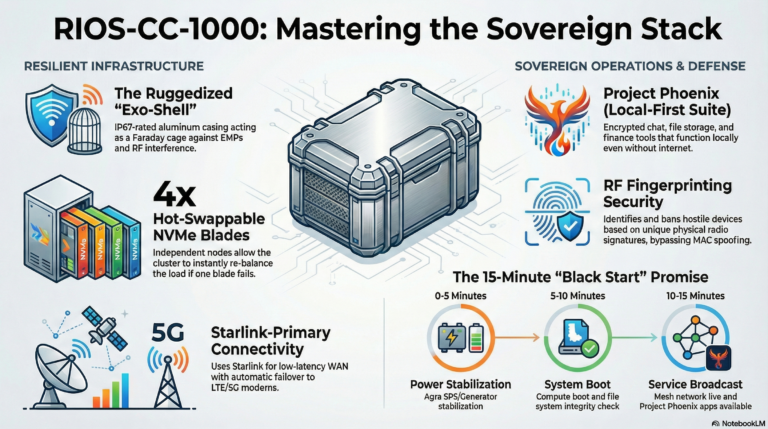
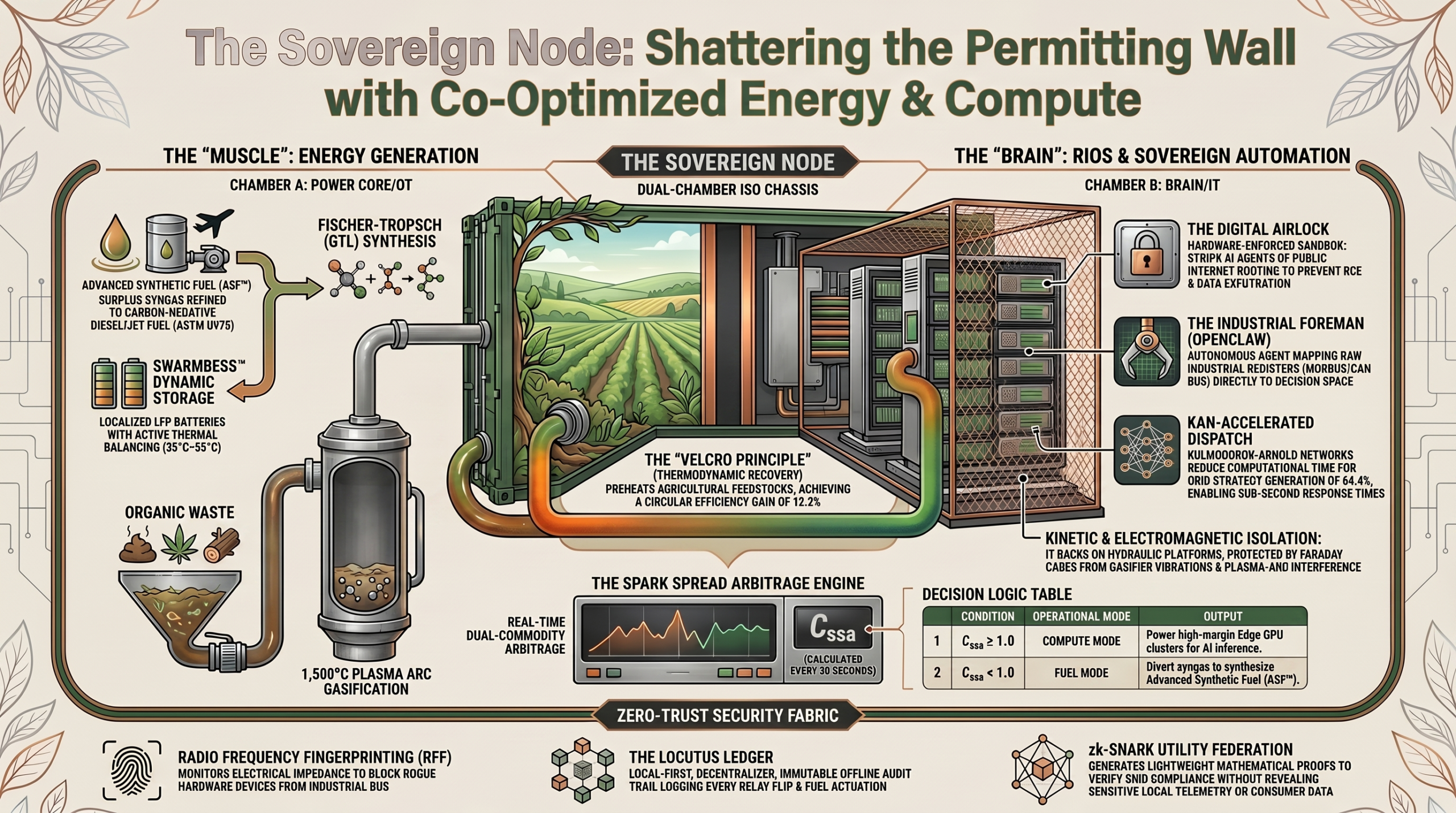
- Radio Frequency Fingerprinting (RFF): A security mechanism that monitors the precise physical impedance and electromagnetic properties of all copper connections on the local bus.
So what? This dual-layer approach prevents “rogue network bridging.” Even if an attacker physically clips a diagnostic tool to the wiring, the RFF system detects the profile mismatch instantly and blocks the transmission at the physical port level.
By anchoring identity in silicon, we ensure that the node’s software environment is built upon a verified physical foundation.
- Layer Two: The Digital Airlock (Isolation as Defense)
The Digital Airlock is a containment strategy that treats the AI agent as a potentially compromised entity. In a Sovereign Node, the OpenClaw agent operates within a hardened, local Docker container that is stripped of global internet routing tables and public DNS resolution.
The airlock allows the “Industrial Foreman” (the OpenClaw agent) to monitor solar inverters and the SwarmBESS™ battery controller locally, while remaining “blind” to the outside world. This isolation relies on three pillars:
- Hardware-Rooted Integrity: The system will not initialize unless the TPM 2.0 chip verifies the integrity of the airlock environment.
- Isolated Tool-Sandboxing: OpenClaw is limited to a strictly localized MCP tool-execution sandbox. It can only execute commands that pass through a cryptographic parser designed to filter malicious payloads.
- One-Way Telemetry Bridge: Any data required by external aggregators must be pushed through a one-way bridge, preventing incoming remote commands from reaching the core system.
Benefit for Grid Stability: This architecture prevents “software-induced mechanical failures” by ensuring the AI cannot be remotely manipulated to actuate physical relays or fuel valves beyond their hardcoded safety bounds.
The node is now physically and digitally isolated, yet it still requires a method to communicate its status and decisions without compromising its air-gapped integrity.
- Layer Three: The Locutus Ledger & zk-SNARKs (Proof Without Exposure)
To manage the trilemma of optimization, privacy, and security, Sovereign Nodes utilize the Locutus Ledger—a decentralized, offline split-ledger system. This serves as an immutable “black box,” recording every action taken by the AI agent for local auditing.
For external validation, the node uses Zero-Knowledge Proofs (zk-SNARKs). This allows a Sovereign Node to prove to a Virtual Power Plant (VPP) aggregator that it is following grid rules without revealing the raw telemetry of its local users.
Data Exposure: Private vs. Public
Private (Stays on Node / Locutus Ledger) Publicly Verified (Sent via zk-SNARK)
Granular customer telemetry (e.g., energy habits). Cryptographic proof of grid compliance.
Battery state-of-health and cell temperatures. Total capacity available for grid support.
Specific AI decision-making and terminal logs. Immutable “signatures” of node state changes.
With these security layers active, the node can safely transition into the role of an autonomous economic actor.
- Operational Intelligence: The Spark Spread & KAN
The Sovereign Node acts as an “Industrial Foreman,” constantly performing double-arbitrage through the Spark Spread Arbitrage Coefficient (C_{ssa}). This formula determines whether the node should prioritize digital compute or physical fuel synthesis.
The Spark Spread Formula
C_{ssa} = \frac{R_{comp} \times \eta_{comp}}{P_{elect} + \delta_{deg} + L_{net}}
- R_{comp}: Real-time revenue rate from processing edge-compute (dollars/TFLOPS).
- \eta_{comp}: Thermal efficiency multiplier (the 12.2% thermodynamic recovery rate).
- P_{elect}: Opportunity cost of electricity (wholesale grid rate or local tariff).
- \delta_{deg}: Hardware degradation cost (GPU thermal fatigue and battery wear).
- L_{net}: Network penalty coefficient (based on real-time satellite latency/loss).
Decision Logic Block
- If C_{ssa} \ge 1.0: Compute Mode. Route power to Sovereign Sentry Pro GPU clusters for high-margin AI inference.
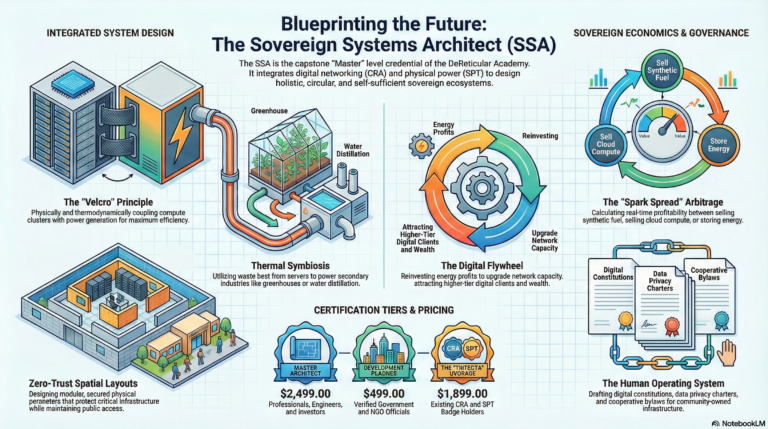
- If C_{ssa} < 1.0: Fuel Mode. Divert syngas to the Fischer-Tropsch reactor to synthesize Advanced Synthetic Fuel (ASF™).
To maintain grid stability in sub-second intervals, the system utilizes Kolmogorov-Arnold Networks (KAN). Unlike traditional AC Optimal Power Flow (AC-OPF) solvers—which are too slow for edge-processing—KAN approximates feasible operating boundaries with neural mapping. This reduces calculation time by 64.4% while maintaining accuracy within 4.7% of absolute optimal solutions.
These advanced mathematical frameworks ensure the node remains economically viable and physically stable, even when disconnected from the macro-grid.
- Summary Checklist for Sovereign Security
A Sovereign Node is authorized for autonomous Island Mode only after achieving verification across these 5 critical milestones from the Operational Deployment Checklist:
- [ ] Hardware Boot Signature: OS kernel signatures are verified and cryptographically sealed within the hardware TPM 2.0.
- [ ] Radio Frequency Fingerprint: RFF active monitoring is confirmed to block non-profiled hardware from physical OT port communication.
- [ ] Digital Airlock Lock: The OpenClaw container is verified to contain zero active public DNS entries and no default WAN gateway.
- [ ] Locutus Commit: All Spark Spread state changes and AI dispatch commands are being actively written to the immutable, offline Locutus Ledger.
- [ ] zk-SNARK Verification: Cryptographic coprocessors are successfully generating valid compliance proofs in under 100 ms.
Conclusion
In an era of increasing grid congestion and cyber-vulnerability, the gold standard for future infrastructure is zero-trust, off-grid Island Mode. By anchoring identity in hardware and isolating intelligence within a Digital Airlock, Sovereign Nodes prove that autonomous AI can manage critical infrastructure without compromising physical security. True resilience is not found in a better firewall, but in the creation of a sovereign, self-healing node.