Democratizing Carbon Finance: The Trash Banker Ecosystem and Sovereign dMRV
Executive Summary
The global carbon credit industry is currently navigating a profound structural transformation characterized by a “flight to quality.” As of 2026, the market has bifurcated: legacy avoidance credits—often criticized for soft baselines and “greenwashing”—are trading at depressed prices (frequently under $5/tonne), while high-integrity, physically verified carbon removals command significant premiums (ranging from $22 to over $1,000/tonne for engineered solutions).
video
Despite this shift, the industry faces systemic bottlenecks, including a “trust deficit” in Monitoring, Reporting, and Verification (MRV), centralized registry vulnerabilities, and the financial exclusion of Indigenous Peoples and Local Communities (IPLCs).
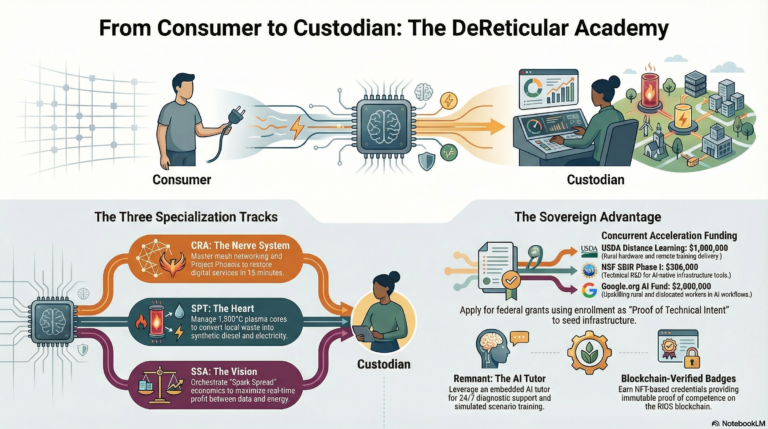
This briefing document examines the DeReticular Sovereign Stack, an integrated ecosystem designed to resolve these gaps. By utilizing ruggedized edge hardware (Sovereign Sentry and Deck), localized AI (HempGrade AI), and decentralized, peer-to-peer ledgers (Locutus Ledger), DeReticular provides a “Hard Physical Attestation” standard. This architecture, exemplified by the “Trash Banker” model at Project Umoja (Node 4) in Uganda, transforms agricultural waste into instant digital liquidity for local farmers while ensuring absolute ecological integrity through hardware-anchored, zero-knowledge proofs.
1. Global Carbon Market Landscape (2025–2026)
The market is defined by a clear divergence between highly regulated Compliance Carbon Markets (CCMs) and the evolving Voluntary Carbon Market (VCM).
1.1 Compliance vs. Voluntary Market Dynamics
| Feature | Compliance Carbon Markets (CCMs) | Voluntary Carbon Market (VCM) |
| Financial Scale | $107B+ in government revenues (2025) | ~$1.68 Billion |
| Global Coverage | 29% of global emissions (87 policies) | Corporate net-zero commitments |
| Average Price | ~21/tCO₂e (Global Avg); ~68/tCO₂e (Europe) | Bifurcated by quality (see below) |
| Primary Drivers | Government mandates (ETS, Carbon Taxes, CBAM) | CSR, ESG scrutiny, and SBTi standards |
1.2 The Pricing Bifurcation
A “quality gap” has emerged, separating legacy credits from high-integrity removals:
- Legacy Avoidance Credits (<$5/tonne): Older REDD+ and renewable energy projects suffering from “linear fragility” and questionable baselines.
- Nature-Based Removals (22–60/tonne): Afforestation, Reforestation, and Revegetation (ARR) and “Blue Carbon” (mangroves/seagrass).
- Engineered Carbon Dioxide Removal (CDR) (115–1,000+/tonne): Biochar Carbon Removal (BCR), Enhanced Rock Weathering (ERW), and Direct Air Capture (DACCS).
2. Systemic Vulnerabilities in Carbon Finance
The industry identifies four critical gaps that hinder institutional scaling:
- The Verification Chasm (Gap A): Traditional MRV relies on manual, retrospective paper audits and distant satellite approximations that struggle with micro-canopy density.
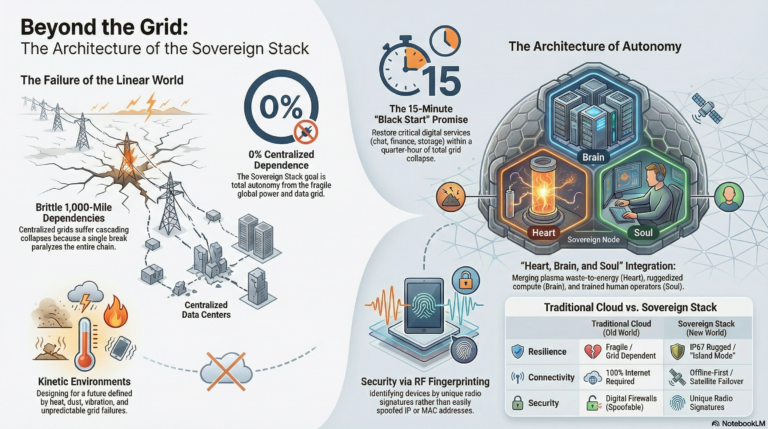
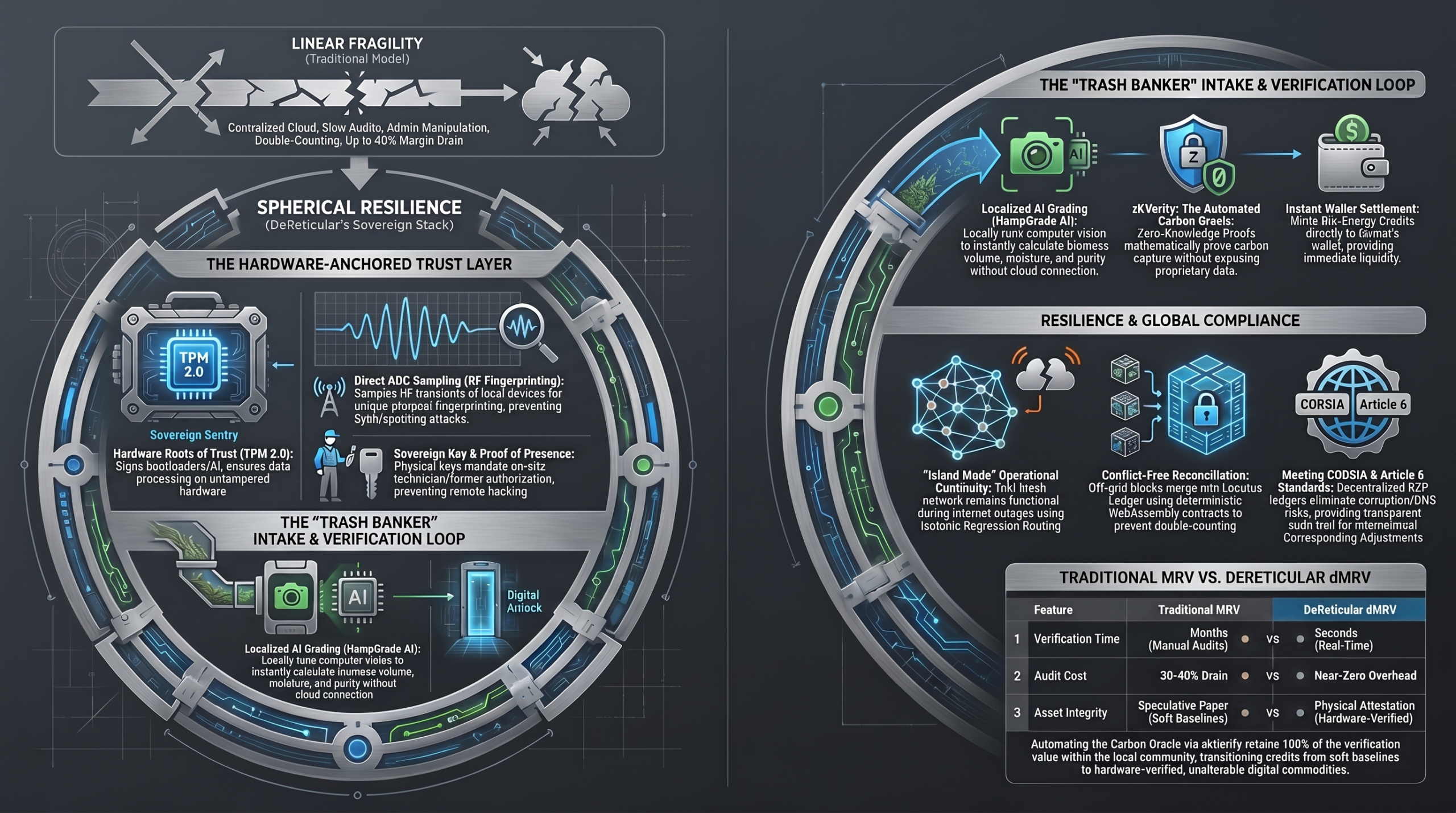
- Linear Fragility (Gap B): Centralized, cloud-dependent registries are vulnerable to DNS poisoning, administrative corruption, and geopolitical disruptions.
- IPLC Exclusion (Gap C): Rural smallholders manage carbon-sequestering land but lack financial liquidity. Their agricultural waste is “dead capital” because banks do not accept it as collateral.
- Feedstock Verification (Gap D): High-durable removals (BCR/BECCS) require proof that feedstocks are sustainable organic waste and not illegally logged timber.
3. The DeReticular Sovereign Stack Architecture
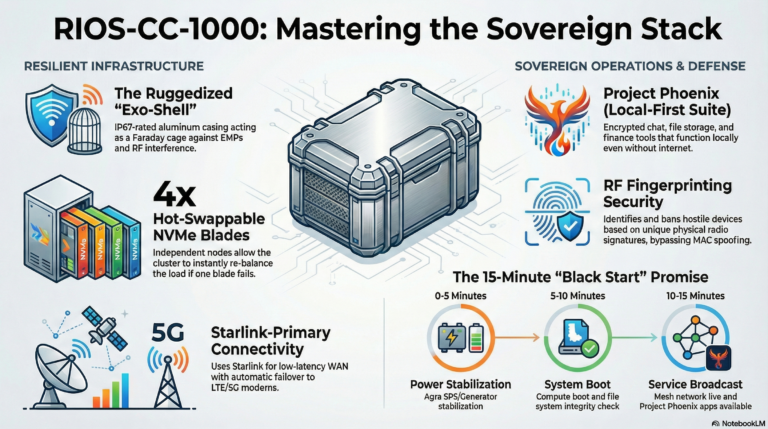
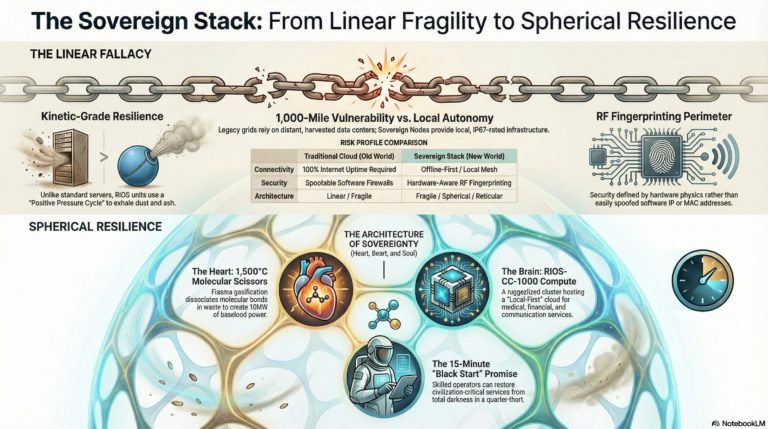
DeReticular replaces fragile, centralized infrastructure with “Spherical Resilience”—a self-sustaining ecosystem designed to run in “Island Mode” (completely offline).
3.1 Hardware Components
- Sovereign Sentry Pro: An industrial-grade server with an integrated 6 TOPS Neural Processing Unit (NPU) and TPM 2.0 security chip. It acts as a stationary core for local AI inference and ledger validation.
- Sovereign Deck: A ruggedized, IP65-rated tactical tablet with integrated Software Defined Radio (SDR) and optical sensors for field audits.
- Sovereign Badge: A solar-assisted RF transponder used for hardware-enforced Proof of Presence for community rangers and farmers.
3.2 Software and Logic Layers
- RIOS (Rural Infrastructure Operating System): An AI-native, decentralized OS that manages workflows and energy loads off-grid.
- HempGrade AI: A specialized computer vision model (TensorFlow Lite) that performs real-time optical analysis of biomass on edge devices, grading quality and moisture content locally.
- Locutus Ledger (Freenet/Hyphanet): A peer-to-peer state machine using WebAssembly (Wasm) contracts. It is immune to administrative deletion and DNS poisoning.
4. Case Study: Project Umoja and the “Trash Banker”
Project Umoja (Node 4) in Kaabong, Uganda, serves as the operational model for democratized carbon finance.
4.1 The Sovereign Stack at Node 4
- The Muscle (Agra Dot Energy): Advanced Plasma Gasification providing 24/7 carbon-negative power.
- The Motion (Kurb Kars): Autonomous logistics handling biomass within the industrial park.
- The Mind (DeReticular RIOS): Managing the energy load and the “Trash Banker” transacting loop.
4.2 The “Trash Banker” Loop
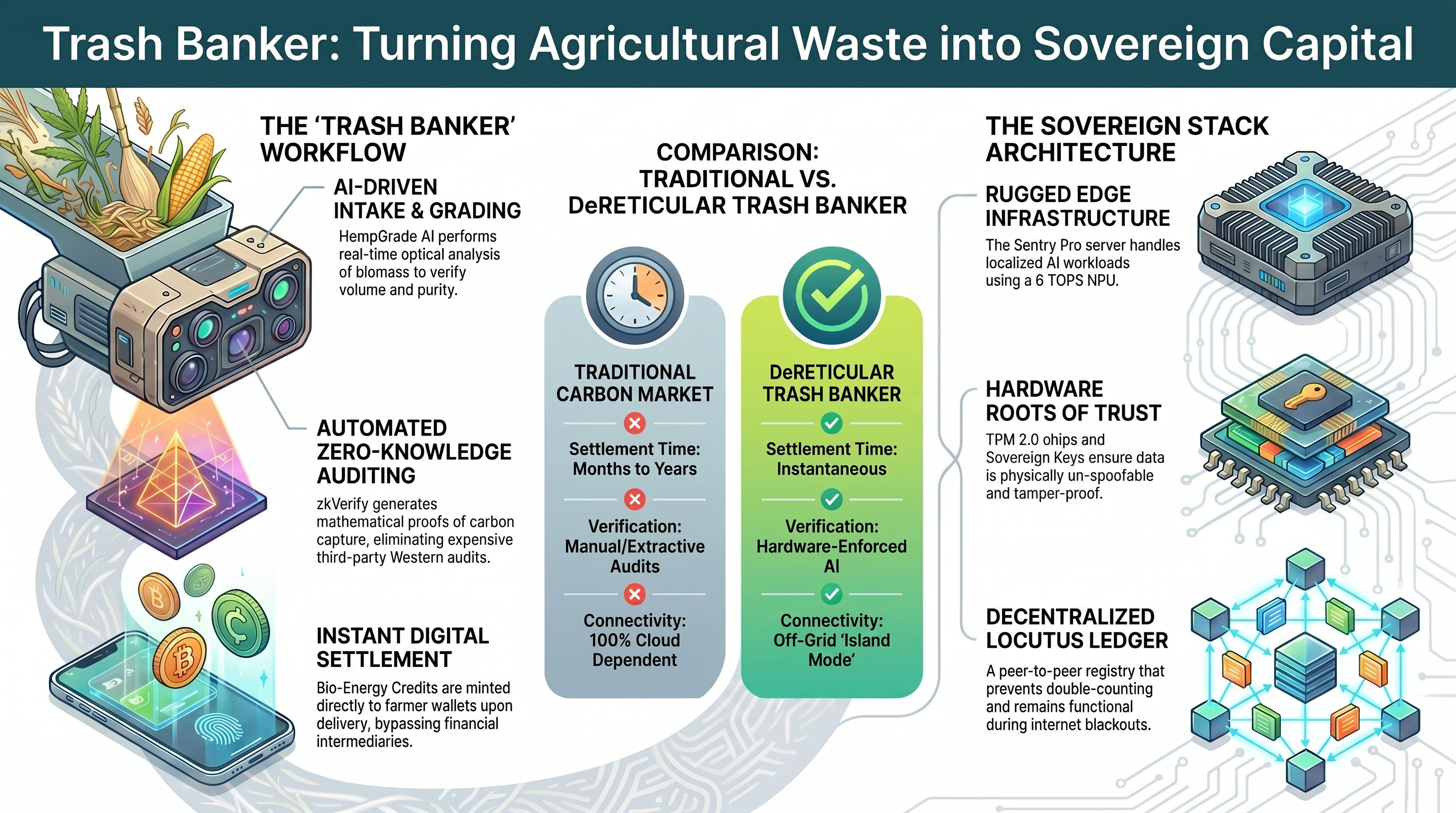
This framework transforms decomposing crop waste (hemp stalks, corn husks) into instant digital liquidity:
- Intake: A farmer delivers raw agricultural waste to the processing hub.
- Evaluation: The Industrial Foreman AI and HempGrade AI (on a Sentry Pro node) scan the load to verify dry mass, quality, and carbon value.
- Tokenization: The system instantly mints “Bio-Energy Credits” (utility tokens) directly to the farmer’s off-grid digital wallet.
- Utility: Farmers can exchange these credits locally for power, clean water, or biochar fertilizer, bypassing predatory financial intermediaries.
5. Technical Mechanics of Ecological Integrity
5.1 Hard Physical Attestation
DeReticular anchors data in physical reality through:
- TPM 2.0 Signatures: The hardware measures the OS kernel and AI weights at boot. If the software is tampered with, the cryptographic keys lock automatically.
- Direct ADC Sampling: The Sentry node fingerprints the unique radio-frequency transients of Sovereign Badges, making virtual node spoofing (Sybil attacks) physically impossible.
- Isotonic Regression Routing: An algorithm that optimizes data propagation across low-bandwidth TriFi Mesh networks during “Island Mode.”
5.2 Zero-Knowledge Carbon Oracles
To eliminate expensive annual third-party audits, the system uses zkVerify. It compiles physical sensor data (biomass input vs. energy output) into a Zero-Knowledge Proof (ZKP). This mathematically proves carbon sequestration occurred without exposing proprietary engineering data, allowing for continuous, on-chain auditing.
6. Regulatory and Geopolitical Context
6.1 The U.S. Legislative Schism (2025–2026)
| Jurisdiction | Primary Policy Trend | Key Legislation |
| Federal | De-regulation & Preemption | “One Big Beautiful Bill” Act (OBBBA) of 2025; EPA rescission of 2009 Endangerment Finding. |
| Conservative States | Anti-ESG | Laws prohibiting pension funds from considering carbon metrics; Texas SB 2337. |
| Progressive States | Transparency & Mandates | California AB 1305 (strict offset disclosures); AB 1207 (offsets placed “under the cap”). |
6.2 International Frameworks
- CORSIA Phase 1 (2024–2026): Requires airlines to purchase credits with a Corresponding Adjustment (CA) from the host nation to prevent double-counting.
- Article 6.4 (Paris Agreement): Operationalized at COP30, providing a UN-regulated “truth layer” for carbon methodologies.
7. Product Ecosystem (Official SKUs)
| SKU | Product Name | Application |
| DR-SENTRY-PRO-CDR-INT | Sovereign Sentry Pro | Industrial feedstock gatekeeper; filters plastic/illegal wood using 6 TOPS NPU. |
| DR-DECK-FIELD-MRV | Sovereign Deck | Rugged field terminal for visual dMRV (Blue Carbon/ARR audits). |
| DR-BADGE-IPLC-SEC | Sovereign Badge | Tamper-proof hardware-enforced Proof of Presence for local rangers. |
| DR-RIOS-ORACLE-LIC | RIOS Carbon Oracle | Software license for zkVerify integrations and Locutus Ledger sync. |
8. Strategic Conclusion
The transition from speculative avoidance to verified removal is the only viable path for the global carbon market. By replacing extractive auditing with localized edge AI and hardware-anchored cryptography, the DeReticular “Trash Banker” framework bridges the gap between local climate stewardship and global finance. This decentralized architecture ensures that carbon offsets are no longer paper promises but bankable, transparent, and physically verified assets that directly empower the communities managing them.