The Sovereign Node: How Rural Entrepreneurs are Decoupling from the Global Entropy Trap

1. The Great Divide: “The Line” vs. “The Node”
The modern industrial agricultural complex has reached an inflection point termed the “Capital Gap.” Legacy machinery—monolithic 20-ton tractors—now carries price tags between $500,000 and $800,000, effectively pricing out small-to-medium landowners and forcing them into a state of “Diesel Slavery.”
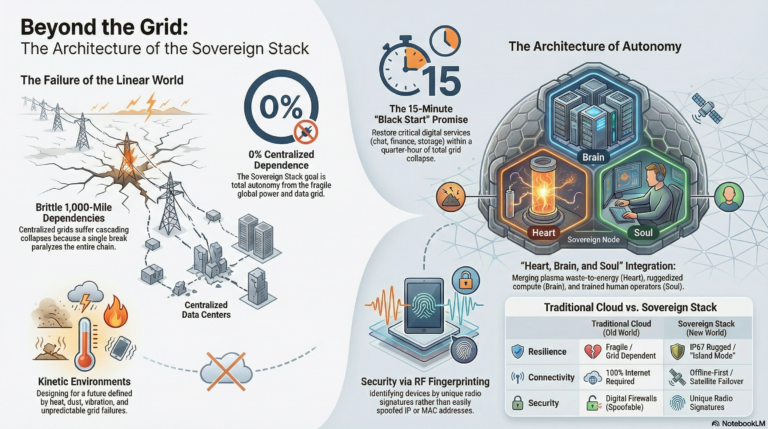
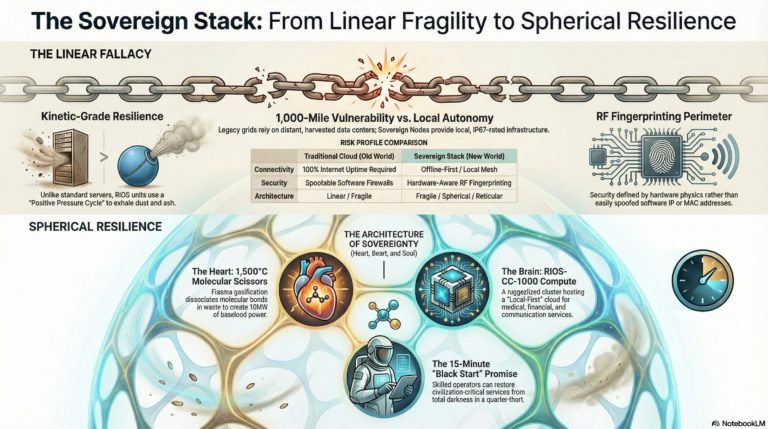
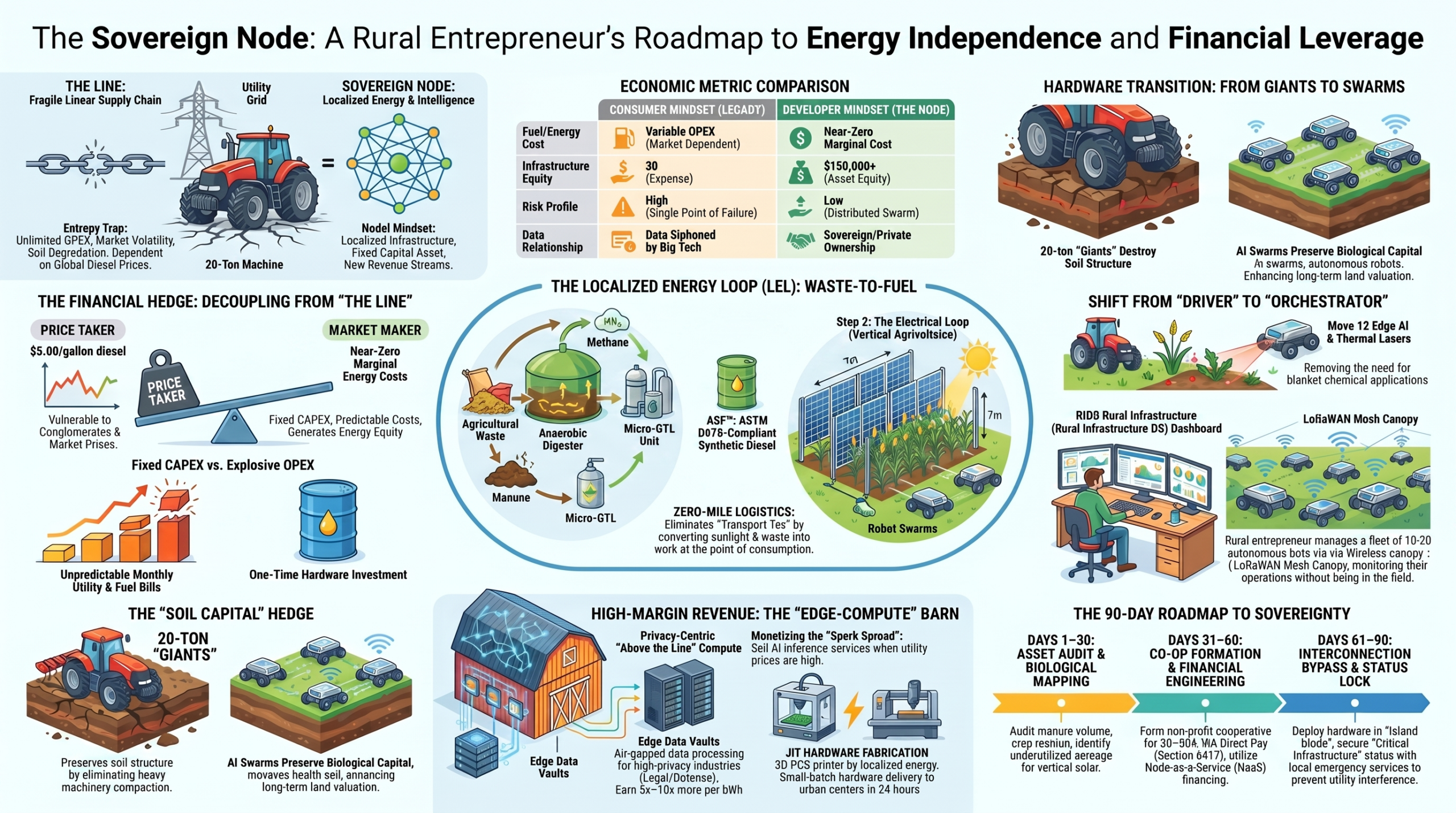
This crisis is a symptom of “The Line”: a global, linear, and fragile logistics chain. The Line begins at a distant oil well and moves through transcontinental shipping and massive refineries, leaving the rural landowner as a “Price Taker” vulnerable to “Capital Flight” and geopolitical shocks. When diesel hits $5.00/gallon, as it did in 2026, the profit margins of legacy operations vanish because The Line offers no fallback.
In contrast, the “Sovereign Node” represents a circular, self-sustaining energy and intelligence loop. By producing energy at the point of consumption, the rural entrepreneur shifts from the fragility of global logistics to the resilience of “Island Mode.” This is the only path to escape the “Entropy Trap” where the costs of maintaining centralization exceed the profits of the land.
The Fundamental Axiom of the AI Industrial Shift The industry is now bisected by a horizontal threshold:
- Below the Line (Commodity): Generic LLMs and raw compute. Competing here results in structural obsolescence.
- Above the Line (Moat): Localized physical execution and proprietary context.
- The Strategic Move: Use “Below the Line” tools as free fuel to build high-margin assets “Above the Line.”
——————————————————————————–
video
2. The Financial Hedge: Fixed CAPEX in a Volatile World
The Sovereign Node is a structural financial hedge against global entropy. Traditional conglomerates operate on an “Unlimited OPEX” model, buying diesel at volatile spot rates. Legacy giants are inherently inefficient, achieving only 25–30% real-world thermal efficiency.
The Sovereign Node utilizes a “Front-Loaded CAPEX” model. Once the infrastructure is deployed, the marginal cost of the next unit of work is statistically near zero. By replacing “Giants” with autonomous swarms, the entrepreneur preserves “Biological Capital” and eliminates the “Soil Compaction Tax.”
Economic Factor Comparison: Legacy Conglomerate vs. Rural Sovereign Node
| Economic Factor | Legacy Conglomerate (The Line) | Rural Sovereign Node (The Node) |
| Primary Risk | Energy and Logistic volatility | Initial hardware deployment logic |
| Operational Logic | Mass-centralization (Giants) | Specialized-Decentralization (Swarms) |
| Profit Protection | Volume-dependent (Must be big to win) | Context-dependent (Must be smart to win) |
| Soil Value | Depreciating via physical impact | Compounding via precision monitoring |
| End Game | Structural Decay: Costs rise exponentially | Structural Leverage: AI efficiency rises |
——————————————————————————–
podcast
3. Pillar of Sovereignty: The Localized Energy Loop (LEL)
The LEL functions as the biological and electrical battery for the Sovereign Node, securing independence through three pillars:
- Pillar I: Biological (Micro-GTL): Utilizing Agra-Dot Micro-GTL units, the node converts manure and waste into Agra Synthetic Fuel (ASF™). A single unit produces 45+ barrels of synthetic diesel per day. Waste heat from this process is recaptured to warm biogas digesters in winter, creating a closed “Molecular Loop.”
- Pillar II: Photovoltaic (Vertical Fences): Bifacial solar fences utilize only 2% of the land footprint. Move 5 logic (RIOS monitoring) tracks output in 15-minute shifts, shifting swarm tasks to “low-energy” mode if cloud cover persists.
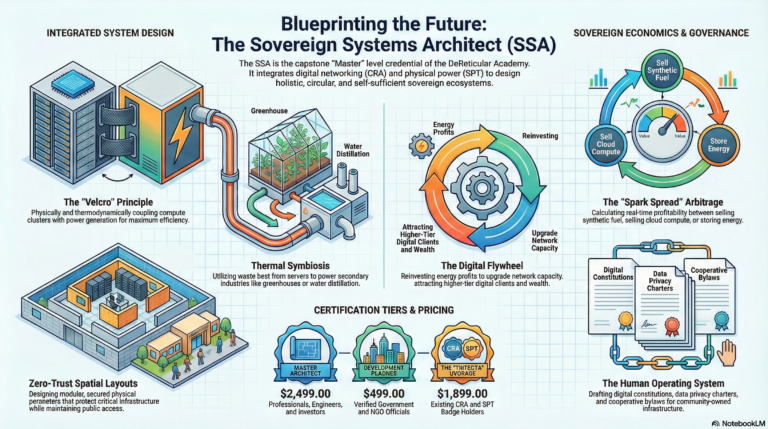
- Pillar III: Storage/Logic (LFP Vaults + RIOS): The Rural Infrastructure Operating System (RIOS) manages the “Spark Spread,” deciding whether energy becomes ASF™, local electricity, or high-margin “Privacy Compute.”
The 24-Hour Integrated Workflow
- 06:00 – 10:00: Solar fences charge batteries. AI handles 70% of operational data (the 70/30 Human Rule).
- 10:00 – 14:00: Peak sun. RIOS routes surplus to AI compute racks or JIT manufacturing.
- 14:00 – 18:00: Swarm bots operate at peak intensity; syngas backfills solar drops.
- 18:00 – 06:00: Hub runs on ASF™ and LFP storage while digesters refine the next day’s fuel.
——————————————————————————–
4. From Giants to Swarms: The Hardware Revolution
Legacy 20-ton “Giants” create deep-soil compaction that reduces yields by up to 20%. Autonomous Swarms—modular electric nodes weighing 150–800 lbs—exert less ground pressure than a human footprint. This allows operation on saturated soil, extending the planting window and increasing the Land Equivalent Ratio (LER) by 1.2x to 1.6x.
The “Compute-at-the-Edge” Advantage Using Move 12 logic, swarm bots shift the metric of productivity from speed (mph) to “Compute-per-Plant”:
- Vision-Based Precision: CNNs differentiate between sprouts and weeds in milliseconds, using micro-targeted lasers to eliminate chemical costs entirely.
- Systemic Resilience: If one node in a 20-unit swarm fails, 95% of the fleet remains active.
- Metabolic Efficiency: Swarms avoid the “Transport Tax” by harvesting energy exactly where they spend it.
——————————————————————————–
5. Beyond the Harvest: Capturing High-Margin Revenue Streams
The rural entrepreneur shifts from “Price Taker” to “Market Maker” through diversified “Above the Line” models:
- Agricultural Autonomy-as-a-Service (AaaS): Managing 10–20 bots across neighbor properties via RIOS. Charging a $35/acre fee or taking 30% of “Chemical Displacement” savings. Soil-carbon data is packaged and sold on the Locutus Ledger.
- The Edge-Compute Barn: Converting vacant structures into climate-controlled Sovereign Data Vaults. Leasing “Privacy Compute” to high-security industries, powered by steady-state syngas to undercut commercial grid rates.
- The Sovereign Fuel Station: Selling ASTM D975-compliant ASF™ to local logistics partners via the Locutus Ledger at fixed, multi-year rates.
- The JIT Hardware Hub: Using System 3 (Software from Spreadsheets) to run 3D printers and CNC machines for “small-batch” hardware, shipping to urban buyers within 24 hours.
- The Medic & Rescue Lifeboat: Securing Critical Infrastructure (CI) Status by providing 24/7 power to medical clinics or hosting an air-gapped emergency mesh. This positions the Node for public grants and priority permitting.
——————————————————————————–
6. The 90-Day Tactical Roadmap to Independence
This roadmap is designed to bypass the three core Choke Gaps: Finance, Information, and Interconnection.
- Phase I (Days 1–30): Asset Audit & The Identity Shift. Identify feedstocks and map vertical agrivoltaic potential. Embrace the 70/30 Rule: delegate 70% of repetitive labor to AI agents. Deploy a Sovereign Sentry kit to shield local data from “Cloud Sickness.”
- Phase II (Days 31–60): Financial Engineering. Form a non-profit community co-op to access IRA Direct Pay (Section 6417). Claim a 50% reimbursement (30% base + 10% Domestic Content + 10% Energy Community). Layer this with Node-as-a-Service (NaaS) leasing to cover the balance via the “Spark Spread.”
- Phase III (Days 61–90): Interconnection Bypass & Status Lock. Build “Behind-the-Meter” to avoid the 7-year grid queue. Secure Critical Infrastructure (CI) Status by linking the Hub to emergency services. This legal designation provides a “lockdown” against utility lobbyists.
——————————————————————————–
7. Conclusion: The Rise of the Industrial Integrator
The Sovereign Node is the definitive cure for the “Entropy Trap.” By increasing the “Intelligence of the Land” rather than merely extracting its value, the rural entrepreneur builds structural wealth. The robot swarm “lives off the land,” harvesting energy exactly where it spends it, decoupling the business from the logistics costs that break the conglomerate.
Strategic Differentiator: Mastering the Node is the only strategy that ensures your business thrives Above the Line.