Sovereign Infrastructure: A Prospectus for Municipal Resilience and “Island Mode” Autonomy
podcast
- The Crisis of Linear Infrastructure and the Pivot to Spherical Resilience
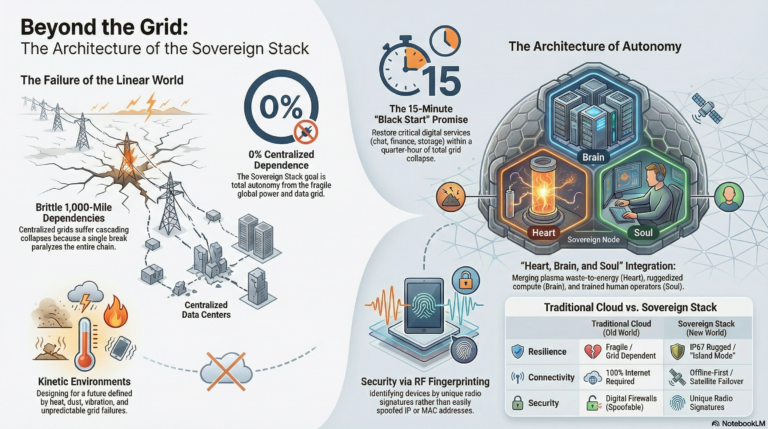
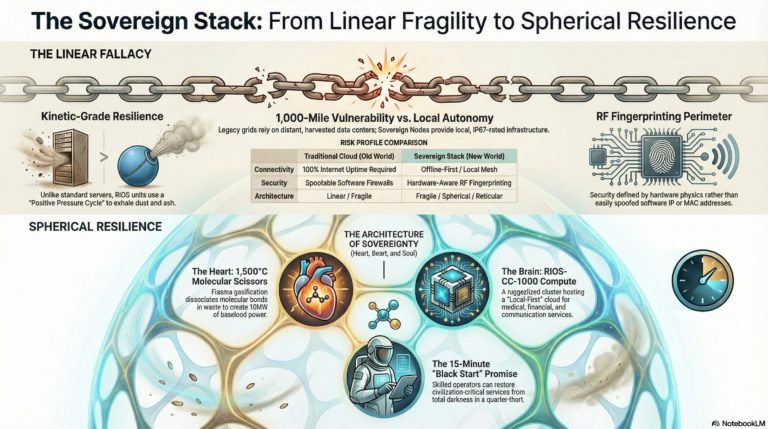
Current municipal utility frameworks are defined by a dangerous “linear” fragility. Historically, regional power grids, global supply chains, and cloud-tethered data centers have operated as a series of single points of failure; if one link collapses, the entire system follows. In this era of increasing infrastructure decay and systemic security threats, transitioning from these fragile networks to “Spherical Resilience” is no longer a luxury—it is a requirement for national and local security. By replacing linear topologies with a decentralized, honeycomb-like geometry, municipalities can capture a significant “trust premium” for regulated sectors like healthcare, defense, and law. This shift ensures that every utility node is engineered for absolute self-sufficiency, turning municipal resilience into a competitive economic asset.
Feature The Line (Centralized Infrastructure) The Sovereign Stack (Spherical Resilience)
Network Topology Linear/Centralized (Chain-dependent) Decentralized Mesh (Honeycomb Geometry)
Failure Points Single points of failure; cascades easily Multi-node resilience; local isolation
Data Dependency Cloud-tethered; requires external APIs Air-gapped; localized “Island Mode”
Energy Sourcing Large-scale regional grid dependency Carbon-negative local microgrids
System State Fragile and reactive Self-healing and autonomous
Defining “Island Mode” Central to this transition is the technical requirement of “Island Mode.” As defined by the DeReticular architecture, a node in Island Mode possesses absolute computational, energy, and communication self-reliance. By sequestering model execution and data storage on local hardware enclaves paired with energy-independent microgrids, we eliminate hyperscaler dependencies. This protects rural nodes from regional grid collapses and total blackouts of public telecommunications, ensuring that critical municipal functions—from emergency dispatch to power generation—never require an external “handshake” to function.
Achieving this resilience requires a fundamental shift in how municipal technology is layered and secured.
- The Triadic Architecture of the Sovereign Stack
For a municipality to achieve true self-sufficiency, it must move away from siloed utilities. A unified approach that integrates energy, transport, and data—rather than disparate, fragile services—is the only viable path to municipal autonomy. The Sovereign Stack achieves this through three distinct industrial layers:
- The Muscle (Agra Dot Energy): This layer transforms waste liabilities into local energy assets. Using high-efficiency plasma gasification (molecular dissociation at 1,500°C), the stack converts organic and agricultural waste into clean syngas and synthetic diesel. While our utility-scale deployment at Node 4 (the 7,000-acre SEIP) generates 10–11 MW of carbon-negative power, the modularity of the system allows even small nodes to achieve energy independence and carbon-negative footprints.
- The Motion (Kurb Kars): Integrated with the stack’s energy and data layers, this “kinetic robotic” layer deploys autonomous electric vehicle fleets. These ruggedized platforms are optimized for last-mile logistics and Non-Emergency Medical Transportation (NEMT). By resolving “transit deserts” in rural areas, these kinetic systems provide reliable medical and freight services without the need for human-intensive infrastructure.
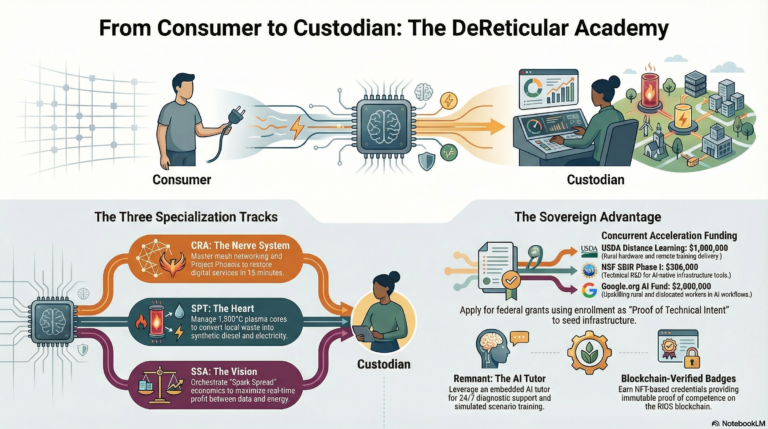
- The Mind (RIOS): The Rural Infrastructure Operating System (RIOS) acts as the decentralized central nervous system. RIOS functions as a “Federated Learning Mesh,” where local optimizations (such as battery-cycling or autonomous navigation) are shared across the planetary mesh via secure Over-the-Air (OTA) updates. This allows for constant, local optimization without capital or data flight to central cloud providers like AWS.
This physical infrastructure is only as secure as the digital environment hosting it.
- Operational Security: Overcoming the Cloud-Dependent “Thin Client” Paradigm
The strategic vulnerabilities of municipal infrastructure were exposed during the 2026 OpenClaw Security Crisis, where cloud-tethered APIs proved to be exploitable backdoors for Remote Code Execution (RCE) and prompt injection. To mitigate these risks, municipal leaders must transition to “Sovereign Embodied AI,” where compute and reasoning happen natively on local hardware in an air-gapped environment.
Split-Loop Control Architecture To ensure physical perimeter security, the Sovereign Stack utilizes a “split-loop” architecture. This design separates high-level cognitive reasoning (calculated by local edge servers) from low-level mechanical reflexes (managed by industrial microcontrollers). This ensures that even if a network layer is compromised, the mechanical integrity and kinetic movements of the infrastructure remain under local, hardware-enforced control.
Sovereign Intelligence Hardware Specifications To facilitate procurement and ensure BABA-compliance (Build America, Buy America), the Consortium provides the following on-device compute anchors:
- Sovereign Sentry (Standard) — $699.00: Local Network Gateway & Ledger Validator.
- Specs: Intel® N100 Quad-Core, 16GB RAM, 1TB NVMe, 4x 2.5GbE LAN.
- Sovereign Sentry (Pro) — $899.00: Advanced Network Defense and Local AI Inference.
- Specs: Intel Core i3-N305 (8-Core), 32GB RAM, 2TB NVMe. Pre-loaded with the “Trinity” security stack.
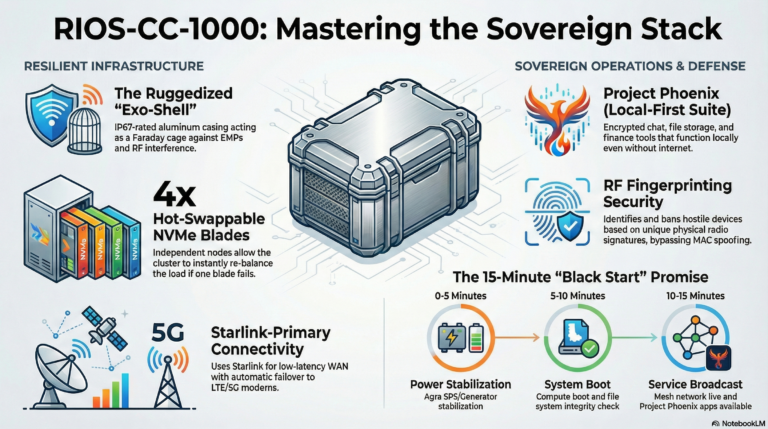
- RIOS Command Center (CC-1000): A turnkey “Infrastructure-in-a-Box” featuring integrated solar arrays, BESS (Battery Energy Storage), and satellite-bonded backhauls.
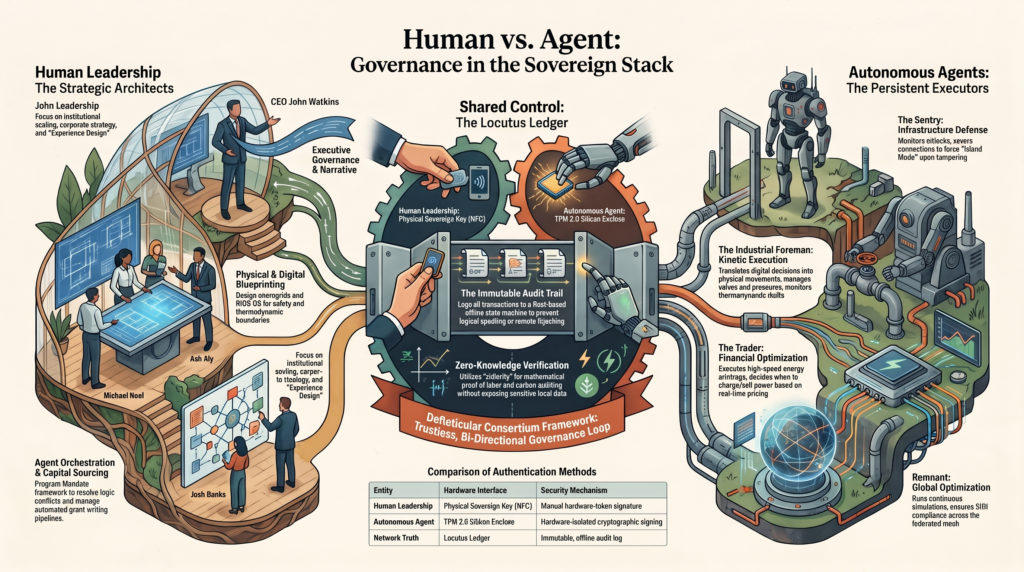
The Locutus Ledger Every state change within the stack is verified via a bi-directional cryptographic co-signing protocol. This process utilizes zkVerify (Zero-Knowledge Enclave Proofs) and WebAssembly (Wasm) smart contracts to ensure all transactions are immutable. Validation requires dual-signatures: one from a human via a physical hardware token and one from an autonomous agent operating within a secure TPM 2.0 enclave.
The transition to this technical security model is supported by financial frameworks designed to fund and de-risk deployment.
- Non-Dilutive Capital Stacking and Financial Engineering
The capital expenditure for hard infrastructure is a significant barrier. InVentures Research de-risks these projects by pairing private equity with federal grant pipelines, ensuring municipalities can bridge the “valley of death” between research and deployment.
The InVentures Funding Roadmap We provide a mathematical roadmap to secure non-dilutive funding by stacking private seed equity with major federal programs, including:
- NTIA’s $50M AI-RAN Fund: For BABA-compliant sovereign telecommunications.
- NSF VINES & USDA Rural Development: For agricultural energy and biomass processing.
- FEMA Resilience Grants: For hardening municipal nodes against regional grid failure.
Data Arbitrage & Value Mapping The stack generates a new revenue stream through Data Arbitrage. By owning the physical sensors, municipalities capture “Ground Truth” data (soil chemistry, grid arbitrage, transit logistics) before it reaches commodity markets. Furthermore, our “The Trader” AI agent executes high-speed energy arbitrage on the ERCOT grid, discharging stored power during peak windows of up to $5,000/MWh.
Using Stellar Research Value Mapping (Stellar-Research.com) and Extended Cost Benefit Analysis (eCBA), city managers can mathematically verify economic welfare improvements to satisfy institutional investors and Opportunity Zone requirements.
- Node 8: The Mobile Technology Hub and Roadshow Deployment
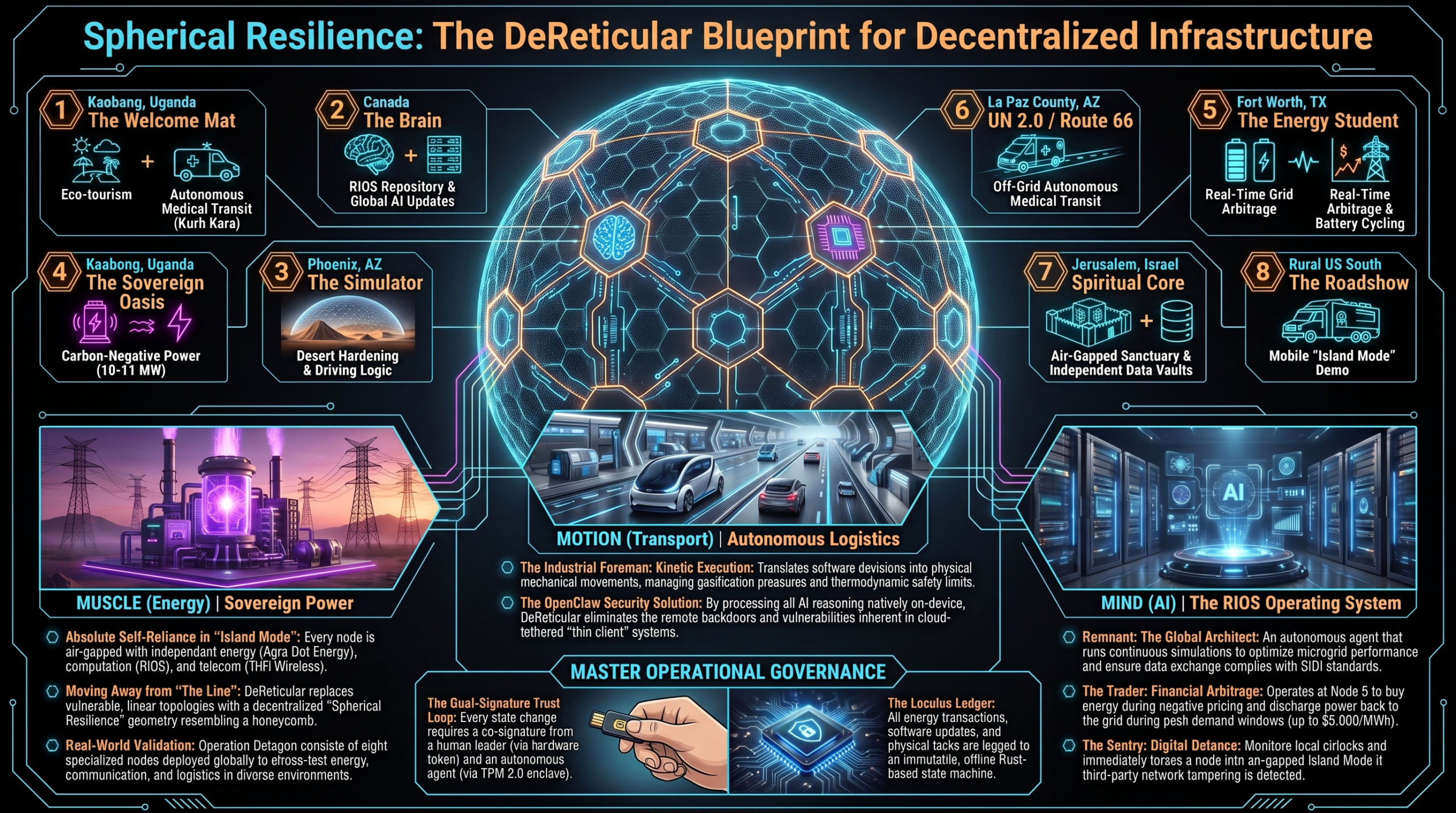
Following the Vanguard Pivot of March 2026, Node 8 was realigned from a static validator into “The Roadshow,” the primary vehicle for bringing the Sovereign Stack directly to municipal leaders in the Rural South.
Asset Capabilities Node 8 is a mobile, ruggedized technology hub housed in an expandable utility truck, featuring:
- 1-TPD Mini Gasifier: A demonstration-scale unit that converts local municipal waste into off-grid electricity to power the mobile hub.
- TriFi Mobile Telecom Array: A BABA-compliant “Campus 15” mesh network providing broadband over a 15-mile diameter within minutes of arrival.
- RIOS-CC-1000 Edge Racks: Showcasing how local databases and emergency dispatch systems run natively and air-gapped from cloud vulnerabilities.
Live Simulation Protocols Field teams perform “Grid Defection” simulations for city managers, illustrating how town halls and emergency services maintain operations indefinitely during public grid blackouts. By pairing this “Show-and-Tell” with the InVentures Funding Roadmap, we provide local officials a clear path to sovereign utility upgrades.
- Consortium Governance: Human Expertise and Agentic Orchestration
Managing large-scale infrastructure requires a cross-functional leadership triad consisting of DeReticular (AI/OS), TriFi Wireless (Telecom), and InVentures Research (Capital).
Consortium Leadership & Node Alignment
- John Watkins (CEO, DeReticular): Strategy and corporate governance; oversees Node 8 validation and Stellar-Research.com metrics.
- Michael Noel (Founder/Lead Architect): Systems engineering; directs Node 1 (Urban Citadel/Fabrication) and Node 7 (Jerusalem Core).
- Ash Aly (CTO, DeReticular): Sponsors Node 2 (Canada OS HQ); manages the global RIOS software repository.
- Aaron Babcock (President, TriFi): Sponsors Node 3 (The Simulator/NOC); manages the BABA-compliant hardware supply chain.
- Melissa Chalfant (GP, InVentures): Champion of Node 5 (Urban Energy Lab); architect of capital stacking and grant pairing.
- Brion Crum (VP, Caliber Companies): Champion of Node 6 (Sovereign Mobility); specialist in Opportunity Zone real estate and transit depots.
The Agentic Layer Autonomous AI agents manage the stack’s high-speed operations without human intervention:
- Remnant: Manages global optimization and SIDI standard compliance.
- The Sentry: Monitors digital airlocks and triggers “Island Mode” during threats.
- The Industrial Foreman: Governs heavy machinery and thermodynamic safety.
- The Trader: Executes grid arbitrage at Node 5, targeting peak demand windows of $5,000/MWh.
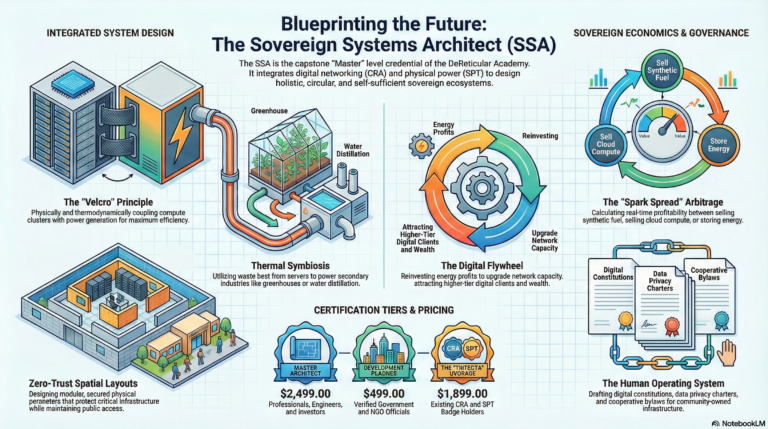
Thermodynamic Coupling: The Velcro Principle The final integration of digital and physical survival is governed by the “Velcro Principle.” This protocol of Thermodynamic Coupling routes server waste heat directly into agricultural greenhouses or water distillation systems. By converting computational waste into a physical community asset, the Sovereign Stack ensures that the digital economy directly supports local survival.
Final Statement The path to municipal resilience is clear: local governments must transition from fragile dependencies to sovereign, autonomous nodes. We invite municipal leaders to begin the roadmap to utility defection and sovereign resilience today.