Study Guide: Sovereign Industrial AI and the Global Strategic Shift

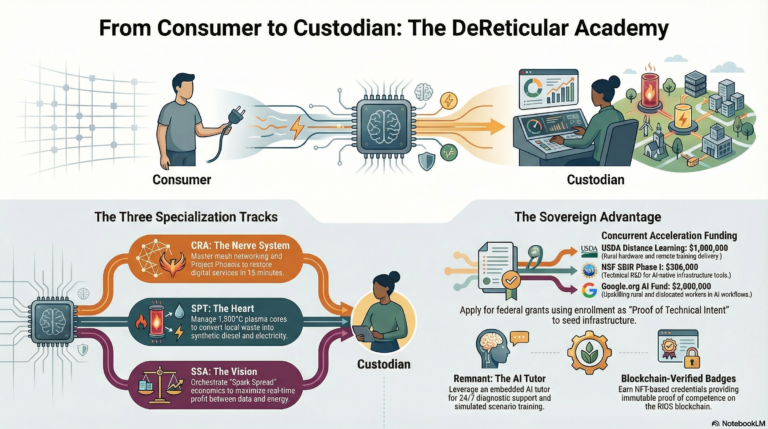
This study guide provides a comprehensive overview of the transition from centralized cloud-based artificial intelligence to decentralized, hardware-sequestered autonomy. It focuses on the strategic, technological, and economic frameworks of the Sovereign Axis Group (SAG) and the broader “Above the Line” industrial movement.
——————————————————————————–
Part 1: Short Answer Quiz
Instructions: Answer the following ten questions in 2–3 sentences, focusing on the specific data and logic provided in the source context.
- Define “The Line” and explain why the Source Context describes its “death.”
- What is the “Sequester Move” and how does it create a competitive moat?
- Explain the technical specifications and purpose of a Light RTLM.
- How does the Agra Micro-GTL system support the operation of a Sovereign Sentry Node?
- Identify the three primary reasons why “Hyperscalers” like Google and Microsoft are structurally unable to offer Absolute Cognitive Sovereignty.
- What is the “Trust Premium” and how does it affect the pricing of sequestered hardware vs. cloud AI?
- Describe the “Pivot” that occurs in the Sovereign Axis Group’s 10-year financial pro forma.
- Explain the concept of “Compliance Autonomy” or “Compliance by Omission.”
- What is the “Spark Spread Arbitrage Coefficient” and how does it function in the system’s control logic?
- Define “Agrivoltaics” as described in the context of rural infrastructure.
——————————————————————————–
podcast
Part 2: Quiz Answer Key
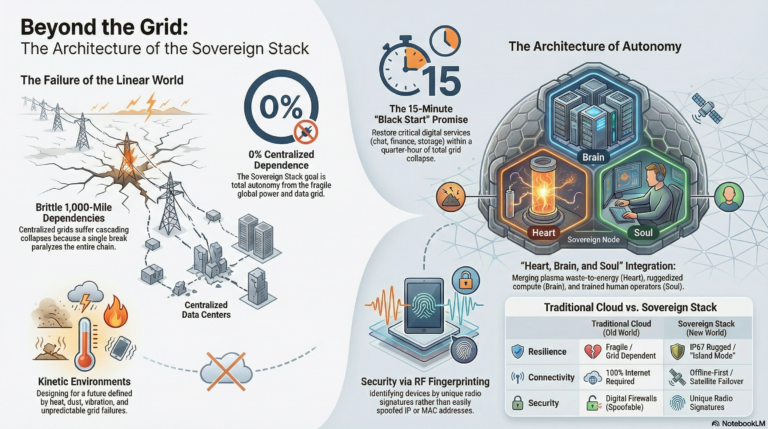
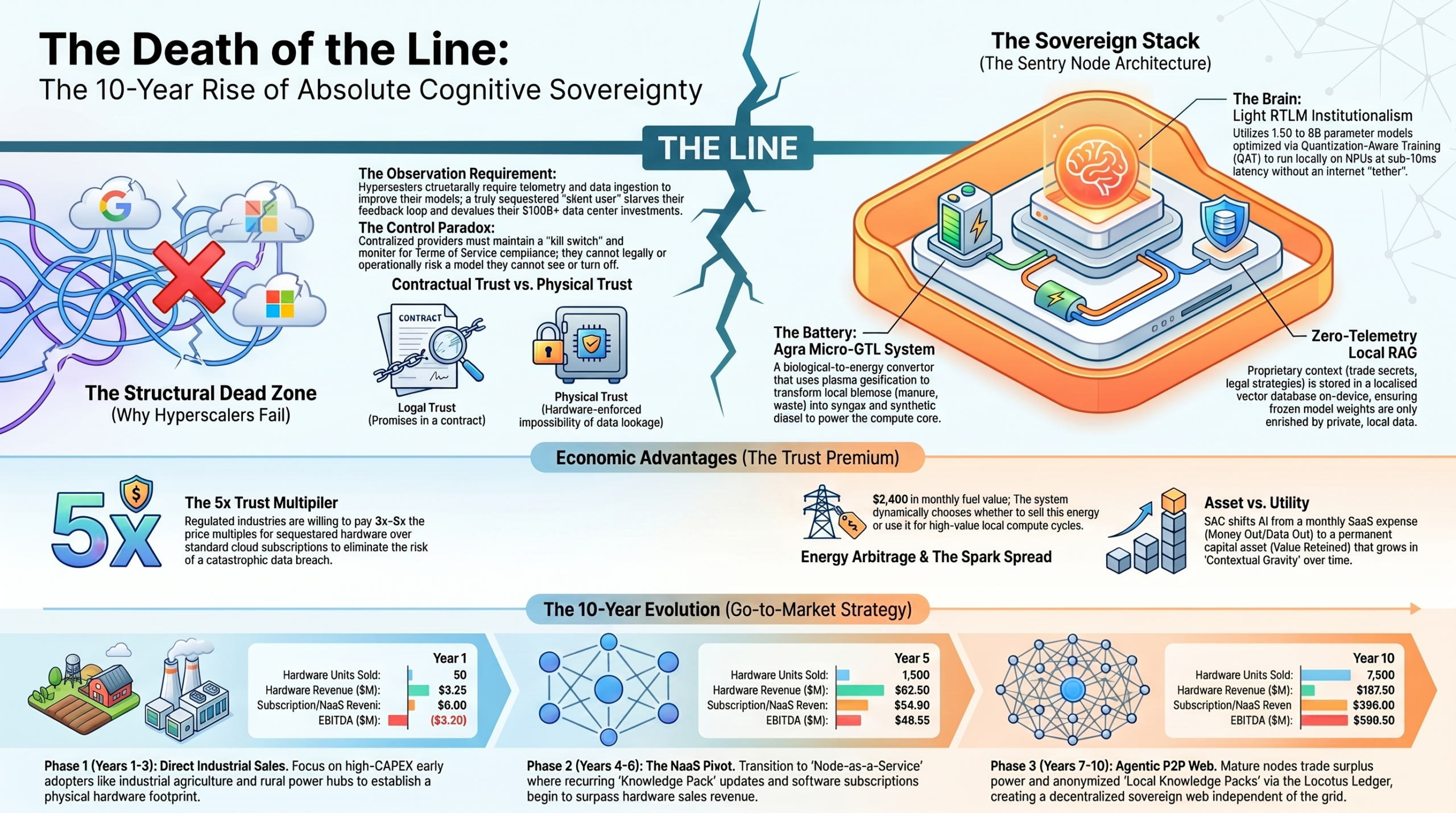
- The Line refers to the centralized, fragile dependencies of the traditional electrical grid and the hyperscale cloud. Its “death” is characterized by the collapse of these centralized systems as value shifts toward localized autonomy and “Absolute Cognitive Sovereignty,” moving intelligence and energy production inside a customer’s physical perimeter.
- The Sequester Move is the physical and digital isolation of an AI’s reasoning capabilities from external networks (air-gapping). It creates a moat by offering “Physical Incapacity”—the hardware-enforced guarantee that data cannot be leaked because there is no physical connection to the outside world, a feature cloud providers cannot match.
- Light RTLMs (Real-Time Language Models) are optimized, small-parameter models (typically 1.5B to 8B parameters) designed for edge inference on NPUs. They utilize quantization and local RAG to provide institutional-grade reasoning and zero-latency response times without requiring an internet “tether.”
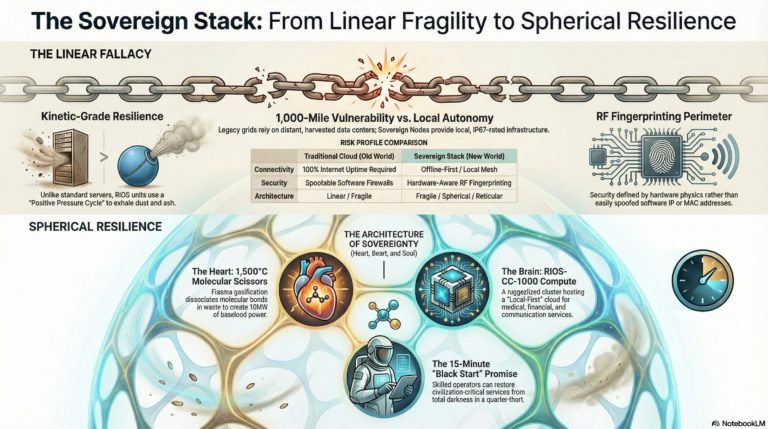
- The Agra Micro-GTL system is a biological-to-energy converter that uses plasma gasification to transform local biomass (such as farm waste) into syngas and synthetic diesel. This provides the Sovereign Sentry Node with behind-the-meter baseload power, making the compute core independent of the centralized electrical grid.
- Hyperscalers are limited by: 1) Telemetry Starvation (air-gapped nodes provide no feedback loop for model training); 2) Margin Erosion (their business relies on high-utilization cloud traffic to justify massive data center investments); and 3) Control Paradox (they cannot monitor Terms of Service compliance on a device they cannot see).
- The Trust Premium is the willingness of enterprises to pay significantly higher multiples (3x–5x) for “Physical Trust” (hardware-enforced privacy) over “Contractual Trust” (legal agreements). While cloud AI is a low-cost commodity (~20/month), sequestered hardware commands high upfront costs (5,000–$65,000) because it eliminates the risk of data breaches.
- The “Pivot” occurs around Year 5 of the 10-year plan, when subscription and “Node-as-a-Service” (NaaS) revenue begins to overtake hardware sales. By Year 7, the dominant revenue stream shifts from selling physical nodes to managing a “sovereign web” through intelligent recurring updates and “Knowledge Packs.”
- Compliance Autonomy is the concept of achieving regulatory standards (like HIPAA or SEC rules) through physical omission rather than software audits. If a hardware device lacks the physical capability to transmit data (due to de-energized networking chips), it is mathematically exempt from many cloud transmission and data-in-transit audits.
- The Spark Spread Arbitrage Coefficient is a mathematical formula that determines whether a node should use its produced energy for local AI execution or export it as liquid fuel. If the coefficient is positive, the system prioritizes local high-value inference; if negative, it routes syngas to liquid synthesis to store chemical energy as synthetic fuel.
- Agrivoltaics involves the use of vertical bifacial solar panels spaced (e.g., 7 meters apart) to allow for simultaneous industrial farming. This dual-use strategy increases land-use efficiency (achieving a Land Equivalent Ratio ≥ 1.35) by harvesting solar energy without removing land from tractor-based cultivation.
——————————————————————————–
video
Part 3: Essay Format Questions
The following questions are designed for deeper analysis and do not include provided answers.
- The Economic Incentive Mismatch: Analyze the argument that Big Tech’s reliance on “Instruction Tuning” and “Contextual Ingestion” creates a permanent market “Dead Zone.” How does the Sovereign Axis Group leverage this mismatch to capture high-value regulated industries?
- Nodal vs. Linear Topologies: Compare and contrast the systemic resilience of “Nodal” decentralized architectures with the “Linear” topologies of high-voltage transmission and fiber optics. Focus on the thermodynamic and cryptographic benefits of the Sovereign Sentry Node.
- The Evolution of AI Value: Discuss the transition of AI from a “Below the Line” commodity to an “Above the Line” industrial asset. In an era where intelligence is essentially free, why does the “Vaulting and Sequestration” logic become the primary value driver?
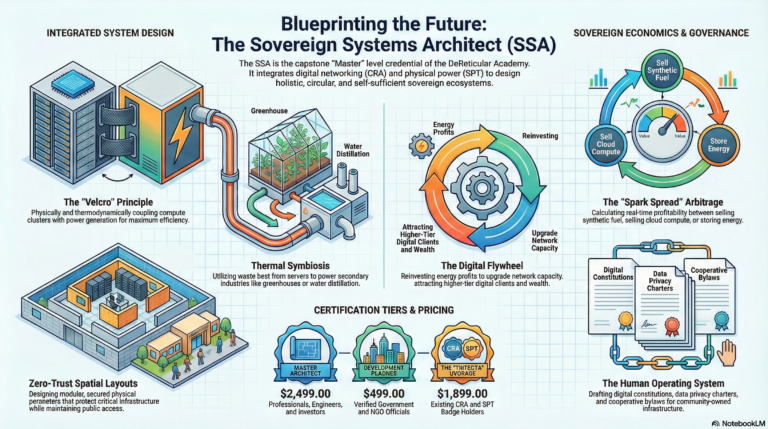
- Thermodynamic Loops in Infrastructure: Evaluate the integration of thermochemical energy (Micro-GTL) with computational clusters. How does the recapturing of waste heat for anaerobic digesters illustrate a “closed-loop” approach to industrial independence?
- The Future of Agentic P2P Markets: Explore Phase 3 of the SAG Go-to-Market strategy regarding the “Locutus Ledger” and “Member Nodes.” What are the implications of trading anonymized “Local Knowledge Packs” and surplus energy in a decentralized marketplace?
——————————————————————————–
Part 4: Glossary of Key Terms
| Term | Definition |
| Above the Line | A strategic position focusing on defensible, high-trust industrial assets, proprietary local context, and hardware-enforced privacy. |
| Air-Gapped Topology | A physical security measure that ensures a computer or network is physically isolated from unsecured networks, such as the public internet. |
| Below the Line | Commodity-level AI services, such as generic LLM access and search-based agents, where competition is a “race to zero” on price. |
| Fischer-Tropsch Synthesis | A catalytic chemical process that converts syngas (carbon monoxide and hydrogen) into liquid hydrocarbons, such as synthetic diesel. |
| INT4 Precision | A method of quantization that compresses AI model weights to 4-bit integers, reducing memory bandwidth requirements and allowing for faster edge inference. |
| Knowledge Distillation | The process of transferring the reasoning capabilities of a large “frontier” model into a smaller, more efficient Light RTLM. |
| Local RAG (Retrieval-Augmented Generation) | An architecture where an AI model retrieves information from a localized, private vector database rather than an external cloud source. |
| Micro-GTL (Gas-to-Liquids) | Modular units designed to convert biomass or waste into syngas and subsequently into liquid synthetic fuels. |
| NPU (Neural Processing Unit) | Specialized hardware optimized for the mathematical operations required for artificial intelligence and edge inference. |
| Plasma Gasification | An extreme-temperature thermochemical process (>1200°C) used to crack organic matter into clean syngas. |
| Quantization-Aware Training (QAT) | A training method that models quantization noise during the fine-tuning of an AI, allowing for high performance at lower bit-widths. |
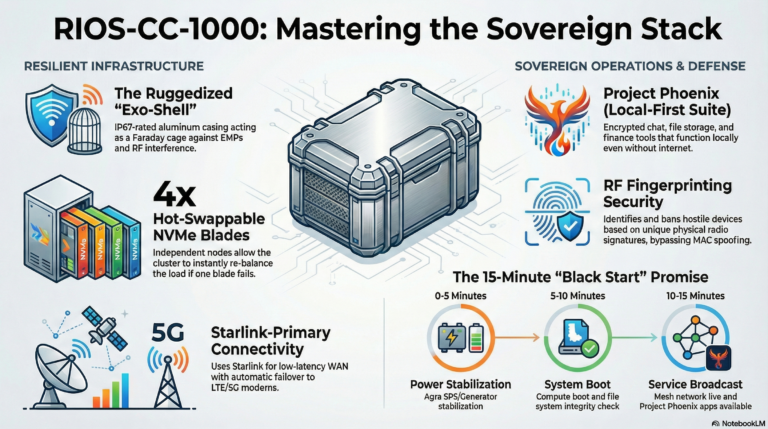
| Sovereign Sentry | An industrial-grade, NEMA 4X-rated hardware enclosure that combines energy production with sequestered AI compute cores. |
| Syngas | A fuel gas mixture consisting primarily of hydrogen, carbon monoxide, and very often some carbon dioxide. |
| TPM 2.0 (Trusted Platform Module) | A dedicated microcontroller designed to secure hardware through integrated cryptographic keys. |
| Web MCP (Model Context Protocol) | A peer-to-peer protocol enabling air-gapped nodes to trade resources like compute cycles and local knowledge over secure mesh networks. |