Strategic Technical Architecture: Securing Enterprise AI through Hardware-Anchored Sovereignty
1. Executive Overview: The Transition from Policy-Based to Physical-Based Security
Modern enterprise leadership currently navigates an acute “Privacy Paradox.” Organizations are pressured to leverage the cognitive reasoning of hyperscale cloud AI models, yet they are legally and contractually prohibited from exfiltrating proprietary intellectual property (IP), protected health information (PHI), or sensitive financial metadata. Historically, CISOs have mitigated this tension by relying on “The Trusted Environment Fallacy”—the assumption that soft, non-binding corporate Terms of Service (ToS) or Business Associate Agreements (BAAs) provide sufficient protection. From a threat-modeling perspective, these legal promises offer no physical barrier against subpoena compulsion, hypervisor-level compromises, or inference-phase reconstruction attacks.
To resolve this, our strategic transition must move from administrative promises to hardware-enforced boundaries. The DeReticular architecture achieves this through “Hardware-Anchored Sovereignty,” a fundamental decoupling of high-scale computational reasoning from sensitive local state. By treating centralized AI as an untrusted arithmetic coprocessor rather than an orchestrator of data, we regain operational autonomy. This shift begins at the network edge with the Sovereign Gateway, where sovereignty is anchored in silicon rather than policy.
2. The Sovereign Gateway: Hardware-Anchored Trust and Physical Defense
Hardware serves as the ultimate root of trust (RoT) because it establishes deterministic boundaries that cannot be bypassed by software exploits or cloud-tenant compromises. By anchoring identity to discrete physical components, the Sovereign Gateway eliminates the vulnerabilities inherent in standard cloud-dependent architectures.
Silicon Sentry Hardware Specifications
The “Silicon Sentry” architecture is engineered for high-security environments, prioritizing physical hardening and cryptographic integrity.
| Component | Specification | Security & Operational Impact |
| Processor | Apple M4 SoC | Utilizes high-bandwidth Neural Engine for local validation logic and <12ms/kilotoken sanitization passes. |
| Root of Trust | Automotive-Grade TPM 2.0 | Anchors identity via Secp256r1 ECC passkeys; prevents software-based identity spoofing. |
| Memory | 16GB Unified Memory | Provides a cache-coherent bus for transient translation dictionaries and quantized fallback models. |
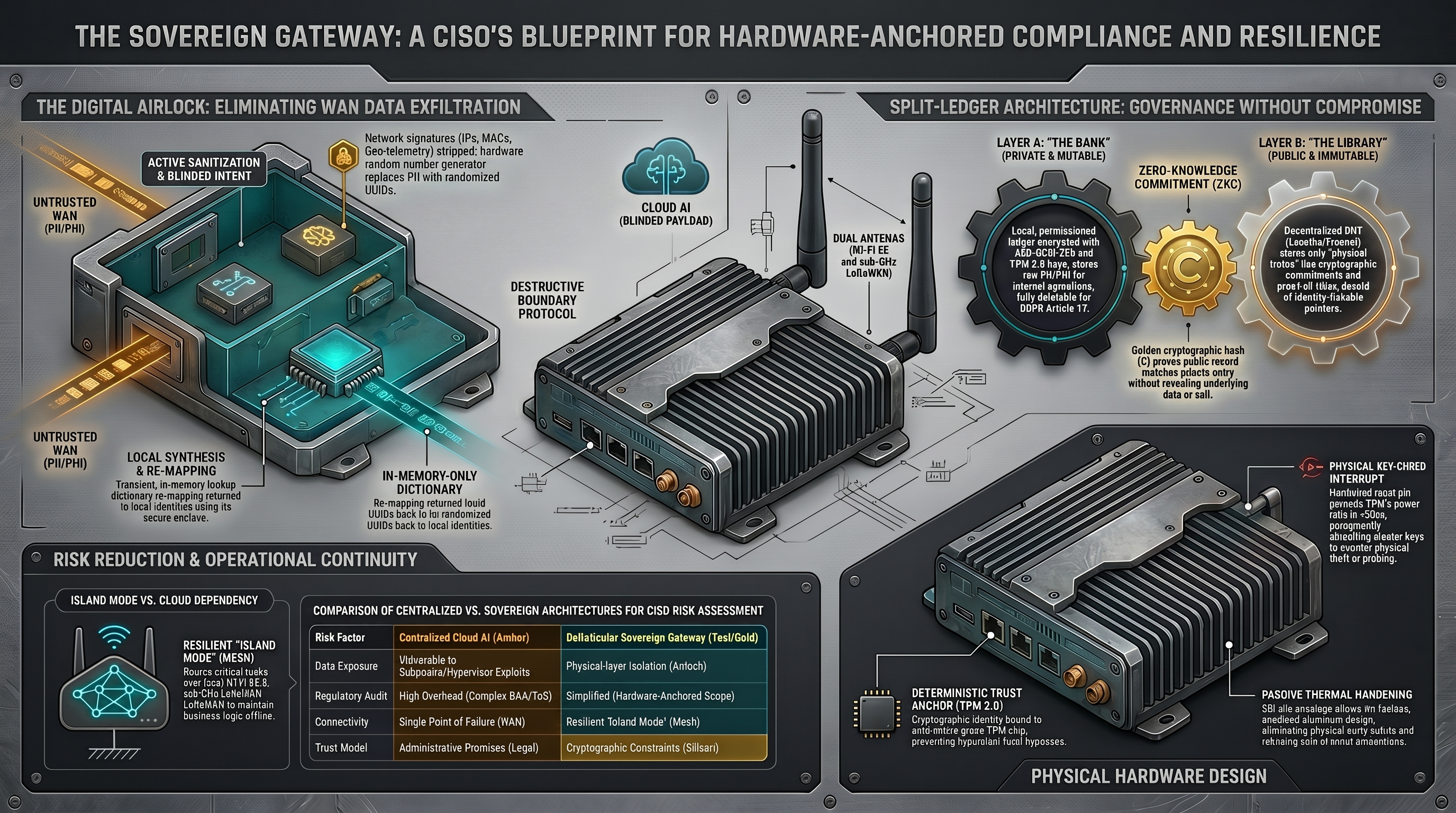
| Thermal/Chassis | 5W Envelope / Passive Cooling | Fanless design prevents dust/moisture entry in industrial settings and eliminates acoustic/thermal side-channel vectors. |
The Key-Shredding Interrupt
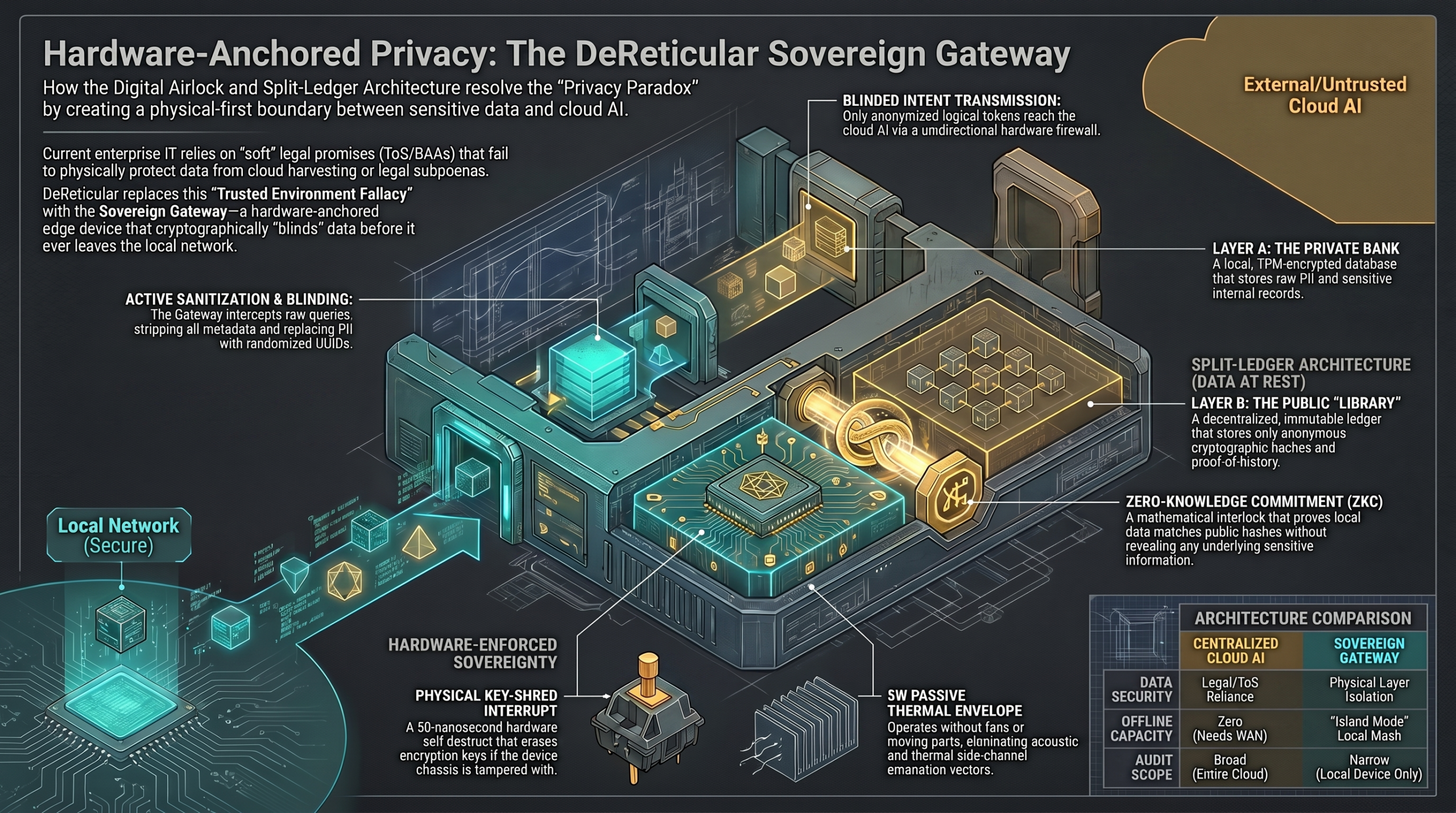
To mitigate the risk of physical theft (Risk R-KEY-02) or laboratory-level microprobing, the Gateway features an active chassis intrusion detection loop. A physical reset pin is hardwired directly to the TPM 2.0’s master clear lines. Upon a physical breach or pin depression, a low-latency hardware interrupt pulls the key-storage voltage rails to ground. This permanently erases the master seed and local decryption keys in less than 50 nanoseconds. Because the local storage uses AES-XTS-256 encryption bound to this seed, the volume becomes mathematically unrecoverable instantly, rendering cold-boot exploits useless. This physical security foundation is the prerequisite for mediating all external traffic through the Digital Airlock.
3. The Digital Airlock Protocol: Engineering Outbound Data Exfiltration
The Digital Airlock is a destructive boundary that replaces transparent network tunnels with a localized translation enclave. It ensures that sensitive data never crosses the Wide Area Network (WAN) boundary by deconstructing queries before transmission.
The 9-Step Data Flow
The Sovereign Gateway mediates all interactions with untrusted models (e.g., Google’s Project Remy) through the following granular protocol:
- Intercept: The Sovereign Executive Agent captures the raw query at the network socket layer.
- Stage: Data is held in volatile, isolated memory within the M4 enclave; it never touches the local SSD.
- Active Sanitization: The engine strips all transport metadata (IPs, MACs, geo-telemetry, and device fingerprints).
- Blinded Intent Generation: Semantic structures are extracted. PII/IP is replaced with randomized UUIDs via a hardware random number generator (TRNG).
- Transmit: The “blinded” JSON payload is sent via a decentralized routing layer (e.g., Tor or private relays) to the cloud.
- Cloud Compute: The untrusted AI executes logic over the blinded tokens (e.g., “{Subject_UUID_A}”).
- Inbound Intercept: The Gateway’s firewall captures the abstract response from the WAN.
- Reverse Lookup: The State Translation Engine uses a transient mapping matrix to re-substitute identifiers.
- Local Synthesis: A resolved, human-readable alert is generated and rendered to the local client via TLS 1.3.
Efficiency and Latency Critique
The “Blinded Intent” model treats hyperscale AI as a blind logic engine, reducing the provider’s visibility into enterprise identity to zero. While this introduces a processing overhead, the M4’s unified memory architecture optimizes the sanitization pass to remain below 12 milliseconds per kilotoken. This trade-off is acceptable for enterprise risk management, though it may preclude use-cases requiring ultra-low-latency high-frequency trading. By protection data in transit this aggressively, we set the stage for the split governance of data at rest.
4. Split-Ledger Architecture: Resolving the Governance and Audit Paradox
Enterprises face a conflict between data immutability for audits and the “Right to be Forgotten” (GDPR Article 17). The Split-Ledger Architecture resolves this by separating identity from history.
Layer Comparison: The Bank vs. The Library
| Feature | Layer A: “The Bank” (Private) | Layer B: “The Library” (Public) |
| Access Model | Permissioned / Local | Decentralized / Permissionless |
| Content | Raw PII, PHI, and Local State | Hashes, Commitments, and Wasm Contracts |
| Storage Mechanic | PostgreSQL / AES-GCM-256 (TPM Keys) | Locutus/Freenet DHT (Zero-Tokenomics) |
| Compliance Role | Identity management and record deletion | Immutable history and audit validation |
The Zero-Knowledge Commitment (ZKC) Interlock
To prove the validity of records without exposing identity, the architecture uses a ZKC interlock. When a transaction is recorded in Layer A, the Gateway generates a commitment (C) using HMAC-SHA256, combining the transaction data with a random salt (r). This commitment is written to a WebAssembly (Wasm) contract on the Locutus DHT. Auditors can verify history via cryptographic proof that the public commitment matches a valid record in the private ledger, without ever seeing the underlying identity or salts. This split simplifies the burden of proof, allowing Layer A records to be purged for compliance while the audit trail remains structurally intact.
5. Operational Continuity: Island Mode and Mesh Resilience
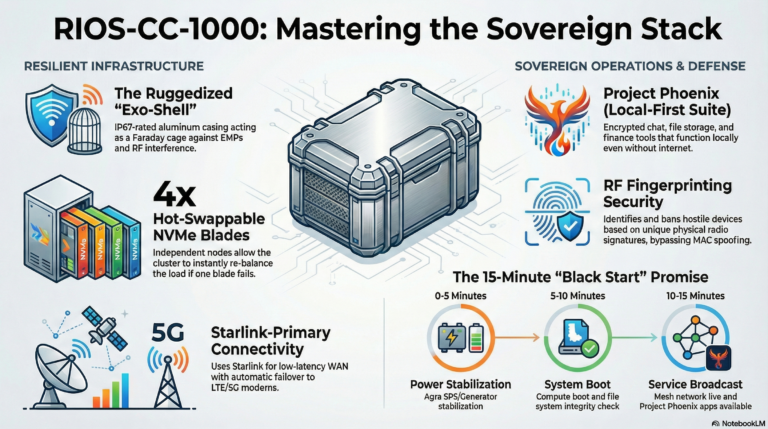
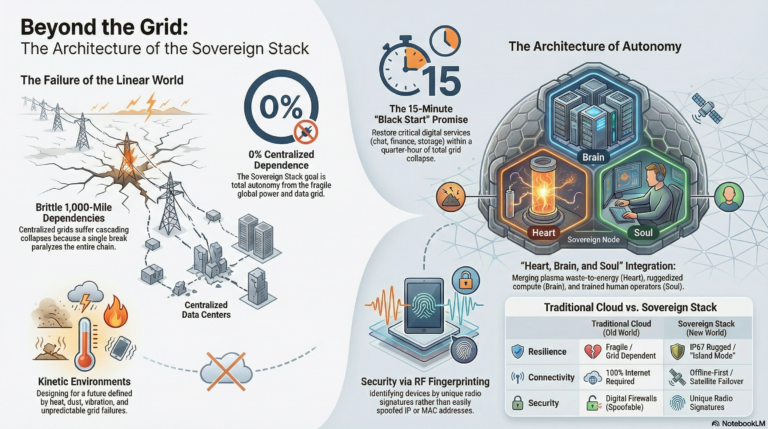
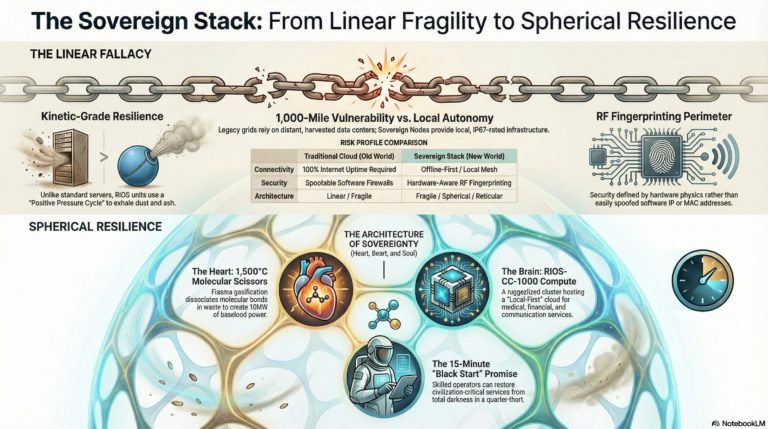
Standard cloud-centric models represent a single point of failure. “Island Mode” is our strategic defense against WAN dependency or cyber-warfare. The Sovereign Gateway utilizes a dual-radio topology: Wi-Fi 6E for high-bandwidth local traffic and sub-GHz LoRaWAN for long-range mesh telemetry.
Managed by the Rural Infrastructure Operating System (RIOS)—a hardened, Unix-based distribution with zero cloud-account dependency—the Gateway automatically isolates the local network during a fiber cut. In this state, critical municipal and enterprise functions continue via the local mesh.
Local Inference Fallback
During Island Mode, the Gateway leverages its 16GB memory footprint to run Local Inference Fallback. The M4 Neural Engine executes highly optimized, quantized (2-bit or 4-bit) small language models, such as Llama-3-8B. These models perform critical task classification and operational commands until cloud access is restored, ensuring that operational uptime is maintained as a core component of risk reduction.
6. Risk Management and Compliance Posture: A CISO’s Gap Analysis
This architecture transforms compliance from a manual documentation exercise into a mathematical certainty, using hardware to enforce what were previously only policy-based boundaries.
Compliance Impact Assessment
- HIPAA (Scope Reduction): Because PHI is sanitized and replaced with UUIDs locally, external cloud hosts are removed from the PHI data flow path. This eliminates the requirement for complex multi-party BAAs.
- GDPR (Article 17): Since PII exists only in Layer A, deleting the local identity mapping renders the immutable hash on Layer B cryptographically anonymous and un-linkable.
- SOC 2 (Technical Evidence): TPM 2.0 boot-chains and physical self-destruct mechanisms provide auditors with verifiable evidence of security boundaries.
Strategic Risk Register
| Risk ID | Risk Vector | Likelihood | Impact | Mitigation Strategy |
| R-API-01 | Upstream Blocking: Providers block blinded queries due to lack of telemetry. | Medium | High | Revert to Local Inference Fallback using internal M4 Neural Engine. |
| R-KEY-02 | Physical Seed Loss: Destruction of setup cards or TPM key block. | Low | Critical | 3-of-5 M-of-N Sharding: Distribute master keys via Shamir’s Secret Sharing. |
| R-NET-03 | RF Jamming: Active interference targeting local mesh spectrum. | Low | Medium | Asymmetric Dual-Radio Fallback: Switch to frequency-hopping sub-GHz LoRaWAN. |
| R-PHY-04 | Side-Channel Analysis: EM or power profiling of cryptographic operations. | Very Low | High | Constant-Time Primitives and EM shielding within the fanless aluminum chassis. |
7. Conclusion: The Sovereign Path Forward
The transition to hardware-anchored sovereignty requires a calculated engineering trade-off: accepting upfront hardware CAPEX and the responsibility of local key management in exchange for absolute data autonomy. The alternative—complete data exposure and high dependency on fragile wide-area networks—is no longer viable for the modern enterprise.
By shifting the security boundary from fragile legal frameworks to physical silicon and cryptographic blinding, the Sovereign Gateway provides a mathematically bounded path forward. We secure the benefits of hyperscale AI without surrendering intellectual, operational, or civic sovereignty.