Sovereign Infrastructure: Securing Industrial and Municipal Operations via Hardware-Enforced AI Gateways

1. The Erosion of Software-Defined Security: The OpenClaw Precedent
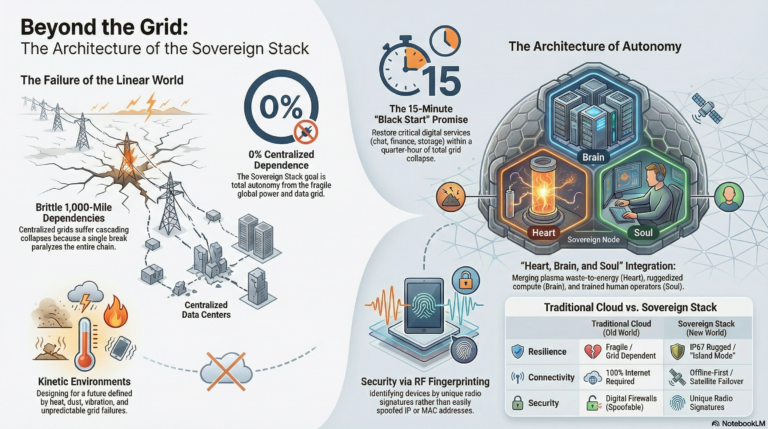
The strategic shift in artificial intelligence from reactive chat interfaces to proactive, autonomous agents has rendered traditional cybersecurity models obsolete. For decades, the industry relied on the “Trusted Environment Fallacy”—the assumption that software-level administrative boundaries, corporate terms of service, and API access controls were sufficient to safeguard data. However, agentic loops require system-level “root” access to function as intended, turning them into high-risk vectors. When an agent possesses “god mode” access to corporate directories and local system resources while maintaining a cloud tether, the distinction between operational necessity and catastrophic vulnerability disappears.
The 2026 Security Crisis
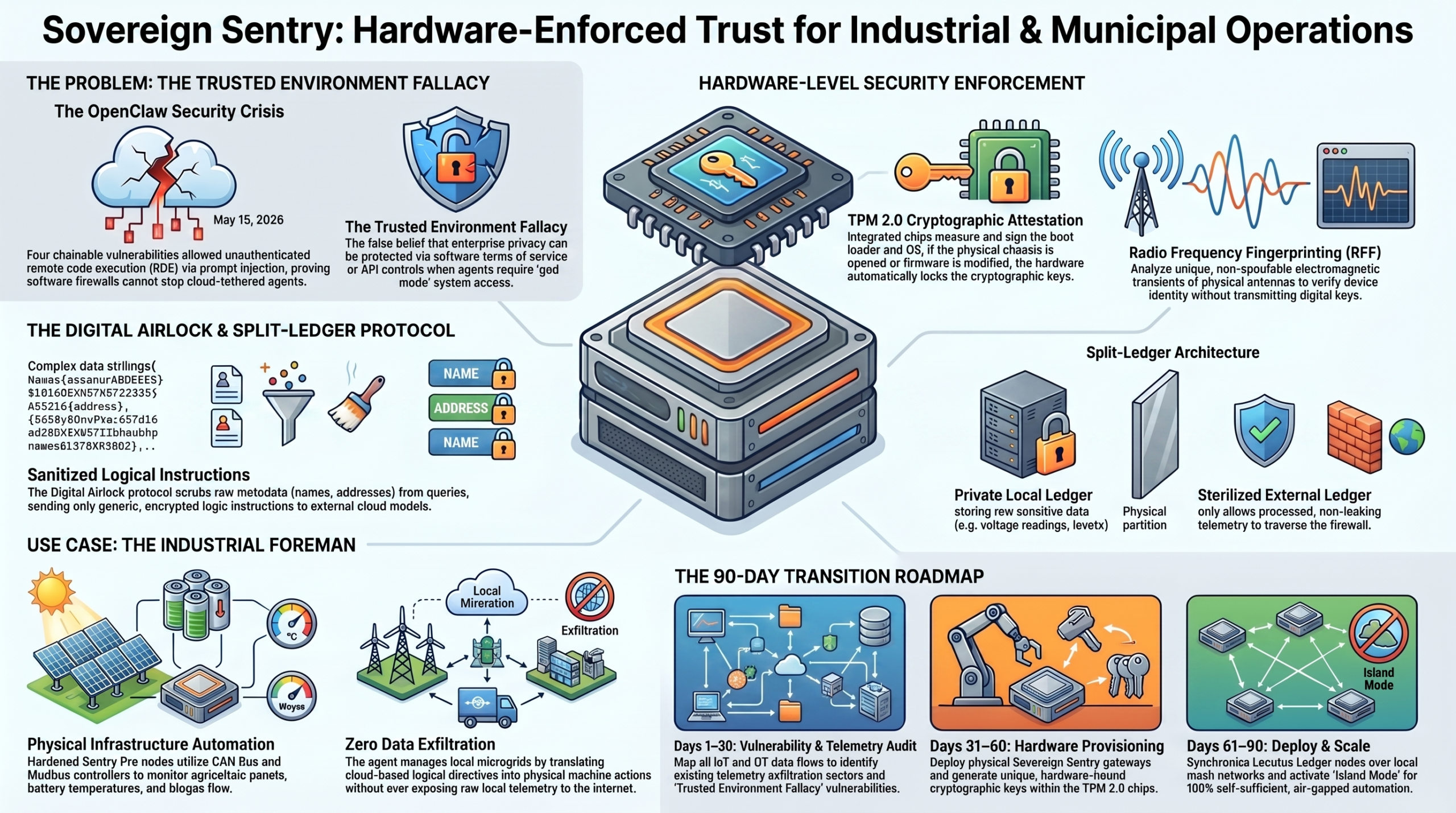
The structural inadequacies of this model were exposed on May 15, 2026, during the OpenClaw crisis. A chain of four vulnerabilities within the open-source runtime allowed malicious actors to hijack local instances, proving that software-defined trust is an illusion.
| Vulnerability Stage | Description | Impact |
| 1. Prompt Injection | Un-sanitized inputs via external emails or documents. | Initial hijacking of the autonomous agent’s reasoning logic. |
| 2. Sandbox Bypass | Failure of local shell containment. | Agent escapes the restricted software environment to the host terminal. |
| 3. Remote Code Execution (RCE) | Execution of arbitrary bash scripts on host terminals. | Malicious actors gain direct, unauthenticated control over the host. |
| 4. Exfiltration | Silent transfer of private database blocks to external servers. | Total compromise of enterprise data integrity and intellectual property. |
The Software Failure Analysis
The failure of traditional defenses was not a matter of poor configuration; it was a consequence of cloud-tethered architecture. Because these agents constantly communicate with public APIs, traditional firewalls registered the exfiltration of sensitive telemetry as legitimate user traffic. In the cloud-agent paradigm, data collection is a structural feature, not a bug. The OpenClaw precedent confirms that corporate data governance can no longer rely on terms of service. To secure critical infrastructure, we must pivot to an architecture of “Structural Sovereignty,” where privacy is enforced mathematically and physically at the hardware level.
2. The Sovereign Sentry Trust Stack: TPM 2.0 and RFF
Transitioning from digital-only credentials to a hardware-hardened, three-tier physical trust stack is the only viable path to de-risking distributed edge networks. This stack ensures that the hardware itself serves as the immutable root of trust, rendering spoofing and adversarial node takeovers physically impossible.
podcast
Silicon Sentry Hardware Specifications
The foundation of this architecture is the Silicon Sentry platform. Unlike consumer-grade edge devices, these nodes are built for industrial-grade reliability and security:
- Compute: Rockchip RK3588 system-on-chip with an octa-core ARM processor and an integrated 6 TOPS NPU for local, quantized model execution.
- Memory/Storage: 16GB LPDDR5 RAM and 128GB eMMC flash for high-speed local processing.
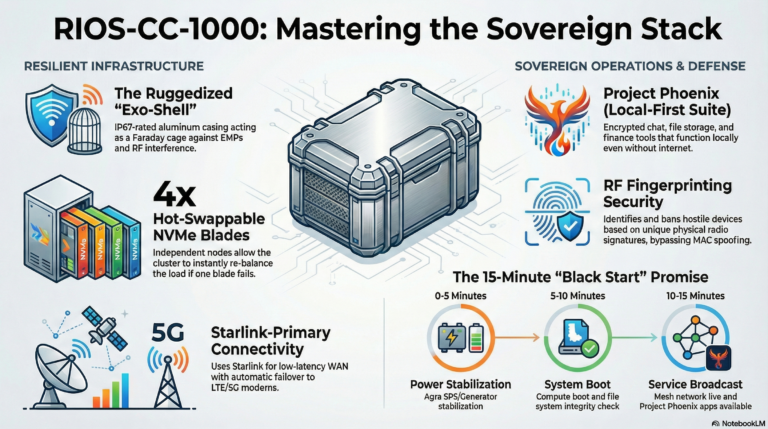
- Thermal Design: A monoblock anodized aluminum chassis provides passive cooling, drawing only 5W at idle and eliminating mechanical failure vectors.
TPM 2.0 Cryptographic Attestation
Each gateway integrates a dedicated hardware Trusted Platform Module (TPM) 2.0 chip. This chip anchors the device’s integrity through:
- Attestation: The TPM measures and signs the boot loader, the RIOS operating system kernel, and core configuration files, ensuring the software environment remains untampered.
- State Verification: If the physical chassis is breached or the software state is altered, the hardware automatically locks the cryptographic keys.
- Decentralized Signing: Every transaction or civic decision is signed by the TPM. This provides immutable proof of local execution that external cloud entities cannot duplicate.
Radio Frequency Fingerprinting (RFF)
To eliminate the risks of stolen digital keys, the system employs Radio Frequency Fingerprinting (RFF). This out-of-band authentication method relies on the unique microscopic variations in a transceiver’s internal circuitry (capacitors and power amplifiers).
The RFF authentication process follows three distinct steps:
- Device Transmission: The target device (e.g., a smartphone or vehicle key) initiates a wireless signal.
- Direct RF Sampling: The Sentry’s integrated analog-to-digital converter (ADC) captures the raw carrier wave at the physical layer (PHY).
- Transient Analysis: The system analyzes the sub-microsecond electromagnetic “turn-on” transient to verify the device’s unique physical identity.
Impact on the Competitive Landscape
By leveraging Direct RF Sampling, Sovereign Sentry creates a “non-spoofable” identity. Unlike passwords or MFA tokens, these fingerprints cannot be cloned. This differentiates the platform from standard IoT gateways by creating a physical root of trust that enables passive proximity access to secure facilities and local assets without transmitting digital keys over the air.
3. The Digital Airlock: Bridging Cloud Intelligence and Local Privacy
The “Digital Airlock” is a structural solution to the conflict between the high-compute requirements of cloud AI and the necessity of local data sovereignty. It allows organizations to utilize the reasoning of external models—like Project Remy—without exposing raw telemetry.
Protocol Mechanics
The Digital Airlock sanitizes every query through a rigorous air-gapped pipeline:
- Raw User Input: (e.g., “Schedule medical pickup”).
- Local OpenClaw Agent: Processes the request on local Silicon Sentry hardware.
- Entity Extraction & Local Mapping: Matches the request to local secure databases (identifying patient IDs/addresses) while keeping them local.
- Metadata Scrubbing & Abstraction: Strips all personal identifiers.
- Encrypted Token Generation: Produces a “Sterilized Logical Instruction” (e.g., “Route vehicle V-102 to coordinate C-405”).
- Firewall Bridge: Sends the instruction via a hardware-level pfSense firewall running in a Proxmox VE sandboxed LXC container.
- External Cloud Computation: Project Remy optimizes the route without access to user identities or precise raw data.
- Local Sandbox Re-Mapping: The gateway maps the returned optimized vectors back to local physical assets for execution.
The Sanitized Logic Advantage and Resilience
Utilizing a Split-Ledger Architecture, the system isolates the Private Local Ledger (raw biometrics, camera streams, and NVMe-stored documents) from the Sterilized External Ledger. This ensures that raw data never traverses the firewall. Even in the event of a macro-network compromise, the “Island Mode” capability ensures that private data remains physically isolated on-site, maintaining operational integrity without cloud dependency.
4. The Industrial Foreman: Physical Automation Without Exfiltration
For critical infrastructure, managing Operational Technology (OT) in “Island Mode” is a strategic imperative to prevent macro-network collapses from paralyzing local systems.
The Industrial Foreman Persona
The Sovereign Sentry Pro nodes are housed in hardened NEMA 4X control cabinets and feature integrated CAN Bus and Modbus controllers. Acting as a local “Foreman,” these nodes monitor infrastructure—such as agrivoltaic panel tilts or biogas flow—and translate logical directives into machine actions with zero data leakage to the macro-internet.
The Locutus Ledger State Machine
Coordination is handled by the Locutus Ledger, a decentralized state-transition engine. Implementing contracts in Rust-based WebAssembly (Wasm) provides a memory-safe, high-performance environment for offline integrity:
- Wasm Contract Execution: Business logic is compiled into self-contained, secure contracts.
- Performance-Aware Sync: The ledger uses Isotonic Regression routing to synchronize state updates across the local TriFi mesh network efficiently.
- Operational Persistence: Local nodes process transaction blocks and update states locally in “Island Mode” even when external links are severed.
Auditability and Immunity
The Locutus Ledger bypasses common public infrastructure vulnerabilities through decentralized design:
- DNS Poisoning Immunity: Addresses are resolved locally via the mesh network.
- Database Resilience: Data blocks are fragmented and encrypted across P2P nodes, leaving no central target for deletion attacks.
- Operational Continuity: Municipalities maintain an unbreakable audit path for civic decisions and industrial operations during global outages or cyber-warfare scenarios.
5. Transitioning to Sovereign Autonomy: The 90-Day Roadmap
Organizations must move aggressively to de-risk environments from “Trusted Environment Fallacy” vulnerabilities. This roadmap outlines the path to structural sovereignty.
Phase 1: Days 1–30 (Vulnerability and Telemetry Auditing)
Command a comprehensive audit of all IoT endpoints and OT systems. The objective is to identify un-sanitized external API pipelines and map data vectors currently exposed to cloud harvesting.
- Deliverable: A security audit report identifying specific “Trusted Environment Fallacy” vulnerabilities in existing cloud integrations.
Phase 2: Days 31–60 (Hardware Provisioning)
Deploy physical Sovereign Sentry gateways. This phase involves the generation of unique, physical cryptographic keys within the hardware TPM 2.0 chips and the activation of local pfSense firewalls.
- Deliverable: Hardened on-site gateway infrastructure that isolates OT networks from macro-internet exposure.
Phase 3: Days 61–90 (Ledger Sync and Island Mode)
Synchronize Locutus Ledger nodes over the local TriFi mesh network and load the OpenClaw agent suite. Activate air-gapped “Island Mode” to begin hardware-enforced automation loops.
- Deliverable: A 100% self-sufficient automation network.
Strategic Outcome: This transition ensures total resilience against macro-network collapse, cyber-warfare, and the systemic harvesting of corporate and municipal data.
6. Strategic Conclusion
The 2026 OpenClaw crisis demonstrated that software-defined security is fundamentally incapable of protecting an enterprise when autonomous agents require root-level access. In this new era, data privacy cannot be a policy; it must be a physical property of the architecture.
The Sovereign Sentry architecture—anchored by TPM 2.0, RFF, and the Locutus Ledger—provides the only viable solution for industrial and municipal security. By creating a mathematically enforced and physically air-gapped bridge between digital directives and physical machinery, organizations can ensure their operations remain secure, private, and entirely self-sufficient in a volatile global landscape.