Advanced Sovereign Stack and Rural Platform Ecosystem: Study Guide

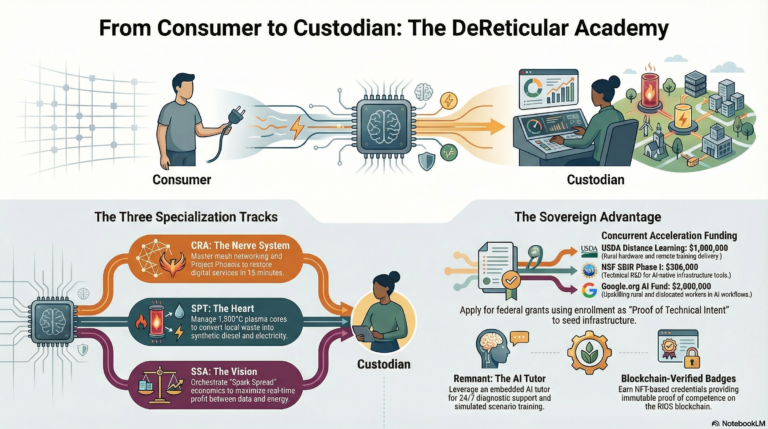
This study guide provides a comprehensive review of the DeReticular ecosystem, the Sovereign Stack architecture, and the macroeconomic landscape of late 2026. It is designed to facilitate a deep understanding of decentralized physical infrastructure networks (DePIN), edge-native artificial intelligence, and localized resource orchestration.
Part I: Short-Answer Quiz
Instructions: Answer the following questions in 2–3 sentences, ensuring all factual details are derived from the provided research.
- What is the primary difference between a “Pipeline” business model and a “Rural Platform” model?
- Explain the concept of “Island Mode” and why it is critical to the Sovereign Stack.
- What is the “Digital Airlock” within the context of a Sovereign Gateway, and what problem does it solve?
- How does the “Spark Spread” algorithm automate financial decision-making for a RIOS node?
- Describe the function of “Radio Frequency Fingerprinting” (RFF) in the DAOSRUS interface layer.
- What specific regulatory and funding advantages does the Sovereign WISP (Rank 1) utilize to remain commercially viable?
- Explain the “Deadhead Economy” and how Kurb Kars (Rank 3) addresses this failure in rural transit.
- What are the three human-centric elements of the “Value Chain of Knowledge” that remain valuable in the age of AI abundance?
- How does the Sovereign Elector utilize the Locutus Ledger and TPM 2.0 to ensure voting integrity?
- What is the significance of the Section 6417 “Direct Pay” provision for non-profit cooperatives and municipalities?
video
Part II: Answer Key
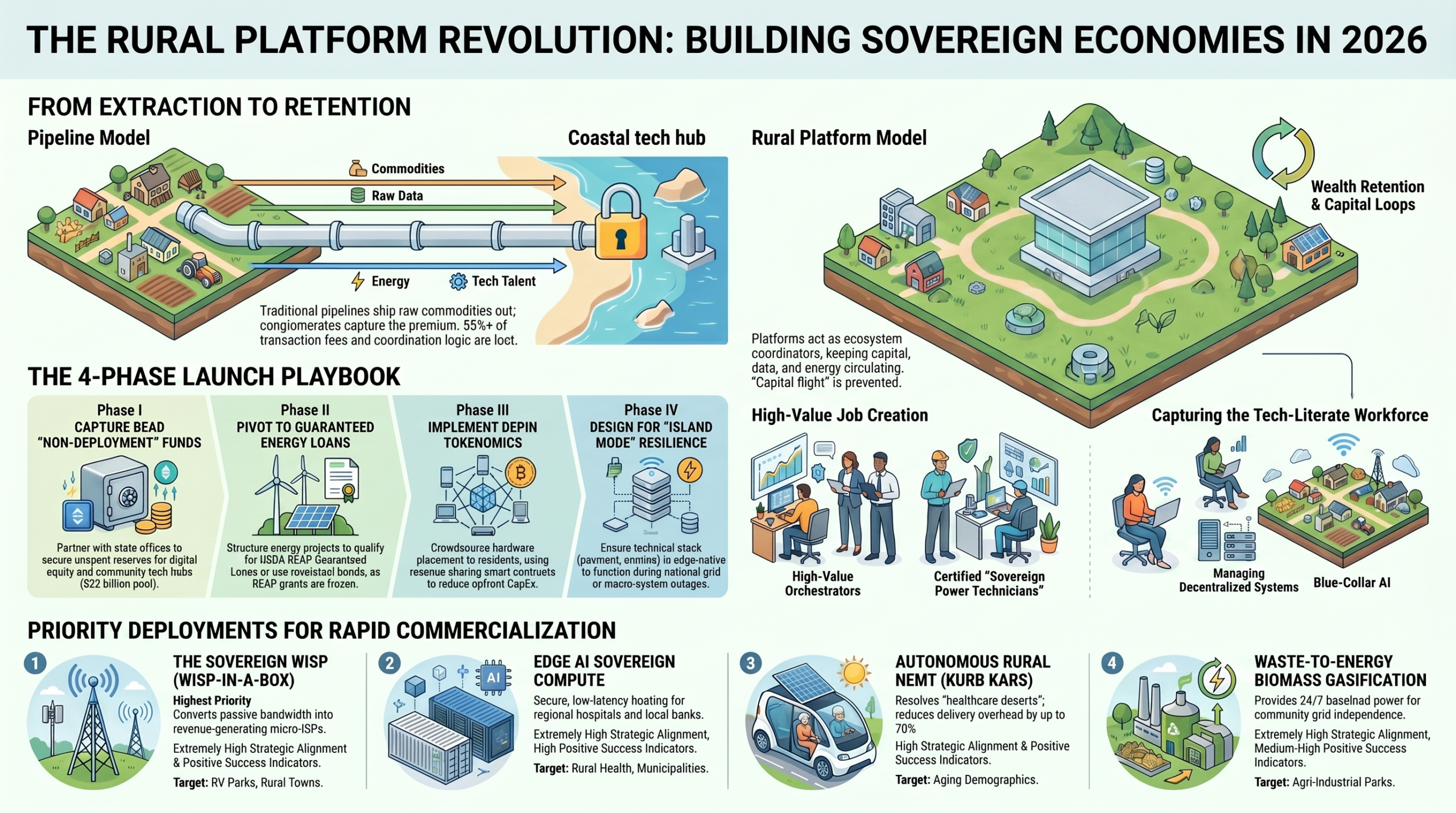
- Pipeline vs. Platform: Traditional pipelines operate on a linear model where raw commodities are extracted and shipped to a centralized conglomerate that captures the bulk of the value. In contrast, a Rural Platform Company acts as an ecosystem coordinator, providing the digital and physical infrastructure that allows local actors to trade energy, data, and goods directly, keeping capital circulating within the community.
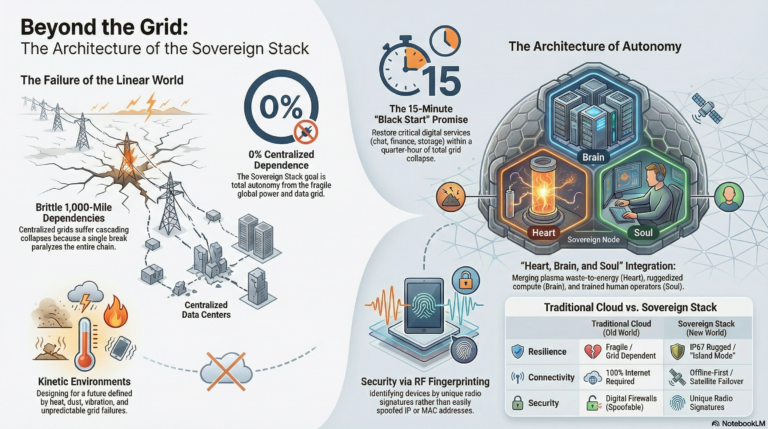
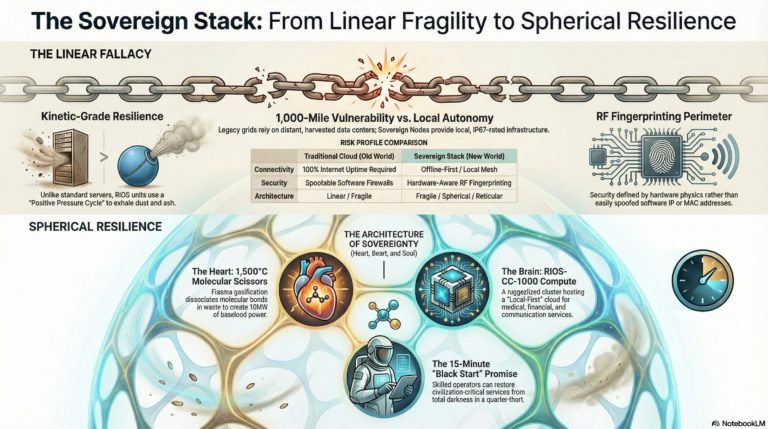
- Island Mode: Island Mode is the capability of a localized infrastructure node to autonomously disconnect from national power grids or public cloud networks without losing essential functionality. It is critical for maintaining operational continuity and security during regional outages, cyber-warfare, or disruptions in centralized telecommunications.
- The Digital Airlock: The Digital Airlock is a cryptographic and physical gatekeeper in the Sovereign Gateway that strips away sensitive user telemetry and personal context before sending logical queries to external cloud AI. This solves the “Trusted Environment Fallacy” by ensuring high-density reasoning (like Google’s Project Remy) can be utilized without exposing the internal smart home network to corporate data harvesting.
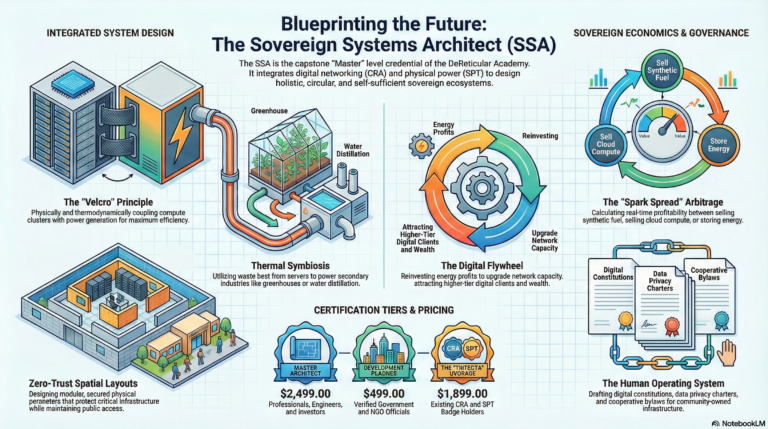
- Spark Spread: The Spark Spread algorithm calculates the real-time profit difference between refining local biogas into liquid synthetic fuel (ASF™) versus using that energy to power high-margin GPU compute for Edge AI inference. Based on these real-time metrics, the Sovereign Sentry Pro automatically redirects energy to whichever mode—Liquid Refining or Digital Alchemy—is currently more profitable.
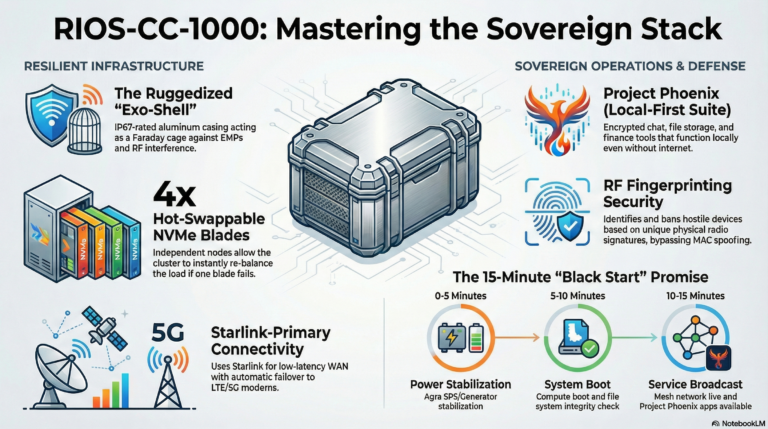
- Radio Frequency Fingerprinting (RFF): RFF is a decentralized identity verification method that measures the unique physical electromagnetic transient of a device’s antenna during transmission. Because this “fingerprint” is tied to the physical hardware, it serves as a non-spoofable credential for Sovereign Badges, allowing for secure access and automated authentication without the need for traditional passwords or apps.
- Sovereign WISP Advantages: The Sovereign WISP leverages professional APIs pre-configured for Starlink Business compliance to legally resell bandwidth, bypassing the service termination risks associated with residential packages. Additionally, it is strategically positioned to capture a share of the $22 billion in unspent federal BEAD “non-deployment” reserves intended for localized digital equity and mesh networks.
- Deadhead Economy: The Deadhead Economy refers to the structural failure where NEMT providers must drive 30–50 miles empty to reach a single patient, incurring fuel and labor costs without generating revenue. Kurb Kars addresses this by utilizing autonomous pods and off-grid solar charging, eliminating driver labor and fuel costs, which raises operating margins from the industry standard of 10% to over 81%.
- Value Chain of Knowledge: As generative AI commoditizes knowledge retrieval, human competitive advantage shifts to Curiosity (framing the right inquiries), Curation (validating signals and filtering noise), and Judgment (making final, high-stakes decisions with conviction and accountability).
- Sovereign Elector Security: The Sovereign Elector uses a physical TPM 2.0 chip to cryptographically sign every cast ballot, ensuring hardware integrity. These votes are then recorded as permanent, immutable state changes on the Locutus Ledger, a decentralized state database that is immune to external cloud manipulation or DNS attacks.
- Section 6417 Direct Pay: This provision allows tax-exempt entities like local governments and 501(c)(3) cooperatives to receive direct cash refunds from the U.S. Treasury for up to 30–50% of the cost of clean energy assets. This eliminates the need for extractive “tax-equity” banking partners, allowing communities to fund sovereign infrastructure more affordably.
podcast
Part III: Essay Questions
- Strategic Prioritization: Evaluate the ranking of the seven Sovereign Stack use cases. Why does the Sovereign WISP rank as the top priority for deployment, and how does its success facilitate the more capital-intensive goals of “Physical Autonomy” use cases like Agra Dot Energy and Kurb Kars?
- Resilience vs. Efficiency: Analyze the architectural shift from “Linear Fragility” to “Spherical Resilience.” How do concepts like multi-directional mesh networks, air-gapped hardware isolation, and “Island Mode” provide a strategic advantage over traditional, centralized cloud-tethered infrastructure?
- The AI Security Crisis of 2026: Discuss the vulnerabilities exposed by the May 2026 OpenClaw CVE security collapse. How does DeReticular’s approach to air-gapped, localized OpenClaw agents on hardened hardware (Sovereign Sentry) resolve the risks of prompt injection and data exfiltration?
- Economic Self-Determination: Explain the “Non-Extractive Financial Architecture” proposed by DeReticular. How do the Sovereign-Public-Private Partnership (S-P3) and Node-as-a-Service (NaaS) models protect emerging markets and rural communities from predatory external debt and currency devaluation?
- Technical Gap Mitigation: Address the engineering realities identified in the Gap Analysis, specifically regarding LoRaWAN bandwidth limits and the silicon supply chain. How should a system designer adjust the Sovereign Stack to ensure real-time application synchronization and commercially viable hardware procurement?
Part IV: Glossary of Key Terms
| Term | Definition |
| Agra Dot Energy | The physical “muscle” layer of the stack; focuses on waste-to-energy plasma gasification and carbon-negative baseload power. |
| Agrivoltaics | The simultaneous use of land for both solar energy generation and agriculture, often utilizing vertical bifacial panels to allow machinery access. |
| ASF™ | Advanced Synthetic Fuel; a clean, liquid fuel refined from syngas produced by plasma gasification. |
| BEAD Program | Broadband Equity, Access, and Deployment; a $42.5 billion federal program for broadband expansion, often suffering from administrative delays in late 2026. |
| BESS | Battery Energy Storage System; localized battery arrays used to stabilize microgrids and store energy for “Island Mode” operations. |
| CAN Bus | Controller Area Network; a robust industrial communication protocol used by the Industrial Foreman to orchestrate physical machinery. |
| DAOSRUS | Digital Adventures R Us; the “Experience Layer” of the RIOS stack that manages decentralized identity, governance, and user interfaces. |
| DePIN | Decentralized Physical Infrastructure Networks; a sector involving crowdsourced hardware (compute, Wi-Fi, sensors) rewarded with blockchain tokens. |
| Digital Airlock | A hardware-enforced cryptographic barrier that sterilizes data before it leaves a local network to interact with external cloud services. |
| Edge AI | Artificial Intelligence processed locally on device hardware rather than in a centralized, remote cloud data center. |
| GGUF | A file format for quantized Large Language Models (LLMs) optimized for high-performance inference on local hardware like the Sovereign Sentry. |
| Hyphanet | Formerly Freenet; a Java-based peer-to-peer network focused on static anonymity and the deep archiving of un-censorable documents. |
| Industrial Symbiosis | A process where the waste or byproducts of one industrial firm serve as raw materials for another within an Eco-Industrial Park. |
| Island Mode | The ability of an infrastructure node to operate independently and air-gapped from macro-grids and the global internet. |
| Kurb Kars | The “motion” layer of the stack; autonomous electric low-speed vehicles (LSVs) designed for rural logistics and medical transport. |
| Locutus Ledger | An on-device, high-performance decentralized state database used to immutably record transactions and civic decisions. |
| NaaS | Node-as-a-Service; a leasing model where hardware is provided to communities with zero down payment, paid back via a share of generated revenue. |
| New Freenet | A Rust-based rewrite of the Freenet protocol designed for low-latency decentralized applications and real-time state synchronization. |
| OpenClaw | An open-source framework for agentic AI that executes automated workflows (using YAML/JSON plans) rather than just generating text. |
| Plasma Gasification | An ultra-high temperature process (1,500°C) that vaporizes biomass waste into clean syngas and biochar. |
| REAP | Rural Energy for America Program; a USDA program providing grants and loans for rural energy projects, which saw a grant freeze in early 2026. |
| RIOS | Rural Infrastructure Operating System; the “Mind” of the stack; an edge-native OS that coordinates local energy, data, and logistics. |
| S-P3 | Sovereign-Public-Private Partnership; a community-owned model where local entities own assets while using technology from private partners. |
| Sovereign Sentry | The primary edge-compute hardware unit of the stack, available in Standard, Pro, and Enterprise (EPYC) editions. |
| Spark Spread | The algorithmic arbitrage of choosing between refining physical energy (fuel) or digital energy (AI compute) based on real-time profitability. |
| TPM 2.0 | Trusted Platform Module; a physical security chip on a mainboard that cryptographically signs data and ensures hardware integrity. |
| TriFiWireless | A high-throughput local mesh network protocol (Wi-Fi 7/5G Private NR) used for real-time data exchange within the Sovereign Stack. |