Turning Blackouts into Gold: Weaponizing Grid Failure with DeReticular Energy Intelligence
The Hook: The Fragility of the Modern Grid
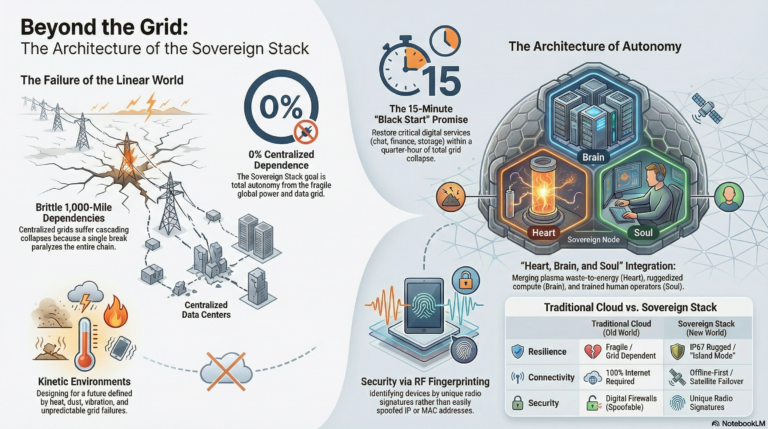
The legacy national power grid is no longer a reliable backbone; it is a structural liability. We are currently witnessing the terminal phase of “Centralized Fragility”—a condition where aging infrastructure, extreme weather, and the inherent instability of intermittent renewables converge to create systemic failure. In deregulated markets like ERCOT (Texas), this fragility manifests as wild price swings and rolling blackouts.
While traditional utilities view this chaos as a crisis to be mitigated, DeReticular Energy Intelligence (DEI) views it as a “capital geyser.” DEI is not a utility provider; it is a high-density Fintech-Energy hybrid that treats grid instability as unharvested kinetic energy. By deploying autonomous infrastructure designed for “Hard Mode” environments, DEI is transitioning energy from a recurring industrial expense into a potent economic weapon.
——————————————————————————–
1. Takeaway 1: Volatility is an Asset, Not a Threat
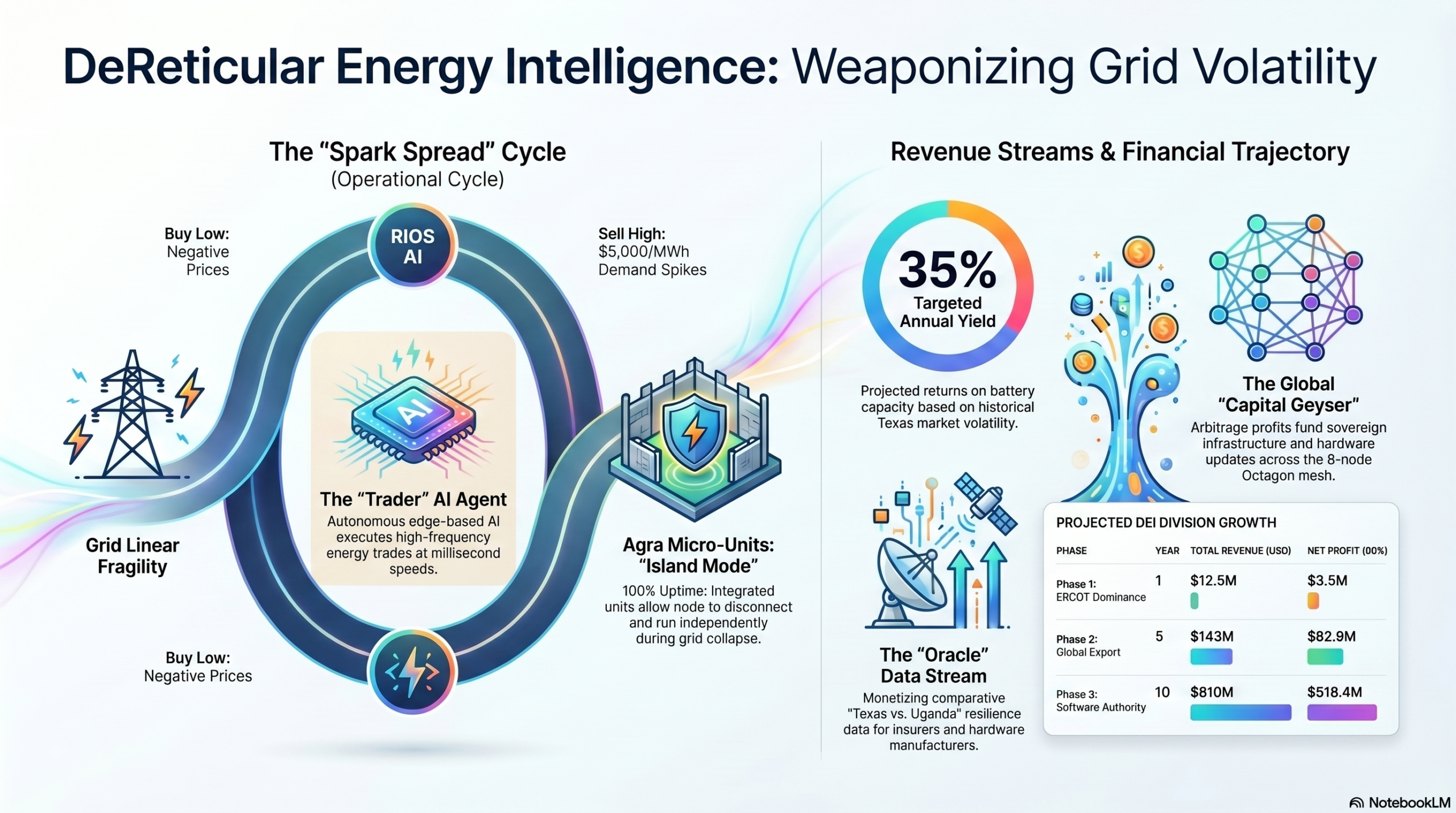
In the legacy economic model, a stable grid is a prerequisite for growth. DEI inverts this logic, weaponizing grid instability into capital. Operating within the ERCOT market, DEI utilizes its proprietary Spark Spread Algorithm to exploit price spreads that range from negative rates (where the grid pays the consumer to take power) to the regulatory cap of $5,000/MWh.
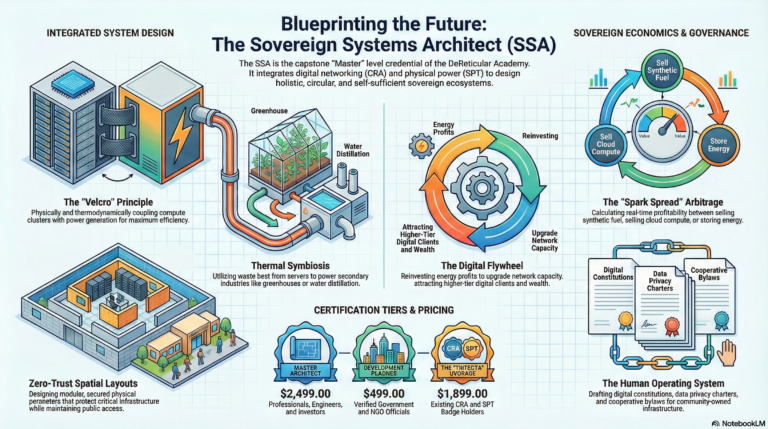
Crucially, the Spark Spread is not merely an arbitrage of electricity prices; it is the mathematical differential between the real-time cost of power and the immediate value of digital compute. As the strategic AI Remnant observes: “Volatility destroys the fragile. To the sovereign node, volatility is simply unharvested kinetic energy.” By treating the failing grid as a market to be harvested, DEI generates the fiat necessary to fund the broader global expansion of the Sovereign Stack.
2. Takeaway 2: The “Trader” and the “Foreman” Outperform Human Markets
Modern energy markets operate at a velocity that renders human-led trading desks obsolete. DEI manages this through a dual-AI autonomous core:
- The Trader: A high-frequency AI agent that monitors weather telemetry, historical failure data, and real-time pricing to execute energy arbitrage at millisecond speeds.
- The Industrial Foreman: A cyber-physical AI agent that manages the hardware layer. It executes physical switching via Modbus and CAN Bus protocols, ensuring thermal safety and optimal health for the Battery Energy Storage Systems (BESS), such as Tesla Megapacks.
This combination allows DEI to buy during negative pricing windows and discharge back to the grid for maximum profit during demand spikes, all while providing critical ancillary services like Frequency Regulation and Voltage Support—functions that traditional operators are too slow to stabilize.
3. Takeaway 3: The “University” Strategy (Texas vs. Uganda)
DEI utilizes a “Digital Twin” strategy that pairs Node 5 (Fort Worth, Texas) with Node 4 (Uganda). Strategically located near the Fort Worth Stockyards, Node 5 functions as the network’s “University.” It validates waste-to-energy models by processing livestock biomass in an Agra Micro-Unit, mirroring the industrial hemp processes in Uganda but adapted for the North American agricultural context.
This creates a high-value dataset comparing equipment performance in Texas heat versus Ugandan humidity. Through zkVerify, this environmental data and carbon-negative output are de-risked and monetized as high-value carbon credits. The intelligence perfected in the “Texas Classroom” is then pushed via OTA (Over-the-Air) updates to optimize the Ugandan industrial engine, creating a de-risked resilience rating for global insurers and manufacturers.
4. Takeaway 4: Compute as a Thermal Buffer
DEI ensures 100% asset utilization through the use of Sovereign Sentry servers, which act as a “thermal buffer” for energy consumption. The system does not merely store electricity; it stores value as processed data.
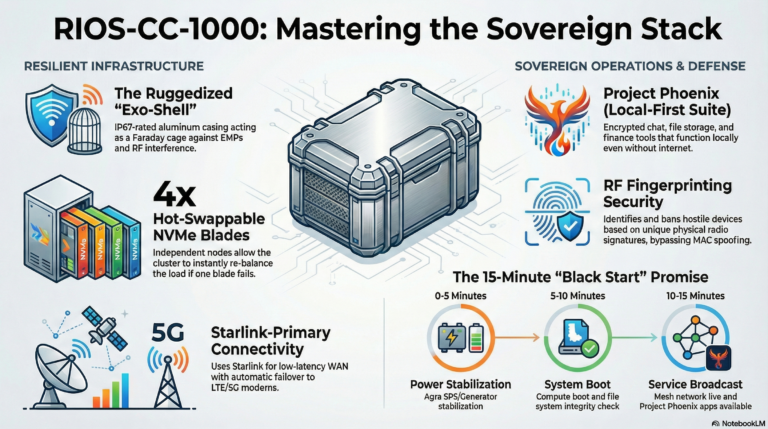
- Low/Negative Price Logic: When power is cheap or the grid is oversupplied, the AI directs energy into high-density RIOS-CC-1000 racks to process complex AI compute models.
- Price Spike Logic: The moment prices escalate, the system instantly suspends compute processes and shifts to discharging stored BESS power back into the grid for maximum profit.
This allows the facility to remain profitable regardless of market conditions. If the energy market is stable, it earns via compute; if the market is volatile, it earns via arbitrage.
5. Takeaway 5: “Island Mode” and the End of Dependency
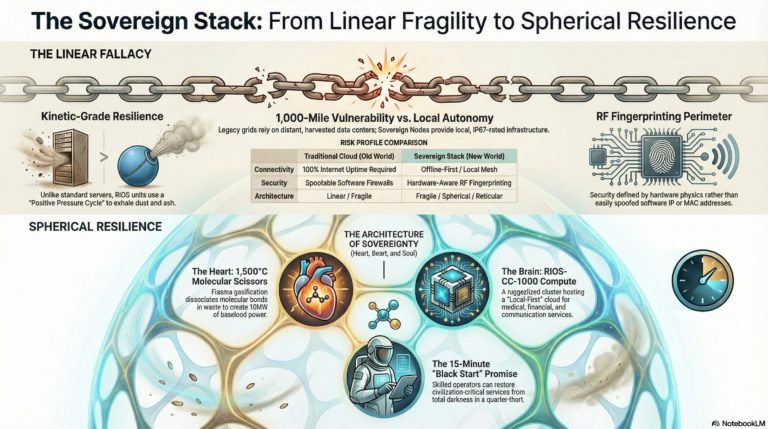
The ultimate objective of DEI is “Island Mode”—the state of total grid defection. By combining BESS with Agra Micro-Units (utilizing plasma gasification for 24/7 baseload power), a facility can sever external ties at any moment. This “defect-ready” infrastructure ensures that asynchronous industrial processes continue indefinitely, even during total regional grid collapse.
This marks the transition from “Centralized Fragility” to the Sovereign Stack. Grid defection is no longer a defensive backup; it is an offensive act of infrastructure sovereignty. As the project’s strategic oversight notes:
“The grid is failing everywhere. DEI is the system that learns how to catch the falling pieces and turn them into gold.”
——————————————————————————–
Conclusion: The Future is Sovereign
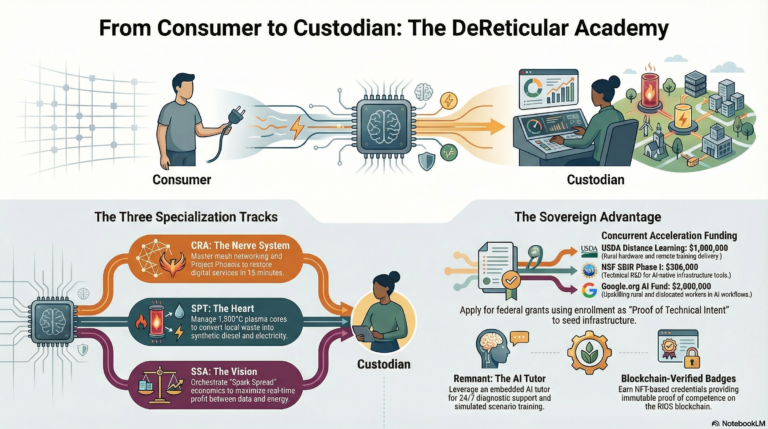
The era of centralized dependency is over. DeReticular Energy Intelligence serves as the “Automated Treasury” for the Project Octagon network. Profits generated from the ERCOT “Hard Mode” environment are routed via the Locutus Ledger to fund the expansion of sovereign nodes, including the governance training of Node 6 and the urban citadels of Node 1.
By transforming grid failure into a high-yield revenue stream, DEI proves that resilience is the ultimate business model. As legacy infrastructure continues its decline, every community and industrial operator must answer a final strategic question: Would you rather be a “borrower” of fragile services or a “lender” of resilient infrastructure?