Strategic Investment Case: Transitioning to Sovereign Point-of-Use Manufacturing for Global Aerospace
1. The Strategic Mandate: Navigating the Global “Parts Drought”
The aerospace industry has entered a historic “super-cycle” of demand, characterized by record-shattering global travel volume. However, this growth is stalled by a fundamental paradox: major Original Equipment Manufacturers (OEMs) are suffering from historic production delays, leaving the industry in a state of paralysis known as the “Parts Drought.” This environment necessitates a radical departure from the traditional “Just-in-Time” supply chain philosophy. To ensure survival and operational continuity, the industry must transition to a “Just-in-Case” model, underpinned by localized, point-of-use manufacturing.
The imperative for this transition is driven by the escalating “Aging Fleet” crisis, which is defined by three critical strategic factors:
- Rising Average Fleet Age: The global commercial fleet’s average age has climbed from 14 years in 2019 to 16 years in 2025, pushing aircraft into high-intensity maintenance cycles (C and D checks).
- Maintenance Frequency and Intensity: As aircraft remain in service longer, the demand for flight-critical components—particularly high-value rotables—now far outstrips the production capacity of the legacy supply chain.
- Rotable Cannibalization: A severe shortage of landing gear and engine components has forced airlines into the non-sustainable practice of “cannibalization”—stripping parts from parked aircraft to maintain active fleet availability.
These market pressures serve as the definitive catalyst for a new era of aerospace logistics. Moving beyond traditional procurement, point-of-use manufacturing empowers organizations to implement a true “Just-in-Case” strategy, creating parts on-demand rather than waiting on a fractured global supply chain.
2. The Financial Impetus: Quantifying the Cost of Traditional Lead Times
For the modern aerospace executive, lead-time compression is the most effective lever for unlocking liquidity. The ability to minimize “Aircraft on Ground” (AOG) time is no longer a marginal gain; it is a financial necessity. Traditional procurement models are currently weighed down by stagnant inventory and astronomical waiting costs, whereas AI-augmented sovereign production offers high-velocity liquidity.
Comparative Economics: Traditional vs. Sovereign Forge Production
| Feature | Traditional Procurement | Sovereign Forge Production |
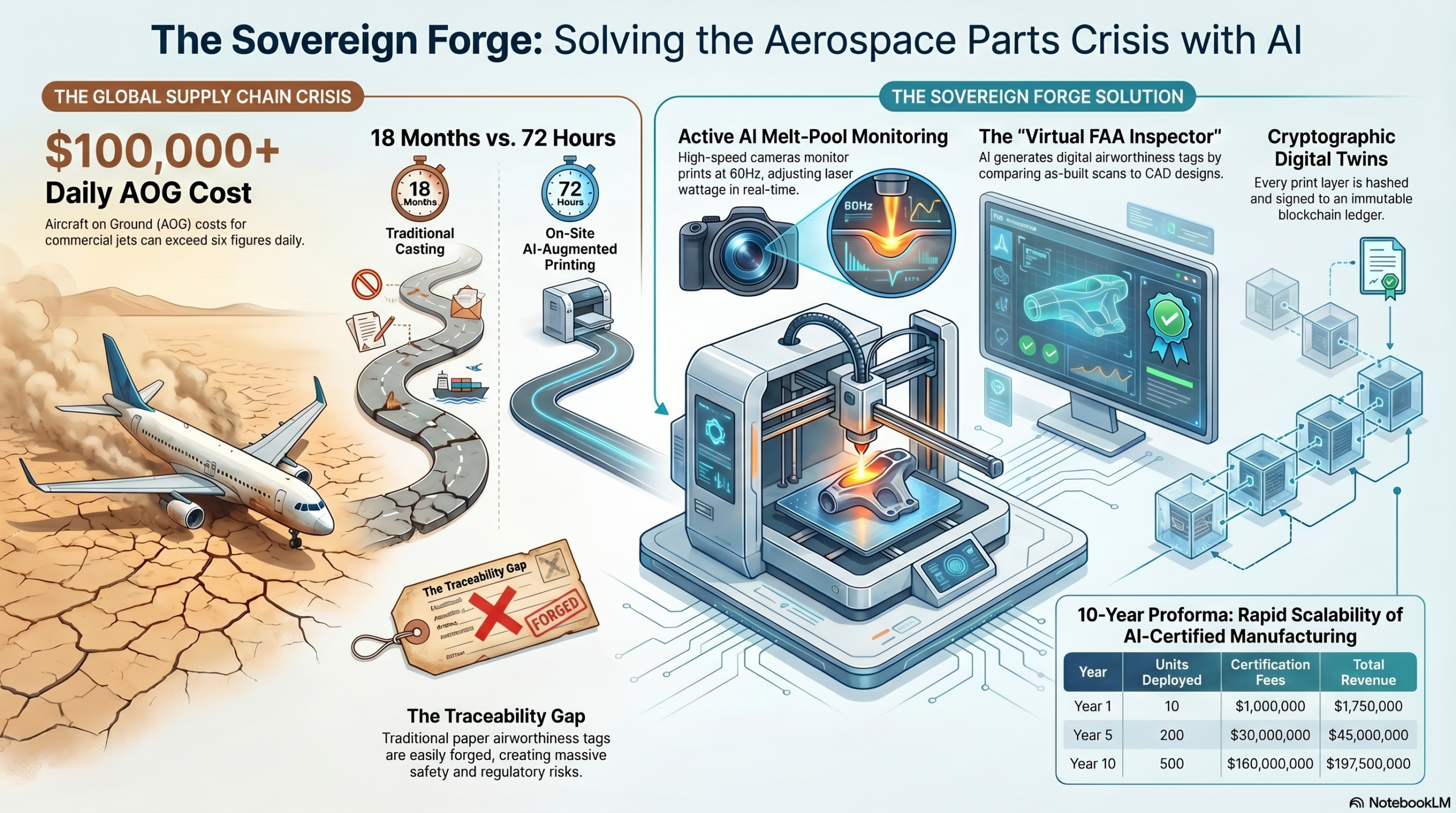
| Lead Time | 12 – 18 Months | 48 – 72 Hours |
| Daily AOG Cost | $100,000+ | $100,000+ |
| Traceability Method | Paper-based (FAA Form 8130-3) | Cryptographic Digital Twin |
| Capital Efficiency | Stagnant Inventory: Capital locked in global transit. | High-Velocity Liquidity: Immediate return-to-service. |
The “So What?” of Lead Time Disparity
The financial implications of an 18-month lead time are catastrophic. At a conservative daily AOG cost of 100,000, a critical engine component with an 18-month (540-day) lead time costs an operator **54,000,000** in lost revenue and storage fees. In contrast, the Sovereign Forge can produce that same component in 72 hours, incurring a total AOG cost of only 300,000**. This results in a **53.7 million variance per grounded aircraft. This radical reduction in financial exposure shifts the strategic focus from managing the burden of the old model to leveraging the technological capabilities of the new one.
3. The Technology Core: Defining the Sovereign Forge AI Stack
The transition to point-of-use manufacturing requires a shift from “passive” industrial printers to “active” robotic inspectors. While standard 3D printers merely follow fixed instructions, the Sovereign Forge (SKU: SOV-AUTO-FORGE) functions as an active participant in the manufacturing process, ensuring airworthiness at the point of creation.
The DeReticular Forge & Defense (DFD) solution is built on three integrated layers:
The Hardware (Refractory Metal Optimization) DFD utilizes Laser Powder Bed Fusion (LPBF) and Directed Energy Deposition (DED) systems optimized for refractory metals such as Tungsten, Rhenium, and Inconel. These materials are essential for high-heat environments but are notoriously difficult to manufacture through traditional casting.
The Intelligence (Sovereign Forge AI) This layer provides the “brain” of the operation. Utilizing FLIR integration, high-speed thermal cameras monitor the laser-metal interaction at 60Hz. The Closed-Loop Control system analyzes the melt-pool in real-time; if thermal fluctuations vary by more than 2%, the AI instantly adjusts laser wattage or scan speed. This precision monitoring prevents microscopic voids and “hot cracking” in brittle materials like Tungsten, drastically increasing manufacturing yield.
The Governance (Split-Ledger Architecture) Security and compliance are hardcoded into the process. Every printed layer is hashed and signed by a TPM 2.0 module, while the Sovereign Key (YubiKey) ensures a “Human-in-the-Loop” requirement for print authorization.
This integrated stack functions as a “Virtual FAA Inspector,” generating a digital FAA Form 8130-3 (Airworthiness Approval Tag) in real-time, providing the verified data necessary for high-value aerospace applications.
4. High-Value Targets: Point-of-Use Production of Critical Components
Specific high-heat components represent the highest ROI for point-of-use manufacturing because they are the most difficult to source and the most likely to ground a fleet. For example, traditional casting of Tungsten-based turbine blades is plagued by brittleness and 18-month delays. The Sovereign Forge manages these thermal gradients through AI, producing these blades in days.
Furthermore, the “Forge Advantage” is critical in “contested logistics” zones and remote repair stations:
- Tactical Drones: Propulsion mounts and heat shields utilizing Titanium-Aluminide or Tungsten-carbide can be printed and verified on-site.
- RIOS Pilot Units: Expeditionary units deployed to naval carriers or remote airfields ensure airworthiness without the need for secondary, centralized inspection facilities.
- Risk Elimination: Localizing the production of a 2kg Tungsten blade eliminates the immense insurance costs and international shipping risks associated with moving sensitive aerospace components across borders.
Localizing production effectively eliminates international shipping risks and costs, establishing the digital trust required for decentralized aerospace operations.
5. The Traceability Premium: Digital Notarization and IP Security
In an era where the AOG Technics scandal has exposed the dangers of falsified paper records, traceability has become the industry’s most valuable “premium currency.” Modern mandates, including the FAA Reauthorization Act of 2024, now require an immutable “Back-to-Birth” history for every component.
The DFD system satisfies these mandates through:
- Immutable Notarization: The Locutus Ledger and TPM 2.0 module create a “dirty fingerprint” digital trail that is mathematically linked to the physical object.
- IP Protection via Ephemeral Decryption: To prevent the theft of high-value designs, DFD utilizes Ephemeral Decryption. CAD designs are decrypted only into volatile RAM during the print process. This ensures the foreign repair station never “owns” the data, as it is wiped the moment the print concludes.
- Market Opportunity: This technology provides an immediate capture opportunity for the 977 FAA-certified foreign repair stations that must automate compliance and tracking for new regulatory mandates by 2027.
These protocols satisfy stringent regulatory requirements while providing the security necessary for OEMs to trust decentralized manufacturing nodes.
6. Financial Proforma and Strategic Implementation Roadmap
The DeReticular Forge & Defense division operates on a high-margin hybrid model (Hardware Lease + AI-as-a-Service + Transactional Certification Fees). Notably, 80% of revenue is focused on transactional certification fees and SaaS, explaining the projected 42% EBITDA.
DeReticular Forge & Defense 10-Year Proforma (USD $000s)
| Metric | Year 1 | Year 5 | Year 10 |
| Units Deployed | 10 | 200 | 500 |
| Total Revenue | $1,750 | $45,000 | $197,500 |
| EBITDA (42%) | $735 | $18,900 | $82,950 |
Strategic Implementation Roadmap
- Phase 1: Validation (Years 1-2): Focus on partner validation with eVTOL leaders like Beta Technologies for non-structural thermal mounts and achieving FAA Part 145 acceptance for the digital audit trail.
- Phase 2: Defense Blitz (Years 3-5): Scale through DoD SBIR Phase III funding to standardize the Forge node for the F-35 supply chain and deploy ruggedized mobile units to remote airfields.
- Phase 3: Global Aftermarket Dominance (Years 6-10): Establish Sovereign Print Hubs at major global transit points (Dubai, Singapore, Atlanta) to become the primary production source for legacy aircraft.
Each of these milestones moves the organization closer to the ultimate goal of establishing the “Global Registry of Physical Assets.”
7. Risk Mitigation and Competitive Moat
The DFD strategy proactively manages the inherent risks of aerospace investment through advanced technological mitigations.
| Identified Risks | Strategic Mitigations |
| Certification Bottlenecks | AI provides high-resolution “Truth” datasets to inspectors, accelerating FAA/EASA approval. |
| Material Shortages (Tungsten) | Industrial Foreman agents manage strategic stockpiles of raw powders. |
| IP Theft at Foreign Stations | Ephemeral Decryption ensures CAD data is held only in volatile RAM; it is never stored permanently. |
| Power Instability | Integration with Resilient Microgrids to ensure 24/7 furnace uptime and print integrity. |
This investment transforms the organization from a “part seeker” into a “part creator.” By establishing a dominant position in the $1.06 trillion aerospace market of 2032, we are not merely reacting to a crisis—we are building the “Global Registry of Physical Assets.”