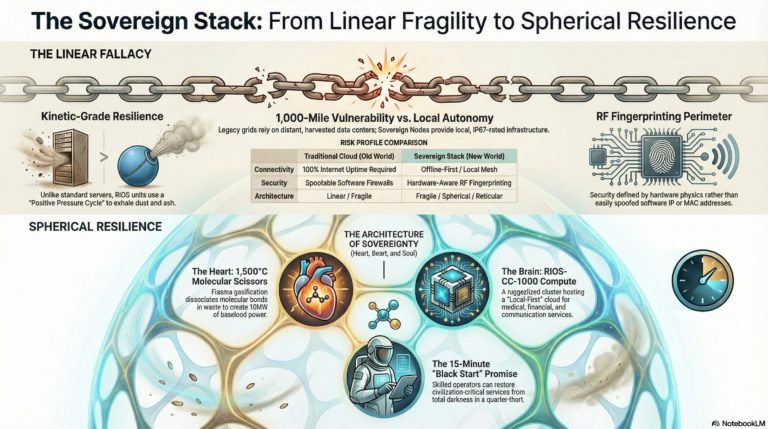

Concept Primer: From Global Clouds to Local Meshes – Understanding Spherical Resilience
1. The Vulnerability of the “Macro-Internet”
In the current digital landscape, rural American cities—specifically those with populations between 1,000 and 3,000—stand at a critical crossroads. While many of these municipalities are experiencing a “Rural Rebound” with a post-pandemic net inflow of 670,000 migrants and a recent population growth of 0.29%, their technological foundations remain dangerously fragile. The traditional “macro-internet” model forces these growing hubs to rely on distant “hyperscale” data centers located thousands of miles away.
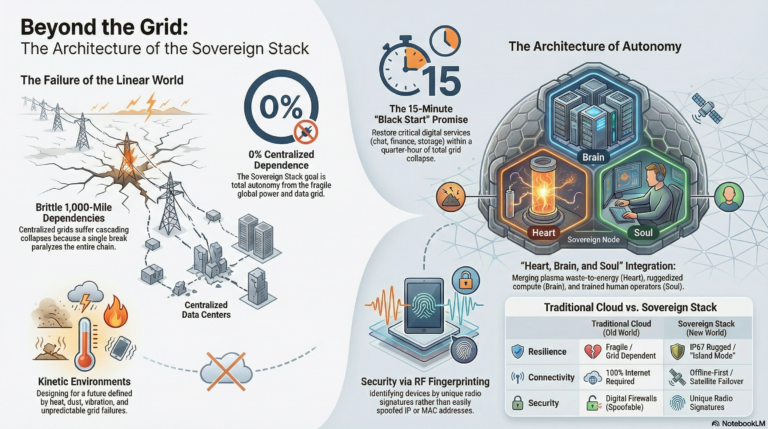
This reliance creates severe structural vulnerabilities. When the regional grid fails or a primary fiber line is severed, the digital heartbeat of the town stops. This fragility exacerbates “healthcare deserts” and “brain drain,” as the talent attracted by the Rural Rebound finds themselves unable to rely on the aging, centralized infrastructure for remote work or critical services. To sustain this growth, we must move from extractive dependencies to generative, localized systems.
| Feature | Centralized Cloud Model | Local Mesh Model (DeReticular) |
| Data Location | Remote hyperscale data centers | Localized “Edge” hardware within city limits |
| Reliability | Dependent on global ISP/Grid uptime | High-survivability; autonomous “Island Mode” |
| Grid Failure | Total loss of critical tools and data | Functions offline; stays fully operational |
| Economic Flow | Extractive (SaaS fees leave the town) | Generative (Community-owned capital asset) |
| Privacy | Processed by third-party corporations | Data remains within the municipal digital border |
The transition from fragile global networks to resilient local meshes is not just a technical upgrade; it is the reclamation of local autonomy.
2. The Core Philosophy: Spherical Resilience and “Island Mode”
As an Educational Technologist, I view Spherical Resilience as the pedagogical foundation for a new era of civic management. Think of a self-contained ecosystem or a lighthouse: it operates with its own fuel, its own intelligence, and its own purpose regardless of external conditions. The engineering objective of DeReticular is to grant every small town this same self-sufficiency through “Island Mode”—the ability to remain fully operational when the external world goes dark.
The RIOS “Trinity Stack”
The Rural Infrastructure Operating System (RIOS) manages this resilience through a “Trinity Stack” architecture, utilizing a Proxmox VE hypervisor to run three distinct, isolated layers:
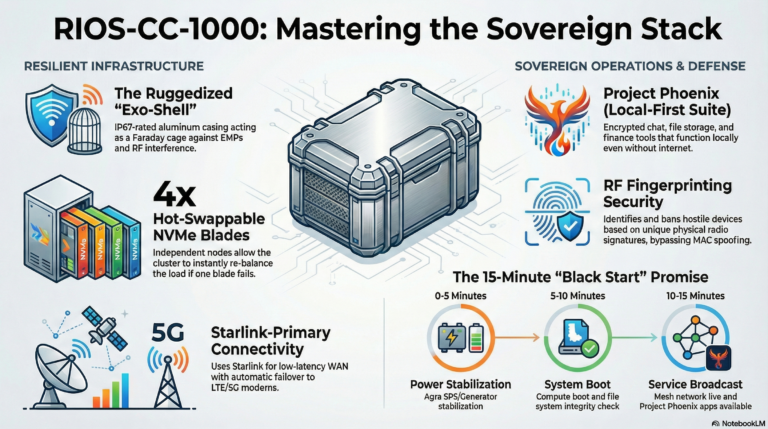
- Layer 1: The Gatekeeper (pfSense): This layer manages the “digital border.” It bonds disparate external connections (Starlink, LTE, Fiber) to maintain maximum uptime for external communication when available.
- Layer 2: The Ledger (Ubuntu Server): Acting as the town’s internal brain, this layer processes core logic and manages peer-to-peer decentralized data storage and automated notary services locally.
- Layer 3: The Auditor (Kali Linux): This security layer executes constant, automated vulnerability scanning and intrusion detection across the internal mesh, ensuring the town’s digital perimeter is never breached.
This philosophy of total resilience requires a physical foundation that turns infrastructure into a sovereign asset: DePIN.
——————————————————————————–
3. DePIN: The Physical Backbone of a Sovereign Town
Decentralized Physical Infrastructure Networks (DePIN) allow a community to “upcycle” its digital footprint. Instead of paying endless monthly fees to Big Tech, the town invests in its own hardware. For the strategist, this represents a shift from a cyclical sunk cost to a permanent, community-owned asset.
The implementation of this sovereign grid is achieved through the “City Infrastructure” Nexus Package (SKU: SOV-BNDL-CITY). Priced at $129,999.00, this turnkey bundle includes:
- 2x Sentry Pro Clusters (The Digital Nervous System): High-capacity server clusters (6x 1U nodes) deployed in redundant locations like City Hall and Police HQ. These run the city’s Root Certificate Authority (CA) and core compute.
- 36x Nomad Mesh-Point Routers (The Un-killable Intranet Canopy): Ruggedized Wi-Fi 6E/LoRaWAN units mounted on utility poles to blanket the city in a high-speed, private intranet that functions without global internet.
- 6x Sovereign Sentry Nodes (The Professional Sub-Nets): Dedicated units for local professionals. This includes 4x nodes for Medical offices and 2x nodes for Law offices, ensuring sensitive data is cryptographically isolated from public traffic.
- 6x Nomad Fleet Kits (The Autonomous Transit Brains): Mobile edge servers that integrate with municipal vehicles to manage autonomous dispatch and route geofencing.
- 3x Municipal Kiosks (The Civic & Tourism Pillar): Outdoor touchscreen nodes running specialized Vault Warden software for secure public square monitoring and LLM-based visitor concierges.
With this hardware in place, the town gains a physical body; the “brains” are provided by localized AI.
——————————————————————————–
4. OpenClaw: AI That Stays Home
Traditional Cloud AI is a privacy liability and a single point of failure. DeReticular’s OpenClaw Framework runs entirely on local NVIDIA GPUs using quantized 4-bit Llama 3 models. This allows high-level intelligence to function on edge hardware without ever sending a single byte of data to a third-party server.
| OpenClaw Agent | Municipal Task | Human/Professional Counterpart |
| The Industrial Foreman | Manages power micro-grids, battery load, and heavy machinery logistics. | Municipal Mechanics & Utility Workers |
| The Field Medic | Processes medical telemetry, HIPAA-compliant dictation, and OCR record sorting. | Clinic Staff & Doctors |
| The Sovereign Elector | Cryptographically secures and verifies localized voting and democratic records. | Election Officials & City Clerks |
This localized AI ensures that the town’s collective intelligence remains available and private, even in “Island Mode.”
——————————————————————————–
5. Real-World Impact: Healthcare and Transit Resilience
The convergence of mesh networks and local AI creates immediate solutions for the rural healthcare and transit crises. Under the Node 6 Sovereign Mobility Initiative, the 6 Nomad Fleet Kits transform standard municipal shuttles into “Kurb Kars.” These autonomous vehicles solve the transportation gap for elderly residents, using the mesh network for spatial awareness and dispatch.
In the medical sector, the Professional Sub-Nets enable:
- Secure Professional Collaboration: A doctor can transfer a high-resolution, high-volume patient file across town instantly using the mesh.
- Absolute Privacy: All medical interactions are HIPAA-compliant, utilizing Local Whisper AI for voice-to-text dictation and OCR for automated record management—all processed locally.
- Total Blackout Functionality: Because the system uses localized VoIP and the mesh network, clinicians and emergency responders can communicate securely during total internet and cellular blackouts.
——————————————————————————–
6. Solving the “Oracle Problem”: Trust in a Decentralized World
To ensure a decentralized network is secure, we must solve the “Oracle Problem”—verifying that data from a sensor or node is real and hasn’t been spoofed. DeReticular achieves this through a three-tier security architecture:
- Radio Frequency Fingerprinting: The system uses software-defined radios to scan devices for microscopic manufacturing imperfections, creating a “unique radio signature” for every hardware component.
- Hardware-Level Cryptography: Data is signed at the moment of ingestion using a non-exportable private key burned into a factory-sealed TPM 2.0 chip.
- Split-Ledger Architecture: The town’s Root CA generates isolated Sub-Nets. Nodes are programmed to drop any packet not signed by their specific Sub-CA. For example, a public kiosk is mathematically invisible to a medical node, preventing pivot attacks.
This architecture ensures the town’s digital world is anchored to a verified physical reality.
——————————————————————————–
7. Conclusion: The “City-in-a-Box” and the Future of Rural Sovereignty
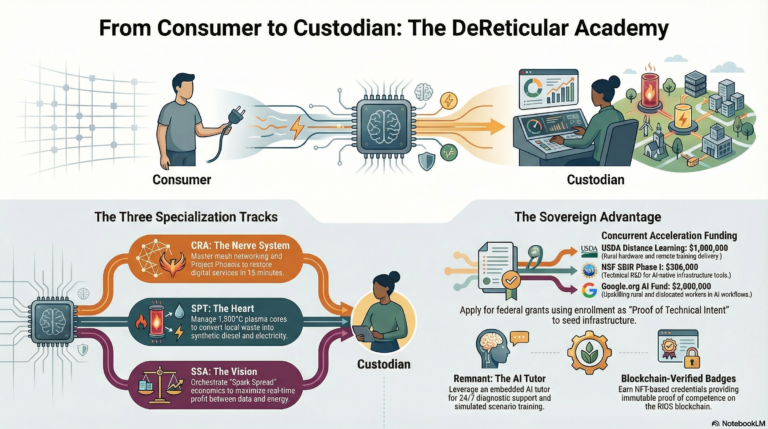
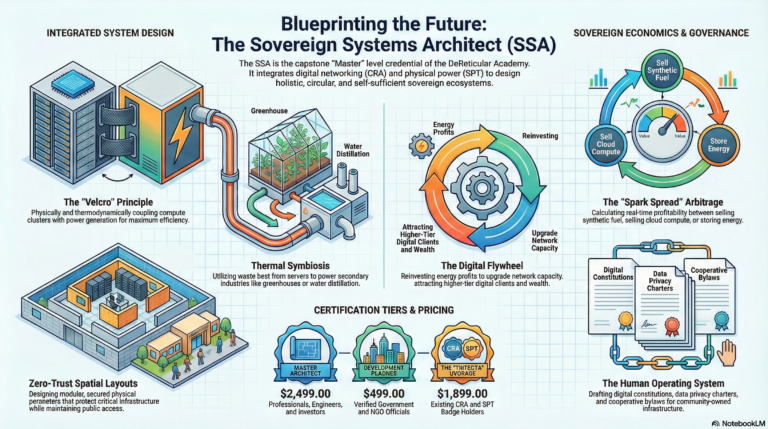
The “City Infrastructure” Nexus Package is more than a hardware bundle; it is a “Human Capital Engine.” Through the DeReticular Academy, city managers can enroll local talent in curricula like “Building the AI Native RIOS.” This ensures that the town’s youth—the very people who often lead the “brain drain”—become the sovereign architects and maintainers of their own municipal infrastructure.
By deploying this “City-in-a-Box,” a mayor transforms infrastructure from a fragile cost center into an un-killable, revenue-generating asset that attracts remote workers and secures the community’s future.
The 3 Keys to Spherical Resilience
- Local Ownership: Transitioning from “rented” services to community-owned, air-gapped infrastructure.
- Localized Intelligence: Utilizing quantized 4-bit Llama 3 models to keep AI assistance and data privacy within city borders.
- Cryptographic Sovereignty: Anchoring security in hardware roots of trust and RF fingerprinting to protect the city’s digital border from external threats.