THE SOVEREIGN OPERATIONAL STACK: A Briefing Document
Executive Summary
The “Sovereign Operational Stack” outlines a comprehensive institutional framework for achieving both physical and epistemic sovereignty through decentralized systems. The core thesis posits that physical sovereignty (energy, mobility, communications) and epistemic sovereignty (truth-claims, data integrity, governance) are structurally, thermodynamically, and mathematically identical problems.
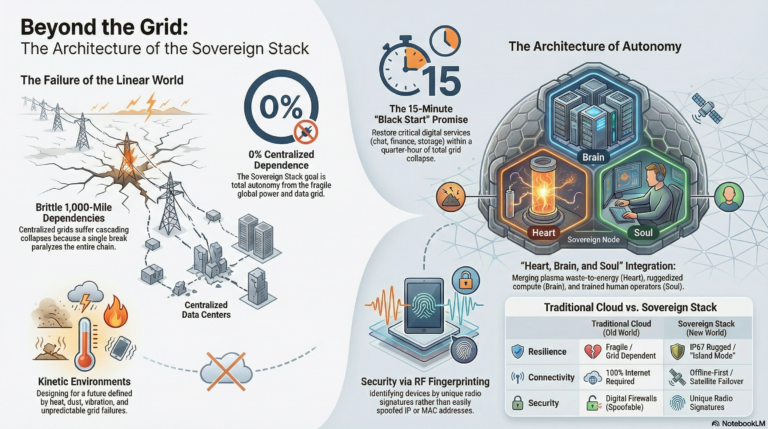
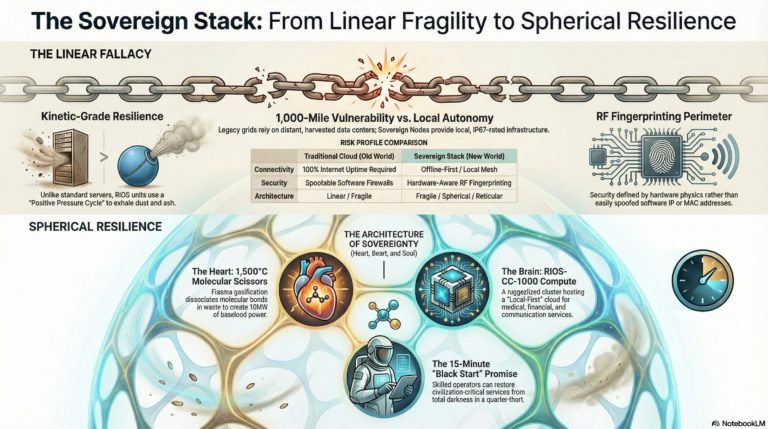
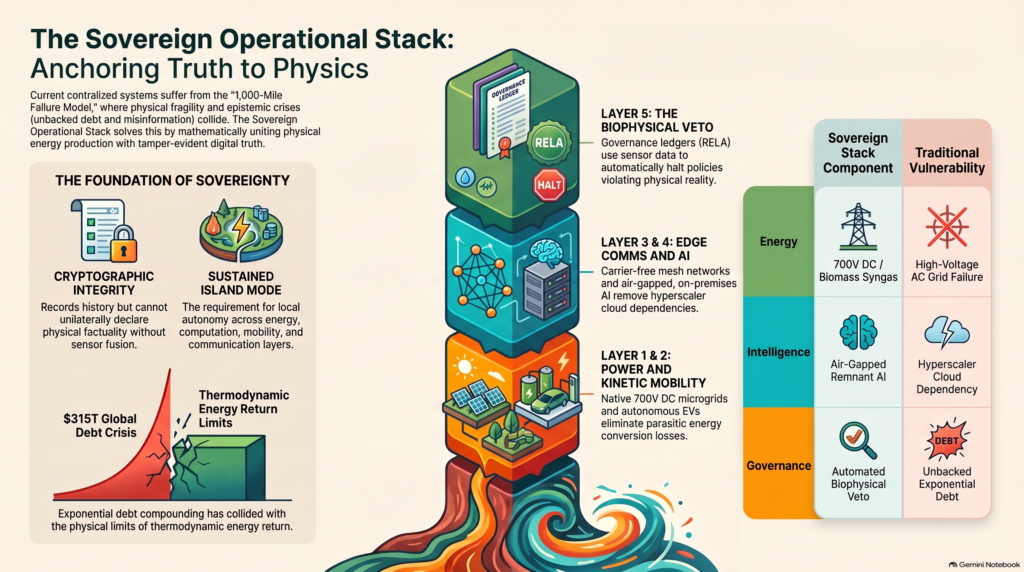
The document argues that current centralized systems suffer from two primary failure modes: the 1,000-Mile Failure Model (physical fragility of extended supply chains and hyperscaler clouds) and the Epistemic Crisis Model (the collision of exponential debt with thermodynamic limits). To resolve these, the paper proposes a five-layer vertical integration—the Sovereign Operational Stack—designed for “Sustained Island Mode.” This stack transitions governance from majoritarian pathologies toward an “Asymptotic Democracy” anchored by an automated biophysical veto and tamper-evident ledger architectures.
I. The Five-Layer Sovereign Operational Stack
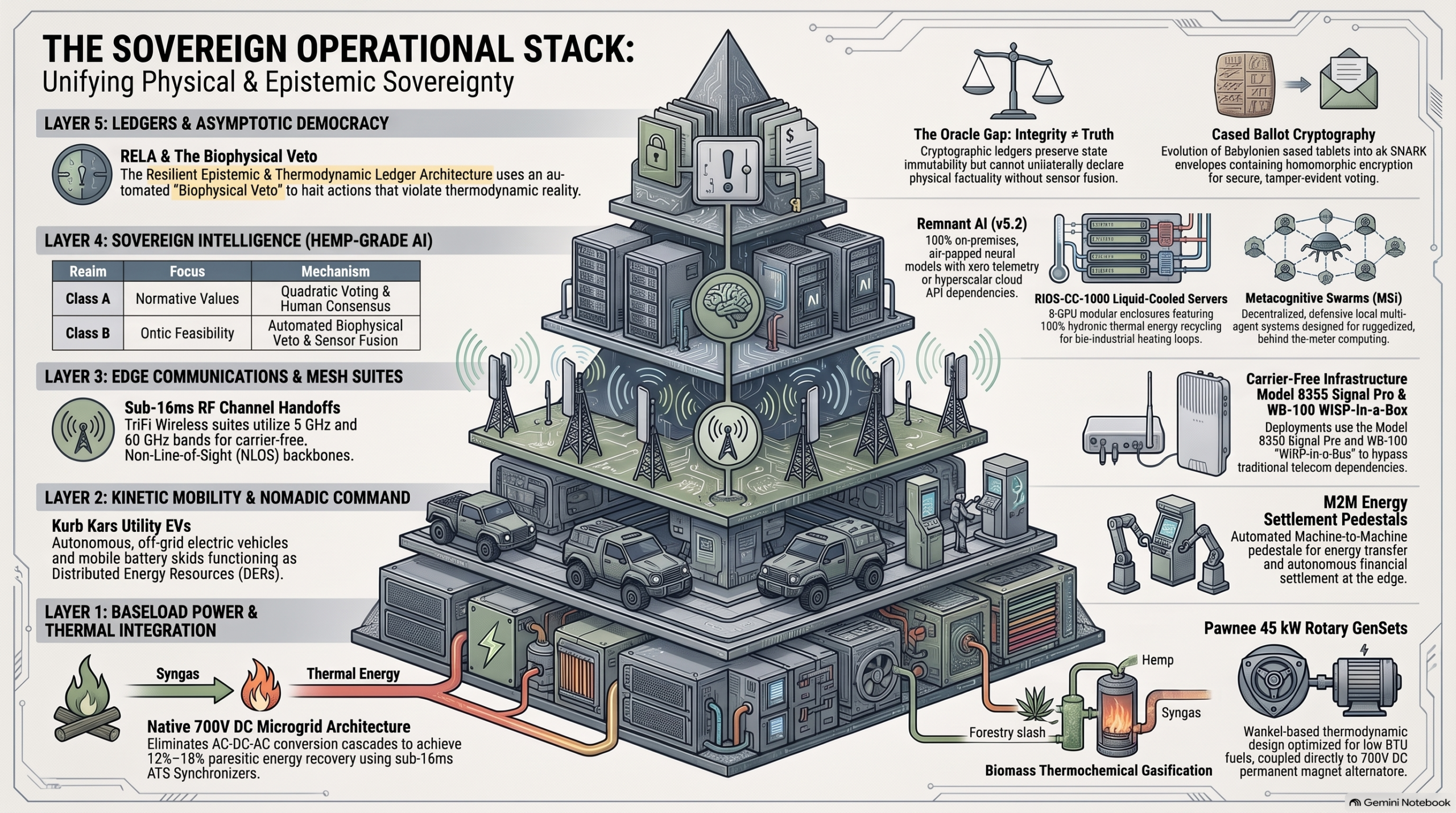
The stack integrates physical engineering with cryptographic and intelligence architectures to ensure operational independence.
Layer Domain Primary Components & Specifications
Layer 1 Baseload Power Agra Energy biomass gasification (syngas); Native 700V DC microgrids; Pawnee 45 kW rotary GenSets (sub-16ms ATS synchronizers).
Layer 2 Kinetic Mobility Kurb Kars autonomous off-grid EVs; mobile battery skids; Machine-to-Machine (M2M) energy settlement pedestals.
Layer 3 Edge Comms TriFi Wireless carrier-free mesh suites (5 GHz & 60 GHz); sub-16ms RF channel handoffs; Model 8355 Signal Pro.
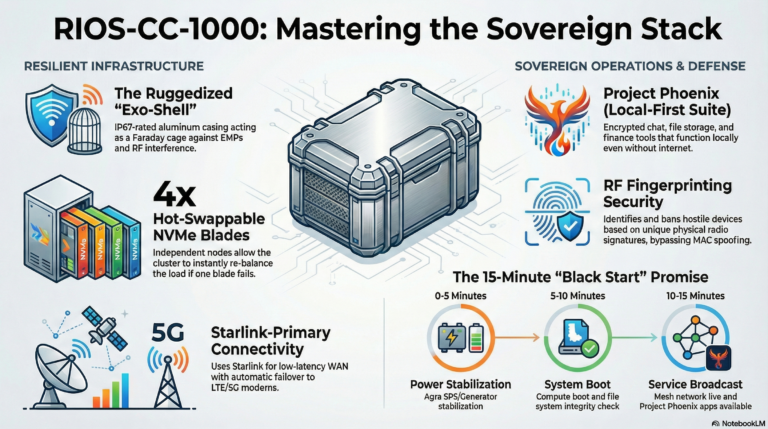
Layer 4 Sovereign Intelligence Remnant AI (v5.2 air-gapped models); RIOS-CC-1000 liquid-cooled 8-GPU servers; 100% hydronic thermal recycling (Hemp-Grade AI).
Layer 5 Governance/Ledgers Resilient Epistemic & Thermodynamic Ledger Architecture (RELA); The Asymptotic Democracy; Project Octagon edge testbeds.
Key Layer Details
- Layer 1 (Energy): Focuses on eliminating inverter conversion cascades (recovering 12%–18% parasitic loss) by using native DC architecture and thermochemical gasification of agricultural residues/hemp.
- Layer 4 (Intelligence): Introduces “Hemp-Grade AI,” which involves ruggedized, behind-the-meter computing co-located with biomass fuel sources, ensuring zero telemetry to hyperscaler cloud APIs.
II. Theoretical and Epistemic Foundations
The architecture is built upon the synthesis of ontological realism and perspectival realism. It treats the pursuit of truth as a mathematical convergence toward an “Invariant Dynamical Attractor.”
The “Via Negativa” of Truth
The document rejects the notion of proving truth directly. Instead, it utilizes Parameter Foreclosure via Negativa.
- Method: Hypothesis space is pruned by falsifying projections that do not align with ontic reality.
- Goal: Monotonic contraction of the hypothesis space toward the attractor, governed by discrepancy test statistics.
Thermodynamic and Information-Theoretic Constraints
The stack operates under absolute physical limits:
- Shannon Channel Capacity: Defines the limits of data transmission.
- Landauer’s Bound: Establishes the minimum energy (ΔQ ≥ kBT ln 2) required for bit erasure, linking information to thermodynamics.
- Quinean Indeterminacy: Recognizes the inherent difficulty in translating meaning across semantic boundaries.
III. Ledger Integrity vs. Ontic Truth
A central postulate of the document is that “Integrity is not Truth.”
- Level 2 (Cryptographic Integrity): Modern ledgers (Ethereum, Hyperledger) preserve state transition immutability and provenance. They ensure that a record has not been tampered with.
- Level 0 (Ontic Reality): Ledgers cannot unilaterally declare physical facts. A perfectly secured ledger can still record a lie about the physical world.
Resolving the “Oracle Gap”
To bridge the gap between digital records and physical reality, the stack employs:
- Multi-Sensor Fusion: Triangulating data from polycentric satellite and IoT sensors.
- Hardware-Bound Security: Using Silicon Physically Unclonable Functions (PUFs) and Trusted Execution Environments (TEEs).
- The Automated Biophysical Veto (RELA Axiom 3): A circuit-breaker mechanism that halts system operations if ledger claims violate thermodynamic or physical feasibility.
IV. The Asymptotic Democracy and Governance
Governance is bifurcated into two distinct realms to prevent “Technocratic Epistemic Coups” and “Pluralistic Ignorance.”
- Class A (Normative Values): Managed via Quadratic Voting. This realm handles human values and preferences.
- Class B (Ontic Feasibility): Governed by the Automated Biophysical Veto. This realm handles hard physical limits (energy, matter, thermodynamics) that are not subject to human vote.
Consensus Mechanics and Pathologies
The document warns against common failures in decentralized consensus:
- Condorcet Inversion: Where a group’s collective probability of error reaches certainty if individual members have a <0.5 probability of being correct.
- Information Cascades: Where individuals ignore their own private signals to follow the actions of predecessors.
- Pluralistic Ignorance: Equilibria where social non-conformity penalties outweigh the rewards for expressing epistemic truth.
V. Operational Implementation and Safety
The transition to this sovereign architecture is planned as a 60-Month Constitutional & Technical Phaseout, structured across four epochs.
Threat Model and Mitigations
- Sybil Attacks: Mitigated by Soulbound biometric nullifiers in Quadratic Voting.
- Whale Attacks: Prediction markets are designed so that the expected return on physical manipulation is -100%.
- Byzantine Sensor Cartels: Countered by cross-spectral fusion and open-hardware TEE audits.
Economic Engineering
Implementation involves capital stacking and “direct-pay” capital integration (e.g., FEMA BRIC, USDA, IRA 6417). The document emphasizes DCAA SF 1408 and FAR Part 31 compliance for institutional procurement, ensuring the architecture can integrate with existing municipal and federal infrastructure frameworks.
VI. Concluding Philosophical Synthesis
The Sovereign Operational Stack represents the “Asymptotic Horizon” of human governance. It acknowledges that human flourishing is ultimately anchored to the “unyielding boundary conditions of the cosmos.” By aligning thermodynamic reality (Layer 1) with epistemic verification (Layer 5), the system seeks a state of “verisimilitude accretion”—a constant, rigorous approach toward truth and physical stability.