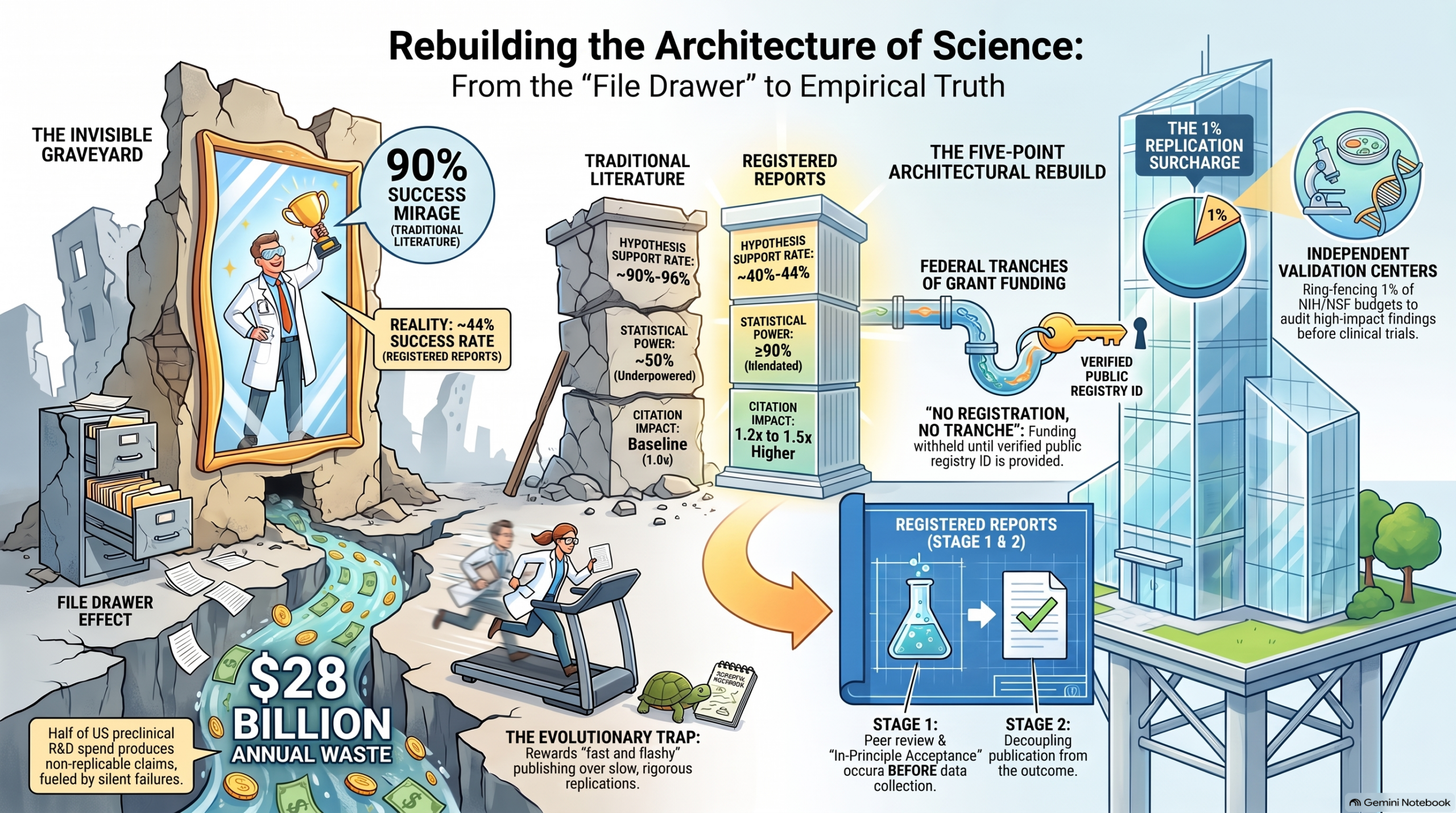
Rebuilding the Architecture of Science: A Study Guide on Scientific Integrity and Structural Reform
This study guide provides a comprehensive overview of the systemic challenges facing modern empirical science—specifically the “file drawer effect”—and the proposed structural solutions to restore scientific verification. It synthesizes data regarding the economic, mathematical, and ethical consequences of current publishing and funding models.
Part 1: Short-Answer Quiz
Instructions: Answer the following questions in 2–3 sentences based on the provided source context.
- What is the “file drawer effect” and why is it considered an institutional market failure?
- How does the “Registered Reports” (RR) workflow differ from traditional peer review?
- Explain the “No Registration, No Tranche” policy proposed for federal grant disbursement.
- What role does PubPeer play in the post-publication peer review (PPPR) landscape?
- Define “p-hacking” and explain how the p=0.05 threshold creates a “mathematical discontinuity” in literature.
- What are the “FAIR Principles,” and how do they relate to the proposed “Data-Code-Narrative Unit”?
- Describe the “Mad-Libs” architecture used by commercial paper mills to fabricate research.
- What is the “r-index” and how does it aim to realign academic incentives?
- Summarize the “Nelson Memo” and its implications for federally funded research data.
- According to the Freedman et al. (2015) model, what is the estimated annual economic cost of irreproducible preclinical research in the US?
Part 2: Quiz Answer Key
- What is the “file drawer effect” and why is it considered an institutional market failure? The file drawer effect is the systematic suppression of null findings and failed replications because journals and funding agencies prioritize positive, novel results. It is an institutional market failure because it breaks the empirical feedback loop, leading to the “invisible graveyard” where redundant experiments are repeated at great expense because previous failures were never made public.
- How does the “Registered Reports” (RR) workflow differ from traditional peer review? Unlike traditional review which evaluates a study after results are known, Registered Reports split review into two stages: Stage 1 evaluates the protocol and hypothesis before data collection, granting “In-Principle Acceptance” (IPA). Stage 2 is a post-study audit that guarantees publication regardless of the outcome, provided the authors adhered to the registered protocol.
- Explain the “No Registration, No Tranche” policy proposed for federal grant disbursement. This policy would make the second or subsequent years of grant funding (tranches) conditional upon the researcher providing a verified URL linking to the public registration of all proposed animal protocols. It aims to force high compliance with preclinical registries, preventing researchers from post-hoc endpoint swapping or concealing failed experimental arms.
- What role does PubPeer play in the post-publication peer review (PPPR) landscape? PubPeer acts as a centralized, crowdsourced clearinghouse where whistleblowers can anonymously comment on published papers via Digital Object Identifiers (DOIs). Its browser extensions integrate directly into researcher workflows, alerting them to suspected image duplications or data concerns before they attempt to build upon a potentially flawed study.
- Define “p-hacking” and explain how the p=0.05 threshold creates a “mathematical discontinuity” in literature. P-hacking involves exploiting analytical flexibility—such as dropping outliers or adding covariates—to force a test statistic over the p < 0.05 (or z \ge 1.96) threshold. This creates a “p-hacking cliff” where studies just below the threshold face desk rejection, leading to a literature filled with inflated effect sizes and stochastic noise rather than true biological parameters.
- What are the “FAIR Principles,” and how do they relate to the proposed “Data-Code-Narrative Unit”? FAIR stands for Findable, Accessible, Interoperable, and Reusable data standards. The “Data-Code-Narrative Unit” expands the definition of a “published paper” from a simple narrative PDF to an integrated package that includes raw machine-readable data, uncropped original imagery, and timestamped scripts to ensure full transparency.
- Describe the “Mad-Libs” architecture used by commercial paper mills to fabricate research. Paper mills use modular manuscript skeletons where they swap out four categorical variables: a target molecule, a biological phenotype, a disease model, and a signaling pathway. This allows automated scripts to generate hundreds of unique-looking but biologically generic manuscripts using shared, manipulated data templates and recycled images.
- What is the “r-index” and how does it aim to realign academic incentives? The r-index is a proposed metric for tenure and promotion that replaces raw publication counts with an evaluation of a researcher’s empirical reliability. It rewards investigators for the proportion of their claims that successfully replicate and for their own contributions to rigorous, registered replications of others’ work.
- Summarize the “Nelson Memo” and its implications for federally funded research data. Released by the White House OSTP, the Nelson Memo mandates that all federally funded research data and peer-reviewed manuscripts must be made freely available in public, machine-readable repositories immediately upon publication. Effective by 2025/2026, it eliminates the traditional one-year embargo period and requires data archiving as a condition of federal support.
- According to the Freedman et al. (2015) model, what is the estimated annual economic cost of irreproducible preclinical research in the US? The model estimates that 50% of annual preclinical research expenditures, totaling approximately 28 billion, is spent on irreproducible claims. A significant portion of this waste (7 billion) is attributed to “secondary redundant waste,” where multiple laboratories repeat the same unviable experiments because the original failures were hidden.
Part 3: Essay Questions
Instructions: These questions are designed for in-depth analysis and do not include provided answers.
- The Prisoner’s Dilemma of Replication: Analyze the game-theoretic payoff matrix for an academic laboratory choosing between publishing a negative replication and pivoting to a novel hypothesis. How does the current “Novelty Premium” ensure a Nash Equilibrium where null data is buried?
- The Bioethics of the “Invisible Graveyard”: Discuss how the suppression of negative results directly violates the “Three Rs” (Replacement, Refinement, Reduction) of animal research. What are the ethical implications for human clinical trials built on “preclinical artifacts”?
- Academic Feudalism and Gatekeeping: Evaluate the ways in which entrenched “incumbents” can weaponize the anonymous peer-review system to suppress disconfirming science. Use the case studies of the “Amyloid Cabal” or the cardiac stem cell empire to support your argument.
- Forensic Technology vs. Industrial Fraud: Compare the effectiveness of traditional human peer review against modern AI-driven forensic tools (such as Imagetwin, Proofig, and Seek & Blastn) in detecting paper-mill activities and image manipulation.
- The 1% Replication Requirement: Argue for or against the proposal to legally mandate a 1% “Replication Surcharge” on federal research budgets. What are the potential translational savings and structural challenges of establishing a National Office of Experimental Verification?
Part 4: Glossary of Key Terms
Term Definition
APC (Article Processing Charge) Fees paid by authors or institutions to publishers to make an article Open Access; often cited as a revenue driver for paper mills.
Cryptographic ELNs Electronic Lab Notebooks that utilize append-only, cryptographic timestamping to ensure research logs are immutable and cannot be retroactively edited.
Experimenter’s Regress A rhetorical defense used by original authors to claim that a failed replication is due to the replicating lab’s lack of “tacit knowledge” or technical skill.
FAIR Principles A set of data management standards ensuring that research data is Findable, Accessible, Interoperable, and Reusable.
HARKing “Hypothesizing After the Results are Known”; the practice of presenting a post-hoc discovery as if it were the original hypothesis.
In-Principle Acceptance (IPA) A virtually irrevocable guarantee from a journal to publish a study regardless of its outcome, granted after the Stage 1 protocol review of a Registered Report.
Ioannidis Transformation A mathematical model demonstrating that when bias is high and pre-study odds are low, most published research findings are likely false.
Nelson Memo A 2022 White House OSTP directive requiring immediate public access to all federally funded research and its underlying data by 2025/2026.
Paper Mill A commercial syndicate that manufactures and sells authorship slots on fabricated scientific manuscripts to meet academic “publish-or-perish” requirements.
PCI RR “Peer Community In Registered Reports”; a non-profit platform that decouples the peer-review process from specific journals to prevent “journal lock-in.”
Positive Predictive Value (PPV) The post-study probability that a statistically significant finding reflects a true relationship in the physical world.
Registered Reports A publishing format that bifurcates peer review into a pre-data protocol stage and a post-data audit stage to eliminate publication bias.
r-index (Replication Index) A proposed alternative to the h-index that measures an investigator’s career standing based on the replicability of their claims and their confirmatory rigor.
Zombie Literature Discredited or retracted research papers that continue to be cited as valid science years after their formal removal from the scientific record.