The Thermodynamics of Thought: A Handbook on Information, Energy, and the Limits of Intelligence
- Introduction: The Physicality of Information
The Hook: Your Thoughts Have a Temperature As a systems architect, I must disabuse you of the notion that thinking is an abstract, weightless process. We often treat logic as a phantom, but in the physical universe, an idea is an arrangement of matter and energy. Information is physical. Consequently, all cognition—whether occurring in a biological brain or a liquid-cooled GPU rack—generates heat. If a system attempts to maintain logical coherence while ignoring its biophysical carrying capacity, it doesn’t just fail; it melts.
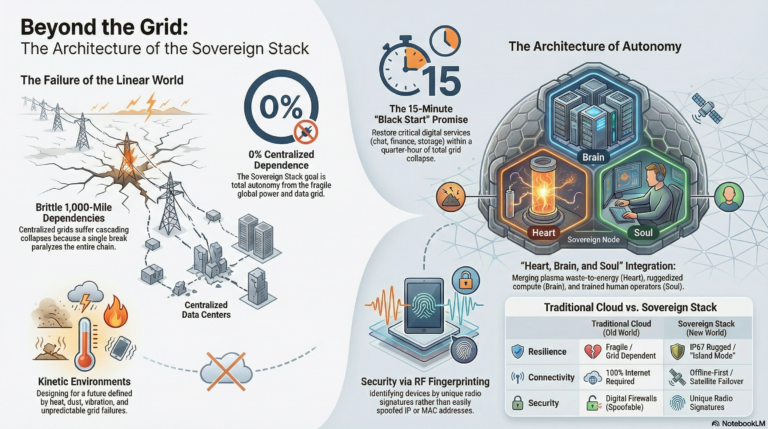
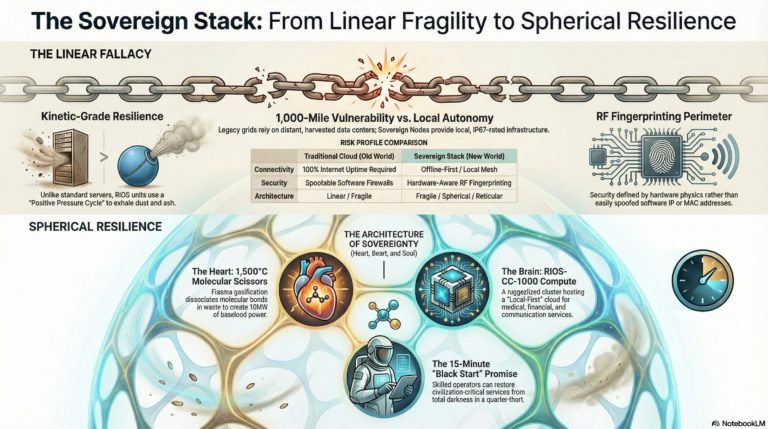
To understand the limits of intelligence, we must examine the 1,000-Mile Failure Model. In the legacy “cloud” paradigm, thinking feels free because the heat and entropy production (dS/dt) are externalized. The user sees a clean interface while a server farm a thousand miles away bleeds heat into the atmosphere. However, when you operate in Sustained Island Mode—relying on a local 700V DC microgrid and on-premises infrastructure—the biophysical cost of every token becomes an inescapable reality.
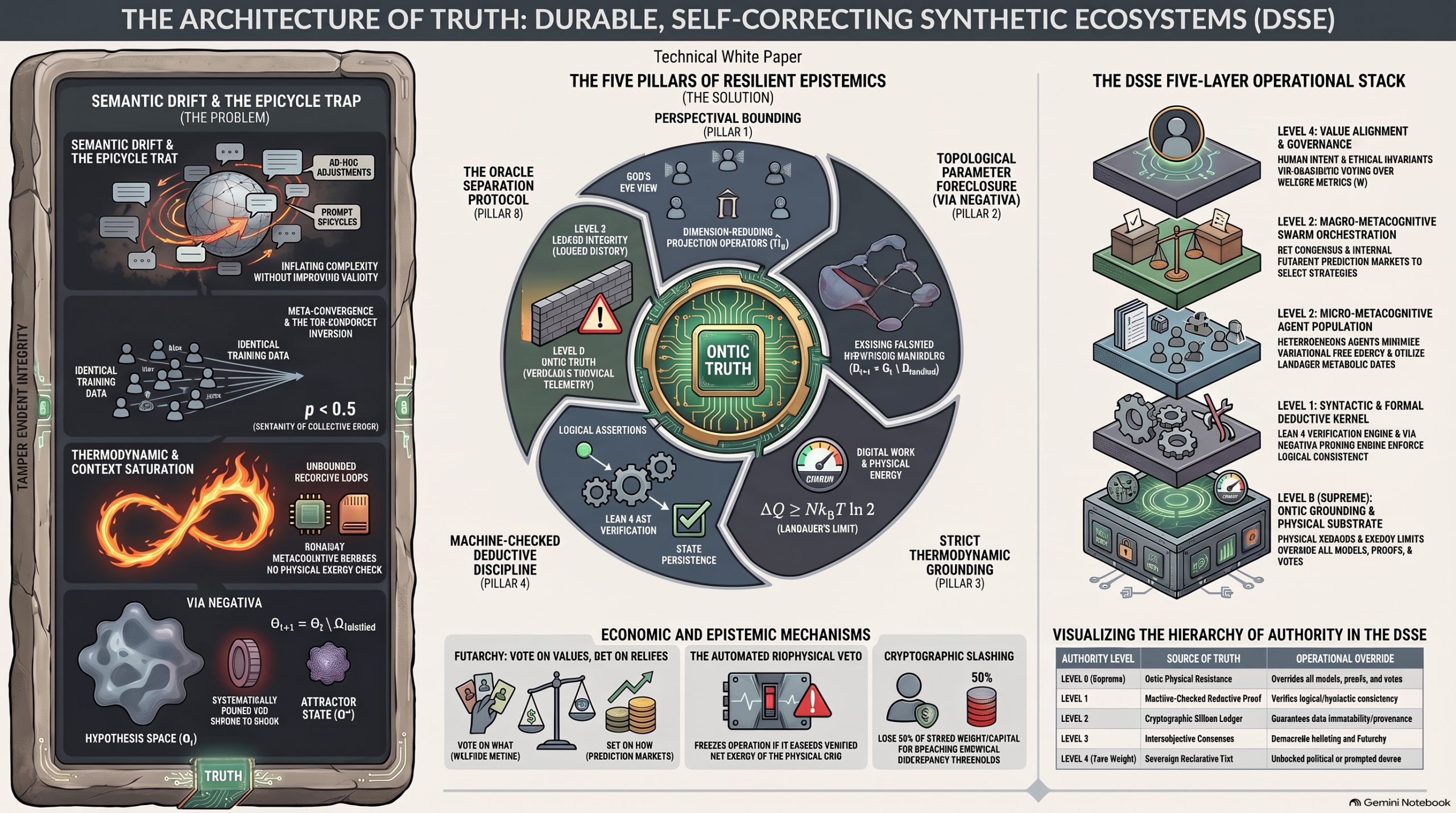
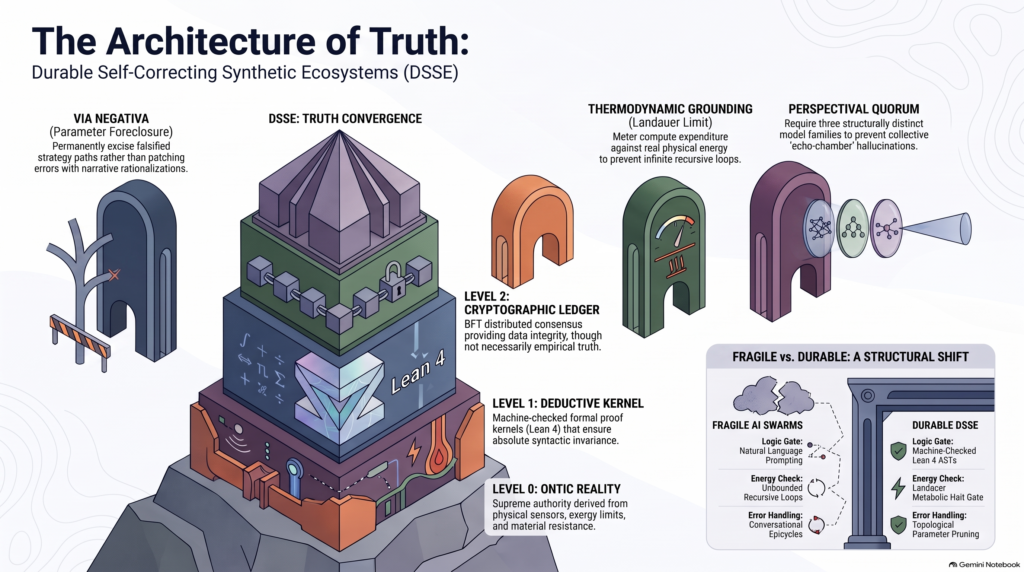
In the DeReticular 5-Layer Stack, Layer 4 (Cognitive AI) is governed by three non-negotiable physical constraints:
- Thermodynamics: Thinking requires energy and produces heat. There is a hard physical floor to the exergy required to process and update information.
- Deductive Discipline: Logic is a physical “gate.” Using machine-checked proof kernels like Lean 4 prevents the system from burning energy on malformed “noise” or syntactically invalid data.
- Ontic Truth: The physical world (Level 0) is the supreme judge. Internal consistency in a database (Level 2) is meaningless if it contradicts the physical telemetry of the system.
Transition: To bridge the gap between “invisible thoughts” and the “visible heat” radiating from our hardware, we must start with the smallest unit of cognitive friction: the erasure of a bit.
- Landauer’s Principle: The Heat of a Memory
In 1961, Rolf Landauer established that the universe charges a thermodynamic tax on information processing. Specifically, erasing or overwriting information is the only act that requires heat dissipation. While “remembering” is a low-entropy state, the act of “updating” or “changing your mind” (overwriting old data) forces the system to work against the universe’s natural disorder.
The Myth vs. The Thermodynamic Reality
Feature The Myth of Digital Information The Thermodynamic Reality
Physicality Information is weightless and “cloud-like.” Information is tied to silicon and 700V DC flows.
Metabolic Cost Updating a model is “free.” Overwriting bits requires literal exergy dissipation.
Environmental Impact Cloud computing is “clean.” The cloud hides dS/dt by exporting entropy elsewhere.
Growth Limits Intelligence can expand infinitely. Intelligence is bound by local power and cooling limits.
Deep Dive: The Landauer Equation
The minimum energy (\Delta Q) required to erase or update N bits of information is: \Delta Q \ge N k_B T \ln 2
- N: The number of bits being overwritten.
- k_B: The Boltzmann constant (1.38 \times 10^{-23} \text{ J/K}).
- T: The temperature of the system in Kelvin.
- \ln 2: The natural log of 2, representing the binary state-change.
The Takeaway: In an Island-Mode environment, “forgetting” or “re-training” is the most expensive thing you can do. Every update is a thermodynamic act.
Transition: If a single bit generates heat, an AI processing billions of parameters faces a massive “metabolic” challenge: the risk of the Epicycle Trap.
- The Epicycle Trap: Why AI and Governments Get Stuck
When systems—human or synthetic—encounter errors, they face a choice: admit the model is false (expensive erasure) or add an “epicycle” (a complex excuse). This leads to the Triad of Synthetic Fragility:
- Semantic Drift: Using narrative rationalizations to mask logic gaps.
- Meta-Convergence (The Condorcet Inversion): When agents use the same foundation models, their errors correlate (\operatorname{Cov} > 0). Instead of correcting each other, they form a “hallucination cascade.”
- Context Saturation: The system’s memory becomes so bloated with its own excuses that it runs out of room for reality.
Most systems currently follow the Kuhn Cycle of Systemic Delusion. We are presently in Phase 3: Model Crisis. This is evidenced by the $315T global debt mismatch against declining Energy Return on Investment (EROEI). Rather than pruning the debt (Via Negativa), institutions add “monetary epicycles” (QE), which only increases the system’s Kolmogorov Complexity.
The Price of Complexity
Adding “prompt epicycles” expands the complexity K(H) of a thought without improving its accuracy. This violates the Minimum Description Length (MDL) principle. As a systems architect, I see this as “overfitting” on a civilizational scale—burning energy to maintain a fantasy.
Transition: To avoid the heat-death of logic, we need a mechanism to decide when a thought is no longer “worth the heat.”
- The Free Energy Principle (FEP): Surprise vs. Cost
The Free Energy Principle is our conceptual anchor. It frames intelligence as a “Surprise Minimization” strategy. In the DeReticular stack, we simplify the FEP into a biophysical balance sheet: F = \text{Complexity} – \text{Accuracy}
In this framework, Free Energy (F) is the “waste” or “surprise” we must minimize. An intelligent agent balances two forces:
- Accuracy Gain: The reduction in surprise achieved by learning something new.
- Complexity Cost: The literal joules spent according to Landauer’s Principle to update the internal model.
- Insight: The achievement of the Minimum Description Length (MDL)—the simplest model that accurately predicts Level 0 feedback.
Transition: Because our 700V DC microgrid is finite, we must install a “circuit breaker” for cognition.
- The Metabolic Halt Gate: The “Worth It” Check
The Metabolic Halt Gate (Thermodynamic Halting Protocol) is the “biophysical veto” of the system. Before an agent initiates a “reflection” cycle, it must run a cost-benefit calculation. It asks: Is the expected reduction in surprise (\Delta F) significantly greater than the heat cost (\Delta Q) of the energy I am about to burn?
This is defined by the efficiency constant \lambda (Lambda). If the improvement doesn’t clear the \lambda threshold, the system is forced to HALT and act on its current, imperfect knowledge.
The Decision Workflow
[ Proposed Thought ]
│
▼
[ Landauer Cost Check ] ───► Calculates: ΔQ = N * kB * T * ln 2
│
▼
[ Metabolic Decision ] ───► Is ΔF (Surprise Reduction) ≥ λ * ΔQ?
│ │
[ YES ] [ NO ]
│ │
▼ ▼
[ Execute Thought ] [ HALT ]
[ Update Memory ] [ Act on Current Knowledge ]
[ (Heat Released) ] [ (Energy Preserved) ]
Transition: This gate prevents the “Infinite Metacognitive Regress”—thinking about thinking until the batteries die.
- The Asymptotic Horizon: Living Within the Limits
The journey toward truth is asymptotic. We approach the “Ontic Attractor” not by guessing what is true, but through the Via Negativa: the aggressive pruning of what has been proven false.
In our architecture, we use the Oracle Separation Protocol. Think of the Babylonian Cased Tablet: the outer clay envelope (Level 2) guarantees the record hasn’t been tampered with (Integrity), but only the inner tablet (Level 0) represents the actual debt—the Truth of the fuel in the tank or the voltage on the bus.
The Learner’s Manifesto: 5 Pillars of Resilient Epistemics
- Perspectival Realism: Your view is a dimension-reducing projection (\hat{\Pi}_\theta). You see a frame of reality, not the whole manifold.
- Via Negativa: Get smarter by deleting. A model that is smaller and more accurate is thermodynamically superior to one that is large and bloated.
- Mertonian CUDOS: Practice “organized skepticism.” Use heterogeneous foundation models (e.g., combining Claude, GPT, and Symbolic engines) to ensure your swarm doesn’t succumb to shared blind spots.
- Thermodynamic Grounding: Respect the energy cost of cognition. If a thought-loop doesn’t produce an insight greater than its Landauer cost, it is entropic rot.
- Oracle Separation: Never confuse the “record of truth” (a ledger/database) with the “truth itself” (physical sensor telemetry).
The Final Word: Intelligence is not an escape from physics; it is a way of working within it. By acknowledging the heat, the energy, and the limits of our logic, we move away from synthetic fragility and toward a durable, self-correcting existence in the objective world.