The Sovereign Infrastructure Primer: From Fragile Lines to Spherical Resilience
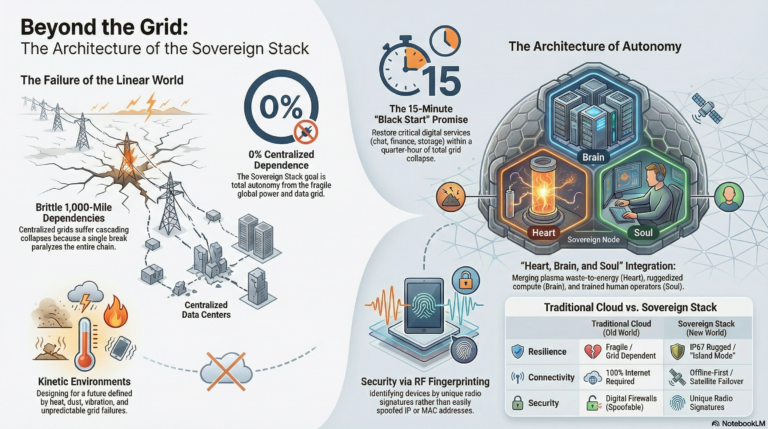
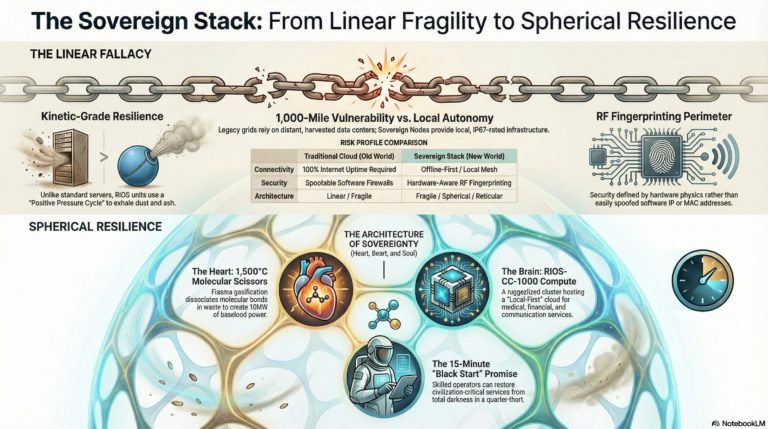
Welcome to the front lines of the Great Infrastructure Shift. At DeReticular Academy, we recognize that the centralized systems governing the modern world—from power grids to hyperscale clouds—are not just inefficient; they are fundamentally broken. We characterize this decaying architecture as the “1,000-Mile Failure Model.” It is a fragile, linear dependency where a single point of failure along “The Line” results in catastrophic terminal collapse.
To survive the coming era of kinetic interdiction and systemic instability, the architect must transition from “The Line” to “Spherical Resilience.” This is the construction of an omnidirectional, self-contained enclave of power and intelligence that operates entirely behind-the-meter and outside the reach of centralized failure.
- The Great Infrastructure Shift: “The Line” vs. “The Sphere”
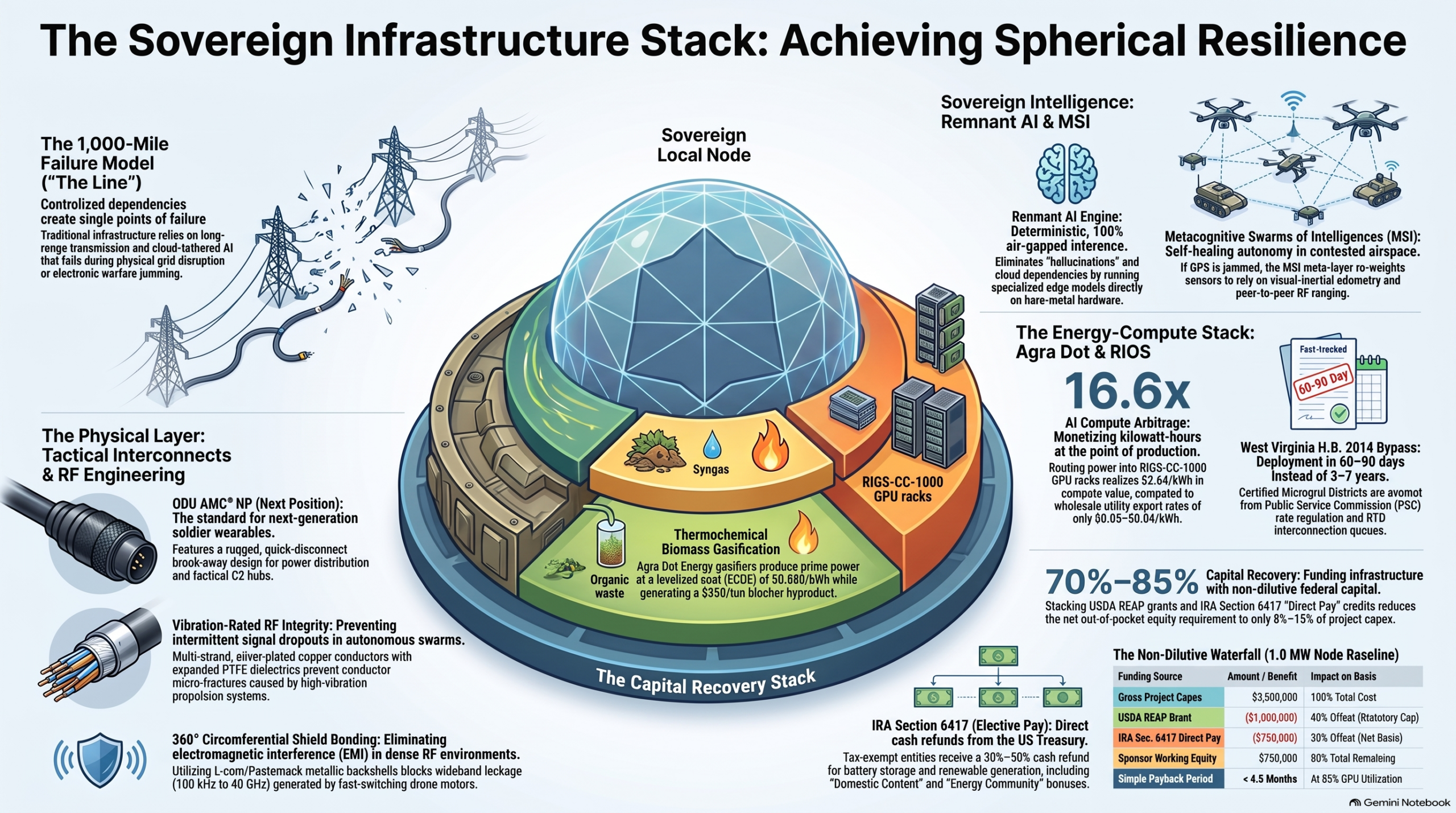
The core vulnerability of modern civilization is its tethering to distant, fragile hubs. Whether it is a transmission line stretching across states or a fiber optic cable routing data to a coastal server farm, these lines represent an unacceptable risk. Spherical Resilience replaces this fragility with a deterministic, air-gapped node capable of generating its own resources and making its own decisions. This shift is a necessity driven by the “Permitting Wall”—the 3-to-7-year bureaucratic delay inherent in traditional grid interconnections—which a sovereign sphere simply bypasses.
The Architecture of Vulnerability vs. The Architecture of Sovereignty
Feature The Line (Linear Dependencies) Spherical Resilience (Omnidirectional)
Connectivity Grid-tethered, centralized Air-gapped, deterministic
Power Flow High-voltage transmission lines Behind-the-meter local generation
Data Logic Probabilistic thin-client (Cloud AI) Native, deterministic (Remnant AI)
Resilience Fragile; single point of failure Robust; spherical/island-mode
Efficiency AC-DC-AC conversion losses Native 700V DC busbar (97.7% efficient)
Transition: The move away from these failing lines begins with the fundamental requirement of any enclave: the ability to generate captive baseload power at the point of consumption.
- Powering the Enclave: The Agra Dot Energy Stack
A sovereign node is defined by its energy independence. We utilize the Agra Dot Energy Stack to achieve a closed-loop generation cycle that operates independent of the public utility. This is not intermittent “green” energy; it is high-BTU prime power designed for steady-state workloads.
The Three-Stage Energy Conversion Process
- Thermochemical Gasification: We convert organic forestry slash, timber waste, or agricultural effluent into high-BTU synthesis gas (Syngas) (CO + H_2). This process creates a secondary revenue stream by producing high-grade agricultural biochar, valued at approximately $350/ton, which serves as a vital carbon sink.
- Solar Augmentation: To eliminate daytime parasitic fuel consumption, we deploy DOE 80x concentrating parabolic troughs. These mirrors focus solar thermal energy to produce 350^\circ C industrial process steam, which is injected directly into the gasifier to maximize syngas yield.
- The Result: The stack delivers prime baseload power at a Levelized Cost of Energy (LCOE) of $0.038/kWh. This allows the enclave to operate with an 84.8% captive load ratio, effectively insulating the node from external market volatility.
Transition: Raw thermochemical energy is useless to a GPU; it must be rectified through a specialized rotary core into a Native 700V DC format to fuel the enclave’s compute requirements.
- The Native 700V DC Busbar: Efficiency by Design
At the heart of the microgrid lies the Pawnee Rotary GenSet and the Native 700V DC Busbar. By moving to a Native DC Topology, we eliminate the traditional AC-DC-AC conversion stages that plague legacy grids, removing the “Inverter Wall” and its associated thermal waste.
- 97.7% Efficiency: By utilizing direct DC rectification from the 45 kW Wankel rotary engines, which run on unrefined syngas without the need for catalytic scrubbers, we achieve near-perfect power-chain efficiency.
- Sub-16ms Islanding: The sovereign node possesses the “magical” capacity for sub-cycle islanding. It can disconnect from a failing external grid in less than 16 milliseconds, ensuring that high-density compute remains operational during a total grid collapse.
- 84.8% Captive Load: High-density liquid-cooled GPU clusters act as the primary “load sink.” By consuming the vast majority of power on-site, the node bypasses Public Service Commission (PSC) rate regulations and utility franchise exclusivity.
Transition: This efficient electrical heartbeat provides the lifeblood for “Sovereign Intelligence”—a cognitive layer that must remain functional even when the world’s networks are darkened.
- Sovereign Intelligence: Air-Gapped and Deterministic
A sovereign system cannot rely on a “probabilistic thin-client” tethered to the cloud. In a contested environment, the internet is not a resource; it is a vector for failure and exfiltration. We utilize the Remnant AI Engine, a 100% air-gapped intelligence layer.
Why the Cloud Fails in the Field
- Electromagnetic Jamming: RF desensitization and jamming render cloud-tethered systems inert.
- Latency Bottlenecks: Round-trip communications to distant servers are incompatible with real-time robotic kinematics.
- Probabilistic Hallucinations: Traditional Large Language Models make “guesses” that are unacceptable for safety-critical missions.
The MSI Framework: Metacognitive Swarms of Intelligences
The Metacognitive Swarms of Intelligences (MSI) framework moves beyond basic automation into true edge autonomy.
- Object-Level: Individual agents (UAVs/UGVs) execute deterministic tasks using bare-metal hardware.
- Meta-Level: This is a Self-Reflective Supervisory Layer that performs Epistemic Uncertainty Estimation. If an agent’s GPS feed is compromised by electronic warfare, the Meta-Level detects the anomaly, re-weights sensor confidence, and shifts the swarm to navigate via Visual-Inertial Odometry (VIO) and peer-to-peer RF ranging.
Transition: This intelligent software must be anchored in a physical fabric rugged enough to survive the harsh mechanical realities of the field.
- The Physical Fabric: Tactical Interconnects & RF Integrity
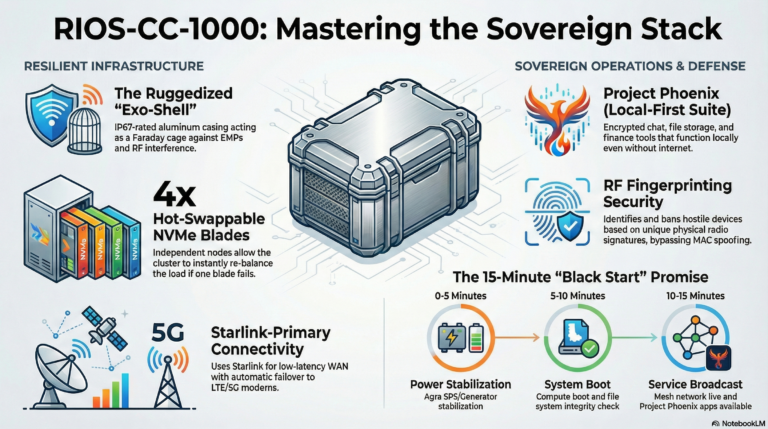
“The Line” frequently breaks at the connector level due to vibration fatigue and environmental ingress. Sovereign hardware requires the ODU AMC® series to ensure that the physical layer remains as resilient as the software logic.
ODU AMC® Connector Architectural Specifications
Series Primary Application Mating Durability Shell Material / Plating
Series T Heavy Vehicles / Ground Stations > 500 cycles Aluminum / Tin-Nickel
High-Density Multi-protocol Splitters (NASA pedigree) > 5,000 cycles Brass / Ruthenium
NP (Next Position) Wearables / Quick Break-away > 2,000 cycles Aluminum / Black Carbon
Critical Factors for RF Integrity
In autonomous systems, maintaining the signal-to-noise ratio is a matter of survival. We enforce three non-negotiable standards:
- 360° Shielding: Solid metallic backshells provide circumferential bonding to block wideband EMI leakage (100 kHz to 40 GHz).
- Vibration-Rated 50Ω Coax: Silver-plated conductors and PTFE dielectrics prevent propulsion-induced micro-fractures.
- VSWR Optimization: We maintain a Voltage Standing Wave Ratio below 1.2:1 to prevent transmitter power rollback and receiver desensitization.
Transition: These rugged components are the physical building blocks of enclaves currently being deployed across the globe.
- Real-World Enclaves: Case Studies in Sovereignty
- The Silicon Hollow (West Virginia): Utilizing W. Va. Code §5B-2-21, we build off-grid GPU clusters in former coal country, operating as Certified Microgrid Districts.
- Impact Statement: Bypasses the PJM interconnection queue, compressing 5-year timelines into 90-day deployments.
- Guam Sovereign Eradication: Pawnee robotics and Remnant AI protect critical C5ISR infrastructure from the Brown Tree Snake (Boiga irregularis), which causes millions in annual repairs through grid-shorting.
- Impact Statement: Replaces reactive administrative maintenance with proactive, air-gapped robotic interdiction.
- Project Octagon: These transportable, hardened skids house a gasifier, liquid-cooled compute, and a Sovereign Factory for additive manufacturing.
- Impact Statement: Enables autonomous, point-of-need fabrication and compute in any austere theater on Earth.
Transition: These enclaves are made economically viable through a sophisticated, non-dilutive “Capital Stack.”
- The Economic Engine: The Non-Dilutive Capital Stack
The engine of this growth is the AI Compute Arbitrage model. By converting $0.038/kWh syngas energy into GPU compute worth $2.64/kWh, we create a 16.6x value multiple.
The Non-Dilutive Recovery Waterfall
We stack federal incentives to minimize parent equity, but we must account for the Timing Deficit—the reality that grants are retrospective. We utilize a Bridge Facility to fund initial procurement, which is then extinguished by the waterfall:
- USDA REAP: A 50% capital grant for rural renewable installations (capped at $1M).
- IRA Section 6417: Provides up to 50% “Direct Pay” cash refunds from the IRS (Base + Energy Community + Domestic Content bonuses).
- The Bottom Line: By layering these instruments, a $2.5M project can be realized with only 8-10% net parent equity, allowing architects to retain 100% ownership while the federal government funds the resilience.
Transition: You have journeyed from the fragile linear dependencies of the old world to the sovereign independence of the new.
- Summary: Your Path to Sovereignty
The shift from the “1,000-Mile Failure Model” to “Spherical Resilience” is the only logical path for the modern architect. Independence is not a luxury; it is the prerequisite for continuity.
Key Insight Checklist
- Energy Independence: Native 700V DC power generation using biomass and solar thermal to bypass the “Permitting Wall.”
- Air-Gapped Intelligence: Deterministic, on-chip AI with Metacognitive self-healing to survive electronic warfare and cloud failure.
- Rugged Physical Integrity: 360° shielding and tactical interconnects designed for 5,000+ cycles in high-vibration environments.
The era of the fragile line is over. The era of the resilient sphere has begun. You have the blueprints; now you must build.
Spherical Resilience is the only path forward.