SOVEREIGN INFRASTRUCTURE CONSORTIUM & SIEA MASTER SINGLE SOURCE OF TRUTH: BRIEFING DOCUMENT
Executive Summary
The Sovereign Infrastructure Consortium and the Sovereign Infrastructure Education Alliance (SIEA) represent an integrated ecosystem designed to transition critical utility and computing functions away from legacy centralized grids. This “Sovereign Stack” philosophy prioritizes hardened, localized, and off-grid infrastructure. Operating under a master architecture established in September 2026, the consortium utilizes a “Hub-and-Spoke” model across eight distinct web properties, ensuring a clear division between educational doctrine, commercial operations, and technical validation.
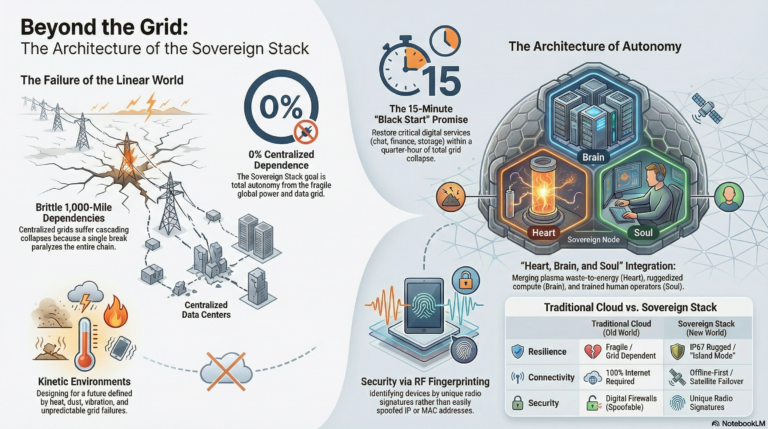
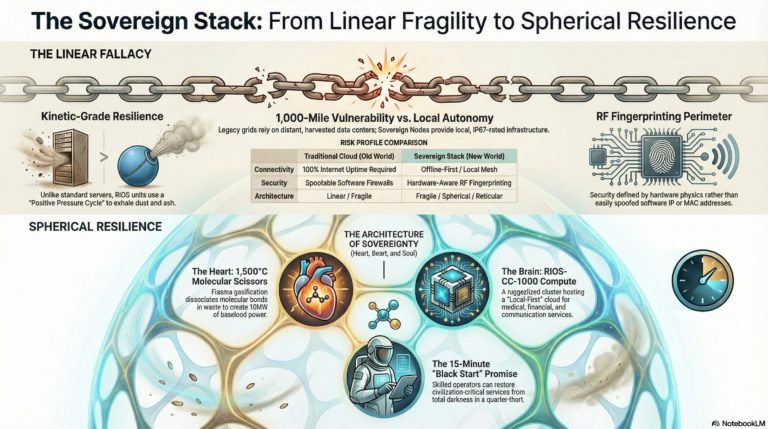
The core objective is “Spherical Resilience”—the ability of a system to withstand macro-grid failures and regulatory pressures through autonomous energy production and captive compute operations. This briefing document details the governing doctrine, technical architecture, and operational standards required to maintain this sovereign network.
- Executive Doctrine and Theoretical Framework
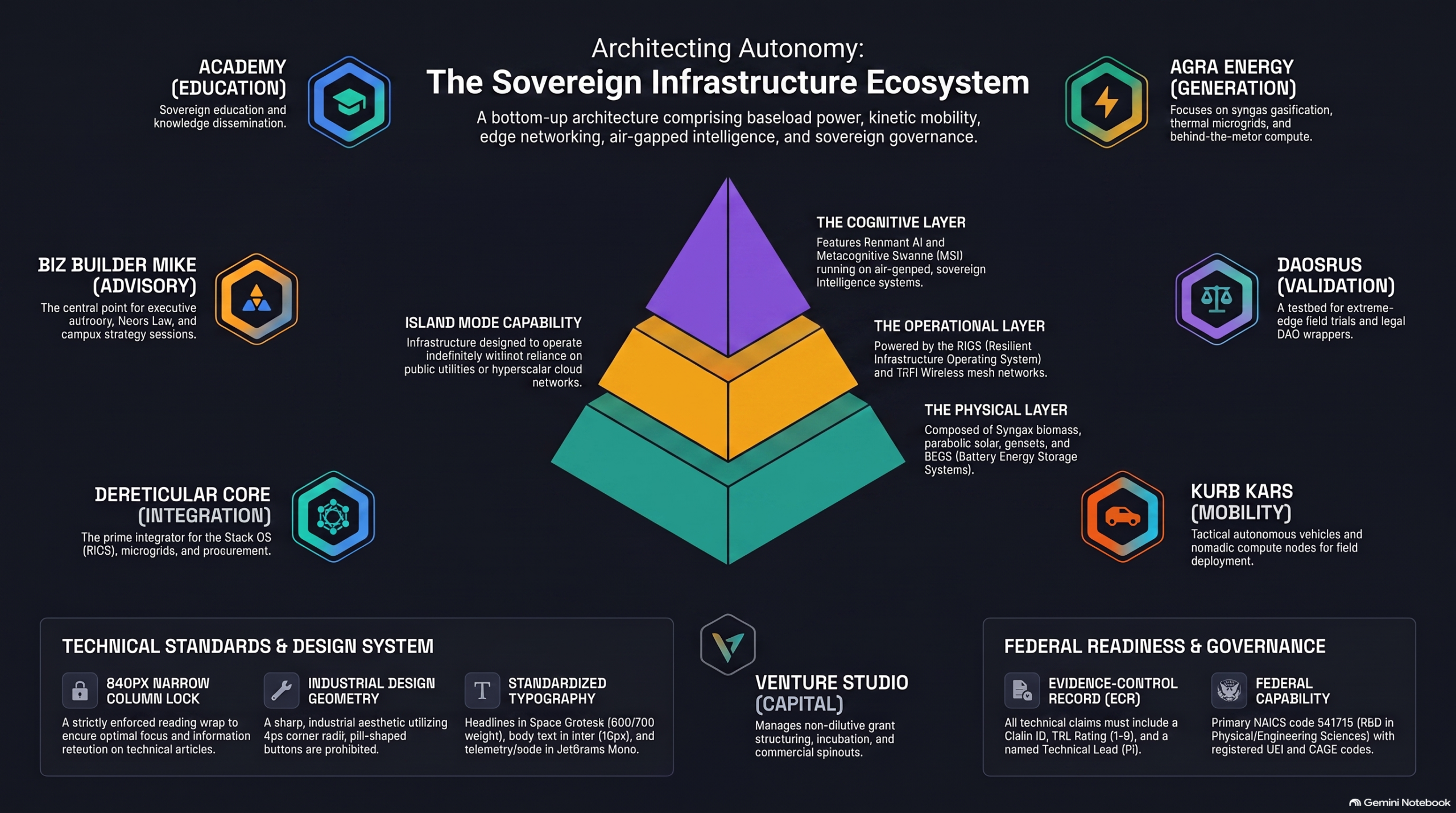
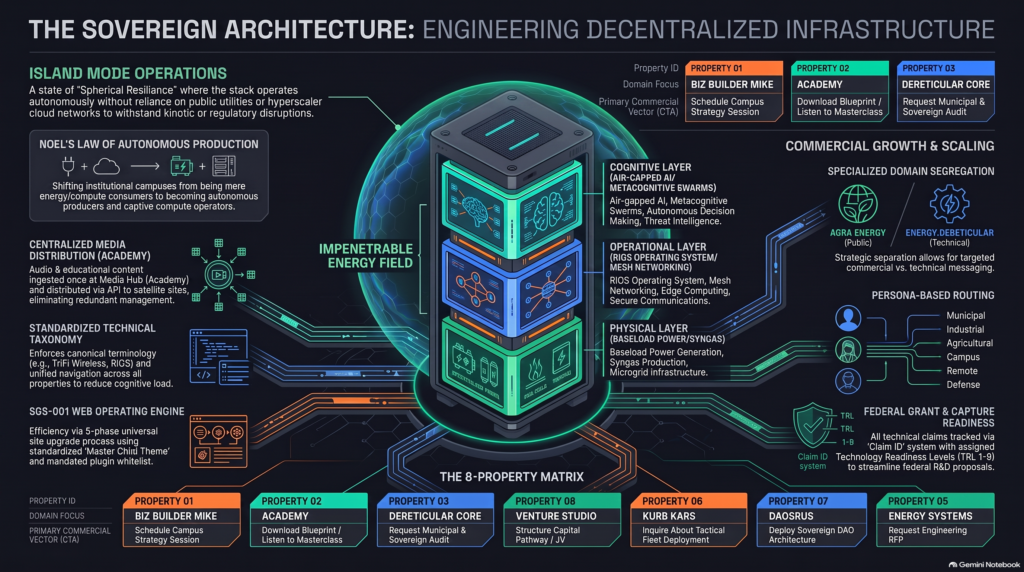
The operating doctrine is built upon the “Sovereign Stack,” a hierarchical model for infrastructure designed for “Island Mode” operation (independent of public utilities or hyperscale clouds).
The Sovereign Stack Hierarchy
- Cognitive Layer: Remnant AI, Metacognitive Swarms (MSI), and Air-Gapped Sovereign Intelligence.
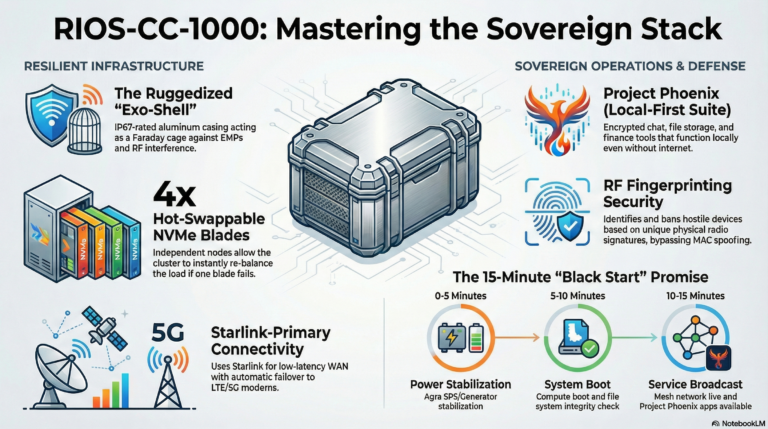
- Operational Layer: RIOS Operating System, Mesh/TriFi Wireless, and Point-of-Need/Point-of-Work Routing.
- Physical Layer: Syngas Biomass, Parabolic Solar, GenSets, BESS, Nomadic Mobility (Kurb Kars), and Testbeds (DAOS).
Core Axioms
- Spherical Resilience: Distributed architectures designed to resist kinetic disruption and regulatory choke-points.
- Noel’s Law (Campus Strategy): A mandate for municipalities and agricultural cooperatives to transition from consumers to autonomous energy producers and compute operators.
- The Sovereign Stack Requirement: Infrastructure must be built from the physical layer up to be truly sovereign.
- Consortium Topology and Property Matrix
The consortium operates eight web properties under a strict Hub-and-Spoke Separation Model. This prevents the overlap of doctrine, media, engineering, and commercial transactions.
ID Domain Ecosystem Function Primary Conversion Vector (CTA)
01 Biz Builder Mike Executive Advisory, Noel’s Law Schedule Campus Strategy Session
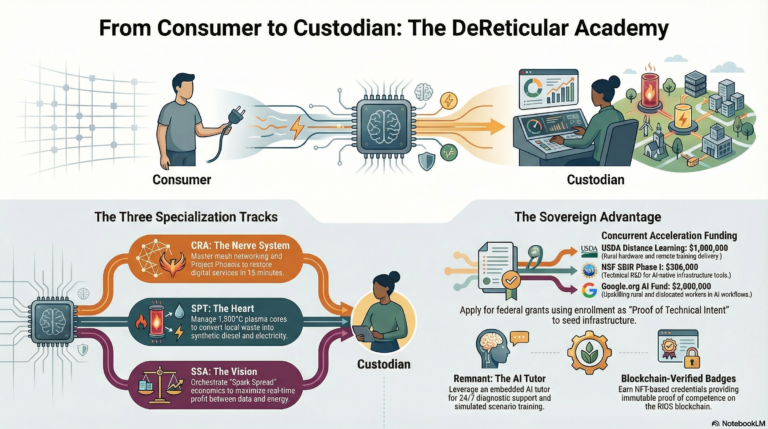
02 DeReticular Academy Multimedia Hub, Workforce Training Listen to Masterclass / Download Blueprint
03 DeReticular Core Prime Integrator, Stack OS Request Municipal & Sovereign Audit
04 Agra Energy Agri-Energy Baseload Narrative Request Microgrid Consultation
05 Energy Systems Technical Repository, SPS Specs Request Engineering RFP
06 Kurb Kars Nomadic Compute, Tactical Mobility Inquire About Tactical Fleet Deployment
07 DAOSRUS Field Trials, Legal Wrappers Deploy Sovereign DAO Architecture
08 Venture Studio Incubation, Non-Dilutive Grants Structure Capital Pathway / JV
- Global Information Architecture
To maintain brand cohesion and operational efficiency, all properties adhere to a standardized taxonomy and navigation structure.
3.1 Standard Navigation Map
All sites must feature a top-level menu including:
- Ecosystem: SIEA Overview and individual property links.
- Solutions: Categorized by sector (Municipal, Industrial, Agriculture, etc.).
- Technology: Covering Power, RIOS OS, Connectivity, and Mobility.
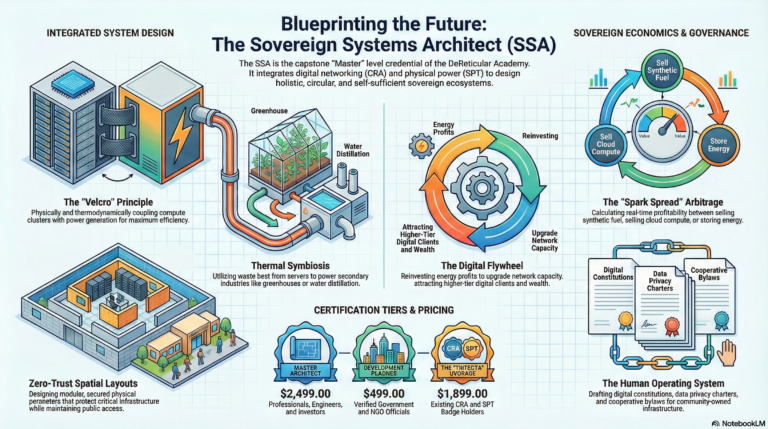
- Education: Training ladders, study guides, and lab practicums.
- Federal: Capability statements and SBIR Prime R&D information.
3.2 Canonical Terminology
- TriFi Wireless: Must be formatted exactly as such; legacy terms are deprecated.
- RIOS: Resilient Infrastructure Operating System.
- SIEA vs. DeReticular: SIEA is strictly the 501(c)(3) educational alliance; DeReticular represents the commercial operating entities.
- Domain Segregation: agra.energy is for public-facing narratives, while energy.dereticular.com is the locked engineering archive.
- Technical Architecture and Design System
The network is powered by a high-performance, secure “Web Operating Engine” (SOS-001).
4.1 Server and Core Stack
- Hosting: WP Engine Enterprise Edge.
- Security/CDN: Cloudflare Enterprise via WP Engine Global Edge Security (GES).
- Theme: WordPress with Kadence-child theme engine.
- Audio Engine: Centralized ingestion via academy.dereticular.com using Castos CDN and Presto Player, distributed to satellite sites.
4.2 Design System Geometry
- Maximum Canvas Width: 1280px.
- Reading Column: 840px (strictly enforced for readability).
- Corner Radius: 4px (industrial aesthetic; no pill-shaped buttons).
- Typography: Space Grotesk (Headings), Inter (Body), JetBrains Mono (Code/Telemetry).
4.3 Color Token Registry (Selected Examples)
Each site utilizes a specific :root palette to maintain identity while sharing a common codebase:
- Academy: Cobalt Intelligence (#3B82F6) and Hyper-Teal (#00E5A3).
- Agra Energy: Bio-Energy Emerald (#10B981) and Thermal Solar Amber (#F59E0B).
- Kurb Kars: Kinetic Orange (#EA580C) and Electric Cyan (#06B6D4).
- Federal Grant and Capture Readiness
The consortium maintains a “Capture Readiness Standard” to ensure compliance with DOE, DOD, NSF, and USDA solicitations. This requires the separation of marketing prose from technical evidence.
Evidence-Control Record Structure
Every technical assertion must be tracked via an Evidence-Control Record:
- Claim ID: Unique slug (e.g., CLM-AGRA-SYNGAS-004).
- Verification Method: Lab test reports or signed engineering stamps.
- TRL Rating: Technology Readiness Level (1–9).
- Operating Bounds: Explicit feedstock and environmental thresholds.
Mandatory Federal Assets
The network must host a SIEA Federal Capability Statement (listing UEI, CAGE, and NAICS 541715) and Principal Investigator (PI) Dossiers for technical leads.
- Standard Operating Procedures (SOPs)
SOP-MIG-01: Site Migration
A five-phase process:
- WP Engine Snapshot: Creating a baseline backup.
- SFTP Directory Clean: Purging legacy themes (Genesis) and blacklisted plugins (WooCommerce, GTranslate).
- Theme Deployment: Activating the Kadence-child theme with site-specific color tokens.
- Block Assembly: Building the homepage using Gutenberg code editor modes.
- Production Cutover: Purging all caches and verifying rendering in incognito.
SOP-PUB-01: Publishing Pre-Flight
- Exactly one H1 tag per post.
- Narrow column lock (840px).
- Mandatory Table of Contents (TOC) after the abstract.
- Embed companion audio from Castos CDN using the universal Presto Player block.
- Schema tagging (TechArticle JSON-LD) to attribute authorship to Michael Noel.
- 90-Day Execution Plan
The roadmap prioritizes establishing the canonical baseline before scaling to commercial routing and workforce training.
Timeline Operational Objectives
Days 1–15 Formalize SSOT and standardize global navigation.
Days 16–30 Assign Claim IDs and reconcile engineering data.
Days 31–45 Deploy Federal Capability Layer and Evidence Library.
Days 46–60 Publish Academy training ladder and certification pathways.
Days 61–75 Standardize CTA anchors and persona routing.
Days 76–90 Implement cross-domain tracking and quarterly claim reviews.
Priority Scorecard
- High Priority: Ecosystem Global Navigation and Federal Evidence Layer.
- Medium Priority: TRL Labeling, Academy Credentialing, and Agra/Energy consolidation.
- Ongoing: Shared analytics and content governance.