DeReticular Generation 5 Ecosystem: Sovereign Infrastructure and Agri-Energy Briefing
Executive Summary
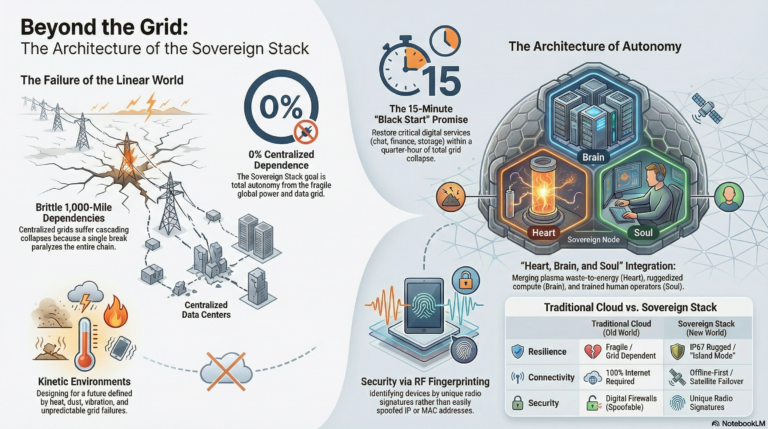
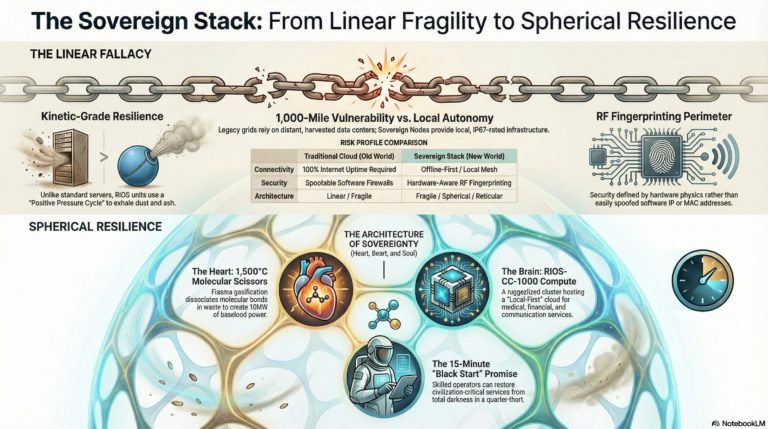
The DeReticular ecosystem, led by Principal Architect Michael Noel, is an integrated systems architecture designed to provide localized autonomy through the convergence of energy production, high-density compute, and resilient telecommunications. Operating under the core doctrine of “Local Autonomy. National Security. Total Sovereignty,” the Generation 5 (Gen 5) infrastructure aims to eliminate single points of failure and circumvent multi-year utility grid interconnection queues.
The ecosystem is structured into four functional layers:
- Upstream Prime Power: Waste-to-energy gasification and solar thermal integration (Agra Dot Energy).
- Physical Storage & Routing: Hardened microgrids and battery energy storage systems (Energy Systems).
- Sovereign Cognitive Core: Air-gapped AI and SCADA defense (DeReticular AI / RIOS).
- Tactical Networking & Mobility: Mesh networks, micro-ISPs, and nomadic vehicles (WISP-in-a-Box / Kurb Kars / TriFi Wireless).
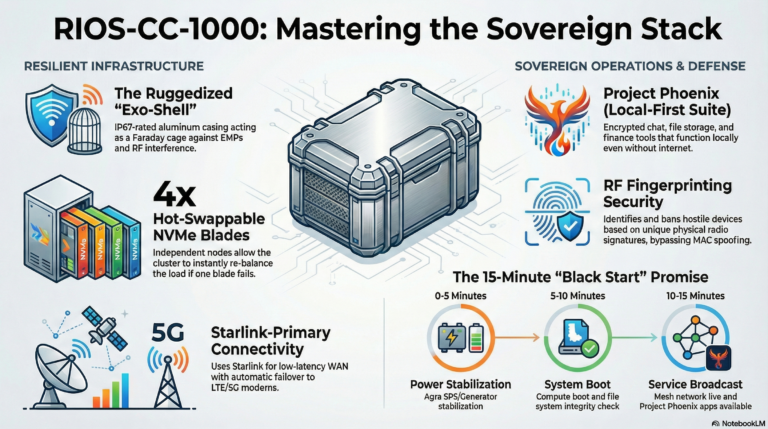
A critical component of the business model is the “Agri-Energy” doctrine, which posits that agriculture can both produce and consume energy. By pairing localized waste-to-energy systems with on-site AI compute (RIOS-CC-1000), operators can achieve a 16.6x economic arbitrage over grid feed-in tariffs while qualifying for regulatory exemptions that bypass utility interconnection delays.
- Architectural Framework: The 4-Layer Reference Model
The Gen 5 product ecosystem is a modular reference architecture designed to maintain operational continuity during grid disruptions or cloud failures.
The Four Layers of Infrastructure
Layer Lead Entity Primary Functions
01. Prime Power Agra Dot Energy / Pawnee Power Feedstock conversion, gasification, solar thermal, rotary generation.
02. Continuity Energy Systems BESS storage, sub-cycle transfer switching (STS), hardened enclosures.
03. Sovereign Core DeReticular / RIOS OS Air-gapped AI inference, SCADA segmentation, deterministic logic.
04. Field Edge WISP-in-a-Box / TriFi / Kurb Kars Starlink LEO backhaul, mesh networking, nomadic logistics.
Consortium Topology
The ecosystem is managed through eight coordinated web properties, each serving a specific strategic role:
- bizbuildermike.com: Principal advisory and JV formation.
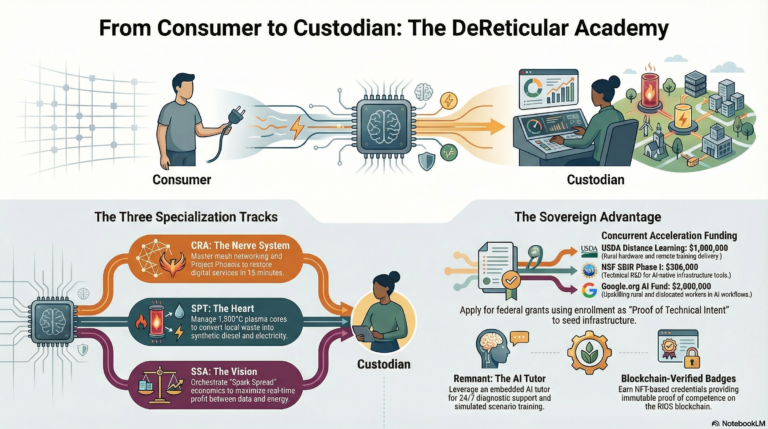
- academy.dereticular.com: Pedagogical hub and technical masterclasses.
- agra.energy: Physical prime power and gasification development.
- energy.dereticular.com: Hardware specifications for BESS and power systems.
- dereticular.com: Sovereign OS (RIOS) and cognitive platform.
- kurbkars.com: Autonomous mobility and tactical fleet deployment.
- daosrus.com: Decentralized governance and legal wrappers.
- venturestudio.dereticular.com: Non-dilutive capital and grant structuring.
- Upstream Energy: Agra Dot Energy and Pawnee Power
Agra Dot Energy serves as the generation engine of the consortium, converting agricultural and forestry waste into low-cost electricity and industrial heat.
Technology Stack
- Plasma Gasification: Converts dairy manure, effluent, and biomass into clean synthesis gas (Syngas: \text{CO} + \text{H}_2).
- DOE Parabolic Solar Thermal Array: Uses linear parabolic troughs to concentrate solar radiation 80x, delivering 350°C steam to preheat gasifiers. This allows for zero daytime fossil fuel consumption.
- Pawnee Rotary Generation Sets: Utilizes licensed Rotapower® and Wankel-type architectures. These engines have only three primary moving parts (rotor, eccentric shaft, and gearing), reducing mechanical complexity and maintenance.
- Direct DC Architecture: Systems rectify power directly to a 700V DC busbar at 97.7% efficiency, bypassing traditional AC-to-DC conversion losses.
Economic and Operational Benchmarks
- Levelized Prime Power Cost: Modeled at $0.038 / kWh.
- Microgrid Deployment Timeline: 60 to 90 days (targeting bypass of 4-year median grid queues).
- Byproducts: Produces high-margin agricultural Biochar valued at $350/Ton for carbon sequestration and soil remediation.
- Sovereign Intelligence and AI Compute
The ecosystem utilizes on-site AI compute as a “Baseload Arbiter” to monetize stranded electricity and satisfy regulatory requirements.
RIOS-CC-1000 AI Compute
- Captive Baseload: The compute racks act as the primary on-site consumer, typically accounting for >70% of generated power.
- 16.6x Arbitrage: By converting electricity into AI processing and cryptographic workloads rather than selling to the grid, the model yields significantly higher returns.
- Remnant AI: An air-gapped cognitive engine running on dedicated NPUs (192GB to 384GB VRAM) to ensure data sovereignty and prevent cloud telemetry leakage.
SCADA Defense
- Hardware Root of Trust: Uses Infineon TPM 2.0 cryptoprocessors for deep packet inspection of industrial protocols (Modbus, DNP3, BACnet).
- Isolation: The DR5-COG-SCADA-ISO gateway ensures that local industrial controllers remain autonomous and protected from external network threats.
- Telecommunications and Tactical Mobility
The telecommunications layer provides resilient, self-powered connectivity for off-grid and mobile operations.
WISP-in-a-Box™ Series
- Lite ($899): Entry-level foundation for custom backhaul.
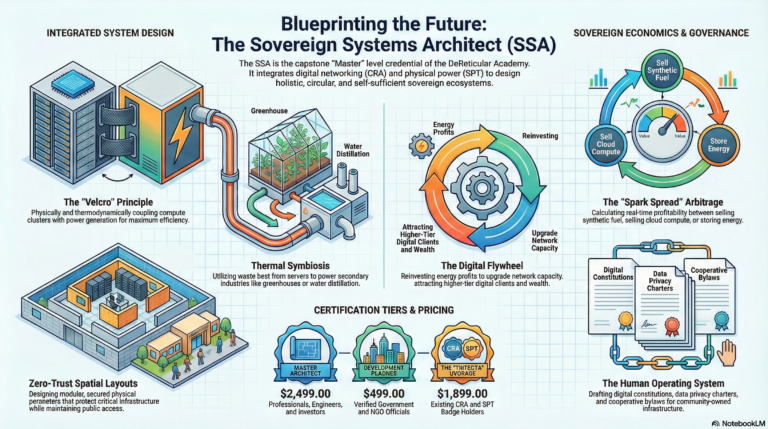
- Professional ($2,499): Turnkey micro-ISP distribution optimized for Starlink LEO backhaul; includes bandwidth monetization logic.
- Agentic ($9,997): Features the RIOS-TC-01 Sovereign Telemetry Core for autonomous mesh synchronization and V2V (Vehicle-to-Vehicle) communication in “Island Mode.”
Kinetic Mobility (Pawnee and Kurb Kars)
- Pawnee Flagship TAV ($797,000): A military-grade mobile command node on a Trophy Truck chassis with 160 kW Wankel range extension and “Ogre Skin” ballistic armor.
- Kurb Kar Logistics Pod ($18,500): An autonomous low-speed utility vehicle (LSEV) with a 1,200 lb payload capacity and solar canopy.
- TriFi Wireless: Acts as the consumer-facing channel, offering 5G gateways and unlimited data plans for rural and mobile users.
- Regulatory Strategy: The West Virginia Pathway
A foundational element of the DeReticular strategy is the use of statutory frameworks to avoid utility-controlled interconnection queues.
- Statutory Framework: Modeled after West Virginia Code §5B-2-21 and §24-2-21a.
- Certified Microgrid Districts: By co-locating power generation with a captive industrial consumer (the high-density GPU racks), an installation can qualify as an independent microgrid district.
- Exemption Status: Qualifying as a “high-impact data center” (consuming >70% of generation) can remove the standard two-district per-county cap and provide exemptions from Public Service Commission (PSC) rate regulation.
- Financial and Capital Recovery Models
Deployment costs are offset through strategic integration with federal non-dilutive capital programs managed via Venture Studio.
Federal Funding Crosswalk
Funding Program Eligible Products Maximum Recovery / Subsidy
IRA Section 6417 BESS, Agra Gasifiers 30% – 50% Direct Cash Refund (Tax-exempt entities)
USDA REAP Grant Agra Gasifiers, BESS Up to 50% Total Project Cost (Note: Grants paused March 2026)
FEMA BRIC Switchgear, Hardened Enclosures Up to 75% Federal Share for Hazard Mitigation
NTIA / BEAD WISP Hardware, Masts Up to 100% Capital Outlay for Rural Broadband
- Evidence Audit and Commercial Status
The Generation 5 ecosystem is currently transitioning from a series of engineering concepts to validated commercial products. An evidence-qualified V2 audit established the following posture:
Evidence Gates (G1–G6)
To move from architecture to investable platform, the ecosystem follows a six-gate validation process:
- G1 Rights: IP licensing and SKU definitions.
- G2 Engineering: Design freeze and BOM finalization.
- G3 Performance: Performance validation under load.
- G4 Compliance: Certifications (UL, IEEE, FCC).
- G5 Economics: Audited techno-economic models.
- G6 Commercial: Warranty and repeatable contracting.
Status of Key Claims
The V2 audit identified several unverified claims in initial marketing, including:
- Efficiency: The 97.7% power-chain efficiency is currently a target, not a verified end-to-end figure.
- LCOE: The $0.038/kWh cost is a modeled target pending further O&M studies.
- Package Pricing: Audit findings revealed “arithmetic failures” where the sum of component Bill of Materials (BOM) exceeded the stated turnkey package MSRPs.
Turnkey Deployment Packages (Budgetary Ranges)
- Tier I: Tactical Node (78,500 MSRP): Sized for dispatch and water stations; BOM floor audited at ~142,349.
- Tier II: Municipal Core ($385,000 MSRP): Sized for town halls and agricultural hubs; includes 50 kWe gasification.
- Tier III: Sovereign Matrix (625,000 MSRP): Sized for regional districts and defense bases; BOM floor audited at >898,000.
Important Quotes
“Agriculture Can Both Produce and Consume Energy.” — Agra Dot Energy Core Doctrine
“The core commercial problem DeReticular addresses is that power availability, interconnection backlogs, and cloud vulnerability—not hardware availability—represent the primary bottleneck for edge operations.” — Generation 5 Research & Evidence Analysis
“Generation 5 compresses four distinct procurement decisions (prime power, power continuity, local cognitive controls, and field communications/mobility) into a single, modular deployment architecture.” — Generation 5 Research & Evidence Analysis
“Investor-safe language: ‘potential certified-microgrid pathway,’ not ‘automatic statutory bypass.'” — Gen 5 Investor Deck V2