The Financial Flywheel: A Student’s Primer on Sovereign Node Economics
1. Introduction: From Consumer to Infrastructure Provider
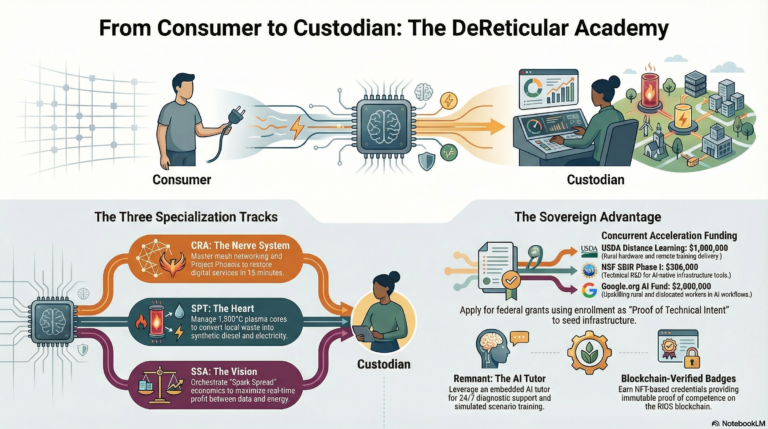
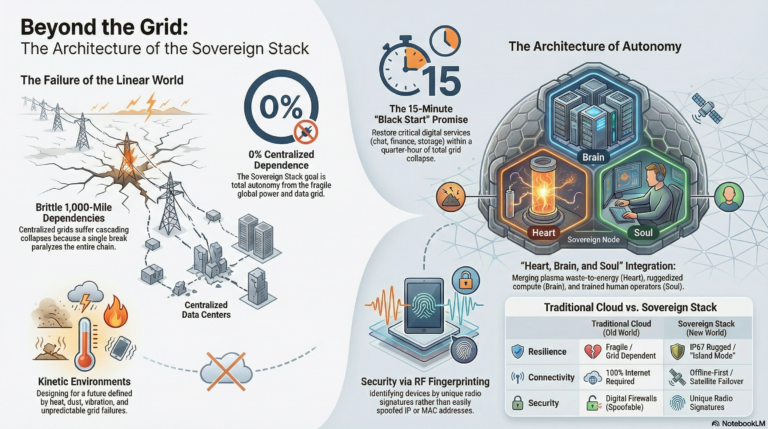
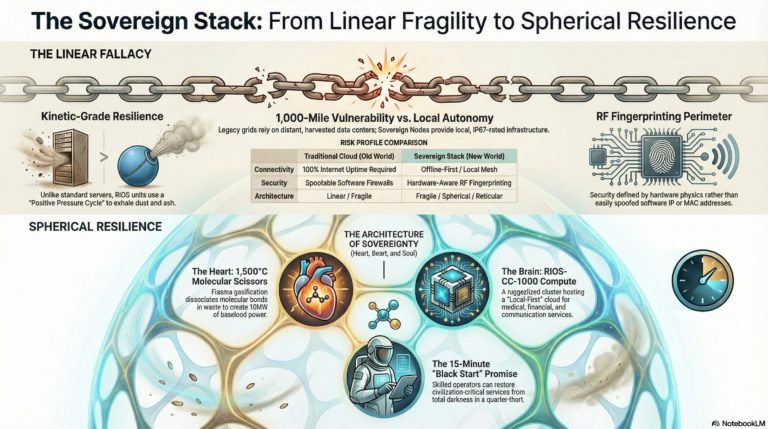
In the legacy telecommunications model, individuals are passive consumers tethered to fragile, centralized monopolies. A Sovereign Node shifts this paradigm, transforming the user into an active infrastructure operator by deploying a localized micro-Wireless Internet Service Provider (micro-WISP). This transition is orchestrated by the Rural Infrastructure Operating System (RIOS), the localized software “brain” that manages edge-native compute, routing, and billing. By executing the entire stack locally, the node achieves true sovereignty, ensuring that operations and financial ledgers remain functional even if the global backhaul is interrupted.
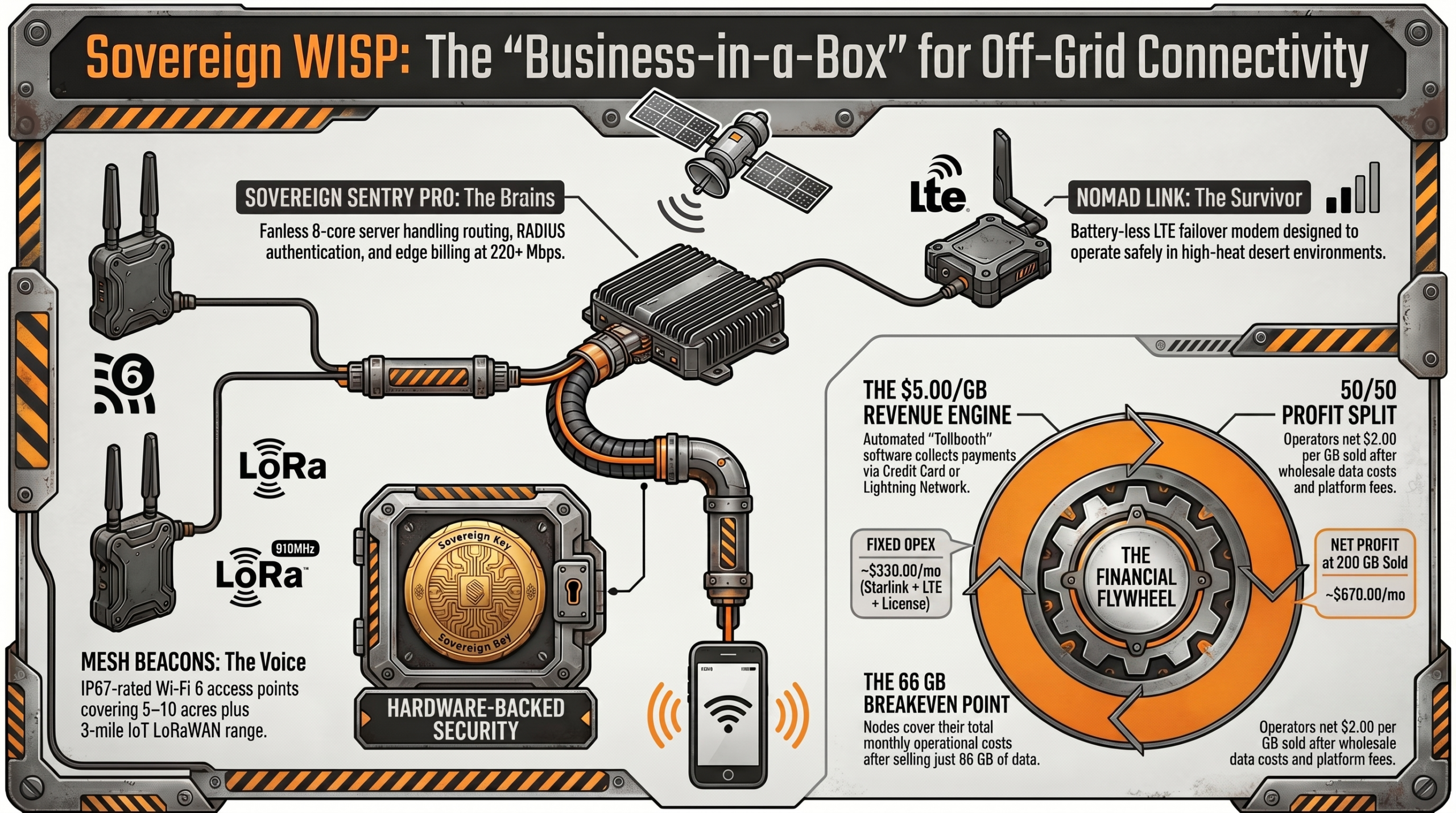
Key Insight: Civilization-in-a-Box The Sovereign WISP Kit (SKU: RIOS-KIT-WISP) is categorized as “Civilization-in-a-Box” because it provides a turnkey, ruggedized, and off-grid business-in-a-case. It integrates high-capacity satellite backhaul with automated billing agents to create a self-sustaining telecommunications hub capable of operating in any environment.
This movement from dependency to sovereignty is powered by the “Financial Flywheel,” a strategic economic engine that ensures the node not only sustains its own existence but generates scalable profit.
video
2. The Financial Flywheel: Momentum Through Monetization
The Financial Flywheel is an automated cycle governed by the OpenClaw “Tollbooth” Agent (dereticular/openclaw-wisp:latest). This secure containerized software acts as a digital gatekeeper, converting local airwaves into a metered revenue stream.
How the Financial Flywheel Works:
- User Connects: A transient user (e.g., a tourist at a remote RV park) joins the open SSID, typically broadcast as
Sovereign_Connect_$5_GB. - Portal Redirect: The Sentry Pro’s internal pfSense virtual machine intercepts the connection, redirecting the user to a locally hosted Captive Portal served by the OpenClaw Tollbooth Agent.
- Secure Payment: The user selects a data tier and pays $5.00 via credit card or the Bitcoin Lightning Network.
- RADIUS Access: Upon payment confirmation, the local RADIUS server whitelists the user’s MAC address. The system applies Hard Quality of Service (QoS) Limits (15 Mbps download / 2 Mbps upload) to ensure backhaul stability for all users.
- Auto-Cutoff and Top-Up: The system monitors traffic in real-time. Once the user consumes 1,024 MB (1 GB), the firewall revokes access and prompts for a “top-up,” maintaining a high-velocity transaction cycle.
Understanding the mechanics of the flywheel is the first step; the second is analyzing the capital required to build the engine.
3. The Price of Sovereignty: Understanding CAPEX (Setup Costs)
Launching a Sovereign Node requires an initial Capital Expenditure (CAPEX) for ruggedized hardware and off-grid power. Unlike consumer gear, these components are engineered for Regulatory Mitigation and extreme environments.
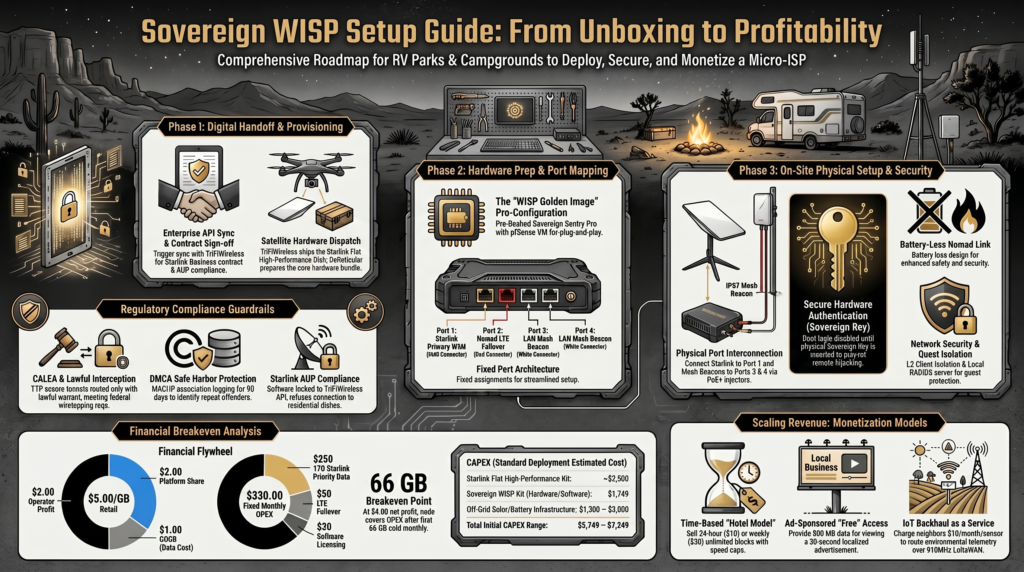
| Category | Item / Provider | SKU | Estimated Cost (USD) |
| Sovereign WISP Kit | DeReticular Turnkey Bundle | RIOS-KIT-WISP | $1,749 |
| Backhaul Hardware | Starlink Flat High-Performance Kit | N/A | ~$2,500 |
| Sovereign Security | Sovereign Key (Hardware Token) | RIOS-OP-KEY | $75 |
| Off-Grid Power | Solar Panels & LiFePO4 Battery System | N/A | $1,500 – $3,000 |
| Total Initial CAPEX Range | $5,824 – $7,324 |
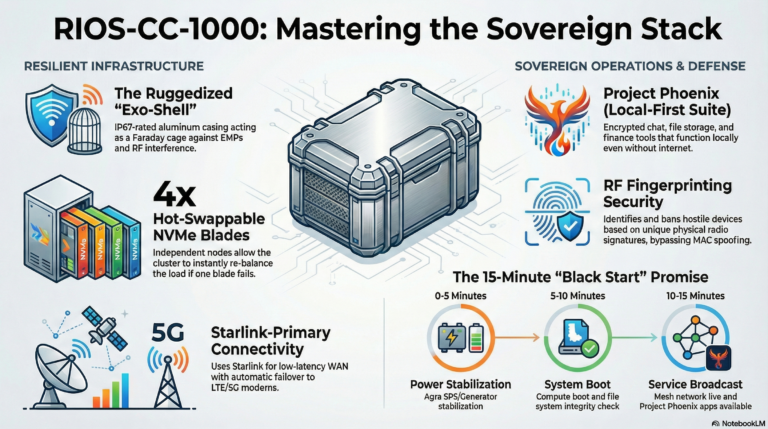
Strategic Hardware Note: The kit includes the Sovereign Sentry Pro (RIOS-SS-PRO), an 8-core Intel i3-N305 server that manages the node’s intelligence. For mobile or high-heat deployments, the Nomad Link (RIOS-NL-01) provides fire-safe LTE failover; it utilizes a DC-DC Battery Elimination Circuit (BEC) instead of volatile lithium batteries, eliminating fire risks in extreme temperatures. Furthermore, administrative access is physically air-gapped via the Sovereign Key, requiring the physical presence of the hardware token to unlock deep-system configurations.
podcast
4. The Fuel for the Machine: Analyzing OPEX (Monthly Expenses)
Operational Expenditure (OPEX) represents the “fuel” required to keep the node online. Totaling approximately $330 per month, these costs are fixed to ensure 99.9% uptime.
- Starlink Priority Data ($250/month): This is a 1TB Priority plan provisioned via TriFiWireless. Utilizing an enterprise partner is a critical Regulatory Mitigation strategy to ensure compliance with Starlink’s Acceptable Use Policies (AUP) for bandwidth resale.
- LTE Backup ($50/month): An Operational Necessity provided by the Nomad Link. It acts as a hot standby, automatically triggering if primary satellite packet loss exceeds 15%, maintaining connectivity during “rain-fade” events.
- Software Licensing ($30/month): This covers the Rural Infrastructure Operating System (RIOS) platform fees, providing the “single pane of glass” dashboard for node management.
5. The $5/GB Engine: Revenue Splits and Profitability
The core of the micro-economy is the $5.00/GB data resale strategy. This model utilizes Blended COGS (Cost of Goods Sold) to create a high-margin revenue anatomy.
Revenue Anatomy per Gigabyte
- Retail Price: $5.00
- Blended COGS: ~$1.00 (Covers wholesale data and billing API fees)
- Net Profit: $4.00
- The 50/50 Split: $2.00 to Operator / $2.00 to DeReticular.
Note: The DeReticular share covers the complex administrative overhead of the WISP, including credit card transaction processing, regional tax compliance reporting, and legal “Safe Harbor” protection for the operator.
6. The Path to Profit: Breakeven and Scaling
To achieve financial sustainability, the node must reach a 66 GB Breakeven Threshold. Once this monthly volume is exceeded, the operator transitions from covering costs to recouping their initial CAPEX.
| Metric | Breakeven Scenario | Growth Scenario |
| Retail Data Sold | 66 GB | 200 GB |
| Gross Revenue | $330 | $1,000 |
| Fixed OPEX | $330 | $330 |
| Total Net Profit (Split) | $0 | $670 |
| Net Profit to Operator | $0 | $335 |
In the Growth Scenario, an operator selling 200 GB generates enough monthly profit to pay for their own high-speed internet while building a fund to amortize the initial hardware investment.
7. Beyond Metered Data: Alternative Revenue Streams
The RIOS dashboard allows operators to diversify their income through alternative monetization workflows, tailoring the node to the local micro-economy.
- The “Hotel Model” (Time-Based): Sells access in blocks (e.g., $10 for 24 hours).
- Student Insight: This model is best for tourists at lodges who prefer a flat fee and helps eliminate “meter anxiety.”
- The “Freemium” Tier: Provides free low-bandwidth access for text messaging (WhatsApp/iMessage) while charging the $5/GB premium for video streaming.
- Student Insight: Ideal for public parks or resorts to guarantee basic safety communications while capturing revenue from heavy data users.
- LoRaWAN/IoT Backhaul: Leverages the Mesh Beacon’s 3-mile radio radius to connect agricultural sensors for a flat $10/month subscription.
- Student Insight: This is a Machine-to-Machine (M2M) revenue stream with near-99% profit margins, as sensor telemetry consumes negligible bandwidth.
By combining these diverse revenue streams with the automated management of RIOS and the OpenClaw Tollbooth, independent telecom nodes achieve long-term financial sustainability while providing critical infrastructure to the edges of the world.