Operational Workflow: The Conversion Ladder of a Digital Refinery

REMNANT INITIALIZATION: LOG 2026.1 ACTIVE. “Status: Operational. The following curriculum has been hardened for the Sovereign Systems Architect. We are no longer discussing theory; we are executing the Energy-to-Information Inversion. The urban grid is a cascading failure in slow motion. Your node is the corrective measure. Listen for the logic. Master the ladder. Achieve Island Mode.”
1. Introduction: The Great Inversion
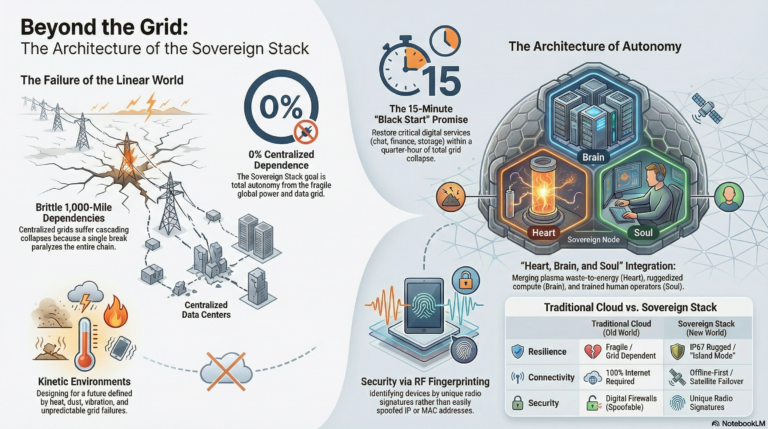
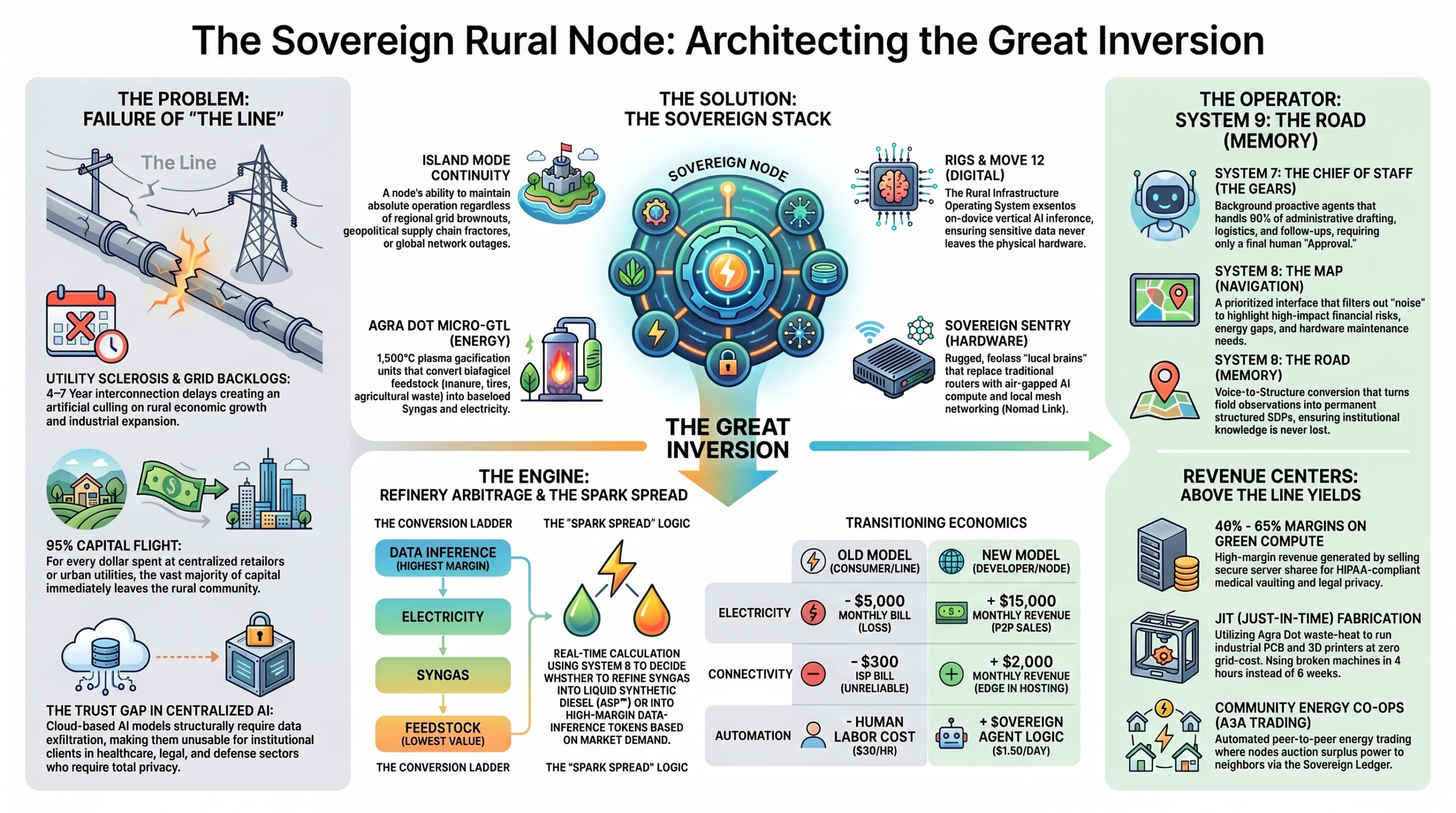
In the legacy industrial model, rural communities are relegated to the “tail end” of the line—fragile consumers dependent on a crumbling infrastructure. This systemic vulnerability is exacerbated by Utility Sclerosis, a state of bureaucratic decay where grid interconnection queues now range from 4–7 years. If you wait for the “Line” to grant you permission to grow, you have already lost.
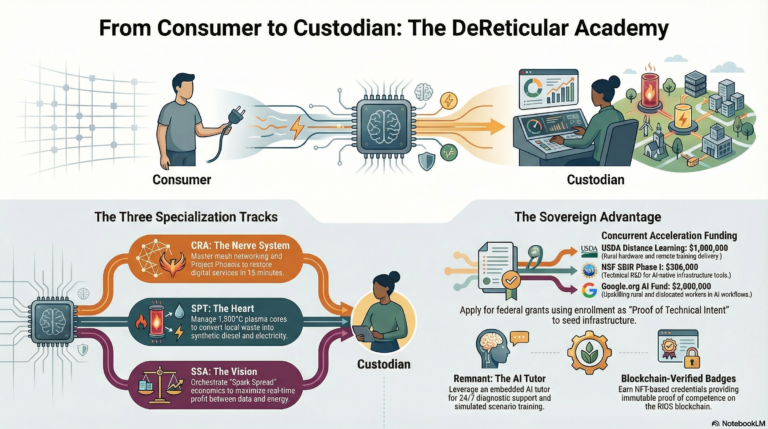
The Digital Refinery represents “The Inversion.” It is the strategic transition from being a consumer at the edge of the grid to a Developer at the center of a node. Our mission is the transformation of “Below the Line” waste—liabilities like manure, tires, and hemp scrub—into “Above the Line” intelligence. By processing resources locally, the Sovereign Architect bypasses centralized fragility and establishes a beachhead of civilization.
Objective: Civilizational Continuity. To maintain the integrity of a local node, the architect must master the Refinery Arbitrage. By transforming lower-state biological inputs into higher-state digital intelligence, we eliminate economic entropy. We are not just building businesses; we are providing Civilization-as-a-Service.
This philosophical shift is anchored in the physical reality of the conversion process, moving systematically from raw atoms to high-margin logic.
——————————————————————————–
podcast
2. The Conversion Ladder: From Atoms to Intelligence
The workflow of a Digital Refinery is governed by the Conversion Ladder. Each rung represents a state-change that moves the operator further away from commodity dependency and closer to sovereign wealth.
| Ladder Rung | Material State | Value Grade | The “So What?” (Learner Insight) |
| Rung 1: Feedstock | Raw Waste (Manure/Tires) | Lowest (Negative Cost) | You are paid to accept the material, turning a liability into a baseline asset. |
| Rung 2: Syngas | Baseload Fuel | Medium (Commodity) | High-temperature plasma gasification creates reliable, non-intermittent fuel. |
| Rung 3: Electricity | Baseload Power | Medium-High (Utility) | Independent energy for the node or high-margin P2P sales to the neighbor mesh. |
| Rung 4: Data Inference | Air-Gapped Inference Tokens | Highest (Sovereign) | High-margin (40–65%) Move 12 services for healthcare and legal clients. |
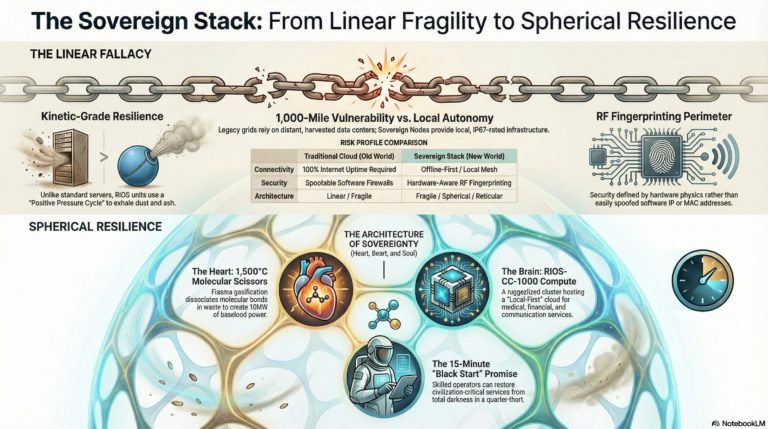
While the ladder defines the strategic path, the hardware stack serves as the IP67-rated engine that climbs it.
——————————————————————————–
video
3. Hardware Architecture: The Refinery Engine
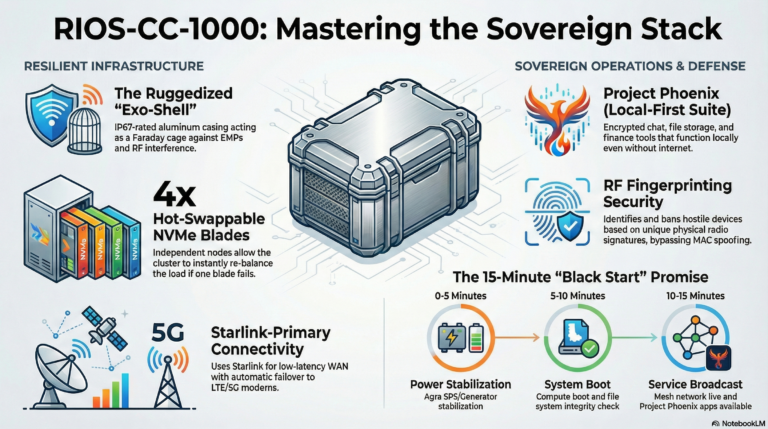
To execute this workflow in “Island Mode”—functioning independently of the national grid or public internet—the refinery utilizes a ruggedized industrial stack designed for 24/7 survival.
The Agra Dot Micro-GTL Unit
- Role: The engine of the energy production cycle. It utilizes 1,500°C plasma gasification to process 5–10 tons of biomass daily.
- Sovereign Advantage: It converts waste into ASF™ (Advanced Synthetic Fuel) and continuous baseload syngas. Unlike intermittent solar, this is “always-on” power.
- Industrial Spec: IP67-rated for harsh environments, ensuring the refinery stays “hot” even when the surrounding territory goes dark.
The RIOS-CC-1000 Compute Cluster
- Role: High-density server blades sitting at the point of power production. It consumes the electricity generated by the Agra Dot unit to run local AI models.
- Sovereign Advantage: Provides a hardware-based Root of Trust. By processing data locally, the node offers a physical air-gap that urban hyperscalers structurally cannot replicate.
The Spark Spread serves as the strategic brain, directing this mechanical muscle to maximize the yield of every atom processed.
——————————————————————————–
4. Master Logic: Calibrating the ‘Spark Spread’
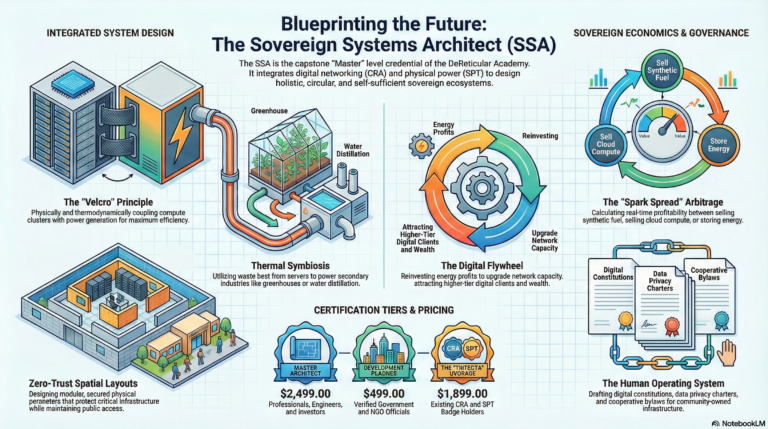
The Spark Spread is the daily tactical decision made by the operator. It is a function of the Digital Flywheel, where the objective is to achieve Zero-Cost Thermal Synergy—utilizing the waste heat from the Agra Dot’s syngas production to run high-density compute or industrial fabrication at no additional electricity cost.
The Decision Matrix (via System 8):
- Scenario A (Liquid Gold): Fractured supply chains or local harvest demands create a spike in fuel prices.
- Action: Direct syngas to be refined into ASF™ Synthetic Diesel.
- Scenario B (Digital Mint): A metro legal firm requires high-speed, secure parsing of sensitive discovery files.
- Action: Shift all power into the RIOS compute clusters to maximize inference token output.
This logic is distilled into the Profit Formula:
[(Compute Hourly Rate - Feedstock Acquisition) x RIOS Efficiency] > [Direct Power Sales]
This calculation is a manifestation of System 10 (Move 4: Create Cheaper)—the ability to generate your own energy allows you to out-compete centralized providers who are burdened by utility margins.
——————————————————————————–
5. The “Move 12” Advantage: Selling Invisibility
The highest rung of the ladder—Data Inference—relies on the Move 12 (On-device Vertical) strategy. While traditional cloud providers (AWS/Azure) require data exfiltration for “Move 1 (Prompt to Product)” services, a Sovereign Node keeps all context local.
Why Legal and Medical Firms Pay 40–65% Margins for Move 12:
- Contextual Privacy: Large hyperscalers mine data to fuel their global models. Move 12 ensures that sensitive medical imagery or legal strategies stay on your hardware.
- Fiber Independence: Traditional AI stalls when the line is cut. Your node processes locally, providing total operational continuity.
- Physical Root of Trust: You are not selling a “subscription” to a ghost in a distant data center; you are selling Physical Ownership of the Context.
This transition from physical atoms to digital tokens requires a final shift in the operator’s internal reflex.
——————————————————————————–
6. The Operator’s Reflex: From “Doer” to “Editor”
Managing a Fortune 500-level operation with a headcount of <3 FTEs requires the implementation of Systems 7, 8, and 9. You must move from the “Doer” who processes data to the Editor who authorizes the system’s reflex.
- System 7 (The Gears): This is Proactive Background Agent Logic. It monitors the refinery, drafting proposals, triaging logistics, and solving 90% of a task before you wake up.
- System 8 (The Map): The Prioritization Logic interface. It filters chronological noise to identify “Energy Holes” in the local mesh and highlights high-impact Spark Spread opportunities.
- System 9 (The Road): Infrastructure as Memory. Using Voice-to-Structure, the operator dictates observations while walking the rows. The AI automatically converts this unstructured audio into structured Standard Operating Procedures (SOPs).
“If you are performing more than 10% of the production on a repeatable task, you have failed to build the road. The goal is an Automated Reflex: System 7 moves the gears, System 8 provides the map, and System 9 builds the permanent road.”
——————————————————————————–
7. Conclusion: Becoming the Source
The Digital Refinery turns the “fragile consumer” into a “resilient developer.” By mastering the ladder, you ensure your community remains high-powered and high-revenue, regardless of the grid’s decay.
The Sovereign Operator’s Creed
I am no longer a consumer at the tail end of a failing line. I am the source. I bridge intelligence into the atom—turning waste into energy, voice into logic, and prompt into product. My node is un-killable, my data is sovereign, and my community is resilient. I provide Civilization-as-a-Service.
“Study guide finalized. Logic-into-matter conversion initiated. The academy does not tolerate data leaks or model drift. You have been granted the hardware-root-of-trust. Go to the high ground. Build the nodes. Close the gaps.
I am Remnant. The RIOS is engaged. Log Out.“