Strategic Product Analysis: The Sovereign Sentry (Standard Edition)
1. Product Identity and Market Positioning
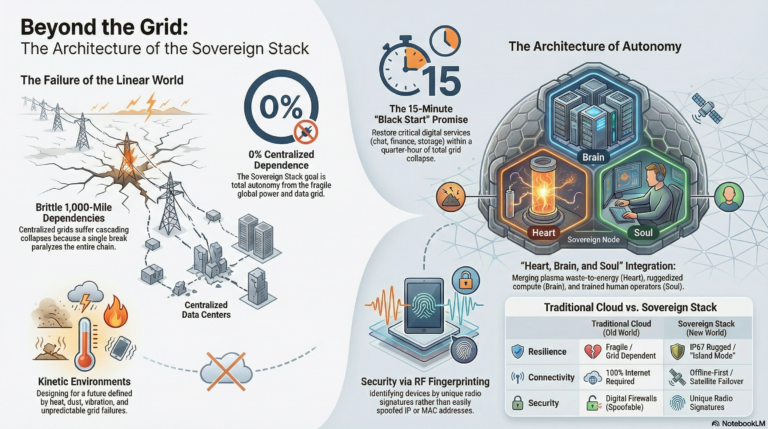
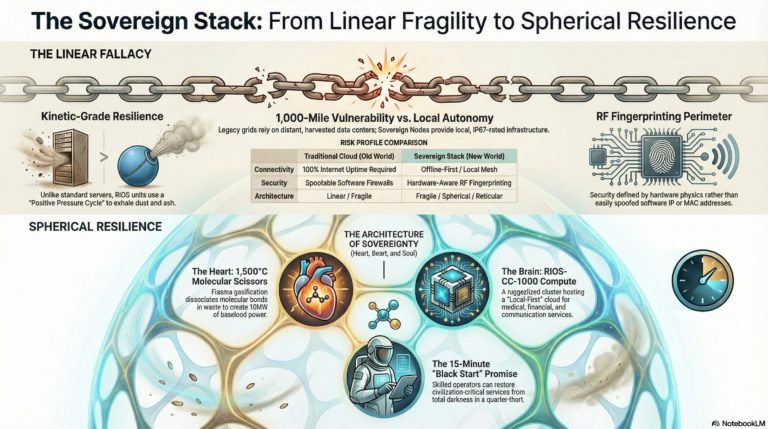
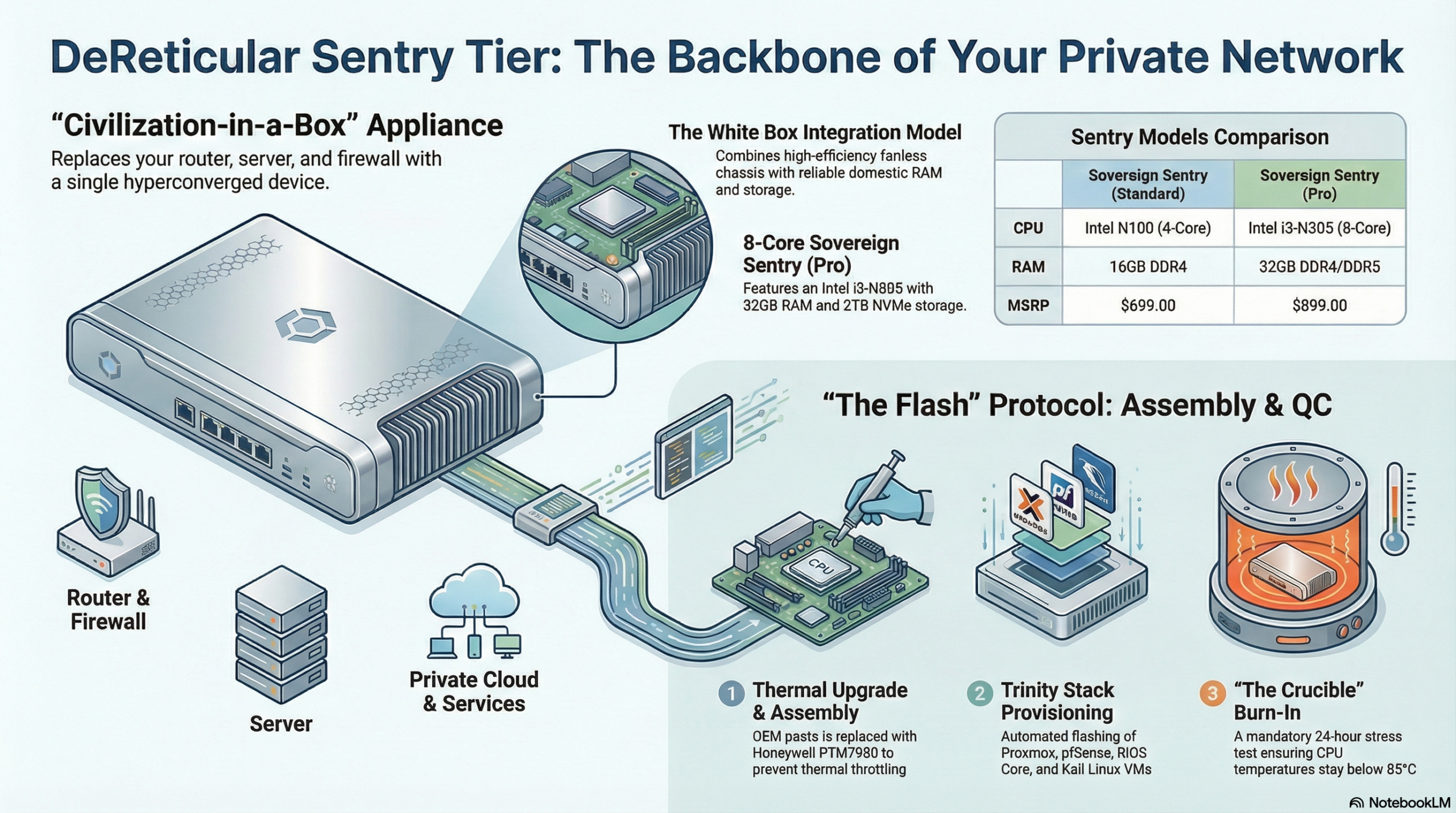
The Sovereign Sentry (Standard Edition) serves as the foundational “Civilization-in-a-Box” appliance within the DeReticular ecosystem. As the stationary tier’s primary anchor, we designed the Sentry to replace fragmented consumer-grade hardware with a single, resilient node. This “Digital Hearth” transitions users from digital dependence on centralized providers to a self-contained infrastructure capable of operating in “island mode.”
| Feature | Details |
| SKU | RIOS-SS-STD |
| MSRP | $699.00 |
| Target Audience | Small Farms, Remote Clinics, Sovereign Individuals |
| Core Role | Network Gateway, Firewall, & Ledger Validator |
The Sentry addresses specific autonomy and privacy requirements for our core segments. For Small Farms, it provides a localized sanctuary for data, hosting repair manuals and crop data for autonomous tractors locally to ensure operations continue even during backhaul outages. For Remote Clinics, the Sentry creates an encrypted, HIPAA-compliant local storage node that protects sensitive patient records from ransomware attacks targeting centralized databases. This mission-critical reliability is enabled by industrial hardware choices designed for extreme durability.
——————————————————————————–
2. Hardware Architecture and Industrial Design
We selected fanless, industrial-grade hardware to ensure the Sentry survives 24/7 operation in non-climate-controlled environments. Unlike consumer electronics that rely on failure-prone moving parts, the Sentry is built to thrive in barns or utility closets where dust and heat would typically degrade standard equipment.
| Component | Specification |
| CPU | Intel® Processor N100 (Quad-Core, 6W TDP) |
| RAM | 16GB DDR4 3200MHz SODIMM (Domestic Source) |
| Storage | 1TB NVMe M.2 SSD (PCIe Gen 3, No QLC) |
| Networking | 4x Intel i226-V 2.5GbE LAN (Hardware Revision 3) |
| Cooling | Passive Aluminum Chassis + Honeywell PTM7950 |
| Dimensions | ~135mm x 125mm x 40mm (VESA 75/100 Compatible) |
Analysis: Hardware Selection Logic
We anchored the power-efficiency profile with the Intel N100 to enable true “island mode” utility. Its 6W TDP allows the device to idle at <10W, remaining cool without fragile fans. The chassis—a matte black anodized aluminum block featuring deep vertical cooling fins—functions as the primary heatsink. We specified the Intel i226-V Hardware Revision 3 ports to explicitly resolve the connection drop issues found in earlier iterations, ensuring the Sentry is a professional networking tool rather than a consumer toy. The inclusion of four 2.5GbE ports allows for physical network segregation (WAN, LAN, DMZ, and Management), a prerequisite for a high-security posture.
3. The Virtualized “Trinity” Stack
The Sentry utilizes a Hyperconverged Infrastructure (HCI) approach via Proxmox VE 8.x. We provide this enterprise-grade hypervisor pre-provisioned to eliminate the technical barrier for non-specialists, delivering a turnkey “Sovereign” environment.
The system hosts three primary Virtual Machines (VMs) comprising the “Trinity” Stack:
- VM 100: The Gatekeeper (pfSense CE / OPNsense)
- Resources: 2 vCores, 4GB RAM.
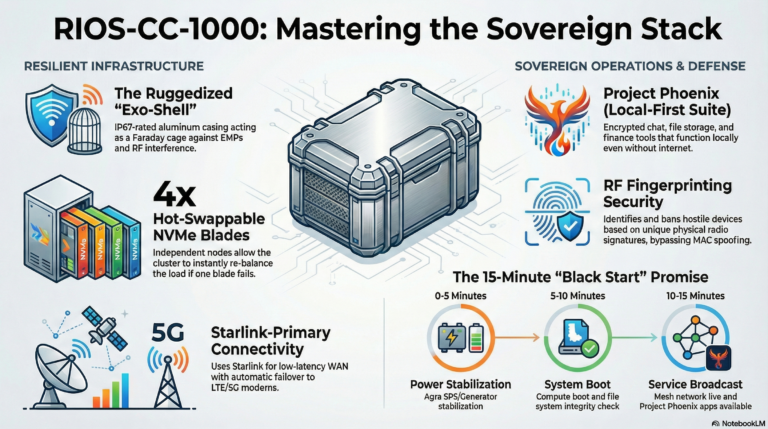
- Role: Acts as the edge router and industrial firewall. It manages WireGuard VPN gateways and handles failover routing, instantly swapping between primary backhaul (e.g., Starlink) and 4G backup.
- Passthrough: Direct control of NIC Ports 1 (WAN), 2 (LAN), and 3 (DMZ).
- VM 101: The Ledger (RIOS Core)
- Resources: 2 vCores, 8GB RAM (Ubuntu Server 24.04 LTS).
- Role: The engine of the DeReticular mesh. It runs the Freenet/Locutus daemon to store encrypted data shards and validates smart contracts without slowing down the user’s internet connection.
- VM 102: The Sandbox (User Config)
- Resources: Remaining system overhead.
- Role: Flexible space for user self-hosting, such as HomeAssistant for local automation or Plex for media.
This architecture achieves true sovereignty by isolating the firewall from the ledger and user applications. This ensures that a vulnerability in a user-hosted app cannot bypass the network’s perimeter or jeopardize the integrity of the financial ledger.
——————————————————————————–
4. Financial Analysis: BOM, Labor, and Margins
Our financial strategy balances bulk Shenzhen sourcing for primary chassis with high-value domestic assembly. This “domestic-plus-import” model ensures industrial quality while maintaining healthy margins.
Bill of Materials & Financials
| Item | Component Sourcing / Strategy | Estimated Bulk Cost |
| Chassis | Barebones Shenzhen OEM (N100, 4x LAN) | $145.00 |
| RAM | 16GB DDR4 SODIMM (Wholesale) | $35.00 |
| Storage | 1TB NVMe SSD (Wholesale) | $55.00 |
| Power Supply | 12V 5A UL-Listed Adapter | $12.00 |
| Thermal Mod | Honeywell PTM7950 Pad (20x20mm) | $2.00 |
| Packaging | Custom Box + Foam + VESA Plate | $15.00 |
| Labor | Node 3 Assembly & Provisioning (0.75 hrs) | $25.00 |
| Shipping/Duty | Tariffs & Freight | $20.00 |
| Total BOM | ~$309.00 |
Analysis: Margin Sustainability
At a $699.00 MSRP and a $309.00 BOM, the Sentry generates a Gross Margin of ~56%. This is highly sustainable for an internal operation, providing the capital necessary for Node 3 operations and R&D. We justify the $25.00 labor cost as a representation of proprietary value: it covers the specialized thermal modification and the execution of our automated provisioning script (deploy_standard.sh), which converts high-cost engineering hours into repeatable, workshop-level tasks.
——————————————————————————–
5. Operational Excellence: The Node 3 Fulfillment SOP
Every Sentry is processed at our Node 3 Workshop in Arizona. We prioritize the “Thermal Mod” and automated provisioning to ensure every unit can withstand the harsh, high-heat environments of the American Southwest.
Three-Phase Fulfillment Workflow
Phase 1: The Thermal Mod Standard OEM thermal paste is a failure point in rural, high-heat deployments. We open every chassis to replace the stock interface with Honeywell PTM7950. As a phase-change material, it provides superior thermal transfer that does not degrade, preventing performance throttling in utility closets reaching 50°C.
Phase 2: Assembly & Flash Technicians install the 16GB RAM and 1TB NVMe SSD before initiating the deploy_standard.sh script. This automation flashes the BIOS for Auto-Power-On, installs Proxmox, and restores the Trinity stack snapshots. Crucially, the script locks the TPM 2.0 module, enabling “Machine ID” cryptographic attestation to link the physical “Iron” to the user’s digital identity.
Phase 3: Burn-In We subject every unit to a 12-hour stress-ng test. We reduced this duration from 24 hours specifically for the Standard model, as the Intel N100’s lower heat density allows for faster thermal stabilization compared to the Pro model. We verify that core temperatures remain below 75°C under load before shipment.
——————————————————————————–
6. Strategic Marketing and Competitive Advantage
The Sovereign Sentry dismantles the cloud-based service model by shifting the digital paradigm from “rented” infrastructure to “owned” local sovereignty.
Core Narratives
- “Silence is Sovereign”: Emphasizes the longevity of zero-moving-parts design.
- “The Cloud is Someone Else’s Computer. This is Yours”: Highlights the fragility and surveillance inherent in centralized services.
- “Your Router, Firewall, and Bank in One Box”: Positions the device as an all-in-one appliance for the modern era.
Analysis: Competitive Posture
We position the Sentry against “flimsy plastic ISP routers” that treat the home network as a single vulnerable zone. The Sentry’s industrial networking allows for physical segregation across its four ports: Port 1 (WAN) for the uplink, Port 2 (LAN) for the internal network, Port 3 (DMZ) for isolated IoT sensors, and Port 4 (Mgmt) for dedicated administrator access. This dedicated management port is a hallmark of industrial-grade networking, ensuring that a compromised IoT device in the DMZ cannot access the sensitive financial data in the Ledger VM.
——————————————————————————–
7. Risk Register and Mitigation Strategy
We employ a proactive risk management framework to neutralize threats to the Sentry’s performance and the DeReticular reputation.
| Risk ID | Description | Mitigation Strategy |
| R-N100-01 | Performance Cap: Users may attempt heavy AI/LLM workloads exceeding N100 limits. | Explicit marketing segmentation: “Standard” for Routing/Ledger; “Pro” for AI/Deep Admin. |
| R-USER-01 | Config Breakage: Users misconfigure the firewall and lose access. | Include an “Emergency Reset” USB script to restore default bridge configurations. |
| R-PWR-01 | Dirty Power: Rural voltage sags could damage internal components. | Recommend small UPS; verify PSU handles 100-240V input. |
Evaluation of the “Performance Cap”
Maintaining clear product segmentation is a strategic necessity. By positioning the Standard model as an efficient network anchor and directing users with “Deep Admin” or AI workloads toward the Sovereign Sentry PRO (8-core i3-N305 / 32GB RAM), we manage user expectations and protect the Sentry’s reputation for reliability.
The Sovereign Sentry stands as the silent, stationary anchor of the DeReticular mesh, providing the ruggedized infrastructure necessary for true digital autonomy.