From Consumer Tech to Industrial Asset: A Guide to DeReticular Ruggedization
1. The Philosophy of “Island Mode” Infrastructure
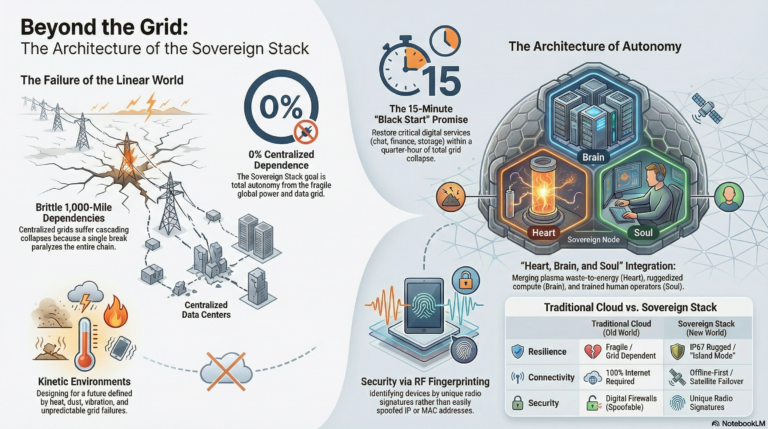
The DeReticular engineering directive focuses on “Sovereign Infrastructure”—the creation of decentralized, resilient hardware nodes designed for the post-cloud era. The core methodology involves the “Upcycling and Ruggedizing” of commodity consumer hardware, transforming high-performance but fragile devices into industrial-grade assets capable of surviving autonomous deployment.
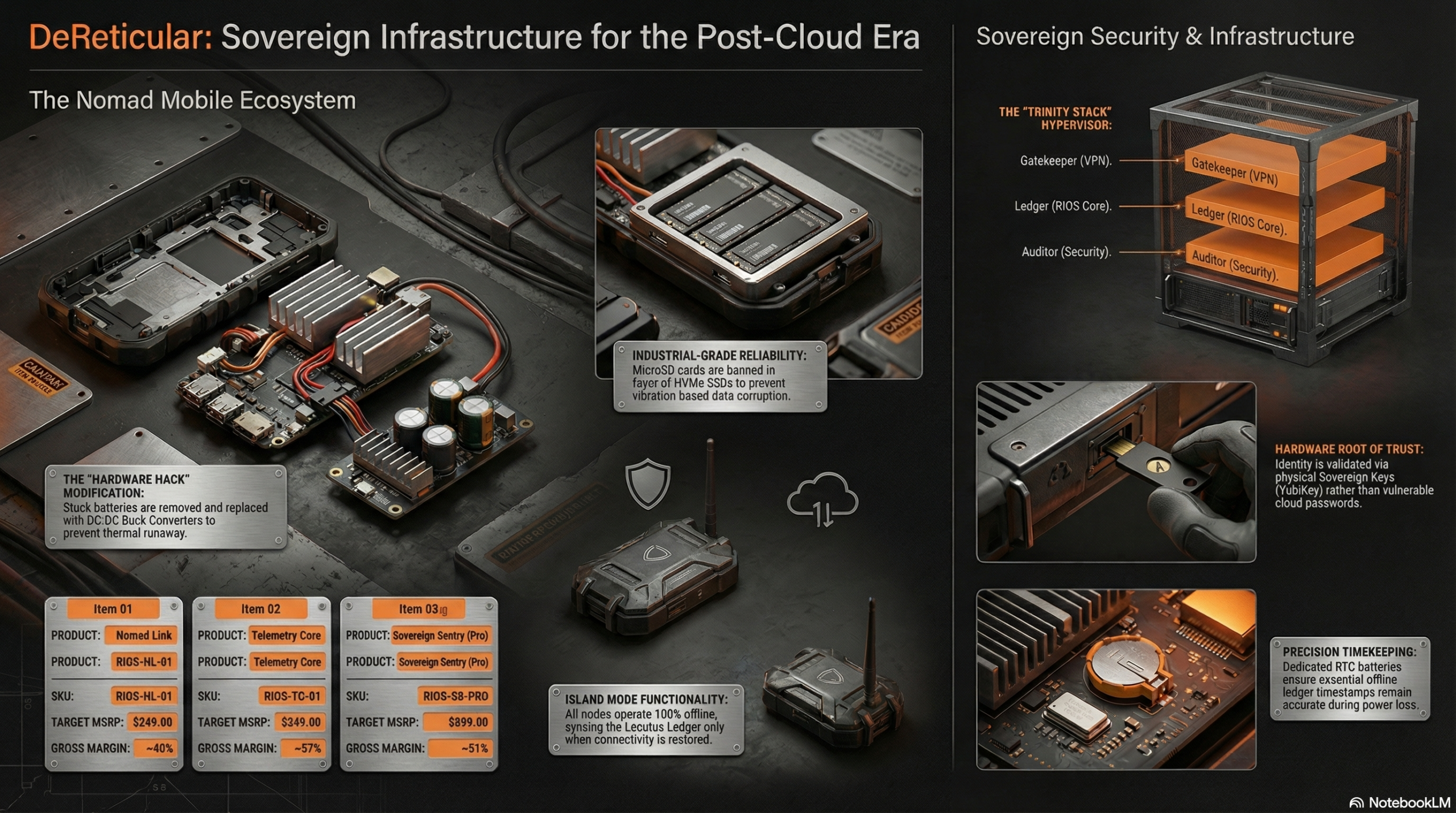
Island Mode: A technical architecture where hardware nodes are engineered to function 100% offline. Nodes execute all logic and data processing locally, synchronizing with the “Locutus Ledger” only when a secure connection is established.
For the systems engineer, this approach addresses the critical bottleneck of decentralized infrastructure: the cost and proprietary lock-in of traditional industrial hardware. By modifying commodity tech, we achieve high-compute density and sovereign control at a fraction of the cost, ensuring that infrastructure remains owned and operated by the individual or local entity rather than a centralized provider.
Transition: Converting consumer mobile hardware into an industrial node requires identifying and mitigating specific mechanical and electrical failure points.
——————————————————————————–
2. The Nomad Link: Anatomy of the “Hardware Hack”
The Nomad Link (RIOS-NL-01) serves as the mobile connectivity interface. It is built upon the Skylink SLG-06 (LTE Cat 6) but undergoes extensive modification to meet industrial specifications for high-heat and variable-power environments.
| Feature | Stock Consumer Features (SLG-06) | Industrial Modifications (RIOS-NL-01) |
| Power Source | Internal Li-ion Battery | Battery Elimination Circuit (BEC) |
| Cooling | Sealed Plastic Housing | 3D-Printed Honeycomb “Nomad Shell” |
| Data Link | Wi-Fi / Internal Antenna | Wired USB-C Tethering (RNDIS) |
| Input Voltage | 5.0V DC (USB Standard) | 12V-48V Variable DC |
Technical Deep-Dive: Internal Components
- 10kΩ BSI Resistor: Consumer devices utilize a Battery Size Indicator (BSI) pin to verify battery presence and temperature. This resistor is soldered between the BSI and Negative pins to “spoof” the thermal sensor, allowing the device to bypass the boot-loop caused by a missing battery.
- DC-DC Buck Converter: Integrated to handle the fluctuating voltages (12V-48V) found in solar outposts and vehicle power systems, stepping input down to a stable 4.0V for the internal circuitry.
- Nomad Shell: A custom 3D-printed enclosure featuring honeycomb ventilation to facilitate passive heat dissipation, replacing the sealed plastic casing that traps heat.
Safety Insight: The removal of the Lithium-ion battery is a mandatory safety mitigation against “Thermal Runaway.” In environments exceeding 70°C, internal batteries swell and pose a high risk of combustion. Removing the chemical storage element entirely ensures the node remains inert and stable in extreme heat.
Transition: While the Nomad Link establishes the connection, the RIOS Telemetry Core provides the compute and cryptographic logic for the node.
3. The RIOS Telemetry Core: Reliability Engineering
The RIOS-TC-01 is the primary processing hub, utilizing a Raspberry Pi 5 base. To meet the demands of decentralized ledger operations, the following hardware logic is applied:
Component & Logic
- 8GB RAM (Mandatory Requirement):
- Engineering Reason: High-density RAM is required to maintain performance during Ed25519 cryptographic signing and Locutus daemon operations. Lower RAM configurations introduce latency and processing bottlenecks in “Island Mode.”
- NVMe SSD via PCIe HAT:
- Engineering Reason: MicroSD cards are strictly banned due to high failure rates under vibration and data corruption risks during sudden power loss. NVMe storage provides the write endurance required for ledger synchronization.
- Active Cooler + Aluminum Armor Case:
- Engineering Reason: To manage the thermal load of sustained cryptographic processing, a hybrid passive/active cooling system prevents thermal throttling, maintaining a consistent clock speed.
- Panasonic ML-2020 RTC Battery:
- Engineering Reason: Cryptographic integrity relies on accurate timekeeping. Without an independent Real-Time Clock, an offline node cannot verify the sequential order of ledger transactions, compromising the “Island Mode” data state.
Transition: As we move from mobile telemetry to stationary site management, hardware requirements shift toward network isolation and virtualization.
——————————————————————————–
4. Sovereign Sentry & The Trinity Stack
The RIOS-SS-PRO is a high-compute density node (Intel Core i3-N305) designed for stationary operations. It utilizes Proxmox VE to host the “Trinity Stack,” a three-VM configuration that manages site security and data.
- VM1 (Gatekeeper): Runs pfSense/OPNsense to provide sovereign routing and VPN services, managing the perimeter of the “Island.”
- VM2 (Ledger): The local instance of the RIOS Core and Freenet, serving as the site’s primary database and file-syncing engine.
- VM3 (Auditor): A Kali Linux instance dedicated to automated vulnerability scanning, ensuring the local network is hardened against intrusion.
Visualizing Connectivity: The Sentry is equipped with 4x Intel i226-V 2.5GbE ports. This physical interface configuration is critical for sovereign security, allowing for physical isolation (WAN/LAN/DMZ). By separating networks at the hardware layer rather than through software VLANs, we significantly reduce the risk of cross-network contamination or “leaks” in the event of a hypervisor breach.
Transition: Infrastructure sovereignty is finalized by securing the operator’s physical identity through hardware-based trust.
——————————————————————————–
5. The Root of Trust: The Sovereign Key
The RIOS-KEY-01 (YubiKey 5C NFC) serves as the hardware Root of Trust, eliminating reliance on cloud-based password managers or centralized identity providers.
| Protocol | Use Case |
| FIDO2 | Hardware-based, passwordless login to Sentry Nodes and local terminals. |
| OpenPGP | Secure storage of private keys for digitally signing offline ledger maintenance logs. |
Safety Insight: To mitigate the risk of physical key theft or loss, the system utilizes a “Dead Man” Revocation Protocol. Lost keys are revoked via the DeReticular Academy, and the updated Certificate Revocation List (CRL) is propagated across the decentralized network, ensuring compromised keys lose access.
Transition: Achieving this level of ruggedization requires a disciplined, multi-stage manufacturing workflow.
——————————————————————————–
6. Manufacturing SOP: The Surgical Mod & The Gauntlet
Every RIOS-NL-01 unit is processed through a strict Standard Operating Procedure (SOP) at the Node 3 Workshop to ensure industrial consistency.
Station C (The Surgical Mod)
- [ ] Open the SLG-06 chassis and remove the Li-ion battery for hazmat disposal.
- [ ] Solder the 10kΩ Resistor between the BSI and Negative pins to spoof the battery sensor.
- [ ] Solder the DC-DC Buck Converter (Whip input to internal battery terminals).
- [ ] Apply Kapton tape for electrical isolation and heat resistance.
Station D (The Gauntlet)
- [ ] Smoke Test: Apply 12V DC power and confirm the unit boots successfully without a battery.
- [ ] RNDIS Check: Connect to a Linux terminal to verify wired USB-C tethering and data link.
- [ ] Thermal Burn-in: Subject the unit to a 30-minute full-load test at 40°C to ensure power stability.
Station E (The Outpost)
- [ ] Install the custom honeycomb “Nomad Shell” backplate.
- [ ] Apply the “Void Warranty” Tamper Seal over the chassis screw ports.
- [ ] Package the unit with the required Power Whip and the mandatory Warning Card (“NO BATTERY”).
Synthesis: The “Gauntlet” represents the boundary between a maker project and an industrial asset. These validation steps ensure the hardware can survive the vibration, heat, and power instability inherent in decentralized field deployments.
——————————————————————————–
7. Risk Mitigation and Warranty Realities
Engineering industrial assets from consumer tech requires a transparent assessment of trade-offs and mitigations.
| Potential Failure | Root Cause | Engineering Mitigation |
| Thermal Runaway | Stock battery failure in >70°C heat. | BEC Mod: Mandatory battery removal and substitution. |
| Data Corruption | MicroSD failure under vibration. | NVMe Mandate: High-speed SSDs via PCIe. |
| Key Loss | Compromised/Lost Sovereign Key. | Dead Man Protocol: Remote revocation via Global CRL. |
| FCC Non-Compliance | RF noise from power modifications. | Shielded Buck Converters: Used to maintain RF integrity. |
The Sovereign Warranty: Assumed Risk Model
Operators must understand that performing the “Hardware Hack” on the Nomad Link voids the original manufacturer warranty. By deploying this hardware, the operator enters an Assumed Risk Model, trading the consumer-grade safety net for an industrial-grade performance profile. DeReticular provides a 90-Day Sovereign Warranty which covers only the specific modifications performed during the ruggedization process.
Final Insight: By meticulously removing consumer-grade weaknesses—volatile batteries, fragile SD cards, and unshielded power inputs—these modifications ensure that upcycled consumer technology can provide reliable, long-term service in the most decentralized and harsh environments on earth.