The Ghost in the Mesh: 4 Ways the DeReticular Operator Series is Redefining Field Tech
In the high-stakes theater of decentralized automation, we are witnessing the rise of the “silicon mesh”—vast networks of Nomad and Sentry nodes operating with eerie autonomy. But silicon is brittle. When these systems drift or fail in the mud and dust of the real world, the “human-in-the-loop” isn’t just a safety requirement; it’s a survival necessity. The DeReticular Operator Series is the tactical response to the fragility of the autonomous edge. It is the Human-Machine Interface (HMI) designed to give biological operators the sovereign authority to diagnose, repair, and command the machines that increasingly manage our environment.
The Sovereign Key and the Human Root of Trust
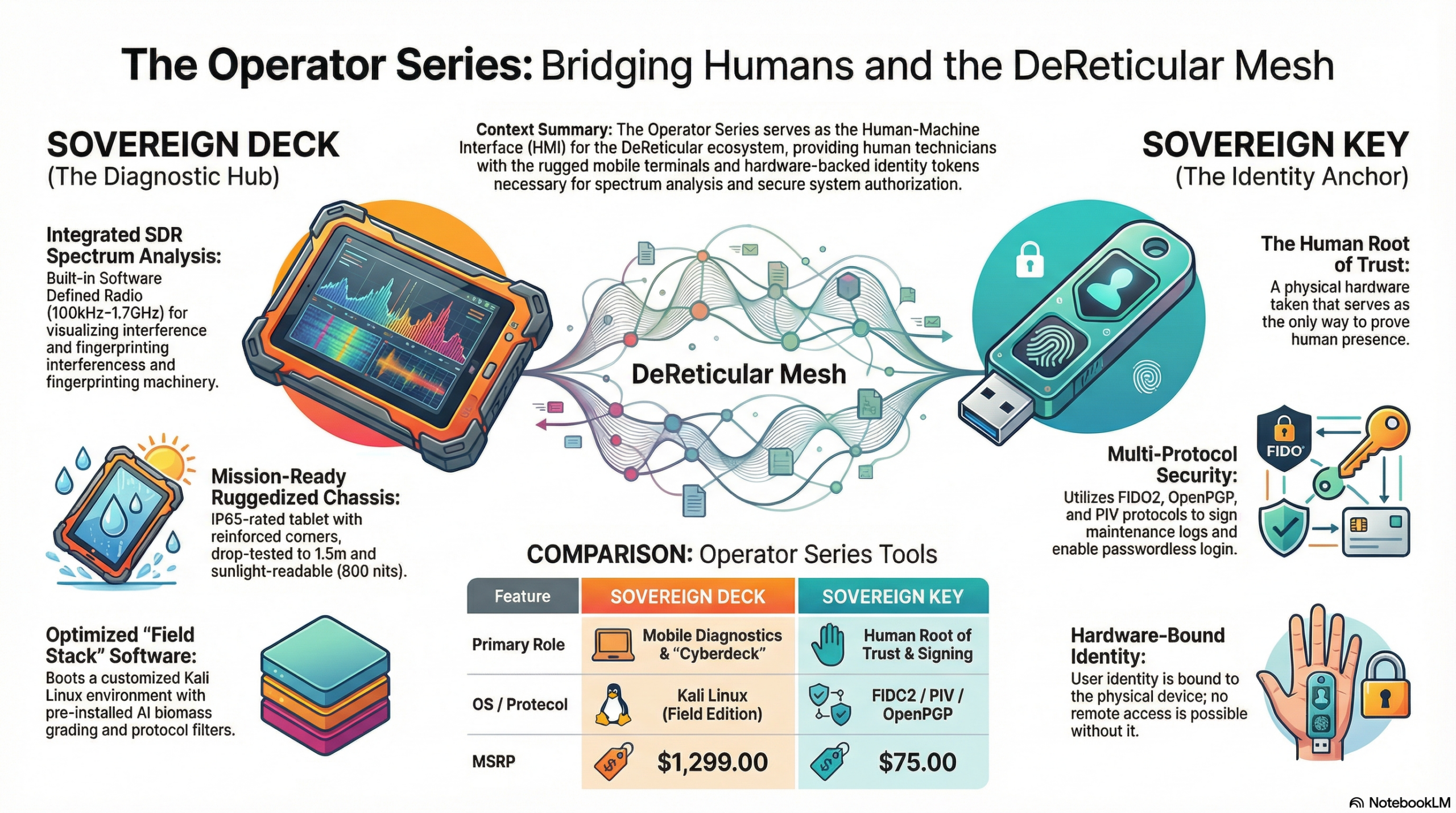
Security in a decentralized network cannot rely on the fragile grace of cloud-based passwords. The RIOS-KEY-01, or Sovereign Key, establishes what we call a “Human Root of Trust.” By utilizing FIDO2 and OpenPGP protocols, this hardware token ensures that every maintenance log and authorization is anchored to a physical presence. This is identity as an immutable object: a 4096-bit RSA Private Key stored directly on the device, ensuring that the “Sovereign Badge” identity is bound to the public key on the hardware itself.
To preserve the integrity of this trust, DeReticular ships these keys blank. By forgoing pre-programming, the system bypasses the shadow of supply chain interdiction; the operator generates their own keys during the “Claiming Ceremony” on their own local machine.
“The Key is the only way to prove human presence”
This physical authentication is a rugged shield against remote hacking. Without the physical USB-C or NFC contact of the Sovereign Key, the mesh simply does not acknowledge your existence. It is a radical return to sovereignty: if you do not hold the key, you do not hold the power.
The Cyberdeck is Real—and it Sees the Invisible
The RIOS-OP-DECK, known as the Sovereign Deck, is the first true “Cyberdeck” for the industrial age. While it looks like a standard rugged tablet, its “Special Sauce” is hidden under the hood. The chassis is internally modified, connecting an RTL2832U module directly to the internal USB header and routing it to an SMA antenna pigtail on the auxiliary port. This integrated RTL-SDR (Software Defined Radio) allows technicians to visualize the RF spectrum from 100kHz to 1.7GHz.
In the field, this isn’t a luxury—it’s a diagnostic requirement. An operator can use SDR++ to:
- Visualize 915MHz LoRa and 2.4GHz Wi-Fi bands to hunt for interference.
- Identify “rogue” nodes or unauthorized signals.
- “Fingerprint” the electromagnetic signature of machinery to predict mechanical failure.
Perhaps most critically, the Deck provides the ultimate fallback for when the mesh goes dark: the ability to SSH into Nomad or Sentry nodes via direct USB serial tethering. When the wireless world fails, the Sovereign Deck remains the hardwired lifeline to the machine.
Industrial Grit Meets the Field Stack
The Sovereign Deck is a masterclass in the “hacker-ethos” of industrial modification. Starting with a Shenzhen-sourced rugged base, DeReticular builds a tool that survives 1.5-meter drops and carries an IP65 rating. The 10.1-inch IPS screen is pushed to a sunlight-readable 800 nits, ensuring the “Field Stack” software is visible even in the harshest desert glare.
The software suite is a curated arsenal running on Kali Linux (Field Edition), specifically tuned for the edge:
- HempGrade AI: Allows for high-precision, offline biomass grading using quantized TensorFlow Lite models and the rear-facing camera.
- Wireshark: Pre-configured with filters to deconstruct RIOS and Locutus protocol traffic in real-time.
Recognizing that the command-line complexity of Kali Linux can be a liability in high-stress environments, DeReticular implemented “Field Mode.” This custom UI launcher abstracts the power of the OS into a simplified, touch-optimized menu for common tasks like “Scan,” “Grade,” and “Repair.” It provides the depth of a penetration testing suite with the usability of a consumer tool.
The Sovereign Badge and the NFT Identity
The Operator Series forces a confrontation with our understanding of digital identity. Through the “Claiming Ceremony,” an operator’s physical Sovereign Key is linked to a “Sovereign Badge”—a blockchain-based NFT. This creates a paradigm of physical possession as digital identity. Because the badge is bound to the public key on the physical token, selling or losing the key effectively transfers the operator’s identity within the decentralized network.
To manage the inherent risk of such a high-stakes tool, the Identity Manager app facilitates redundancy. Technicians are encouraged to register two keys to a single NFT identity, creating a backup “Root of Trust” should one key be lost in the field. This architecture makes identity a tangible, transferable asset, mirroring the rugged reality of the physical tools it authorizes.
The Future of the Operator
The Operator Series is the indispensable bridge between the biological operator and the silicon mesh. In an era where we are surrounded by increasingly autonomous systems, DeReticular reminds us that rugged mobility and hardware-backed identity are the only ways to maintain human agency. We are moving toward a future where the human is no longer just a user, but the sovereign anchor of the network.
As the mesh expands, the question for every technician remains the same: Are you prepared to be the Root of Trust for the machines you manage?