Operational Sovereignty: A Strategic Framework for Revenue and Workforce Development
- The Commercial Value Engine: Multi-Tier Revenue Architecture
Establishing true “Island Mode” commercial independence requires more than mere hardware; it necessitates a diversified revenue architecture designed to sustain operations without reliance on centralized financial or utility fragility. This “Value Engine” converts local liabilities—such as municipal solid waste and timber slash—into sovereign compute assets and high-density electricity. By leveraging high-margin advisory services and specialized education, the Consortium enforces a model where intellectual capital funds the physical scaling of the Sovereign Stack, capturing the 16.6x arbitrage multiple that currently leaks to centralized utilities under the failing centralized model.
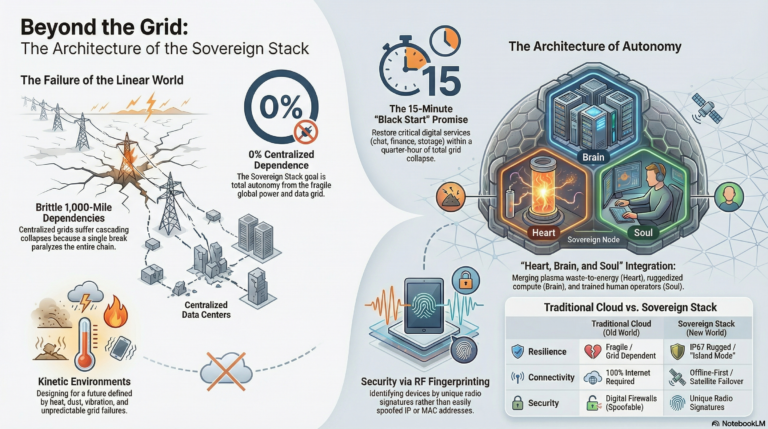
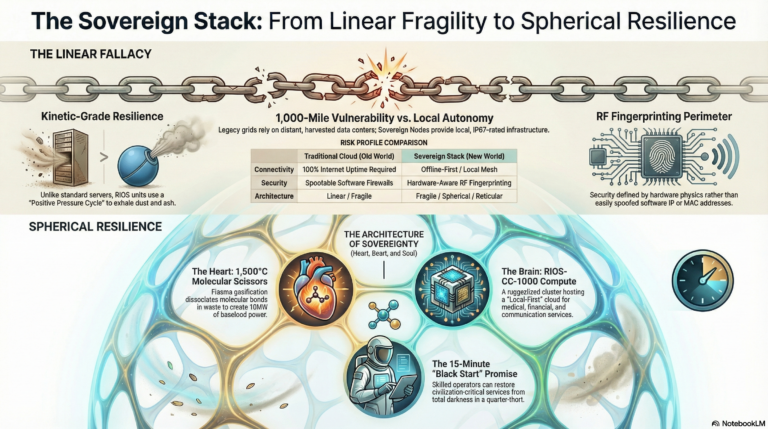
The Consortium Value Engine is built upon three primary pillars: Consulting & Advisory, Academy Courseware, and the Commercial Store. These pillars work in a closed-loop synergy to dismantle the “1,000-Mile Failure Model”—the inherent economic and structural fragility of long-haul centralized systems. While consulting engagements identify and remediate municipal vulnerabilities, the Academy trains the workforce to operate localized solutions, and the Commercial Store provides the TRL-7 and TRL-8 (Technology Readiness Level) hardware required to operationalize the transition from passive consumer to autonomous producer.

Consolidated Revenue Service Matrix
Service Offering Host Property Target Clientele Pricing Structure
Campus Strategy Sessions bizbuildermike.com Higher Ed, Municipal Commissioners, Co-ops $750 – $1,500 (1-Hr / 15-Min Free)
Municipal Sovereign Infrastructure Audit dereticular.com Townships, Water SCADA Districts, 911 Centers $25,000 – $75,000 (Fixed-Fee Study)
Non-Dilutive Grant Structuring & P3 venturestudio.dereticular.com Rural Co-ops, Tribal Nations, Clean Tech JVs $10,000 Retainer + 5–8% Success Fee
Turnkey Engineering RFP & Microgrid Study energy.dereticular.com Industrial Data Centers, Agricultural Consortia $15,000 – $50,000 (Engineering Package)
Consolidated Annual Run-Rate Projection
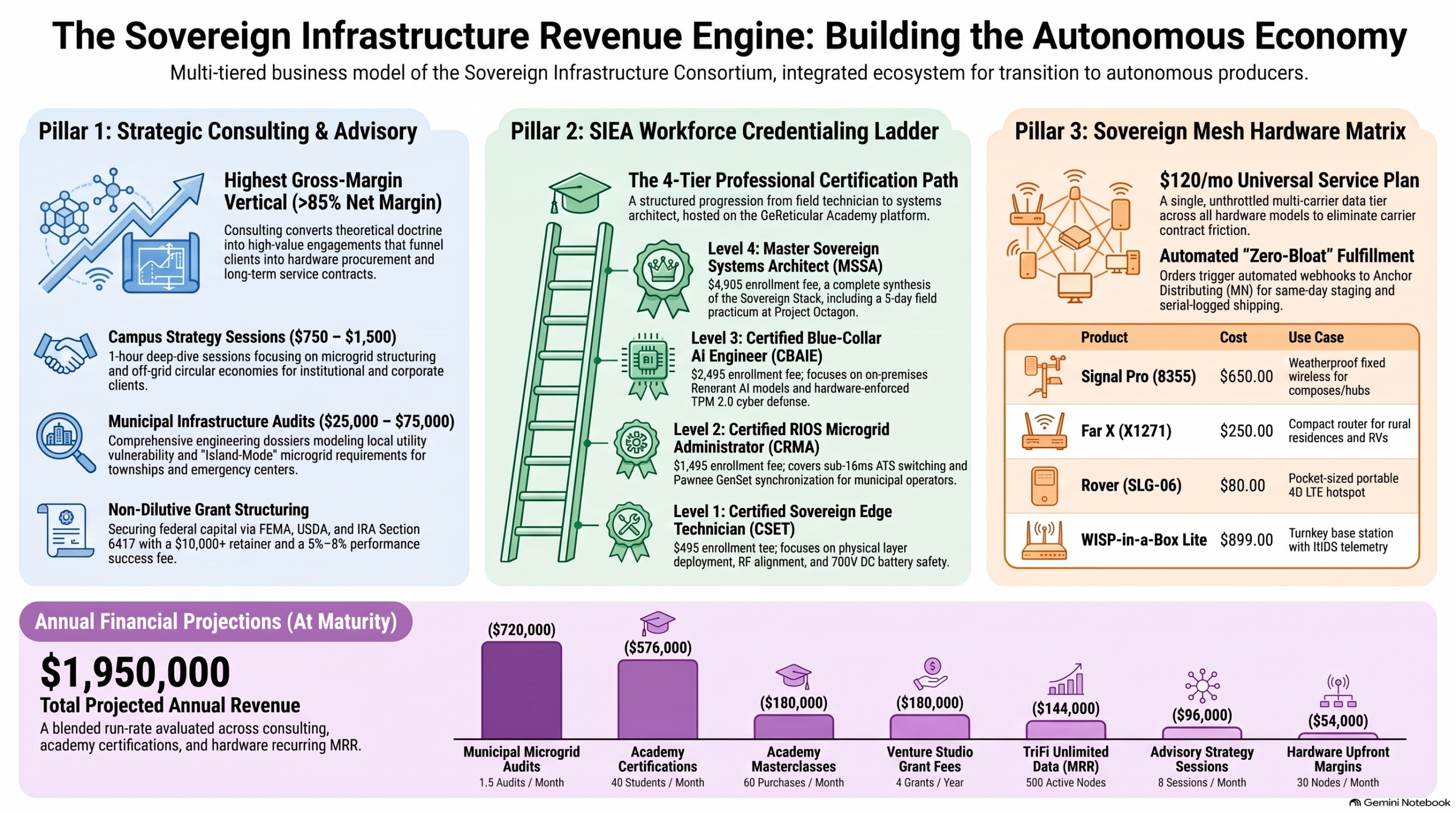
At maturity, the Sovereign Stack is projected to achieve a total annualized revenue of $1,950,000. The sustainability of this ecosystem is anchored by exceptionally high net margins (75%–95%) across primary knowledge verticals, ensuring the capital resilience required to defend the Stack:
- Advisory Strategy Sessions: $96,000/year (95% Net Margin)
- Municipal Microgrid Audits: $720,000/year (75% Net Margin)
- Venture Studio Grant Fees: $180,000/year (85% Net Margin)
- Academy Certifications: $576,000/year (90% Net Margin)
- Academy Masterclasses: $180,000/year (95% Net Margin)
- Hardware Upfront Margins: $54,000/year (20% Net Margin)
- TriFi Unlimited Data (MRR): $144,000/year (20% Share)
This financial architecture provides the bedrock for the human capital required to operate, maintain, and defend these sovereign systems.
- The SIEA Workforce Credentialing Hierarchy
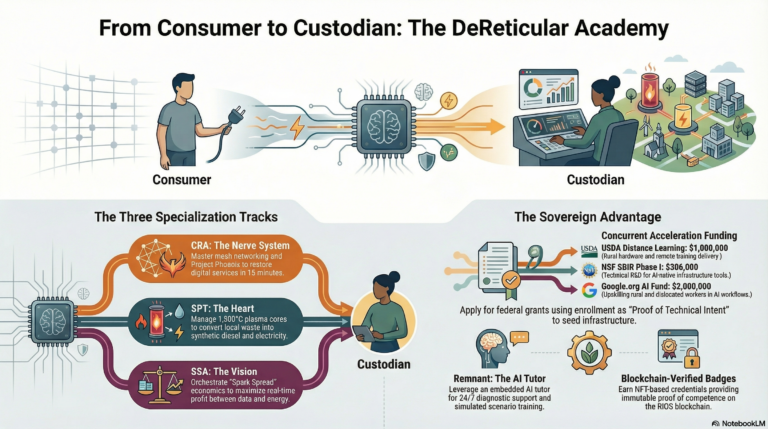
The Sovereign Infrastructure Education Alliance (SIEA) is the strategic mandate for the adoption of Noel’s Law. Operating as a 501(c)(3)-governed body, the SIEA ensures that the workforce required to build and maintain autonomous systems is trained through a non-proprietary, standardized framework. This alliance is essential for creating a labor pool capable of operationalizing the transition from grid-dependency to institutional sovereignty.
The 4-Tier Certification Ladder
The SIEA mandates a structured hierarchy to move professionals from field technicians to master-level architects:
- Level 1: Certified Sovereign Edge Technician (CSET)
- Enrollment Fee: $495.00
- Target Audience: Electricians, telecom linemen, agricultural technicians.
- Delivery: Online video masterclass, 50-question proctored exam, digital credential.
- Level 2: Certified RIOS Microgrid Administrator (CRMA)
- Enrollment Fee: $1,495.00
- Target Audience: Municipal utility operators, water SCADA engineers, facility directors.
- Delivery: 6-week self-paced curriculum with interactive laboratory simulators.
- Level 3: Certified Blue-Collar AI Engineer (CBAIE)
- Enrollment Fee: $2,495.00
- Target Audience: Industrial automation specialists, IT directors, systems integrators.
- Delivery: Advanced study vault and hands-on CLI terminal labs.
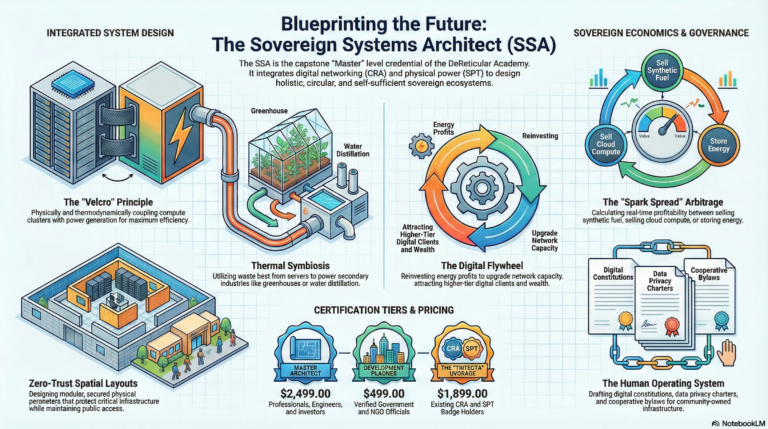
- Level 4: Master Sovereign Systems Architect (MSSA)
- Enrollment Fee: $4,995.00
- Target Audience: CTOs, Senior Civil Engineers, Venture Partners.
- Delivery: Vertical synthesis training and a mandatory 3-day on-site Field Practicum.
The Consortium enforces a “Zero-Bloat” (SOS-001) delivery philosophy. To maintain absolute edge performance and security, the Academy prohibits standard LMS plugins (LearnDash/WooCommerce) in favor of Native Stripe Checkout and Magic Link Webhooks. This Lean Plugin Rule ensures that training materials are 100% edge-cached and tokenized, providing high-speed access without the database overhead and security vulnerabilities of traditional systems.
This structure ensures that every participant masters the specific practical skills required to deploy and defend the Sovereign Stack at scale.
- Practical Competency Mapping: From Technician to Architect
The SIEA curriculum is founded on the three layers of the Sovereign Stack: Physical, Operational, and Cognitive. This framework prioritizes hands-on field validation of TRL-7 and TRL-8 systems over theoretical abstraction, ensuring that every certified professional can maintain resilient systems in contested environments.
Technical Skills Breakdown
- Level 1 (CSET): Focus on the physical layer, masterfully deploying TriFi Wireless transceivers across 5.8 GHz and 60 GHz bands. Technicians must demonstrate proficiency in high-gain antenna alignment and safety protocols for 48V and 700V DC battery systems (LiFePO4 chemistry).
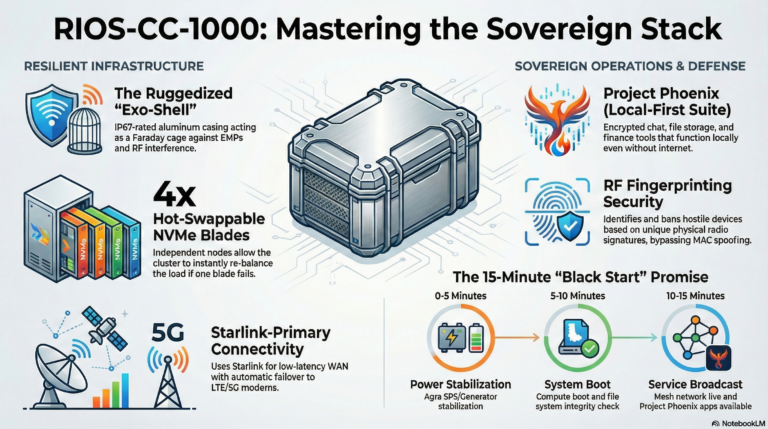
- Level 2 (CRMA): Training focuses on the Resilient Infrastructure Operating System (RIOS). Administrators configure sub-16ms Automatic Transfer Switches (ATS) for seamless islanding and synchronize Pawnee 45 kW Wankel rotary GenSets using syngas, biogas, and propane.
- Level 3 (CBAIE): This tier masters the cognitive layer. Engineers deploy wisdom-trained neural weights on air-gapped silicon and manage RIOS-CC-1000 liquid-cooled GPU enclosures. Competency includes managing Metacognitive Swarms (MSI) for autonomous load balancing and utilizing Deterministic Hallucination Arbitration to ensure SCADA-safe AI reasoning.
- Level 4 (MSSA): Architects perform vertical synthesis, operationalizing statutory bypasses like West Virginia H.B. 2014—specifically meeting the 70% captive consumption ratio required for Certified Microgrid District status.
The “Project Octagon” Field Practicum is the mandatory validation for Level 4 candidates. By requiring 3-day deployments in extreme environments—including the Quartzsite desert (high thermal flux), West Virginia timberlands, the maritime salt-fog of Guam, and the remote frontier of Kaabong, Uganda—the SIEA validates the architect’s ability to manage “Island Mode” systems under real-world stress. These credentials represent the highest tier of professional value in the sovereign infrastructure labor market.
- Professional Trajectory in Sovereign Infrastructure Industries
As centralized utility models succumb to the 1,000-Mile Failure Model, the demand for “Sovereign Systems Architects” has become a strategic necessity. Professionals holding these credentials move beyond the role of “passive consumer” to become “autonomous producers,” occupying high-value positions that command expertise in regulatory, fiscal, and technical defense layers.
SIEA graduates provide value in three critical institutional areas:
- Regulatory Mastery: Architects are trained to navigate statutory environments, leveraging laws like West Virginia H.B. 2014 to bypass Public Service Commission (PSC) rate regulations and accelerate microgrid deployment to within 60–90 days.
- Fiscal Ingenuity: Mastery of non-dilutive capital—including FEMA BRIC, USDA REAP, and IRA Section 6417 Direct Pay—allows architects to reduce Net CapEx by 40% to 80%. All project models are structured under FAR Part 31 and DCAA SF 1408 job-cost ledgers to guarantee federal audit compliance.
- Technical Defense: Certified specialists utilize hardware-enforced SCADA defense, leveraging TPM 2.0 cryptographic chips to protect critical municipal assets from supply-chain poisoning and cyber-disruption at the edge.
By transitioning into these roles, professionals codify Noel’s Law into their career trajectories. The integration of a multi-tier revenue model and a rigorous certification ladder creates a self-sustaining ecosystem that guarantees both institutional sovereignty and the professional growth of the architects who build it.