The Sovereign Infrastructure Stack: Spherical Resilience and Decentralized Architecture
Executive Summary
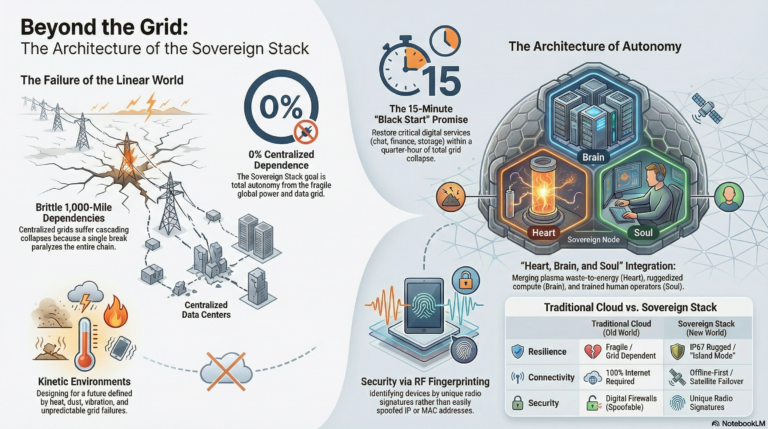
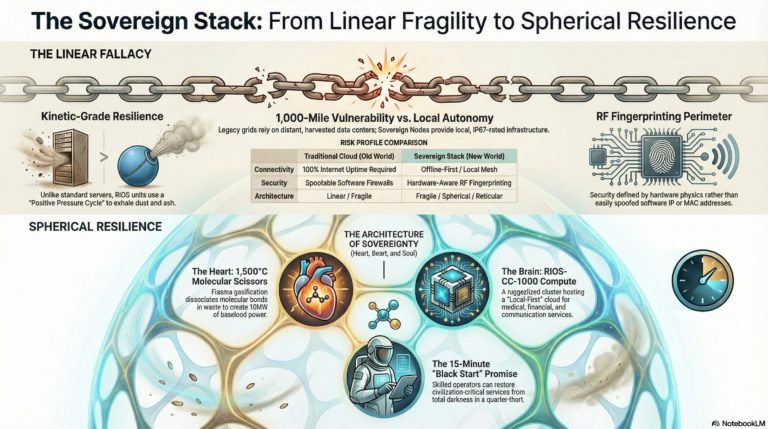
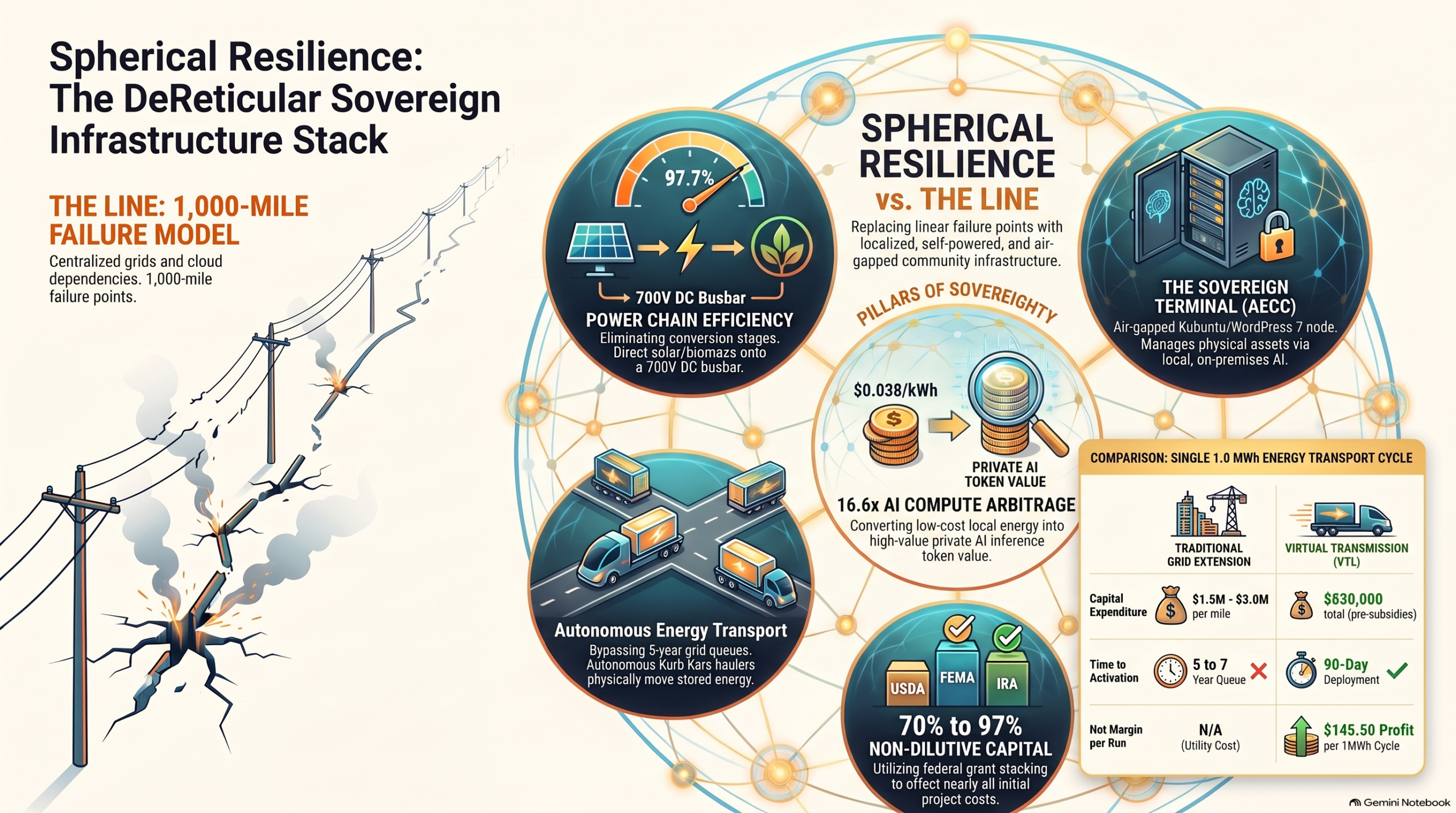
Modern industrial and civil institutions are currently tethered to “The Line”—a centralized, 1,000-mile failure model characterized by brittle electrical grids, public cloud dependencies, and vulnerable telecommunications monopolies. The DeReticular Sovereign Architecture, founded by Michael Noel (“Biz Builder Mike”), presents an integrated, air-gapped technology stack designed to replace this fragility with Spherical Resilience.
This architecture enables communities and enterprises to operate in absolute “Island Mode” through three interoperable pillars:
- Physical Power: Behind-the-meter energy generation via thermochemical gasification and solar-thermal concentration.
- Cognitive Sovereignty: On-premises, air-gapped AI and edge computing secured by hardware-level cryptographic trust.
- Operational Autonomy: Serverless, peer-to-peer (P2P) communications and autonomous mobility for energy and resource logistics.
Key takeaways from the ecosystem analysis include the realization of a 16.6x economic arbitrage multiple by converting local energy into AI compute cycles, the implementation of “Compliance-by-Architecture” for HIPAA-secured healthcare, and the use of Virtual Transmission Lines (VTL) to bypass multi-year utility grid backlogs.
- Philosophical Foundation: Spherical Resilience vs. “The Line”
The ecosystem is governed by Noel’s Law of Decentralization, which states: “System resilience is inversely proportional to its dependency on single-path centralized choke points.”
Concept “The Line” (Centralized) Spherical Resilience (Sovereign)
Connectivity Public Cloud / Fiber Optic Backbones Decentralized Mesh / WISP-in-a-Box
Power High-Voltage Utility Grid Localized 700V DC Microgrids
Intelligence SaaS / Cloud-hosted AI On-Premises Remnant AI
Risk Profile Cascading Total Failure Isolated, Continuous “Island Mode”
By decoupling infrastructure from centralized networks, the DeReticular stack resolves the “Bush Gap”—the structural deficit of power and connectivity that prevents rural and frontier markets from industrializing.
- The Physical Layer: Sovereign Power & Energy Logistics
The foundation of the stack is the Agra Dot Energy production facility, which produces baseload prime power at an estimated levelized cost (LCOE) of $0.038/kWh.
2.1 Prime Power Generation
- Thermochemical Gasification: High-temperature plasma gasifiers convert agricultural waste, forestry slash, and coal refuse into high-calorie synthesis gas (Syngas) and biochar.
- Parabolic Solar-Thermal: 80x mirror troughs produce 350°C industrial steam, providing carbon-free pre-heating for gasification and driving thermal membrane distillation for water independence.
- 700V DC Common Busbar: By utilizing a direct-current bus, the system eliminates multiple AC-to-DC conversion stages, achieving an end-to-end power chain efficiency of 97.7%.
2.2 Virtual Transmission Lines (VTL)
To bypass the 5- to 7-year wait times for utility grid interconnections, the architecture utilizes Mobile BESS (Battery Energy Storage Systems).
- Project Octagon Skids: 1.0 MWh containerized battery units mounted on autonomous carriers.
- Economic Viability: Moving bulk electrons physically via roads delivers peak power at $0.078/kWh, selling at peak tariffs of 0.24–0.35/kWh. A single unit can achieve capital payback in under 11 months.
- The Cognitive Layer: RIOS™ and The Sovereign Terminal
The Rural Infrastructure Operating System (RIOS™) serves as the control plane, integrating SCADA (Supervisory Control and Data Acquisition), edge intelligence, and secure communications.
3.1 The Autonomous Economic Command Center (AECC)
The architecture transforms WordPress 7 from a content management system into an industrial controller. Running on a hardened Kubuntu LTS (or NixOS) host, the Sovereign Terminal operates as an air-gapped node.
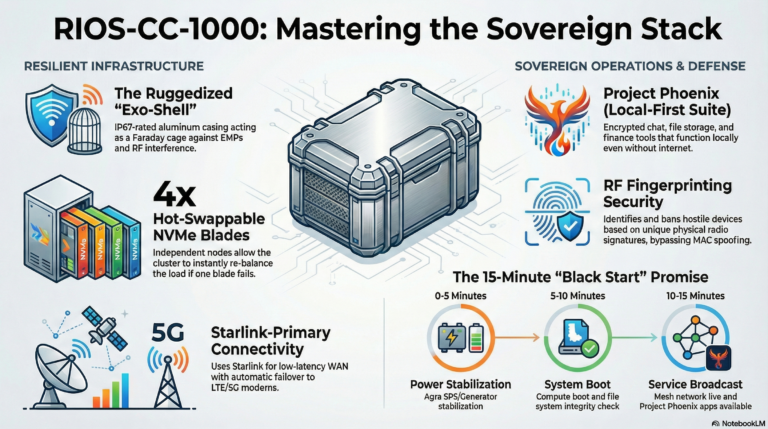
- Hardware Trust: Secured by TPM 2.0 cryptographic modules and sealed RJ-45 loopback plugs.
- Remnant AI Engine: A private cognitive core that arbitrates between local energy demand and compute loads.
- Custom Post Types (CPTs): Used as physical state ledgers to manage assets like battery charge levels (cpt_bess_cell) and energy auctions (cpt_energy_auction).
3.2 Decentralized Communications
The system utilizes Freenet (Locutus) and Freenet River to establish serverless, un-censorable communications.
- Serverless Web: Sites are published as WebAssembly (Wasm) state contracts, replicating across peer nodes to eliminate hosting dependencies.
- Encrypted Mesh: WISP-in-a-Box masts provide carrier-class wireless hubs with a 15-km radius, enabling P2P coordination without public internet access.
- Sector-Specific Deployments and Use Cases
The Sovereign Stack is optimized for diverse, high-stakes environments where “The Line” is most likely to fail.
4.1 Sovereign Clinical Terminal (Healthcare)
Transitioning from “Compliance-by-Paperwork” to “Compliance-by-Architecture”, this deployment meets HIPAA standards through physical isolation.
- Zero-Cloud Telemetry: AI scribing and diagnostic reasoning occur locally on the node, preventing PHI leakage to third-party clouds.
- Black-Sky Disaster Triage: In a grid collapse, the terminal maintains ICU power, manages blood-bank cold chains via M2M (Machine-to-Machine) handshakes, and coordinates autonomous medical drone deliveries.
4.2 Regional Edge Campuses
- West Virginia: Leverages H.B. 2014 to certify generation sites as Certified Microgrid Districts, legally bypassing public utility regulation and enabling high-density AI compute arbitrage.
- Guam: Provides Black-Sky Defense during tropical typhoons and hosts autonomous biosecurity UGVs (Unmanned Ground Vehicles) to protect electrical substations from invasive species.
- Quartzsite, AZ: Operates a Desert Hydro-Portal, using solar-thermal distillation to dispense potable water to nomadic communities via cryptographic hydro-credits.
- Uganda: Bridges the “Bush Gap” by powering walk-in cold-storage lockers with agricultural waste gasification, reducing post-harvest spoilage from 45% to less than 3%.
- Financial Engineering: Grant Stacking and Capital Offsets
The deployment of the DeReticular ecosystem utilizes a “Capital Stacking Flywheel” to secure non-dilutive funding, often offsetting 70% to 97% of initial capital expenditures.
Funding Source Applicable Infrastructure
USDA REAP Agricultural biomass gasifiers and solar energy.
FEMA BRIC / ARC POWER Critical municipal microgrids and disaster resilience.
IRA Section 6417 Direct Pay cash refunds for clean-energy CapEx.
DoD DCIP Tactical energy awards for defense-critical nodes.
- The Pragmatic Sovereign Stack: Next-Gen Optimization
An objective engineering analysis identifies a roadmap for hardening the architecture for global industrial enterprise standards.
- From Kubuntu to NixOS: Moving to an immutable, declarative operating system reduces memory footprint from ~1GB to <120MB and prevents configuration drift.
- From PHP/WP7 to Rust/PocketBase: Replacing the interpreted WordPress core with a single-binary Rust engine (Axum) and PocketBase provides sub-microsecond messaging and 95% less RAM consumption.
- From Rotary to Linear Generators: Transitioning to Mainspring Linear Generators increases electrical efficiency to 45%+ and eliminates the maintenance issues (apex seal wear) associated with Wankel rotary engines.
- From Bespoke to REE Skateboard: Utilizing pre-homologated EV “skateboard” chassis (like REE Automotive) allows Kurb Kars to focus on modular “Top-Hat” payloads (BESS skids, passenger pods) while meeting federal safety standards.
- Master Visual Taxonomy (12 Hero Image Directives)
The ecosystem’s narrative is captured in 12 “Hero Images” intended for high-end cinematic visualization:
- The Sovereign Terminal: The air-gapped command core.
- Agra Dot Energy: Solar-thermal and thermochemical baseload power.
- The Rolling Microgrid: Autonomous heavy electric freight.
- WISP-in-a-Box: Self-powered wireless mesh masts.
- West Virginia Hub: Reclaimed coal-to-clean microgrid district.
- Guam Black-Sky C2: Storm-hardened island resilience.
- Desert Hydro-Portal: Solar-distilled water independence.
- Uganda Cold-Chain: Frontier agricultural value retention.
- Sovereign Clinical: Zero-cloud disaster surgery pods.
- Sub-Surface Mining: Autonomous deep-earth SCADA.
- eVTOL Vertiport: Off-grid megawatt aviation charging.
- Spherical Resilience vs. The Line: The macro-philosophical dichotomy.
Conclusion
The DeReticular Sovereign Infrastructure Stack represents a fundamental shift in critical infrastructure design. By integrating behind-the-meter energy, on-premises cognitive intelligence, and serverless communications, the ecosystem operationalizes physical and digital autonomy. This transition from vulnerable dependencies to Spherical Resilience ensures that the survival and prosperity of local communities are no longer contingent on the stability of “The Line.”