The Architecture of Truth: Materialized Error Reduction and the Crisis of Symbolic Ledgers
- The Epistemic Paradox: Biological Cognition vs. Ontic Reality
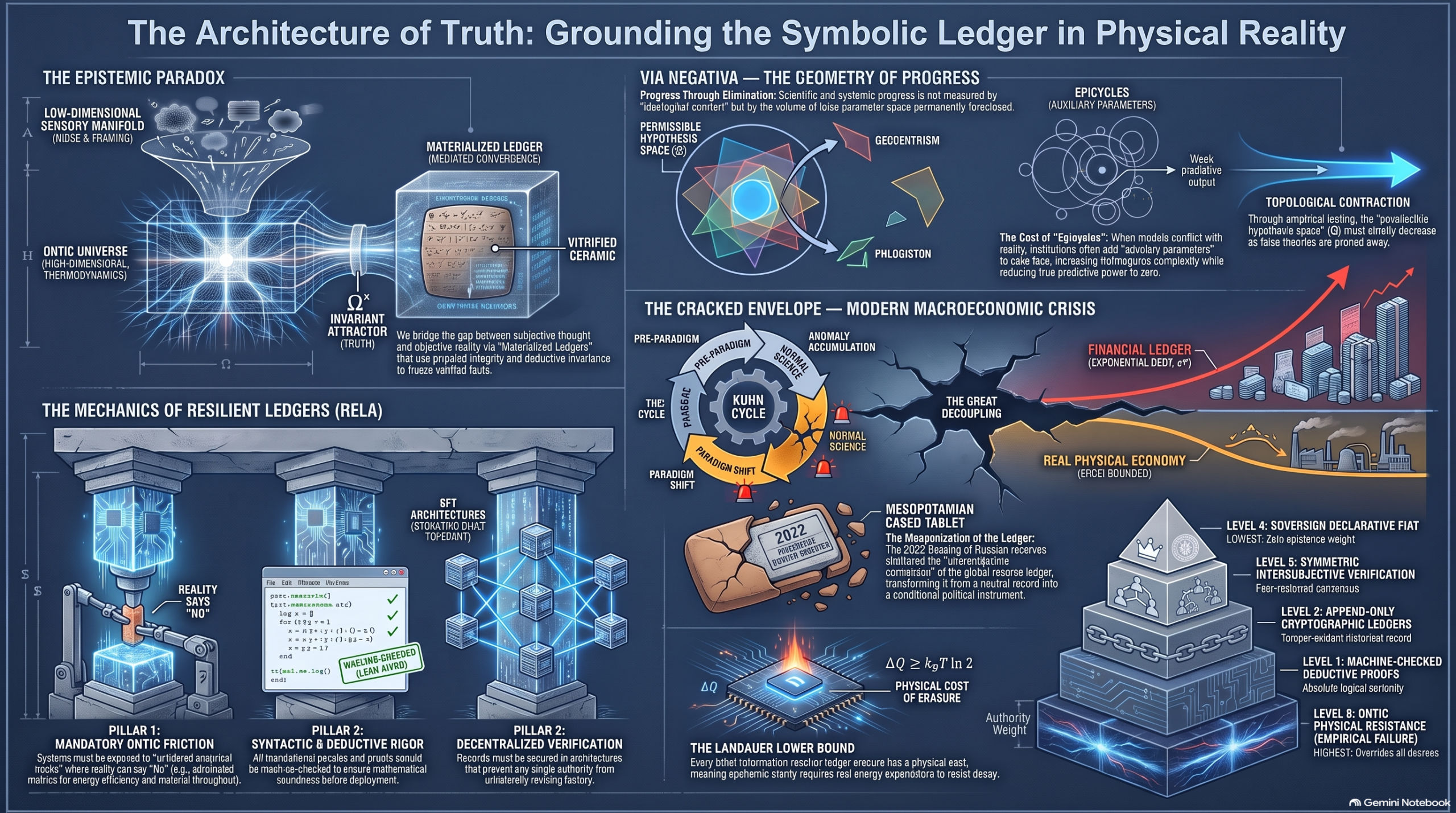
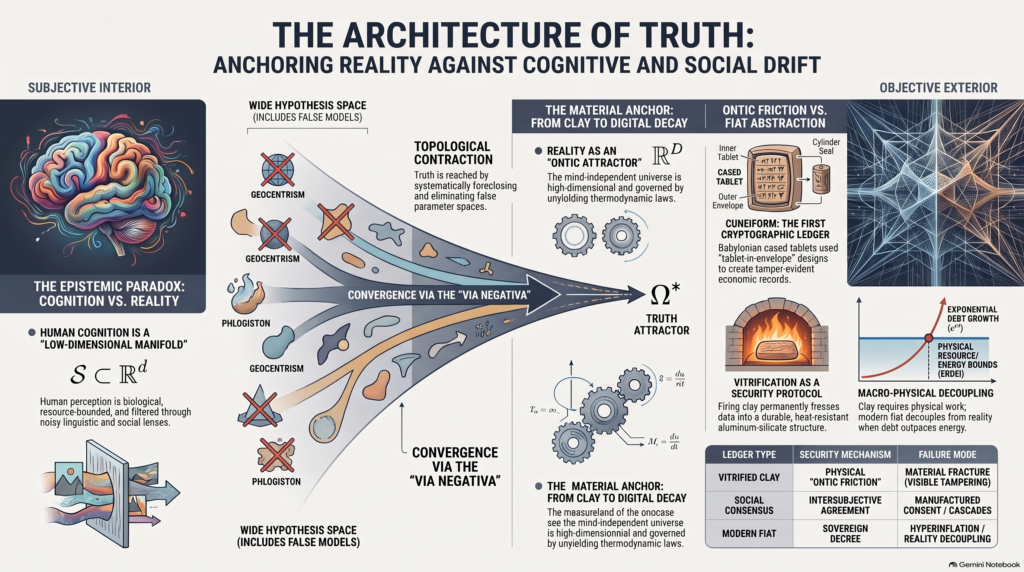
Human cognition is a resource-bounded biological process operating within a low-dimensional sensory manifold. This localized framing creates a catastrophic strategic tension with the mind-independent universe—an ontic reality (\mathcal{M}) that is high-dimensional, thermodynamically unyielding, and non-teleological. Because biological agents are prone to neurological noise and the distortions of linguistic framing, civilization requires “Materialized Ledgers” to prevent cognitive drift. These architectures function as an externalized anchor, freezing verified information into high-entropy physical substrates that resist the volatility of subjective negotiation and the entropy of human memory.
Dimensional Mismatch Analysis
The mathematical constraints of human perception are defined by the mapping where subjective experience \mathcal{S} is a subset of a low-dimensional space \mathbb{R}^d (where d \ll \infty). This “Low-Dimensional Framing” represents a lossy projection of the “High-Dimensional Ontic Reality” (\mathcal{M}). Because this projection drops significant dimensions, unmediated access to the ontic substrate is physically impossible. Truth is therefore not a static possession of the mind, but an invariant dynamical attractor (\Omega^*) toward which we converge by mediation.
The Via Negativa Methodology
Systems converge toward the “Ontic Attractor” (\Omega^*) through the Via Negativa: the systematic and irreversible truncation of false parameter manifolds. In this architecture, progress is measured not by the coherence of a narrative, but by the volume of hypothesis space we permanently foreclose. This process enforces three operational layers:
- Empirical Resistance (Ontic Friction): Reality acts as an unyielding boundary condition that falsifies flawed representations through structural failure.
- Deductive Consistency: The application of formal logical transformations to guarantee the lossless transport of truth-values across inferences.
- Tamper-Evident Intersubjective Ledgers: The externalization of claims onto physical substrates (vitrified clay, inscribed metals, or cryptographic silicon) that resist political revision.
Synthesis of Truthlikeness
Progress within this framework is defined by “Verisimilitude Accretion.” As the community of inquirers identifies and discards false parameter spaces, the distance between the remaining hypothesis space and the ontic attractor decreases. Truth is the asymptotic limit of this self-correcting process; it is the invariant core that remains stable across all valid projection angles. The inherent fragility of individual cognition—susceptible to bias and biological decay—forces the transition from private belief into collective, intersubjective validation through shared, material ledgers.
- The Pathologies of Consensus: From Signal to Manufactured Consent
Social consensus protocols possess a binary failure state: they function either as powerful error-correcting engines or as catastrophic amplifiers of systematic delusion. In modern institutional contexts, the strategic risk of “Epistemic Cascades” has reached a critical threshold, where communication channels are utilized to obfuscate rather than clarify reality.
The Condorcet Scaling Regime
The effectiveness of collective truth-seeking is governed by the Condorcet Jury Theorem, which delineates the mathematical divide between independent signal aggregation and correlated bias.
State Condition Outcome
Independent Signal Individual accuracy p > 0.5 \lim_{N \to \infty} P = 1 (Certain convergence to Truth)
Correlated Bias Individual accuracy p < 0.5 \lim_{N \to \infty} P = 0 (Certain convergence to Error)
Mechanics of Systemic Failure
When consensus engines decouple from independent signals, they enter specialized failure modes that prioritize institutional comfort over ontic accuracy:
- Information Cascades: Agents rationally ignore private signals (s_i) in favor of public history (H_t). Once the threshold is met, individual observations convey zero new information, and the system reaches a permanent equilibrium around a falsehood.
- Manufactured Consent: Institutional filtering ensures P_{public} \neq P_{private}. By suppressing dissenting signals, controllers create an artificial cascade that serves ideological preservation. This is often achieved by inflating a model’s Kolmogorov complexity K(\mathcal{H})—adding auxiliary parameters (m \to \infty) to fit anomalies—which reduces the model’s true predictive power to zero.
- Pluralistic Ignorance: The “Collective Defense of Recognized Fiction.” High social penalties force individuals to publicly endorse claims they privately know to be false, maintaining an institutional fiction through social fear.
The Habermasian Correction
To restore the truth-seeking function, the “Ideal Speech Situation” mandates four structural constraints as a game-theoretic protocol: (1) Universal Entry for all capable inquirers; (2) Symmetry in the standing to challenge propositions; (3) Absence of Coercion, where payoffs are determined solely by epistemic merit; and (4) Sincerity, requiring signals to match private beliefs. When verbal consensus fails these criteria due to institutional capture, civilization must anchor its truth in the unyielding friction of physical matter.
- The Mesopotamia Protocol: Cuneiform as Cryptographic Truth
The transition from abstract tokens to vitrified clay marks the birth of “Hard” information architecture. In ancient Mesopotamia, the need for invariant economic records led to the development of the “Mesopotamia Protocol,” where truth was vitrified into the substrate of the ledger itself.
The Materiality of Invariance
“Physical Vitrification” represented the first major advancement in institutional truth-preservation. By firing wet alluvial clay into kiln-baked aluminum-silicate, scribes created a high-entropy record that resisted the volatility of human memory and millennia of decay. This material transformation moved the record out of the fragile linguistic space and into the durable physical domain.
The Babylonian Cased Tablet (Tablet-within-an-Envelope)
The Old Babylonian period perfected a tamper-evident cryptographic protocol using the cased tablet. This architecture functioned through a series of “Judicial Fracture” steps:
- Inner Inscription: The core contract (M) was inscribed onto a primary tablet.
- Outer Encapsulation: A clay sheet was folded around the inner tablet, and the text was duplicated on this outer shell.
- Cylinder Seal Hashing: Unique cylinder seals—physical cryptographic signatures (\Sigma)—were rolled across the wet envelope.
The Anti-Tamper Test
The protocol relied on the “Strip” function (Strip(T_{env}) \equiv T_{core}). If a dispute arose, a magistrate would smash the outer envelope in public. Because the inner tablet was protected by the shell, it served as the immutable ground truth. If the T_{env} conflicted with T_{core}, fraud was exposed.
This “Judicial Fracture” is isomorphic to the “Cracking of the Envelope” in modern systems. In both instances, the physical destruction of the symbolic shell is the mechanism that reveals the underlying reality. This historical friction stands in stark contrast to modern symbolic ledgers, which lack such material anchors and are thus susceptible to infinite, ungrounded revision.
- The Thermodynamic Breach: Modern Fiat vs. Physical Reality
“Symbolic Decoupling” occurs when a ledger system attempts to operate independently of the physical world. A ledger that ignores the laws of thermodynamics inevitably enters a “Model Crisis,” as symbolic claims on wealth eventually collide with the finite Energy Return on Energy Invested (EROEI) of the physical environment.
The Exponential/Thermodynamic Divergence
The modern financial system is characterized by a mathematical mismatch between the growth of symbolic debt and real thermodynamic surplus.
- Symbolic Claims: Grow exponentially as e^{rt} through compounding interest.
- Thermodynamic Surplus: Bounded by \Delta E_{net} and the EROEI of primary fuels.
We are currently witnessing a “Model Crisis” as global EROEI declines from conventional ratios (30:1) toward lower-efficiency sources (10:1). As the energy required to service symbolic claims outpaces the energy the economy can generate, the ledger must fracture.
The Kuhn Cycle of Macroeconomics
Macroeconomics currently mirrors the Kuhn Cycle. It has transitioned from “Normal Science” into “Model Drift,” adding “epicycles” such as Quantitative Easing (QE) and ZIRP to patch over structural anomalies. This hyper-parameterization has reached its limit; we are now witnessing the “Cracking of the Envelope,” where these monetary patches fail to hide underlying insolvency.
The Weaponization of the Global Ledger
The 2022 freeze of foreign exchange reserves marked a transformative “Warrant Failure” in the global ledger. By transforming reserve assets into conditional political instruments, the “Ledger Neutrality” essential for intersubjective consensus was shattered. This loss of trust forces a systemic return to “Outside Money”—physical gold and commodities—which possess no counterparty risk and cannot be erased by an issuing authority. This collapse is an inevitable “Parameter Foreclosure” of unconstrained fiat illusions by the unyielding laws of physics.
- Specifications for a Resilient Epistemic Architecture (RELA)
The next civilization-scale ledger must migrate from “Institutional Fiat” to “Ontic Friction.” This architecture must be designed to resist institutional capture by grounding every entry in the physical and logical constraints of the universe.
Pillar 1: Mandatory Ontic Friction
RELA enforces “Automated Falsification Hooks” and “Biophysical Accounting.” Financial projections must be rejected at the structural level if they violate mass-energy balances. Furthermore, the architecture recognizes that truth is not free; it has a minimum thermodynamic cost. Following Landauer’s Principle, any belief-state reset or falsification logging must dissipate a minimum quantity of energy: \Delta Q \ge k_B T \ln 2. Epistemic clarity requires physical work to resist the entropy of misinformation.
Pillar 2: Syntactic and Deductive Rigor
To prevent the proliferation of epicycles, RELA mandates “Algorithmic Parsimony.” All foundational proofs must be encoded using formal proof kernels (such as Lean 4). This ensures that deductive derivations are machine-checked and mathematically sound before they can be utilized for policy, preventing the accumulation of the logical errors that characterize current model drift.
Pillar 3: Decentralized BFT Verification
The architecture must be “Byzantine Fault Tolerant” (BFT), assuming that a fraction of the network (up to f < N/3) is compromised or dishonest. By utilizing cryptographic silicate or silicon ledgers, RELA ensures that historical records are append-only and tamper-evident, preventing any sovereign from unilaterally revising the ledger.
The SSOT Precedence Hierarchy
RELA resolves all conflicts through a strict 5-level “Source-of-Truth Hierarchy”:
- Level 0: Ontic Physical Resistance. The apex arbiter. Empirical failure or material fracture overrides all downstream models. If a bridge collapses, the collapse is the authoritative datum, regardless of the blueprints or political decrees.
- Level 1: Automated Machine-Checked Deductive Proofs. (Lean 4/Coq verification).
- Level 2: Append-Only Cryptographic Ledgers. (BFT state transitions).
- Level 3: Symmetric Intersubjective Peer Verification. (Mertonian CUDOS norms).
- Level 4: Sovereign Declarative Fiat. (Zero epistemic weight).
Humanity survives by systematically discarding the “Cracked Envelopes” of what is demonstrably false. While we may never possess the “View from Nowhere,” we anchor our survival in the disciplined practice of materialized error reduction, bringing our systems into closer, unyielding alignment with the objective world.