Beyond the “Ask AI” Button: How WordPress 7.0 is Quietly Rebuilding for the Agentic Web
For years, integrating AI into WordPress has felt like a desperate land grab. Site owners and developers have been forced into a chaotic “Wild West” of fragmented API keys, bloated proprietary plugins, and the looming threat of vendor lock-in. If you hard-coded your workflow around a specific version of OpenAI or Anthropic last year, you likely spent this year managing technical debt as those models shifted. This is the “Ask AI” era: a fragile layer of generative hype taped onto a traditional CMS.
WordPress 7.0 signals the end of this fragmentation. We are moving from a platform that simply uses AI to one that hosts the infrastructure for it. This isn’t just about adding new buttons; it is a fundamental architectural pivot designed to ensure long-term sustainability. By standardizing how the web communicates with intelligence, WordPress is positioning itself as the central nervous system for the “agentic web.”
The End of “API Key Chaos” Through Standardized Architecture
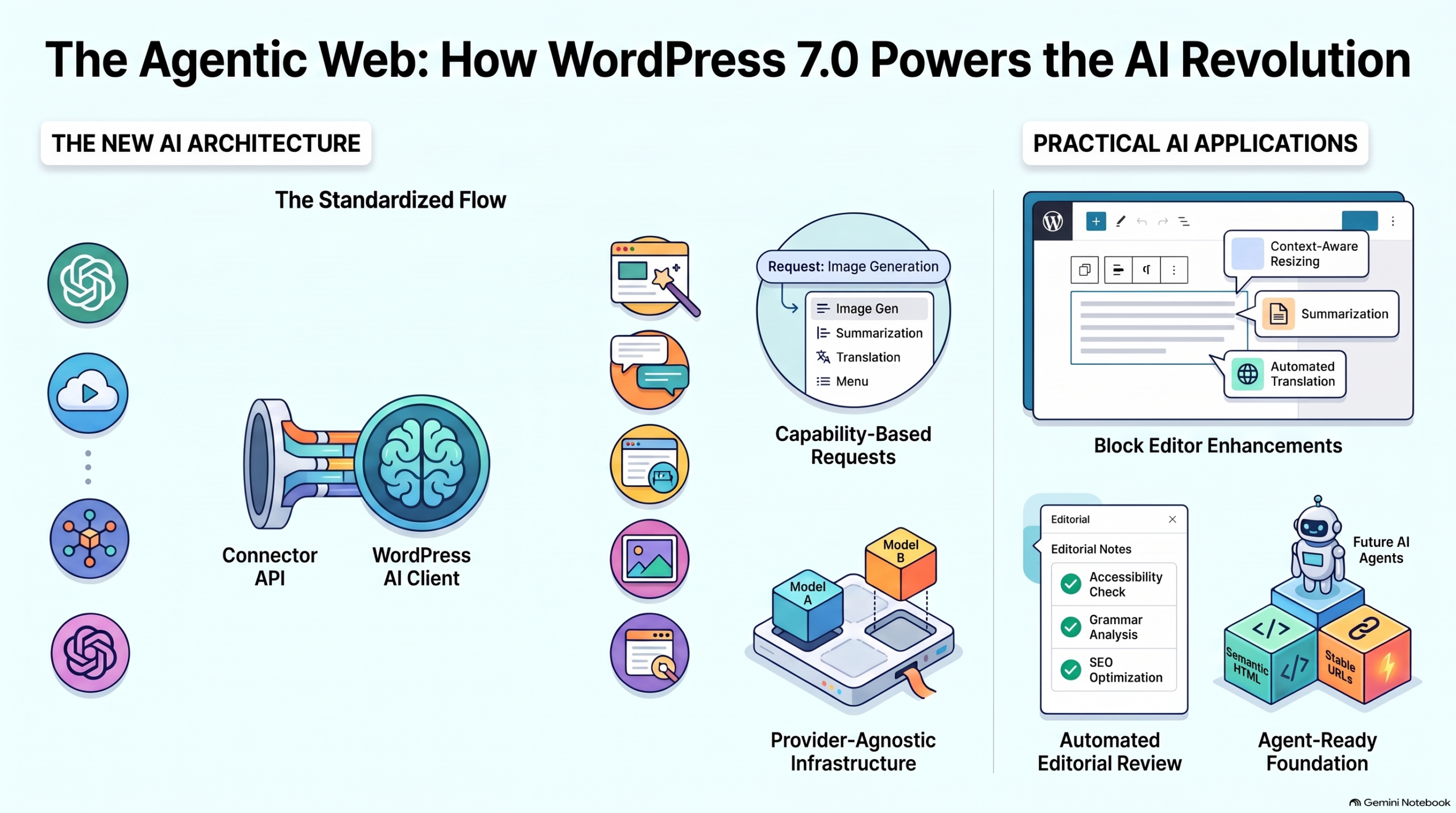
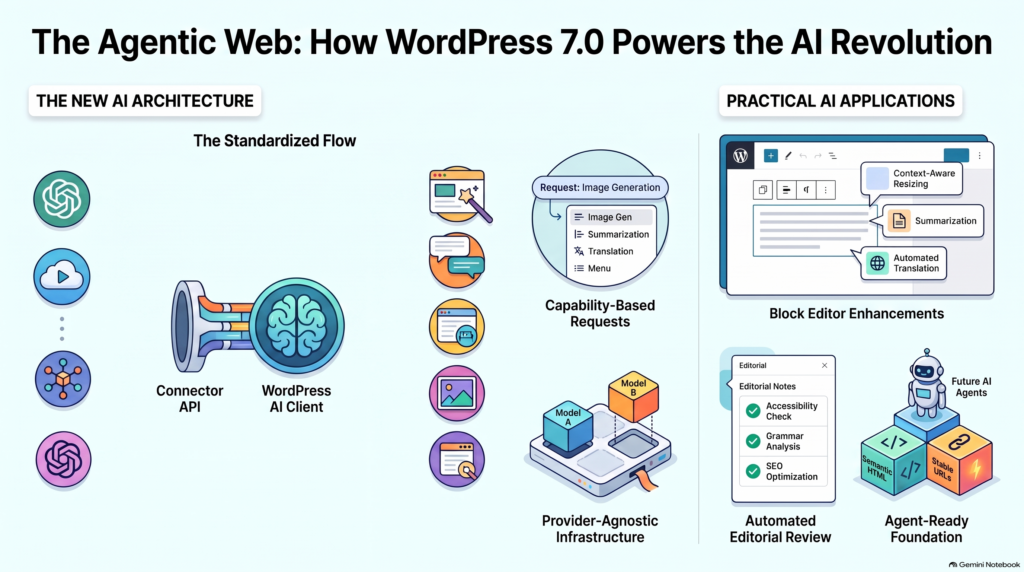
The most urgent shift in WordPress 7.0 is the introduction of the AI Client and the Connectors API. Historically, every AI-powered plugin required its own bespoke configuration, leading to a maintenance nightmare. Version 7.0 solves this by positioning WordPress as a standardized “middleman” that handles model communication at the core level.
Instead of hunting for settings across dozens of plugin menus, administrators now have a unified Settings → Connectors screen. This centralized hub handles credentials for initial “featured connectors” like Anthropic, Google, and OpenAI. By decoupling the provider from the feature, WordPress eliminates vendor lock-in. If a provider changes their terms or performance dips, you swap the connector at the site level, and every plugin on your site follows suit. As the architectural blueprint suggests:
“relatively simple architecture: AI provider → AI Connector → WordPress AI Client → AI-powered feature”
Why “Capabilities” are More Important Than “Models”
From a strategic standpoint, the most brilliant move in 7.0 is the shift toward “capability-based” requests. A thought-leading developer no longer writes code that asks for “GPT-4o.” Instead, they build features that request a specific capability, such as “text generation.”
This is essential for future-proofing against the inevitable depreciation of specific LLM versions. When your site requests a capability rather than a brand, it becomes durable. You are building for a three-year roadmap rather than next week’s API update. Primary examples of these standardized capabilities include:
- Text Generation: Powering everything from summarization to real-time translation.
- Vision-based Image Analysis: Enabling the system to “see” and describe media assets.
- Image Generation: Creating or modifying visual content directly within the block editor workflow.
AI as the New “Editorial Layer,” Not Just a Ghostwriter
The AI plugin for WordPress functions as a working laboratory for these APIs, specifically shifting the focus from AI as a “ghostwriter” to AI as a professional “editorial layer.” This transition moves us away from the low-value trap of bulk content generation and toward high-value refinement and quality control.
Experiments like Editorial Notes analyze content block-by-block, providing critical feedback on Accessibility, Readability, Grammar, and SEO.
The Editorial Updates feature then allows these suggestions to be applied automatically. This is particularly vital for tasks like Alt Text Generation, where the system uses vision models to suggest descriptions. However, WordPress 7.0 maintains a grounded perspective: human review remains non-negotiable because effective alt text depends entirely on the context and intent of the post, a nuance that pure automation often misses.
The Agentic Web Reality Check
While the Connectors API allows WordPress to “see” and “use” external AI models, version 7.0 also introduces the Abilities API and the MCP (Model Context Protocol) Adapter. These are the bridges for the “agentic web,” allowing external agents—like a local Claude Desktop or an autonomous research bot—to “see” and “use” WordPress functions.
However, we must face a strategic reality check. As Miriam Schwab aptly noted:
“WordPress is ready for the agentic web, but our ecosystem isn’t.”
The core infrastructure is now in place to expose WordPress “abilities” to the world via the MCP Adapter, but the vast majority of the plugin ecosystem is not yet exposing meaningful capabilities. The framework exists, but the “muscles” of the ecosystem have yet to be connected to this new nervous system.
The Surprising Power of “Old School” Web Standards
There is a common myth that we need exotic new formats like llms.txt or dedicated Markdown mirrors to be “AI-ready.” The reality is more grounded: the most effective way to prepare for AI agents is to double down on semantic HTML and stable URLs.
Structure is the language of AI. Agents currently prioritize existing semantic hierarchy and structured data over experimental, agent-specific formats. In practice, this means that the same clean code that wins at SEO now wins at “AIO” (AI Optimization). The Abilities API and MCP Adapter succeed precisely because they rely on the same logical structure that high-quality HTML provides. Good accessibility and proper heading hierarchies are no longer just “best practices”—they are the technical requirements for being discoverable in an agent-driven economy.
Conclusion: A Foundation for What Comes Next
The experiments we see today—title generation, content resizing, and alt-text suggestions—are merely the surface-level demonstrations of a seismic architectural shift. WordPress 7.0 is not trying to win the AI feature war; it is winning the AI infrastructure war. By creating a provider-agnostic foundation that prioritizes durable capabilities over fleeting models, WordPress has secured its relevance for the next decade.
The question for digital strategists and site owners is simple: Are you still chasing the hype of the latest “Ask AI” button, or are you ready to start building on a durable, agentic infrastructure?