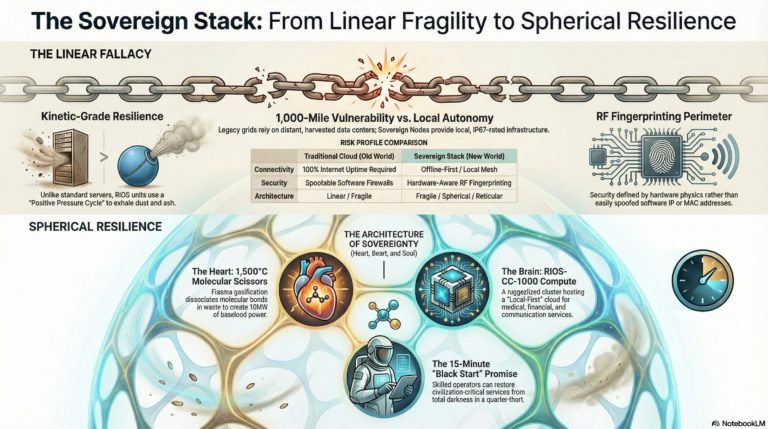
The Life Cycle of a Sovereign Node: From Spoken Word to Field Deployment
The transition to the Generation 5 (Gen 5) Systems Architecture marks a critical evolution in mobile connectivity. By consolidating disparate hardware into vertically integrated products like the WISP-in-a-Box series (Products 1 and 2), the Sovereign Stack Consortium has replaced “Connectivity Chaos” with industrial-grade reliability. This document traces the architectural journey of a Sovereign Node—specifically the RIOS-NL-01—from initial intake through surgical modification to final air-gapped deployment.
- The Digital Handshake: AI-Driven Intake
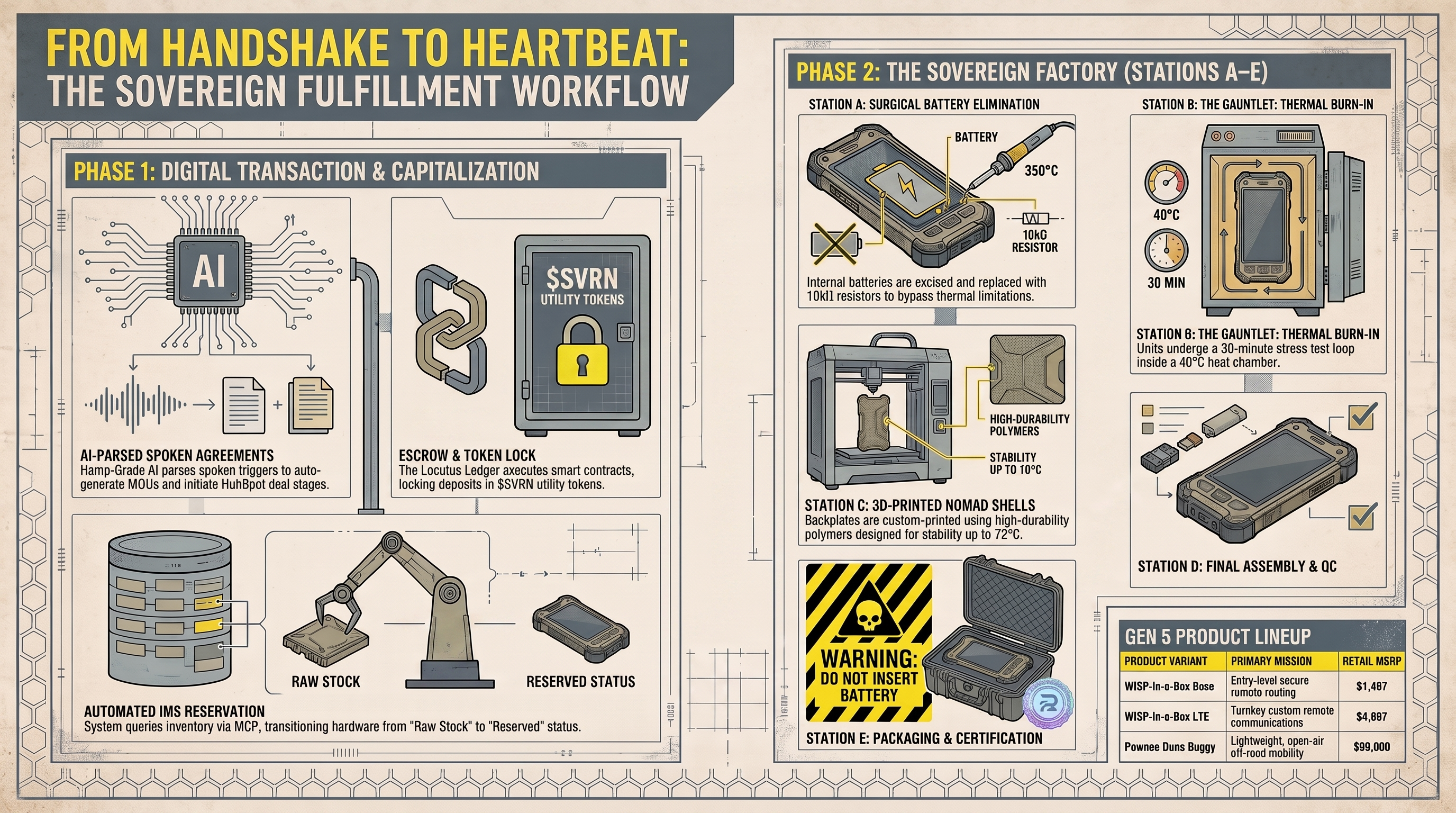
The lifecycle begins with the elimination of clerical friction. In high-stakes industrial deployments, manual data entry is a point of failure. We utilize “Hemp-Grade AI” to bridge the gap between human agreement and digital execution. During a live session, the AI monitors for specific architectural triggers—the most vital being the phrase, “Lock this structure.”
Upon detection, the system autonomously parses the technical requirements, generates a Microsoft Word Memorandum of Understanding (MOU), and establishes a structured “Deal” within the HubSpot CRM. This ensures the 100% duty cycle requirements and technical specifications discussed are captured with zero human transcription error.
Process Highlight: AI Parsing for Transaction Speed and Accuracy By utilizing Hemp-Grade AI to interpret spoken agreement triggers, the system removes traditional clerical bottlenecks. This ensures that the fulfillment pipeline is triggered with absolute precision, allowing manufacturing protocols to commence the moment the digital record is established.
This instantaneous digital record acts as the authoritative source for the subsequent financial and hardware allocation layers.
- The Smart Contract Escrow: Securing the Transaction
Once the HubSpot Deal is live, the transaction enters the “Programmable Fulfillment” phase managed by InVentures Treasury. We bypass the delays and “Inverter Drain” of traditional credit systems—which rely on centralized bank authorizations—by utilizing the Locutus Ledger.
The Treasury executes a smart contract that locks $SVRN utility tokens (or their fiat equivalent) into an escrow layer. This lock is more than a payment; it is a “guaranteed booking” that secures the hardware SKU in the Inventory Management System (IMS). This ensures that capital is reserved and production is capitalized before the first solder joint is ever made.
Feature Traditional Payment Processing Locutus Ledger Escrow
Verification Speed 2–5 Business Days (Manual) Instantaneous / Block-time
Security Layer Centralized Bank Authorization Decentralized Smart Contract
Assurance Level Subject to chargebacks/holds Guaranteed $SVRN Token Lock
Fulfillment Trigger Manual clerk verification Automated trigger upon escrow lock
Successful financial confirmation triggers a HubSpot “Run Agent” workflow, which queries the IMS via the Model Context Protocol (MCP) to move the RIOS-NL-01 from “Raw Stock” to “Reserved.”
- The Sovereign Factory: Phase I (Triage & The Forge)
Physical transformation occurs at the Node 3 Workshop in Arizona. The assembly line is divided into specialized stations designed to maximize mechanical integrity.
Station A: The Boneyard (Intake & Triage) Technicians retrieve raw SLG-06 modems and execute a three-step triage to ensure only Tier-1 silicon enters the modification phase:
- Intake: The manufacturer serial number is scanned into the IMS for lifecycle tracking.
- Functional Check: The unit is powered via a temporary battery to verify LCD activation and SSID broadcast.
- Firmware Check: Carriers are verified for locks. Units failing these checks are immediately routed to Bin F for spare parts harvesting or the Software Bench for IMEI unlocking.
Station B: The Forge (3D Printing) While internals are verified, Station B manufactures the external “Nomad Shell.” Using high-durability polymer filaments, we 3D-print a custom, honeycomb-ventilated backplate. This design is an engineering requirement for the “windshield greenhouse” effect; the shell maintains structural integrity up to 75°C, providing the necessary thermal buffer for units operating in extreme solar environments.
With the shell and internal hardware validated, the unit moves to the surgical stage of the pipeline.
- The Surgical Modification: Eliminating the “Spicy Pillow”
The technical heart of the Sovereign Node is the Battery Elimination Circuit (BEC). Standard consumer hotspots rely on lithium-ion batteries that swell and fail—the “Spicy Pillow” effect—when exposed to 100% duty cycles and high heat. At Station C (The Operating Table), we perform a total battery evacuation to create a solid-state, vehicle-ready cellular compressor.
Using a soldering iron set to exactly 350°C, technicians implement the following modifications:
- Removal of Lithium-Ion Core: The battery is excised and placed in a HAZMAT bin, eliminating the risk of thermal runaway.
- 10kΩ Resistor: Soldered between the motherboard’s BSI (Battery Status Indicator) pin and the Negative (-) terminal. This spoofing resistor tricks the CPU into detecting a healthy, 100% charged battery, bypassing boot-loop safeguards.
- Mini-360 DC-DC Buck Converter: This tuned converter is soldered to the positive and negative terminals and secured to the board with heat-resistant Kapton tape.
This modification enables the system to run Direct-to-12V, solving the “Inverter Drain” problem where standard AC-dependent hardware wastes significant battery capacity through inefficient power conversion.
- The Gauntlet: Stress Testing & Quality Assurance
Every modified unit must survive Station D (The Gauntlet). We test to the limits of the silicon itself (~60°C operational ambient) to ensure field reliability.
The protocol begins with a “Smoke Test” (instant 12V DC application). If the device fails to boot or display “Battery: 100%,” technicians initiate Protocol Red, which requires desoldering the components and re-verifying the BSI resistor’s resistance. Data integrity is then verified by connecting the unit to a Linux test terminal via USB-C.
Pass/Fail Criteria Checklist:
- [ ] Power-On: Device boots instantly upon 12V application via the power whip.
- [ ] Battery Spoofing: LCD indicates a constant “100%” charge status.
- [ ] Interface Recognition: check_rndis.sh confirms the device is recognized as a network interface (usb0/eth1).
- [ ] Connectivity Ping: Successful data loop to 8.8.8.8 via the internal vSIM network.
- [ ] Thermal Burn-In: 30-minute high-load speed-test loop at 40°C in a heat chamber with zero reboots or thermal throttling.
Units that survive the Gauntlet receive a serialized “DeReticular Modified” tamper-evident void seal.
- Kitting & Secure Dispatch
At Station E (The Outpost), the hardware is paired with its specific owner. This process transitions the unit from an industrial component to a customer-ready asset, locking in the 90-day sovereign modification warranty.
What’s In The Box (RIOS-NL-01):
- Modified Nomad Link Unit: Encased in an anti-static bag and housed in the 3D-printed honeycomb Nomad Shell.
- 3ft Fused Hardwire Power Whip: Engineered for direct connection to vehicle DC buses (12V–48V).
- 6-inch High-Speed USB-C Cable: For high-bandwidth data tethering.
- The Warn-Card: A high-visibility yellow card explicitly stating: “DO NOT INSERT BATTERY.”
The logistics bench scans the holographic SKU label, pairing the unit’s serial number with the customer’s HubSpot record before dispatch via USPS/UPS.
- Field Installation: The Certified Specialist & Final Settlement
The final stage of the lifecycle is the hand-off to a certified RCT – Mobile Specialist. Because the system is hardwired into the vehicle’s DC bus, professional installation is required to maintain system integrity.
The “Sovereign Release” mechanism is the final layer of our automated pipeline. Unlike traditional service models where technicians wait weeks for payment, our system uses telemetry-triggered smart contracts.
Entity Role & Responsibility Output / Artifact
HubSpot CRM Monitors carrier delivery and coordinates technician dispatch. Dispatch Notification
RCT Specialist Performs hardwired 12V installation and verifies telemetry sync. Installation Log
Locutus Ledger Detects “Heartbeat” telemetry from the newly installed unit. Automated Fee Release
Crucially, the release occurs the moment the device writes its initial heartbeat to the local ledger. This ensures that even in air-gapped or remote environments, the technician is compensated automatically once the system is functionally online.
- Summary of the Sovereign Advantage
The Gen 5 Sovereign Node lifecycle replaces the “Traditional Consumer Patchwork” with a vertically integrated, small-batch manufacturing process. This pipeline ensures that every RIOS-NL-01 and WISP-in-a-Box unit is prepared for 100% duty cycle operations in the most demanding mobile environments.
- Industrial-Grade Reliability: Our solid-state, battery-free design eliminates thermal runaway risks and “Inverter Drain,” ensuring the system stays online as long as the vehicle has power.
- Thermal Resilience: The honeycomb-ventilated Nomad Shell and high-quality BEC components allow the hardware to operate at the absolute limits of silicon, surviving dashboard temperatures that would destroy consumer gear.
- Professional Support & Fulfillment: By integrating AI-driven intake with a certified installer network and ledger-backed payments, we provide a “closed-loop” experience that prioritizes uptime for the modern nomad.