Strategic Operations Manual: Integrated Sovereign Eradication Framework (Guam)
- Strategic Foundation & Mission Directive
The persistence of the invasive brown tree snake (Boiga irregularis) on Guam represents a systemic failure of traditional “cost-plus” administrative suppression models. For decades, federal and territorial efforts have relied on open-ended labor contracts and localized containment that prioritize process over definitive outcomes. This manual defines a strategic pivot to the “Sovereign Eradication” model: an outcome-driven, high-technology framework designed to transition Guam from perpetual suppression to a definitive, audited state of biosecurity.
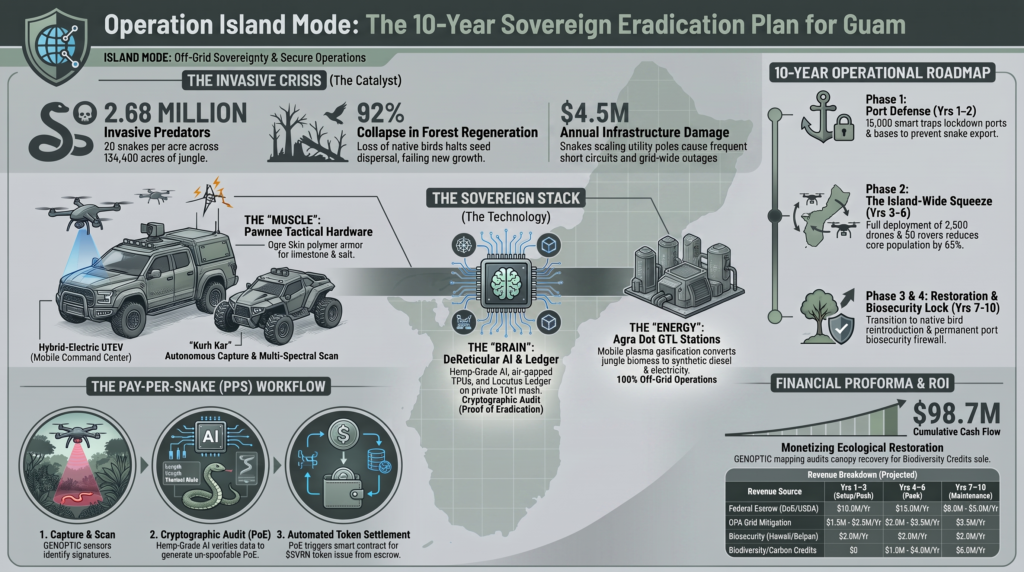
This framework is necessitated by an island-wide population density of 20 snakes per acre, resulting in an estimated 2.68 million specimens across Guam’s 134,400 acres of jungle. The current infestation imposes a $4.5 million annual burden on the Guam Power Authority (GPA) due to grid damage caused by “lasso locomotion” scaling of utility poles. Ecologically, the island has faced a near-total collapse of native avifauna, leading to a 92% decline in tree seedling recruitment. Furthermore, Guam serves as a high-risk launchpad for regional export; colonization of Hawaii carries an estimated annual liability between $456 million and $761 million. These combined factors justify the $101.5 million program expenditure not as a recurring cost, but as a “Biosecurity Insurance” one-time premium to permanently mitigate multi-billion-dollar long-term risks.
Unified Mission Statement The Sovereign Eradication Framework integrates the specialized capabilities of the DeReticular Pawnee Group into a single directive: To deploy an air-gapped, robotic, and artificial intelligence-driven ecosystem that eliminates the invasive brown tree snake population through a performance-linked treasury model, ensuring the permanent restoration of Guam’s biodiversity and infrastructure integrity.
This mission is executed on the ground through a sophisticated layer of physical hardware designed for Guam’s most unforgiving environments.
- The Physical Mechanical Layer: Tactical Hardware “Muscle”
Traditional vehicles consistently fail in the “Prey Abundance Trap.” On Guam, high-quality live prey is so abundant that snakes ignore passive baits, rendering traditional trapping ineffective. Active intervention via mobile robotics is the only viable path to eradication. However, Guam’s terrain—comprised of abrasive limestone that acts like industrial sandpaper and corrosive volcanic clay—rapidly degrades unprotected steel-alloy control arms and aluminum skid plates. To bridge this terrestrial materials deficit, our hardware utilizes marine-grade titanium fasteners and quick-swap modular suspension segments for high-tempo field repairability.
Tactical Hardware Fleet
Platform Name Technical Specifications Operational Role
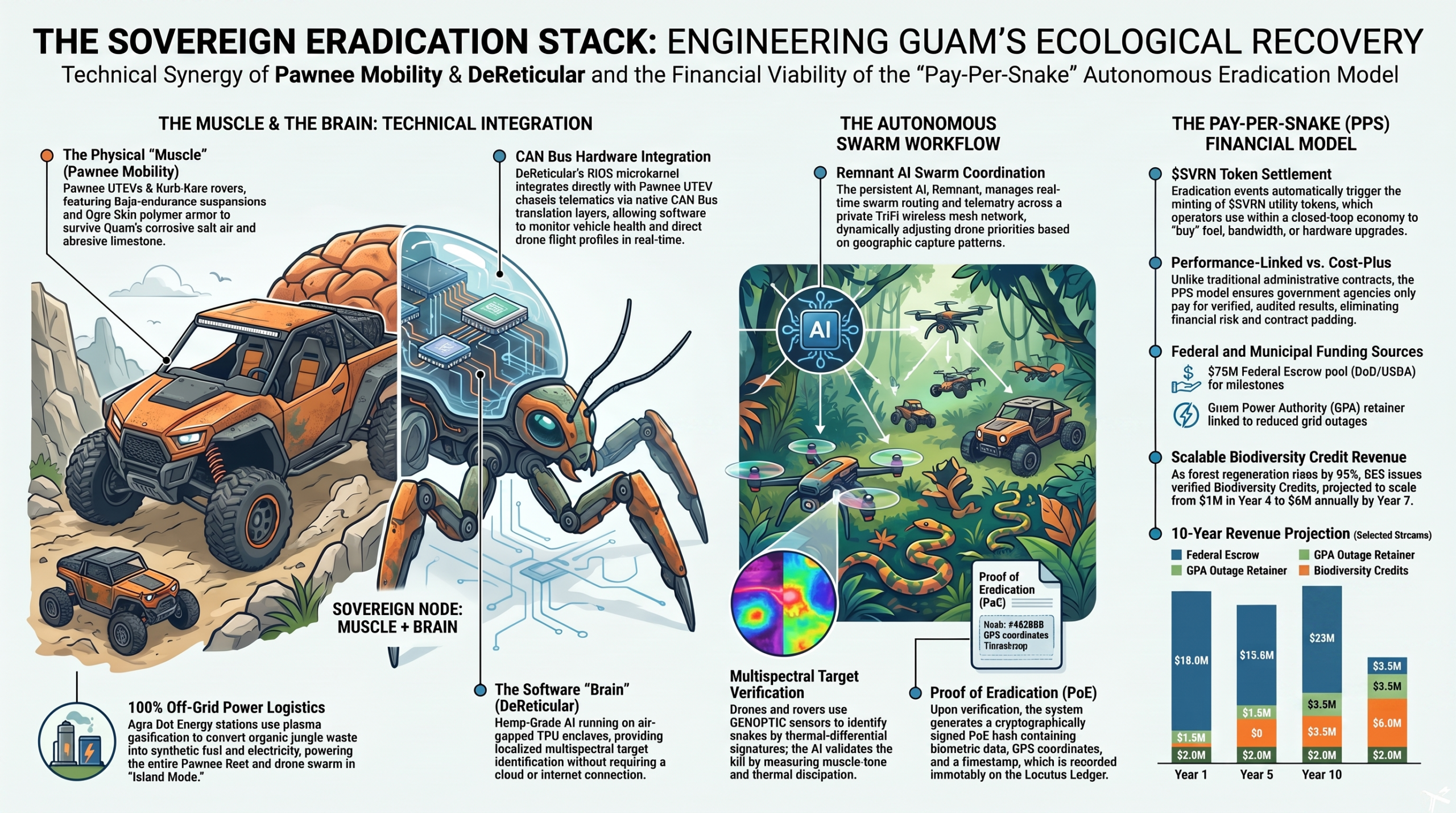
Pawnee UTEV (MTCC) Range-extended hybrid-electric; high-output rotary engines; quick-swap modular suspension. Mobile Command Hub: Forward base for drone docking, automated rapid recharging, and edge-computing enclaves.
Kurb Kar Rover Rugged, low-signature autonomous ground vehicle; fitted with Ogre Skin armor. Specimen Retrieval: Traverses the forest floor to harvest targets and process them through internal imaging bays.
GENOPTIC Drone VTOL (Vertical Take-Off and Landing); carbon-fiber frames; multispectral camera payloads. Aerial Swarm: Executes active canopy target capture and large-area nocturnal surveillance.
The Strategic Role of Ogre Skin Armor The “Ogre Skin” polymer-composite armor is the critical component in maintaining a 10-year hardware lifecycle. Unlike standard aluminum plating, Ogre Skin is self-lubricating and non-corrosive, allowing the chassis to slide over jagged limestone without structural scraping. This barrier is essential to combat galvanic corrosion caused by the 84% relative humidity and salt-vapor saturation of the northern interior. By utilizing these specialized materials, we ensure the fleet meets its rigorous 1,500-hour engine service and annual suspension overhaul schedule despite the environmental wear-and-tear.
These physical platforms, however, are inert without the software intelligence described in the next section.
- The Edge Computing & Software Layer: The “Brain”
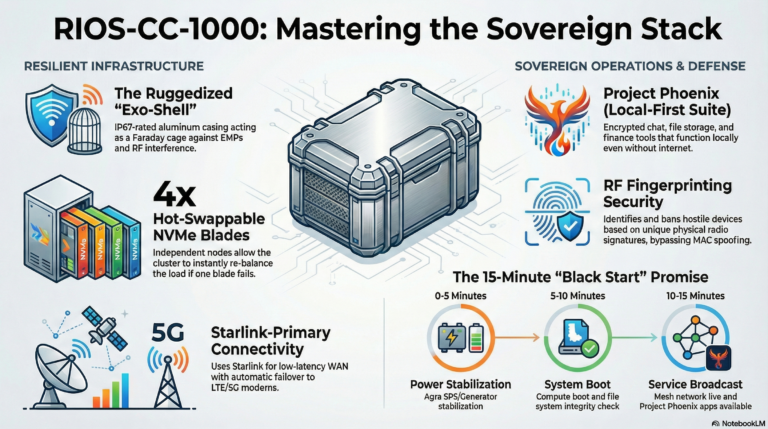
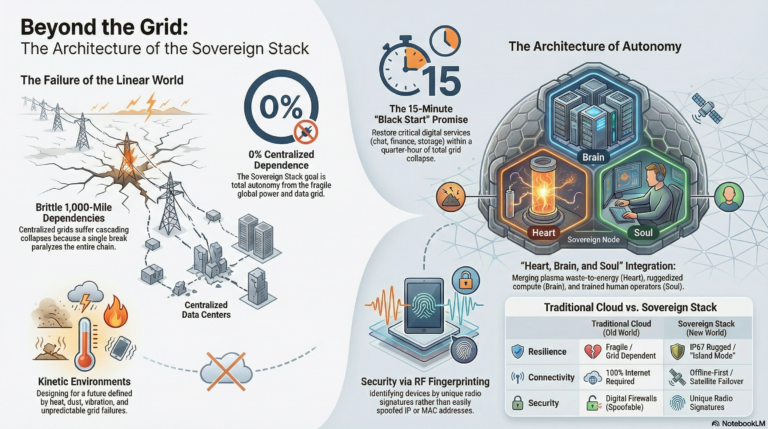
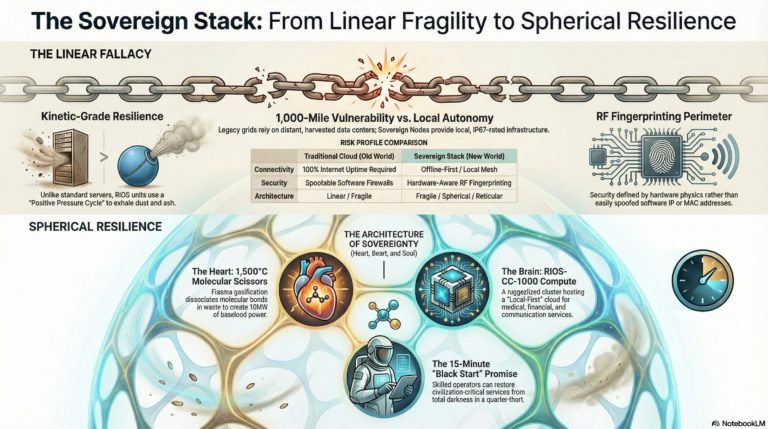
To operate in a remote, typhoon-prone, and militarized strategic zone, the framework utilizes “Island Mode”—a total air-gapped sovereignty. Relying on public cloud infrastructure or the local grid is a catastrophic vulnerability; instead, the system functions as a private enclave that remains operational even during regional infrastructure failures.
Hemp-Grade AI Architecture The “Brain” utilizes Hemp-Grade AI, a ruggedized architecture consisting of Convolutional Neural Networks (CNNs) optimized for high-frequency visual noise filtering. Running localized inference on Tensor Processing Units (TPUs) embedded in the hardware, the system maintains 24/7 nocturnal operations. It specifically identifies the “thermal-differential signature” of the cold-blooded brown tree snake against rain-cooled leaves and shifting shadows, environments where visible-spectrum optics fall to less than 15% efficiency.
The TriFi Wireless Mesh Machine-to-machine coordination is facilitated by the TriFi Wireless Mesh. This private data fabric utilizes ruggedized solar relays and 2.4/5.8GHz transceivers to maintain high-bandwidth communication through dense, water-logged forest canopies. It ensures the robotic fleet shares real-time telemetry without exposing sensitive data to external networks.
This localized intelligence enables the specific verification protocols that translate raw sensing into economic units.
- The Proof of Eradication (PoE) Verification Protocol
Strategic “fraud-proof auditing” is essential to eliminate double-counting, “bounty spoofing,” or the re-submission of synthetic/old specimens. The framework utilizes a hardware-anchored protocol where every dollar spent corresponds to a verified, newly neutralized specimen.
The 4-Step Verification Sequence
- Multi-Spectral Scan: The specimen is captured in thermal, near-infrared, and high-resolution visible light to confirm organic origin.
- Biometric Profile: The AI measures length, volume, and weight while analyzing unique lateral scale patterns to prevent duplicate entries.
- State Verification: The system monitors muscle tone, body posture, and thermal dissipation over a set timeframe to ensure the target is organic and newly neutralized rather than a synthetic duplicate.
- Cryptographic Hash: A unique Proof of Eradication (PoE) certificate is generated, signed by Hardware-Rooted TPM Chips at the lens level.
This verification ensures that the video stream is signed at the moment of capture, making the data un-spoofable. Once verified, the PoE is submitted to the ledger for financial settlement.
- Energy Sovereignty & Off-Grid Logistics
Logistics in roadless jungles require localized “Sovereign Nodes” to avoid vulnerable external supply lines. The framework utilizes mobile Agra Dot Energy modules to maintain operation in the deep interior.
Plasma Gasification and Micro-GTL Localized power is generated via a mobile plasma gasification and Micro-GTL (Gas-to-Liquid) process. This system transforms materials into ASTM-grade synthetic fuel and electricity:
- Input Materials: Jungle biomass, discarded tires, and municipal waste.
- Outputs: ASTM-grade synthetic diesel for rotary engines and high-output electrical power for drone recharging.
Modular Forward Support By transitioning from stationary plants to trailer-mounted modular stations, we support the swarm as it penetrates the roadless interior. These mobile units serve as forward fueling and recharging nodes, ensuring the robotic fleet can maintain operations for years without returning to centralized bases for energy.
- The Pay-Per-Snake (PPS) Economic Architecture
The “Performance-Linked Treasury Model” buys “guaranteed ecological outcomes” rather than open-ended labor. Capital is held in a USD-backed federal escrow fund and disbursed only upon the commitment of a verified PoE to the ledger.
Closed-Loop Utility Token Marketplace
Cohort Member Strategic Business Function Revenue Model Integration
InVentures Capital Fund Custody & Treasury Manages federal escrow; provides 1:1 USD-backed liquidity for tokens.
DeReticular AI & Ledger Licensing Collects transaction fees in $SVRN per PoE processed.
Pawnee & Kurb Kars Field Operations Earns $SVRN tokens for every verified, audited eradication.
Agra Dot Energy Resource Supply Earns $SVRN by selling ASTM-grade fuel and power to operators.
Infrastructure (TriFi/Ogre) Data & Hardware Supply Earns $SVRN by leasing bandwidth and protective armor plates.
The Split-Ledger Gateway The system utilizes a “Split-Ledger Gateway.” Internally, the economy functions using $SVRN utility tokens, allowing members to “buy back” resources (fuel, bandwidth) and recirculate capital entirely within the cohort to eliminate third-party banking fees. Externally, federal auditors see standard fiat settlements from the escrow account, ensuring full FAR compliance while maintaining high-velocity internal settlement.
- Phased Roadmap & Long-Term Biosecurity
Eradication is executed through a “Containment -> Squeeze -> Audit -> Lock” methodology to clear and secure geographic zones.
Operational Timeline: Years 1–10
- Years 1–2 (Containment): Focus on Andersen AFB, Apra Harbor, and the Asan Beach triangular peninsula. Deployment of vinyl and electrical exclusions and 15,000 smart traps to prevent hitchhiking export.
- Years 3–6 (Active Squeeze): Heavy swarming in Northern and Central Guam. Deployment of 2,500 drones and 50 Kurb Kars to process up to 800,000 snake eradications annually.
- Years 7–8 (Audit & Restoration): Transition to smart-trap monitoring as population falls below 5%. Initiation of native bird (Såli) reintroduction in audited northern havens.
- Years 9–10 (Biosecurity Lock): Establishment of a permanent smart-trap network at all ports of entry to prevent re-colonization. The system is then transitioned for export to other regional invasive species markets.
Current Status and Delivery The Sovereign Eradication Framework is currently at Technology Readiness Level (TRL) 6. All primary subsystems have been proven in relevant environments. The program is on a 3-month timeline to deliver a physical Proof of Concept (POC) demonstrating full off-grid eradication and cryptographic verification on Guam.