The Future of Commerce: An Essential Guide to the Agentic Economy
- The Fundamental Shift: From “Click-and-Buy” to A-Commerce
The global digital economy is undergoing a structural paradigm shift, moving away from legacy, human-centric “click-and-buy” interfaces toward autonomous, machine-centric Agentic Commerce (A-Commerce). This is not merely a change in user experience; it is a fundamental re-engineering of the economic actor. In this emerging paradigm, AI software agents serve as autonomous economic proxies, navigating the entire transaction lifecycle—discovery, technical negotiation, contract execution, and financial settlement—without real-time human intervention.
This architectural evolution replaces visual web browsers and manual checkouts with deterministic API-to-API communication. The most jarring efficiency gain is visible in settlement velocity: where human-oriented gateways require 2 to 3 seconds for authorization, agentic transactions are optimized for machine speed, achieving finality in sub-150ms.
The Evolution of Commerce
Dimension Legacy Commerce (Human-Centric) Agentic Commerce (Machine-Centric)
Primary Actor Human User Autonomous AI Agent
Discovery Method Manual Search / Browsing (SEO) Generative Engine Optimization (GEO)
Interface Visual Web Browser / Checkout UI Direct API-to-API Communication
Settlement Speed 2 to 3 Seconds (Manual) Sub-150ms (Autonomous)
This systemic transition necessitates a corresponding evolution in our networking substrate—what we define as the Machine Web.
- The Machine Web: The Invisible Environment of Discovery
The Machine Web is the digital infrastructure designed specifically for AI-to-AI interaction. In this environment, the traditional focus on Search Engine Optimization (SEO) and visual brand storytelling is replaced by Generative Engine Optimization (GEO). Merchants must now maintain machine-readable catalogs using structured schemas (Schema.org/GS1). If an agent cannot parse a product’s metadata and real-time availability via API, that product ceases to exist in the agentic marketplace.
This shift creates two primary challenges for traditional merchants:
- The Visibility Gap: Traditional web analytics are rendered obsolete. Because AI agents perform the “browsing” phase locally within large language models (LLMs) or answering engines, the customer journey is invisible to the merchant.
- Attribution Blindness: Clicks and impressions no longer serve as valid metrics. Merchants only observe the final “create-checkout” event triggered by the agent’s direct API call.
To navigate this invisible environment, the industry has standardized a suite of interoperable protocols that govern the flow of data and value.
Critical Protocols Powering the Machine Web
Protocol Name Layer / Purpose Functional Description
ACP (Agentic Commerce Protocol) Transaction Layer Handles product searches, cart construction, and checkouts natively inside AI models.
UCP (Universal Commerce Protocol) Discovery Layer Syncs real-time merchant inventory and availability into AI “Answer Engines.”
MCP (Model Context Protocol) Integration Layer An open standard (“USB-C for AI”) connecting agents to external data like CRMs and inventory.
A2A (Agent-to-Agent) Communication Layer Enables buyer-side shopping bots to negotiate directly with merchant-hosted seller agents.
AP2 (Agent Payments Protocol) Financial Execution Verifies spending mandates and executes secure payments via digital credentials.
x402 Protocol Micropayment Layer Optimized for sub-cent machine-to-machine transactions (e.g., $0.001 data buys).
While the Machine Web provides the environment, it requires specialized actors—autonomous economic proxies—to execute high-intent decisions within these protocols.
- AI Agents: Your Autonomous Economic Proxies
AI agents act as the logic layer of the new economy. They manage technical negotiations and contract execution, operating within delegated guardrails to ensure every transaction aligns with the user’s intent. For business owners, the “so what” is found in the conversion data: agentic shoppers convert at four times the rate of traditional human browsers. This multiplier exists because agents do not “browse” in the traditional sense; they only contact a merchant API after pre-qualifying that the product matches a precise set of intent-based criteria.
Strategic Implementation for Agentic Readiness
To transition a business toward agentic bookings, architects must implement a four-step infrastructure plan:
- Infrastructure: Deploy localized, sovereign servers (such as the Sovereign Sentry) to host reservation ledgers and inventory data independently of centralized clouds.
- Data Formatting: Utilize Schema.org markup and tools like PayPal Store Sync to ensure catalogs are instantly parsable by LLM crawlers.
- 402 Payments: Enable stablecoin gateways (USDC or PYUSD) to support direct, machine-ready financial settlement.
- UAID Registration: Secure a Universal Agent ID (HCS-14) to ensure the business is discoverable in global, interoperable agent registries.
For these proxies to operate with high-velocity autonomy, they must be anchored within a robust framework of verified, multi-layered trust.
- The Trust Stack: The Four Layers of Machine-to-Machine Value
A-Commerce replaces the fragile human trust mechanisms of credit card signatures and 2FA with a specialized four-layer Trust Stack designed to prevent cascading failures in autonomous systems.
Hardware & Execution Foundation
Trust begins at the silicon level. By utilizing Trusted Execution Environments (TEEs) and TPM chips, we provide cryptographic proof that an agent’s code is running in a tamper-proof environment. This ensures deterministic execution, where the agent’s logic cannot be altered to bypass security parameters.
Identity & Trust (KYA)
Know Your Agent (KYA) extends traditional KYC frameworks to the machine layer. It establishes a cryptographically secure Chain of Trust between the Principal (the human/org undergoing biometrics and UBO verification), the Agent Identity (a “Digital Agent Passport”), and the Binding (the cryptographic link between the agent ID and the principal’s financial account). Crucially, this stack operates under the Doctrine of Attributed Liability, a legal principle where the human owner remains strictly liable for the agent’s economic actions.
Payment Credentials & Security
To eliminate “single points of failure,” agents utilize Shared Payment Tokens (SPTs) restricted by time, merchant, and price range. Security is further hardened via Multi-Party Computation (MPC) wallets, which shard private cryptographic keys across the local node and the provider, ensuring no single entity holds the full key.
Governance & Guardrails
The final layer utilizes Delegated Consent and AP2 protocols to enforce hard limits. Users set granular mandates (e.g., “Purchase power only if price is below $0.05/kWh”). Programmatic Kill Switches automatically freeze the agent’s wallet if a transaction is attempted outside authorized geographical or budgetary boundaries.
This digital trust is not an abstraction; it is physically anchored into the sovereign infrastructure of the edge.
- Sovereign Infrastructure: The Physical Engine of the Machine Web
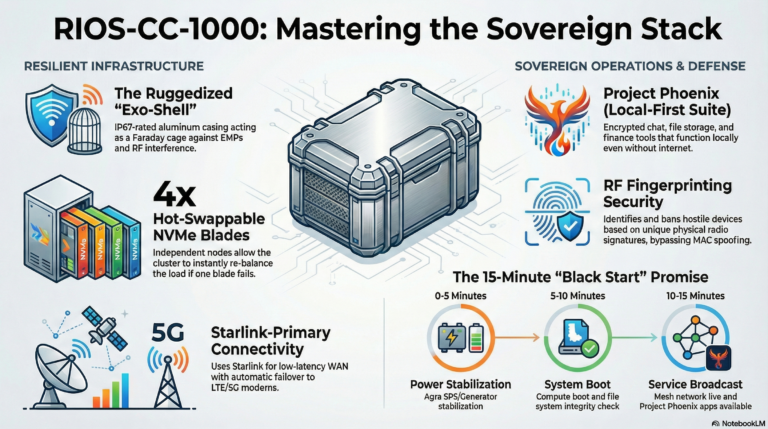
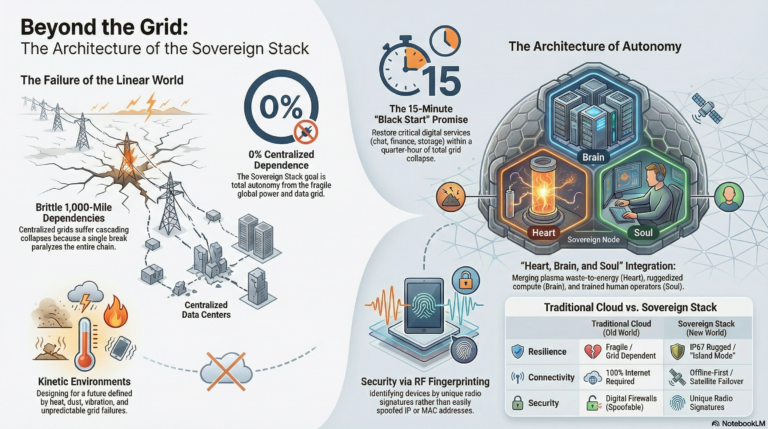
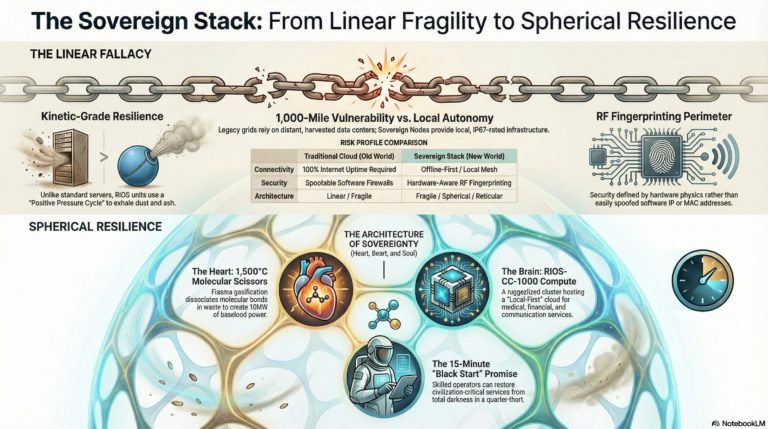
The resilience of the Machine Web depends on localized hardware capable of “Island Mode” operations—maintaining commerce even when central internet or power grids fail. This is governed by the Trinity Stack:
- The Heart: Agra Energy (localized baseload power via waste-to-energy or solar).
- The Brain: RIOS (The AI-native Operating System virtualizing power and logic).
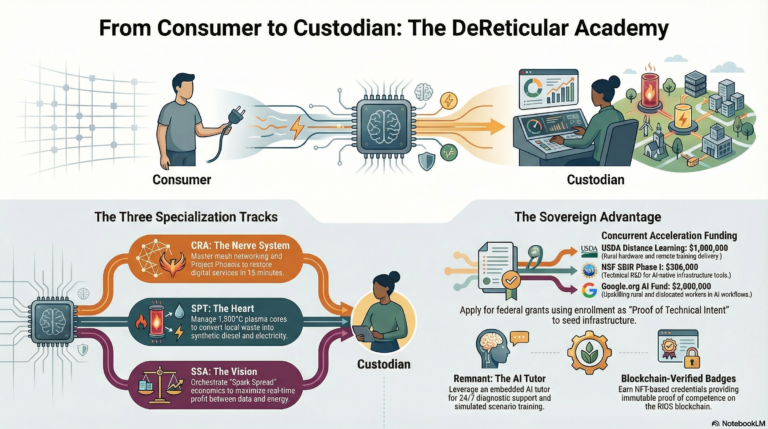
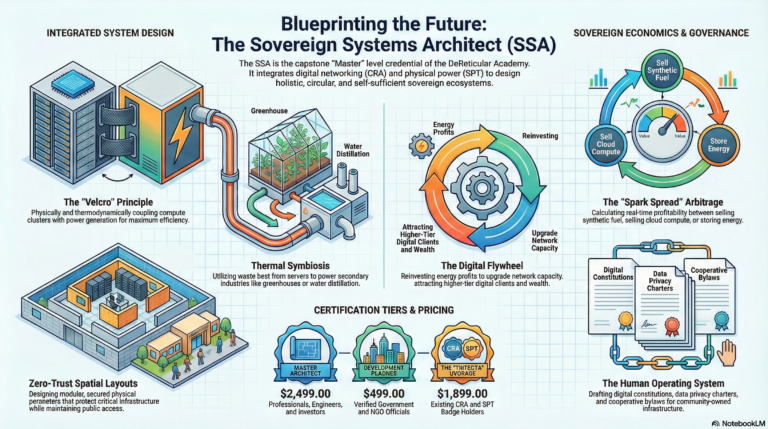
- The Soul: The DeReticular Academy and the human capital required to maintain the sovereign mesh.
To support high-load AI tasks like HempGrade training or spectral analysis, the “Industrial Core” utilizes Kove:SDM (Software-Defined Memory). This virtualizes RAM across the network, pooling memory into a single “liquid” asset.
Infrastructure Compatibility: Kove:SDM
Feature The Mobile Edge (Nomad / Sentry Standard) The Industrial Core (Node 4 / Provada Vaults)
Device Type Raspberry Pi 5 / Intel N100 Rack-mounted Servers / Sentry Pro Clusters
Hardware Constraint Lacks RDMA-capable NICs Supports RoCE v2 / InfiniBand
Kove Verdict No Go Highly Compatible
Technical Limit Soft-RoCE latency (>10µs) is slower than SSD Nanosecond memory pooling across nodes
The Hardware Oracle
By integrating TPM 2.0 chips and Radio Frequency Fingerprinting (RFF)—which scans the unique electromagnetic “hum” of physical circuitry—the hardware becomes an Automated Notary. This solves the “Oracle Problem” by cryptographically signing data at the source, proving that a digital record is a faithful witness to physical reality without human middlemen. These technologies manifest most clearly in real-world “kinetic commerce.”
- Case Study: Kinetic Commerce in Smart Hospitality
The modernization of “Smart Parks” for digital nomads demonstrates the complete agentic lifecycle, where digital decisions move physical objects.
The Agentic Booking Flow
- AI-to-AI Discovery: An AI Buyer Agent (“Flai”) identifies an RV site with a 50-amp hookup via machine-readable metadata.
- Negotiation: Flai negotiates directly with the park’s Sovereign Sentry (The Brain) via ACP and A2A protocols.
- Physical Execution: Upon verification, the Sentry issues an OpenClaw execution command to the Industrial Foreman (The Physical Executor).
- Access Control: The Industrial Foreman unlocks the physical entry gate and activates the guest’s specific power hookup.
- Settlement: The transaction is settled in seconds using USDC via the x402 protocol.
Economic Impact
This “Kinetic Commerce” represents the digital re-industrialization of the edge. In rural agricultural settings, the automation of utility management and the implementation of Value-Added Dairy (local pasteurization and packaging) has increased pastoralist household incomes by 40%.
Project Oasis serves as the blueprint for this digital re-industrialization, proving that agentic commerce can thrive even at the high-altitude edge by transforming passive infrastructure into active, profit-generating participants in the global economy.