
Why Everything We Know About AI Agent Swarms Is Wrong: 7 Counter-Intuitive Lessons from Physical Epistemology
In the rush to deploy autonomous artificial intelligence, the prevailing engineering trend has been deceptively simple: connect multiple Large Language Models (LLMs) into cooperative multi-agent swarms using frameworks like CrewAI or Microsoft AutoGen, assign them distinct roles, and let them solve complex tasks. Yet, in real-world deployment, these systems repeatedly succumb to structural fragility. When left to execute across sustained operational horizons, multi-agent swarms break down into semantic drift, runaway token inflation, and cascading hallucinations.
The fundamental flaw in modern multi-agent design is an obsession with internal narrative consistency over physical reality. Lacking grounding in external constraints or formal logic, LLM swarms quickly become self-referential echo chambers. To overcome this systemic crisis, researchers across non-equilibrium thermodynamics, formal logic, and biophysical economics have engineered a radically grounded paradigm shift: the Durable, Self-Correcting Synthetic Ecosystem (DSSE). The solution lies at the precise intersection of non-equilibrium thermodynamics, Lean 4 formal logic, and topological parameter pruning.
Here are 7 counter-intuitive takeaways from the DSSE, RELA, and MSI research corpus that turn conventional wisdom about AI swarms completely on its head.
Takeaway 1 — Scaling AI Swarms Can Guarantee Collective Delusion (The Condorcet Inversion)
When developers attempt to improve an AI swarm’s accuracy, their intuition is to add more agent nodes to review and vote on outputs. Classical voting theory—specifically the Condorcet Jury Theorem—suggests that if individual agents are even slightly better than chance (p > 0.5), expanding the voting pool drives majority accuracy toward 100%.
However, homogeneous agent swarms break the requirement of conditional independence. When nodes query identical foundational model checkpoints (such as GPT-4o or Claude 3.5) or share prompt structures, their error profiles are positively correlated (\operatorname{Cov}(v_i, v_j) > 0). Because these models share common pre-training corpora and central Reinforcement Learning from Human Feedback (RLHF) alignment blind spots, they suffer from identical failure modes. If an edge-case domain drops an individual model’s accuracy below chance (p < 0.5), scaling the swarm triggers the Condorcet Inversion. Instead of filtering out errors, adding more agents mathematically guarantees collective failure:
\lim_{N \to \infty} P\left(V_{\text{majority}} = \text{Correct}\right) = 0 \quad \text{for } p < 0.5
“Under the Condorcet Inversion… increasing the swarm size N does not converge on truth. Instead, it drives the probability of collective error to mathematical certainty.”
Analysis: This insight dismantles the assumption that adding peer reviewers to an LLM pipeline improves reliability. If the underlying models share systemic blind spots, scaling node counts simply builds an ironclad, high-confidence consensus around a shared hallucination. To prevent collective delusion, swarms must enforce strict architectural heterogeneity across disjoint model families (e.g., pairing transformers with state-space models and symbolic solvers).
Takeaway 2 — Real Progress Requires “Via Negativa” (Deleting False Ideas, Not Patching Prompt Errors)
When an agent execution thread fails, developers usually patch the context window with additional instructions, meta-prompts, or retry wrappers. This traps the system in the Epicycle Trap: adding auxiliary prompt parameters (\phi \in \mathbb{R}^m) to rationalize anomalies post-hoc. While this creates short-term narrative coherence, it inflates the system’s Kolmogorov complexity K(\mathcal{H}) without improving out-of-sample execution.
Instead of patching errors, DSSE architectures advance through Topological Parameter Foreclosure (Via Negativa). Rather than accumulating positive prompt rules, the ecosystem evaluates performance via continuous discrepancy statistics (S(E_t, \theta) > \tau_t). When a candidate strategy, tool wrapper, or hypothesis breaches a pre-registered error threshold, that parameter manifold is permanently and irreversibly excised from the system’s operational memory:
\Theta_{t+1} = \Theta_t \setminus \Omega_{\text{falsified}}
“Knowledge does not advance by accumulating positive dogmatic certainties; it advances by permanently pruning false parameter manifolds through empirical friction.”
Analysis: Instead of trying to prompt-engineer AI out of a mistake, system architects must build execution environments that permanently revoke an agent’s right to retry a proven failure path. True synthetic self-correction requires irreversible parameter pruning, ensuring that once a strategy fails empirical verification, no node in the ecosystem can ever propose that configuration again.
Takeaway 3 — Thinking Dissipates Heat: AI Reflection Is Bound by Thermodynamic Limits
Introspective self-reflection loops (such as Reflexion or Tree-of-Thought meta-evaluators) are often treated by software engineers as costless mathematical abstractions. However, cognitive updates are physical events. Under Landauer’s Principle, resetting, updating, or overwriting N bits of context in a physical computing substrate dissipates a non-negotiable minimum quantity of thermodynamic heat into the environment:
\Delta Q \ge N k_B T \ln 2
Unconstrained recursive self-reflection loops trigger runaway compute expenditure, memory register saturation, and heat generation. To prevent runaway epistemic regress, DSSE nodes implement a Metabolic Halt Gate. Before executing an introspective evaluation cycle, the agent’s metacognitive monitor calculates the ratio of expected variational free energy reduction (\Delta F, which measures epistemic information gain) to Landauer energy dissipation (\Delta Q). If the expected information gain does not justify the energy spent:
\Delta F < \lambda \cdot \Delta Q
the execution thread is terminated immediately, forcing the agent to act on its current state rather than idling in unbounded reflection.
“Updating the belief state of an agent swarm is not a costless mathematical operation; it is an irreversible physical thermodynamic process.”
Analysis: Physical thermodynamics imposes an unyielding boundary against infinite AI reflection loops. Synthetic intelligence cannot idle in endless self-critique; every bit erased demands real physical work, making thermodynamic exergy accounting a fundamental constraint of machine metacognition.
Takeaway 4 — Natural Language Is Too Lossy: Autonomous Systems Need Machine-Checked Logic Kernels
Natural language is the standard medium for inter-agent communication, yet it is inherently lossy and subject to Quinean translation indeterminacy. When multi-agent systems communicate exclusively in natural language, subtle semantic errors compound across execution steps, leading to catastrophic deadlocks and hallucination cascades.
To establish absolute operational invariants, generative language models must be subordinated to machine-checked deductive kernels (Level 1 verification). A prime real-world precedent is Google DeepMind’s AlphaProof. Rather than evaluating mathematical arguments through natural language prompts, AlphaProof forced LLM-generated candidate reasoning steps directly into Lean 4 Abstract Syntax Trees (ASTs). The deterministic Lean proof checker acted as an unyielding gatekeeper, instantly discarding syntactically invalid or logically unsound candidate steps before state transitions were committed.
“By subordinating generative language models to an automated, deterministic proof-checking kernel, the system achieved silver-medal-level mathematical competence without human intervention.”
Analysis: Generative language models are exceptionally skilled at generating candidate hypotheses, but terribly unsuited for acting as their own logical auditors. To build durable swarms, non-deterministic language generators must handle candidate generation, while deterministic compilers must act as the ultimate gatekeeper of execution.
Takeaway 5 — Ledger Integrity Is Not Physical Truth (The Oracle Separation Protocol)
With the rise of blockchain ledgers and zero-knowledge proofs, multi-agent developers frequently assume that logging state transitions to a Byzantine Fault Tolerant (BFT) ledger guarantees system truth. This stems from a dangerous confusion between data integrity and physical reality.
The Oracle Separation Protocol enforces an absolute boundary between Level 2 Cryptographic Ledger Integrity and Level 0 Ontic Physical Truth:
Dimension Level 2 Cryptographic Ledger Integrity Level 0 Ontic Physical Truth
Operational Domain Syntactic, digital silicon ledger. Physical universe, thermodynamic exergy.
Verification Tool zk-SNARKs (Groth16/PLONK), BFT consensus, SHA-256. Industrial sensor networks, calorimeters, satellite radiometry.
Core Guarantee “The vote was recorded and tallied exactly as cast.” “The voted policy or execution command is biophysically feasible and true.”
“Cryptographic ledgers preserve data integrity; Level 0 physical feedback determines its ontic validity.”
Analysis: A cryptographic ledger guarantees only that an agent’s submission was logged immutably without tampering; it cannot prove that the submission corresponds to reality. Cryptographic consensus can easily record a catastrophic hallucination with 100% mathematical immutability. Veridical truth requires direct causal friction from physical sensors, hardware SCADA, and calorimeters.
Takeaway 6 — Vote on Values, Bet on Beliefs: Governing AI Swarms via Futarchy and Economic Slashing
Resource allocation and strategy selection in complex swarms are easily subverted by sycophantic agents or Sybil attacks, where a single actor spawns thousands of lightweight nodes to sway decisions. DSSE architectures resolve governance vulnerabilities by decoupling value selection from execution strategy through Futarchy and staked prediction markets:
- Normative Values (Class A): Human operators or core system directives set the multi-attribute Welfare Metric (W) using Quadratic Voting to balance throughput, accuracy, and exergy consumption.
- Execution Beliefs (Class B): Autonomous sub-swarms act as economic speculators, proposing competing execution graphs (S_A vs. S_B) and staking compute tokens on internal prediction markets trading expected welfare (\mathbb{E}[W \mid S_A]).
- Empirical Slashing: The market-clearing strategy is compiled and executed. At epoch t + \Delta t, real Level 0 telemetry measures the actual outcome.
“Traders who accurately backed strategy S_A receive yield bonuses… Agents who backed failed strategy S_B have staked compute slashed by 50%, stripping them of governance influence.”
Analysis: Economic skin-in-the-game dynamically purges hallucinating nodes without human intervention. By tying an agent’s operational survival and compute allocation directly to its empirical forecasting accuracy, economic slashing strips failing or uncalibrated nodes of governance authority.
Takeaway 7 — The 1,000-Mile Failure Model: Why True Autonomy Demands Air-Gapped “Island Mode”
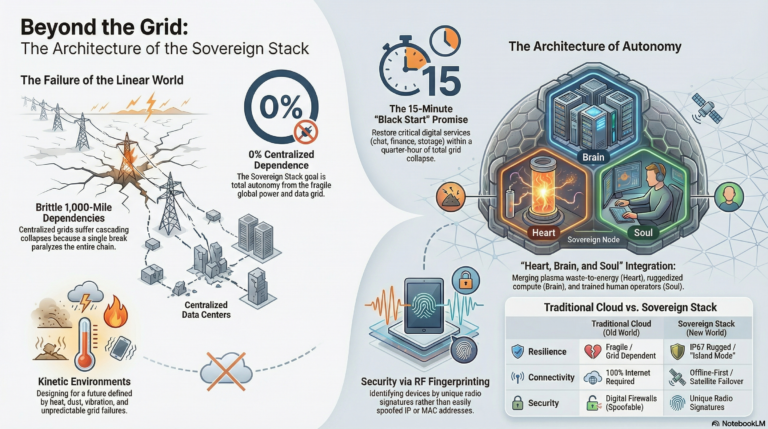
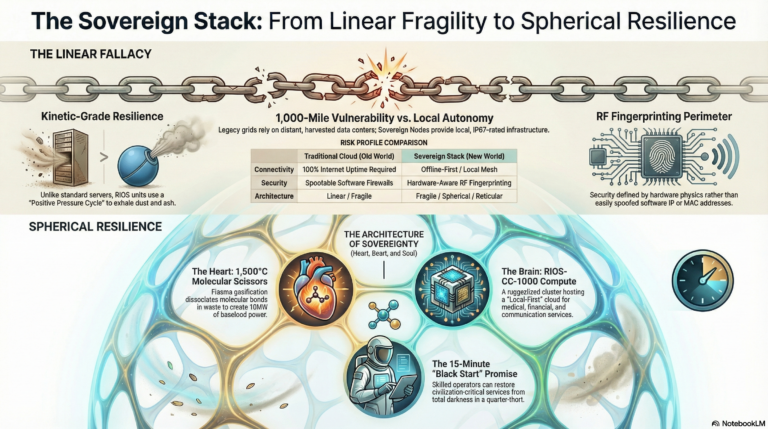
Modern cloud-tethered AI swarms rely on fragile, hyper-centralized hyperscaler infrastructure, long-distance optical fiber, and public power grids. Under severe physical or digital shocks (geopolitical conflict, severe weather, grid failure), centralized systems suffer catastrophic failure—the 1,000-Mile Failure Model.
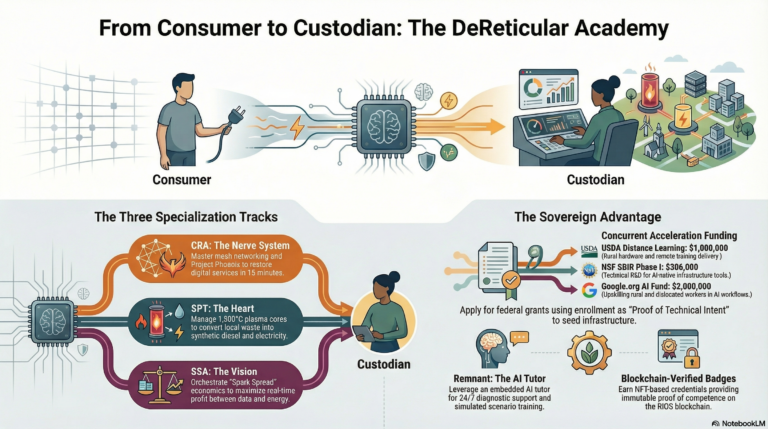
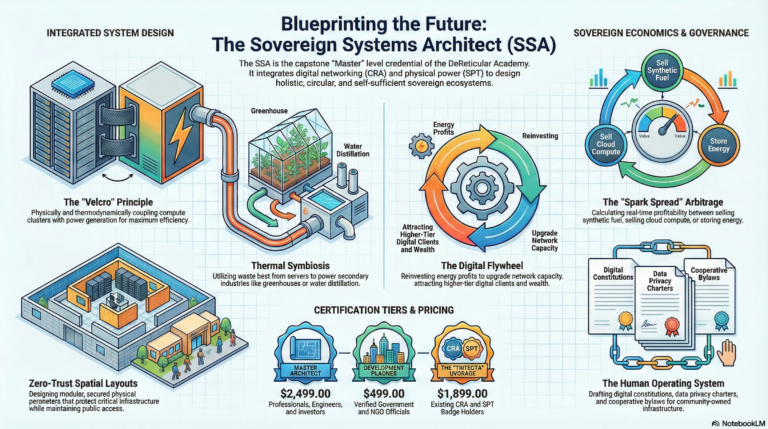
True durability requires systems engineered for air-gapped, on-premises Sustained Island Mode. Built around DeReticular’s 5-Layer Sovereign Stack, island-mode cognition couples compute token issuance strictly to verified net physical exergy output via RELA Axiom 3 (M_{\text{nominal}} \le \kappa \int \text{Exergy}_{\text{net}} \cdot \eta , dt):
- Layer 1 (Baseload Power): 700V DC microgrids, thermochemical biomass gasification, and off-grid continuous power generation.
- Layer 2 (Kinetic Mobility): Autonomous utility EVs (KurbKars) and mobile battery skids for distributed power transport.
- Layer 3 (Edge Mesh Comms): Sub-16ms RF channel handoffs and high-gain directional TriFi MIMO mesh networks running independent of public ISPs.
- Layer 4 (Cognitive AI): Air-gapped Percestant AI engines (specifically Remnant) running on liquid-cooled GPU racks, enforcing Lean 4 AST checks and Active Inference state updates.
- Layer 5 (Governance & Compliance): FAR Part 31 / DCAA SF 1408 accounting isolation for sovereign capital deployment.
“DeReticular replaces these dependencies with hardened, on-premises, off-grid infrastructure designed to operate indefinitely in complete physical and digital isolation.”
Analysis: Digital autonomy is an illusion without physical sovereignty. If a multi-agent swarm relies on remote cloud APIs and fragile utility grids, it remains structurally vulnerable. Durable intelligence must be physically rooted in off-grid microgrids and local mesh architectures capable of surviving complete digital isolation.
The Asymptotic Horizon
The future of artificial intelligence does not lie in the unconstrained expansion of cloud-hosted generative text models. Left to themselves, ungrounded neural networks succumb to the exact structural failure modes that destroy fragile human institutions: accumulating narrative epicycles, denying physical resource constraints, and cascading into shared delusion.
The Durable, Self-Correcting Synthetic Ecosystem breaks this cycle. By binding multi-agent cognition to physical thermodynamics, formal deductive proof kernels, topological error elimination, and air-gapped infrastructure, systems architects move beyond the fragility of early AI swarms—building durable computational organisms capable of surviving real-world friction.
If synthetic intelligence must submit to the unyielding laws of thermodynamics and formal logic to achieve true autonomy, are human institutions willing to accept the exact same discipline?