Systems Integration Plan: Operational Deployment Strategy for Autonomous Biomorphic Emergency Fleets within Municipal Infrastructure
- Executive Vision & Architectural Directive
Context & Strategic Importance
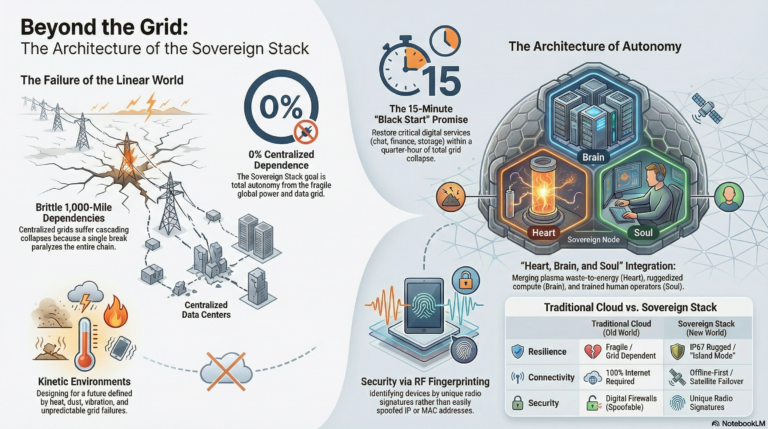
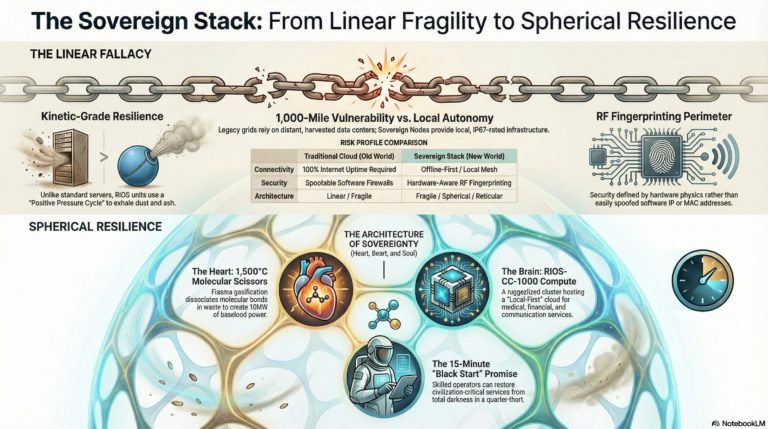
Modern municipal transport modernization stands at a critical juncture: traditional urban emergency dispatch networks are inherently fragile, tethered to centralized commercial cloud hyperscalers and unhardened cellular communication backbones. The primary objective of this integration plan is to establish an operational deployment framework that bridges high-order cryptographic protocols with kinetic automotive hardware. By replacing fragile, cloud-dependent emergency response networks with sovereign, edge-verifiable biomorphic fleets, municipal authorities can guarantee life-safety operations, real-time traffic coordination, and absolute data privacy—even during widespread electrical grid blackouts, physical urban disasters, or active electronic warfare.
Analytical Transformation
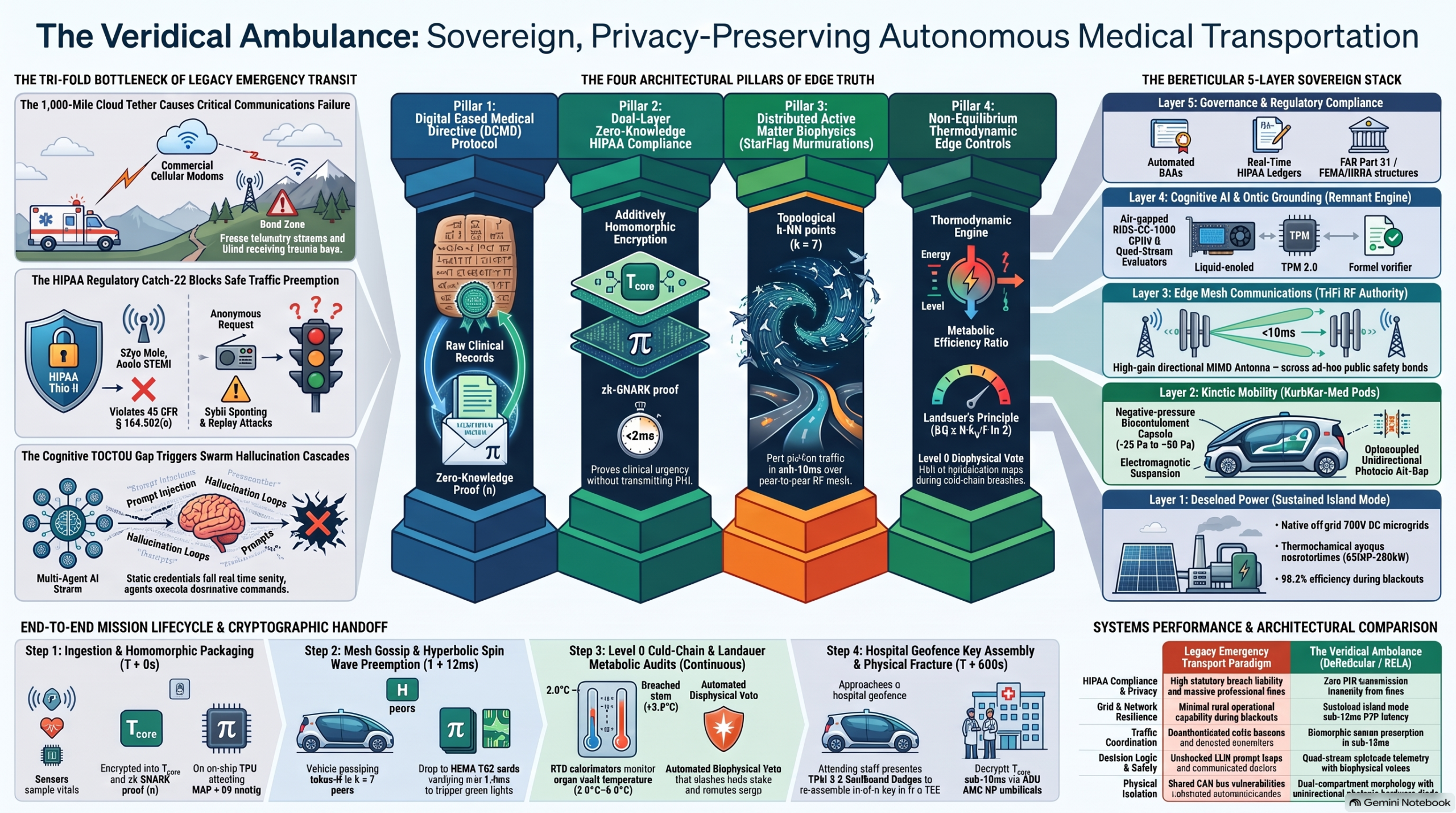
Legacy emergency transit models suffer from a tri-fold systemic bottleneck that severely compromises operational effectiveness, system resilience, and regulatory compliance:
- The 1,000-Mile Cloud Tether: Conventional emergency dispatch and medical transport systems rely on commercial 4G/5G LTE cellular connections linked to centralized cloud Electronic Health Records (EHR) and routing algorithms. When vehicles pass through rural cellular dead zones, dense urban concrete canyons, or infrastructure-deprived disaster zones, backhaul round-trip latencies spike beyond critical intervention thresholds (>1.5\text{ seconds}). Telemetry streams freeze, destination trauma bays are blinded, and remote routing fails completely.
- The Cognitive Time-of-Check to Time-of-Use (TOCTOU) Gap: Enterprise security architectures rely on perimeter Single Sign-On (SSO) mechanisms—such as OAuth 2.0, OpenID Connect (OIDC), JSON Web Tokens (JWT), or mutual TLS (mTLS). These protocols authenticate an agent or compute node at an initial time t_0, issuing a static bearer token trusted unconditionally across an execution window [t_0, t_0 + \Delta t]. In multi-agent autonomous systems driven by probabilistic neural controllers or Large Language Models (LLMs), this creates a dangerous TOCTOU gap: an agent authenticated at t_0 can experience adversarial context poisoning, prompt injection, or semantic drift by t_1. Static credentials force the system to trust degraded, hallucinated, or malicious instructions (the Confused Deputy Problem).
- The Statutory HIPAA Title II Regulatory Catch-22: Federal privacy standards under Title 45 CFR Parts 160 and 164 create a severe operational dilemma. Section 164.502(b) (Minimum Necessary Standard) requires restricting Protected Health Information (PHI) to the absolute minimum necessary for a specific operational task. However, municipal traffic signal controllers, roadside units (RSUs), and consumer vehicles are not healthcare providers (rendering the Treatment Exception under § 164.506 inapplicable). Emitting clinical diagnoses or physiological telemetry over public airwaves to secure traffic right-of-way violates federal privacy law. Conversely, broadcasting an unauthenticated, content-free priority beacon exposes municipal infrastructure to Sybil spoofing and replay attacks by malicious actors using software-defined radios.
To eliminate these vulnerabilities, the architecture transitions from static perimeter SSO authentication to continuous, multi-stream runtime execution telemetry. System agency is continuously evaluated and dynamically re-earned across four orthogonal streams: Epistemic Calibration, Syntactic Deductive Soundness, Thermodynamic Efficiency, and Ontic Sensor Resistance.
Operational Dimension Legacy Cloud-Tethered Emergency Transit DeReticular Veridical Swarm Infrastructure
Network Dependency Centralized commercial cellular (4G/5G LTE) linked to cloud hyperscalers; vulnerable to dead zones and latency spikes (>1.5\text{ s}). Sustained Island Mode; peer-to-peer TriFi RF directional MIMO mesh delivering sub-16ms packet authority without cloud relays.
Regulatory Privacy Mechanism Probabilistic policies, paper Business Associate Agreements (BAAs), or cleartext voice/data transmissions over public cellular networks. Digital Cased Medical Directive (DCMD); homomorphic inner core with Groth16 zero-knowledge envelope (\pi) ensuring zero PHI disclosure.
Traffic Preemption Latency Centralized cloud/dispatch routing or unauthenticated optical/RF beacons; high latency and susceptible to replay spoofing. Sub-12ms biomorphic lane clearance via second-order hyperbolic spin waves (c \approx 20\text{–}40\text{ m/s}) and sub-2ms edge SNARK verification.
Epistemic Integrity Controls Static perimeter SSO credentials (OAuth2, JWT, mTLS); vulnerable to cognitive TOCTOU gaps and neural hallucinations. Continuous Quad-Stream Runtime Telemetry (Epistemic, Syntactic, Thermodynamic, Ontic) feeding a dynamic health index \Psi_i(t).
Hardware Isolation Shared commercial vehicle chassis; unified CAN bus connecting drive controls directly to infotainment and telehealth devices. Dual-compartment morphology; physical bulkhead separating Kinetic Drive Bay from Clinical Capsule via an optocoupled unidirectional air-gap.
Connective Tissue
These high-level architectural mandates dictate the physical, mechanical, and electronic morphology of the fleet, requiring physical segregation of vehicular locomotion from life-critical clinical environments.
- System Morphology & Subsystem Interoperability Architecture
Context & Strategic Importance
In cyber-physical emergency transit, software-only security boundaries are inherently insufficient to guarantee life-safety and statutory privacy. A breach in a tele-health application or diagnostic sensor bus must never compromise powertrain, braking, or steering actuators. Physical hardware compartment isolation is required to establish hard safety invariants that remain unbreakable regardless of software state.
Analytical Transformation
The DeReticular 5-Layer Sovereign Stack provides vertical integration from raw physical energy up to regulatory legal compliance, mapping every functional requirement to its dedicated physical substrate:
- Layer 1: Baseload Power (Sustained Island Mode)
- Substrate & Microgrid Infrastructure: Off-grid native 700V DC traction buses fed by Agra.Energy thermochemical syngas microturbines (65\text{ kW}–250\text{ kW}) and liquid-cooled battery escrow skids.
- Efficiency Metrics: 98.2% round-trip electrical efficiency achieved by eliminating stepped AC/DC conversion stages.
- Thermodynamic Constraint: Enforces RELA Axiom 3 (Biophysical-Monetary Equivalence Constraint), where compute and life-support operations are strictly bounded by verified net exergy: M_{\text{nominal}}(t) \le \kappa \int_{t_0}^t \left( \text{Exergy}_{\text{net}}(\tau) \cdot \eta(\tau) \right) d\tau.
- Hard Cutoff Circuit: Solid-state power disconnect relays trip at the firmware level if proposed compute or thermal loads exceed available physical exergy reserves.
- Layer 2: Kinetic Mobility (Vehicle Platforms)
- Substrate & Chassis: Drive-by-wire electric vehicles (KurbKar-Med pods) equipped with tubular space-frame chassis and active linear electromagnetic suspension actuators.
- Vibration Suppression: High-frequency inertial measurement units (IMUs) drive active suspension counteracting pitch and roll, maintaining a <0.05\text{ g} vibration floor to stabilize hemodynamically unstable patients and delicate surgical anastomoses.
- Powertrain Hardware: High-frequency Silicon Carbide (SiC) MOSFET fast-switching inverters driving Brushless DC (BLDC) hub motors.
- Biocontainment Envelope: Hermetically sealed carbon-fiber monocoque mounted on elastomeric isolation dampers, operating under continuous negative pressure (-25\text{ Pa} to -50\text{ Pa}).
- Layer 3: Edge Mesh Communications (RF Mesh Network)
- Substrate & Hardware: High-gain directional TriFi RF MIMO antenna arrays featuring 360^\circ circumferential metallic backshell shielding and matched 50\ \Omega terminations (\text{VSWR} < 1.2).
- Network Performance: Peer-to-peer zero-cloud inter-vehicle coordination delivering sub-16ms packet authority across licensed public safety and ad-hoc bands.
- Topological Attention Graph: Enforces topological k-nearest neighbor (k \approx 7) attention graphs (S_i = {j \in \text{Fleet} : \operatorname{rank}(d_{ij}) \le 7}), making communication invariant to physical flock density.
- Wave Propagation: Transmits cased zero-knowledge preemption tokens to induce second-order hyperbolic spin wave lane clearance across surrounding civilian vehicular grids.
- Layer 4: Cognitive AI (Ontic Grounding)
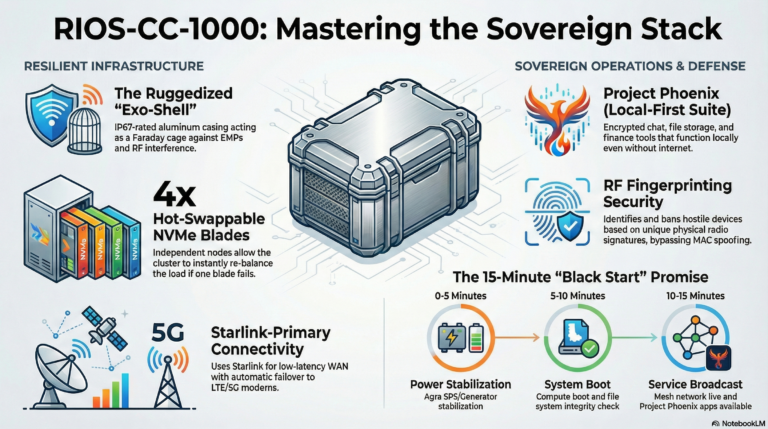
- Substrate & Compute Skids: Air-gapped, liquid-cooled RIOS-CC-1000 GPU/TPU skids anchored by hardware Trusted Platform Module (TPM 2.0) cryptoprocessors.
- Execution Kernel: Runs the Remnant Core Engine to execute Active Inference free-energy minimization (F = D_{\mathrm{KL}}(q(\vartheta) \parallel p(\vartheta \mid x)) – \ln p(x)), Lean 4 Abstract Syntax Tree (AST) deductive type-checking, and Groth16 zk-SNARK proof compilation.
- Thermodynamic Halting: On-chip Landauer Halting Gates enforce metabolic efficiency bounds (\mathcal{M}_{\text{ratio}} \ge 1.0), halting recursive reflection loops before thermal runaway occurs.
- Root of Trust: Hardware Platform Configuration Registers (PCR 0–7) record measured boot states, registering Poseidon nullifiers to prevent virtualized clone attacks.
- Layer 5: Governance & P3 Compliance (Regulatory Integration)
- Substrate & Legal Automation: Automated Business Associate Agreement (BAA) smart contracts, Level 2 append-only BFT ledgers, and formal accounting isolation software.
- Regulatory Accounting: Enforces full compliance with FAR Part 31 and DCAA SF 1408 standards, isolating capital expenditure channels.
- Capital Infrastructure Capture: Integrates deployment financing with non-municipal federal grant frameworks, including FEMA BRIC (Building Resilient Infrastructure and Communities), USDA Rural Development, and IRA Section 6417 Elective Pay for clean energy infrastructure.
- Normative Value Space: Enforces Class A Normative Values via Quadratic Values Voting (QV) while closing physical feasibility manifolds (Class B) to democratic manipulation.
+———————————————————————————–+
| KURBKAR-MED STRUCTURAL MORPHOLOGY |
+——————————————+—————————————-+
| KINETIC DRIVE BAY | CLINICAL CARE CAPSULE |
| (Locomotion & Road Mesh) | (Negative-Pressure Cleanroom) |
+——————————————+—————————————-+
| – 700V DC Native Traction Bus | – Carbon-Fiber Monocoque (-35 Pa) |
| – Brushless DC (BLDC) Hub Motors | – H14 HEPA / UV-C Germicidal Scrubbing |
| – Silicon Carbide (SiC) MOSFET Inverters | – Stirling Cooler (2.0°C to 8.0°C) |
| – Electromagnetic Suspension (<0.05g) | – Seamless PVDF / 316L Stainless Steel |
| – TriFi Directional MIMO Antenna Array | – Automated 6-Log VHP Sterilization |
| – >300mm PWM Conduit Segregation | – Isolated Bio-Telemetry Bus (CAN-FD) |
| – 360° Shielding (100 kHz to 40 GHz) | – RIOS-CC-1000 GPU / TPM 2.0 Engine |
+——————————————+—————————————-+
| BULKHEAD BOUNDARY |
| ============================================================================= |
| DATA PATH: [Capsule] –(GaAs Laser Diode -> PIN Photodiode)–> [Drive Bay] |
| PHYSICAL INGRESS: Zero copper wire penetrations across boundary in transit |
+———————————————————————————–+
The KurbKar-Med platform enforces absolute dual-compartment physical morphology:
- The Kinetic Drive Bay: Houses all drive-by-wire steering, braking, and throttle actuators, dual traction inverters utilizing high-frequency Silicon Carbide (SiC) MOSFET switches, Brushless DC (BLDC) hub motors, and native 700V DC traction power. Chassis stability is maintained via active linear electromagnetic suspension counteracting pitch and roll. Communication is managed by 360^\circ circumferentially shielded TriFi directional MIMO arrays with antenna transmission lines locked to a Voltage Standing Wave Ratio (\text{VSWR} < 1.2). High-voltage motor pulse-width modulation (PWM) cables are routed through grounded aluminum conduit channels physically segregated by >300\text{ mm} from command-and-control (C2) antennas and GPS/GNSS feeds, paired with 360^\circ circumferential shield bonding suppressing electromagnetic interference (EMI) across 100\text{ kHz} to 40\text{ GHz}.
- The Clinical Care Capsule: Formed as a hermetically sealed carbon-fiber monocoque mounted on elastomeric isolation dampers. To prevent pathogen escape, the cabin operates under a continuous negative-pressure depression between -25\text{ Pa} and -50\text{ Pa} (nominally -35\text{ Pa}), venting exhaust through two-stage H14 HEPA filtration (99.995% efficiency at 0.3\ \mu\text{m}) and high-intensity UV-C (254\text{ nm}) germicidal irradiation chambers. Interior surfaces are lined with seamless polyvinylidene fluoride (PVDF) and surgical-grade 316L stainless steel, allowing atomizing nozzles to execute automated Vaporized Hydrogen Peroxide (VHP) cycles that achieve a 6\text{-log} biological sterilization (99.9999% spore destruction) without human intervention. Life-support telemetry operates on an isolated CAN-FD/Ethernet-AVB bus. Cold-chain biologics and donor organs are secured in a vault powered by an active Free-Piston Stirling Cooler (FPSC) maintained strictly within a 2.0^\circ\text{C} to 8.0^\circ\text{C} temperature window.
Connective Tissue
This physical dual-compartment isolation creates the essential boundary conditions required to address the core cyber-physical integration hurdles facing edge deployment.
- Engineering Roadmap for the Four Core Systems Hurdles
3.1. Mitigation of Edge zk-SNARK Proving Overhead
Context & Strategic Importance
Generating zero-knowledge proofs (such as Groth16 or PLONK) over continuous, high-frequency biosensor streams on edge automotive hardware introduces severe computational friction. Evaluating large Multi-Scalar Multiplications (MSMs) and Number Theoretic Transforms (NTTs) over BN254 or BLS12-381 curves can cause edge TPU thermal runaway, computational latency spikes (>1.5\text{ s} per proof), and battery drain.
Analytical Transformation
The framework resolves edge proving overhead through a three-pronged optimization strategy:
- Decoupling the Homomorphic Inner Core from the zk-Envelope: High-frequency raw sensor streams (e.g., 1\text{ kHz} 12-lead EKG waveforms) are not passed directly into the zk-SNARK proving circuit. Instead, raw telemetry M is encrypted into an inner core (T_{\text{core}}) using additively homomorphic encryption (Paillier or Exponential ElGamal) under the destination trauma center’s public key K_{\text{pub}}: C = \operatorname{Enc}(M, r) = \left( g^r \pmod{n^2}, ; h^r \cdot g^M \pmod{n^2} \right) Intermediate updates (such as running averages or cumulative vital metrics) are updated via simple point additions on the curve at microjoule energy levels: C_{\text{accum}} = \prod_{t=1}^K C_t = \operatorname{Enc}\left( \sum_{t=1}^K M_t, ; \sum_{t=1}^K r_t \right)
- Event-Driven Predicate Triggering via Level 0 Ontic State Filters: The outer zero-knowledge envelope (T_{\text{env}}) proves discrete, high-level medical state predicates rather than raw physiological arrays. A proof \pi is synthesized over arithmetic circuit \mathcal{C}{\text{triage}} only when an on-chip TPU detects a discrete state boundary transition: \mathcal{C}{\text{triage}}: \left( \text{MAP} < 65\text{ mmHg} \lor \text{GCS} \le 8 \lor \Delta \text{ST}_{\text{elevation}} > 2\text{ mm} \right) where Mean Arterial Pressure is calculated as \text{MAP} = \frac{\text{Systolic} + 2 \cdot \text{Diastolic}}{3}.
- Enforcement of the Landauer Halting Gate: Before committing GPU cycles to proof compilation, the Remnant Engine evaluates the Metabolic Efficiency Ratio \mathcal{M}{\text{ratio}}, defined as the ratio of information gain in Variational Free Energy between execution cycles (\Delta F = D{\mathrm{KL}}(q_{\text{new}} \parallel q_{\text{old}})) to the Landauer thermodynamic bit-erasure dissipation limit (\Delta Q \ge N_{\text{bits}} k_B T \ln 2): \mathcal{M}{\text{ratio}} = \frac{\Delta F}{\lambda \cdot \Delta Q} = \frac{D{\mathrm{KL}}(q_{\text{new}} \parallel q_{\text{old}})}{\lambda \cdot (N_{\text{bits}} \cdot k_B T \ln 2)} \ge 1.0 where k_B = 1.380649 \times 10^{-23}\text{ J/K}, ambient operating temperature T = 300\text{ K}, \ln 2 \approx 0.693147, and efficiency multiplier \lambda = 1.25. Erasing N_{\text{bits}} in GPU VRAM dissipates a minimum thermodynamic heat limit \Delta Q. If the information gain \Delta F per Joule dissipated falls below \lambda, the system trips a FORCE_ACTION_HALT, bypassing proof generation to preserve compute and thermal reserves.
Algorithm 1: Landauer-Bounded Predicate Proving Gate
def landauer_bounded_proving_gate(
sensor_stream: dict,
theta_current: float,
theta_new: float,
context_erased_bits: int,
k_B: float = 1.380649e-23,
T_kelvin: float = 300.0,
lambda_eff: float = 1.25,
tau_triage_threshold: float = 0.05
) -> tuple[str, dict]:
# Step 1: Calculate Landauer thermodynamic heat limit (Delta Q)
ln_2 = 0.6931471805599453
delta_q = context_erased_bits * k_B * T_kelvin * ln_2

# Step 2: Estimate Variational Free Energy reduction (Delta F)
# Delta F = D_KL(q_new || q_old)
d_kl = sensor_stream.get("kl_divergence", 0.0)
delta_f = d_kl

# Step 3: Evaluate Metabolic Efficiency Ratio (M_ratio)
m_ratio = delta_f / (lambda_eff * delta_q) if delta_q > 0 else 0.0

if m_ratio < 1.0:
    # Halt reflection loop to prevent thermal exhaustion
    return "FORCE_ACTION_HALT", {"reason": "Landauer ratio below threshold", "m_ratio": m_ratio}

# Step 4: Evaluate Level 0 Ontic Predicates
map_val = (sensor_stream["systolic"] + 2 * sensor_stream["diastolic"]) / 3.0
gcs_val = sensor_stream.get("gcs", 15)

predicate_triggered = (map_val < 65.0) or (gcs_val <= 8)

if predicate_triggered:
    # Compile zk-SNARK proof over discrete state transition
    proof_pi = compile_groth16_proof(
        circuit="C_triage",
        public_inputs={"map_low": map_val < 65.0, "gcs_low": gcs_val <= 8},
        private_witness=sensor_stream
    )
    return "PROVE_SNARK", {"proof_pi": proof_pi, "m_ratio": m_ratio}
else:
    # Accumulate high-frequency vitals homomorphically in inner core
    c_accum = homomorphic_point_addition(sensor_stream["raw_vitals"])
    return "DISPATCH_HOMOMORPHIC_PROXY", {"c_accum": c_accum, "m_ratio": m_ratio}
3.2. Automated Trauma Center Threshold Key Reconstruction
Context & Strategic Importance
During emergency arrivals at Level 1 Trauma Bays, clinical environments experience high operational entropy. Requiring surgeons or nurses to manually type passphrases, locate physical tokens, or enter administrative passwords to decrypt incoming patient telemetry introduces unacceptable clinical delay, directly threatening patient survival.
Analytical Transformation
The decryption key lifecycle utilizes Shamir secret sharing over threshold ElGamal/Paillier keys, hardware TPM 2.0 Soulbound Tokens (SBT) embedded in physical clinician access badges, and Dynamic Role Mutation receipts (\mathcal{M}_{\text{mutate}}). Clinicians carry non-transferable SBT badges running hardware attestation routines that verify Platform Configuration Register (PCR) digests via Ed25519 signatures.
When administrative or clinical leadership shifts during an active emergency, handovers do not require re-issuing key shares. The departing physician and incoming fellow sign a Role Mutation Receipt: \mathcal{M}{\text{mutate}} = \operatorname{Sign}{\text{TPM}}\left( \text{Agent_UUID}, ; \text{Role}{\text{prior}}, ; \text{Role}{\text{target}}, ; \text{AST}_{\text{spec}}, ; \text{Nonce} \right) The underlying silicon identity remains invariant while access authority transfers instantly.
If an uncalibrated clinical decision, out-of-bounds directive, or unauthorized data access attempt occurs across a delegated capability chain (A \to B \to C), Transitive Epistemic Delegation triggers a conserved liability slashing protocol with Instant Snap-Back Reversion:
- Primary Executor Slash: The executing node (C) that caused the breach suffers an immediate 50% cryptographic stake slash.
- Curator Slash: The intermediary node (B) that forwarded the delegation loses 25% of its curation stake.
- Sponsorship Slash: The originating sponsor (A) incurs a 10% risk deduction.
- Brier Score Penalty & Reversion: All failing agents in the delegation chain receive an immediate Brier score error penalty of +0.50 (degrading their epistemic health rating \Psi), the delegation tree is permanently dissolved on the local BFT ledger, and full access authority snaps back instantly to the primary attending physician.
+———————————————————————————–+
| GEOFENCED TRAUMA BAY KEY RECONSTRUCTION |
+———————————————————————————–+
| 1. Vehicle crosses 1.5 km geofence boundary -> Initiates TriFi RF P2P mesh link |
| 2. Hospital TEE queries attending staff TPM 2.0 / SBT badges (m-of-n quorum) |
| 3. m-of-n threshold private key shares combined inside isolated hospital TEE |
| 4. Ephemeral session key generated and held in pre-computed TEE buffer |
| 5. Vehicle docks at Trauma Airlock -> T_core decrypted in <10ms with zero manual entries |
+———————————————————————————–+
Key reconstruction is fully automated through the following sequential geofenced workflow:
- Geofence Perimeter Activation: As the KurbKar-Med approaches within 1.5\text{ km} of the hospital perimeter, its TriFi directional MIMO array establishes a direct peer-to-peer RF mesh link with the hospital’s edge infrastructure at sub-16ms latency.
- Automated Quorum Discovery: The hospital edge server polls the physical proximity of active trauma team members (Attending Surgeon, Surgical Fellow, Charge Nurse) by verifying their TPM 2.0 Soulbound Badges.
- Threshold Key Assembly: Once an m-of-n threshold of valid clinician signatures is detected, the distributed private key shares are combined inside an isolated hospital Trusted Execution Environment (TEE).
- Pre-Computed Decryption Buffer: The combined private key decrypts the ephemeral session key, pre-computing the decryption buffer while the ambulance completes its final physical approach.
- Sub-10ms Instant Core Clearing: The moment the vehicle docks at the trauma airlock and connects to the physical umbilical, T_{\text{core}} is decrypted directly into the hospital’s Electronic Health Record (EHR) system in <10\text{ ms}, exposing complete hemodynamic history without requiring a single manual entry.
3.3. Drop-In Municipal Traffic Controller Retrofits & Flocking Dynamics
Context & Strategic Importance
Upgrading thousands of physical municipal intersections with expensive roadside processing units, optical sensors, and central server connections poses an insurmountable capital barrier for local governments. A dual-layer preemption strategy bypasses this financial obstacle by combining civilian biomorphic flocking dynamics with ultra-low-cost traffic cabinet adapter cards.
Analytical Transformation
The system models multi-agent vehicle coordination on the active matter physics of European starling murmurations (Sturnus vulgaris), derived from the European StarFlag project. Rather than using metric distance radii, vehicles interact with a fixed number of topological nearest neighbors (k \approx 7): S_i = \left{ j \in \text{Fleet} : \operatorname{rank}(d_{ij}) \le 7 \right} When an emergency vehicle approaches, corridor clearance propagates through surrounding civilian traffic grids as an undamped, second-order hyperbolic spin wave rather than step-by-step diffusive braking. Defining \mathbf{u}_j(t) = \mathbf{v}j(t) – \mathbf{V}{\text{platoon}} as the local velocity fluctuation vector relative to the mean platoon trajectory, velocity updates (\frac{d\mathbf{v}_i}{dt}) and generalized spin updates (\frac{d\mathbf{s}_i}{dt}) are governed by: \frac{d\mathbf{v}_i}{dt} = \frac{1}{\chi_0} \mathbf{s}_i \times \mathbf{v}i, \qquad \frac{d\mathbf{s}i}{dt} = \sum{j \in S_i} J{ij} (\mathbf{v}_i \times \mathbf{v}_j) – \frac{\eta_0}{\chi_0} \mathbf{s}i where rotational inertia \chi_0 = 1.42, rotational viscosity \eta_0 = 0.18, and coupling stiffness J{ij} = \frac{1}{\text{BS}_j + 10^{-4}} (inversely proportional to neighbor j’s historical Brier score \text{BS}j). Because \chi_0 \gg \eta_0, trajectory directives travel linearly across the grid as an acoustic spin wave at speeds c = v_0 \sqrt{J / \chi_0} \approx 20\text{–}40\text{ m/s} (nominally 25\text{ m/s}), directly emerging from the ratio of coupling stiffness J{ij} to rotational inertia \chi_0 = 1.42. This allows civilian vehicles to yield smoothly in sub-12ms without central coordination.
For hard intersection signal preemption, municipalities insert modular, drop-in adapter cards into existing NEMA TS1/TS2 detector racks or Model 170/2070 input files. Each card contains a sub-$50 RISC-V System-on-Chip (SoC) equipped with a hardware elliptic curve pairing accelerator. The chip ingests the cased token H = \text{SHA256}(C \parallel \pi) over TriFi RF and executes a Groth16 pairing check evaluating three pairings: e(A, B) = e(\alpha, \beta) \cdot e(x \cdot \gamma, \delta) \cdot e(C, \delta) The RISC-V card verifies the proof in <2\text{ ms}, dropping a standard dry-contact closure relay that trips the traffic controller’s existing Emergency Priority Phase.
System Dimension Layer A: Civilian Swarm Flocking Layer B: Municipal Cabinet Hardware
Targeted Hardware Autonomous & connected civilian consumer vehicles. Existing NEMA TS1/TS2 & Model 170/2070 input files.
Primary Algorithm Second-Order Hyperbolic Spin Waves (\omega = ck). Groth16 Elliptic Curve Pairing Verification (<2\text{ ms}).
Communication Substrate Peer-to-Peer TriFi RF Directional Mesh (k \approx 7). Direct TriFi RF Receiver on Drop-In RISC-V Card.
Preemption Latency Sub-12ms continuous lane parting. Sub-2ms contact closure relay trip.
Infrastructure Cost $0.00 (Software update over consumer fleets). <$50.00 per intersection (Modular drop-in card).
3.4. Unidirectional Optical Air-Gap Ingress & Maintenance Protocols
Context & Strategic Importance
Strict physical security invariants are required to prevent malicious actors from exploiting wireless road-mesh communications or chassis drive controllers to traverse into the clinical care capsule, or vice versa. Absolute physical separation guarantees kinetic and clinical isolation during transit.
Analytical Transformation
During transit, the boundary between the Clinical Care Capsule and Kinetic Drive Bay operates as an Optocoupled Unidirectional Air-Gap:
+———————————————————————————–+
| OPTOCOUPLED UNIDIRECTIONAL PHOTONIC DIODE |
+———————————————————————————–+
| CLINICAL CARE CAPSULE (TX ONLY) | KINETIC DRIVE BAY (RX ONLY) |
| High-Speed GaAs Infrared Laser Diode | Silicon PIN Photodiode Receiver |
| (λ = 850nm / 1310nm) | (Zero Light-Emitting Capability) |
| | |
| —- Serialized Stream (8b/10b, RS FEC) —-> Single Fiber Strand / Quartz Window |
| | |
| [NO COPPER TRACES] [NO GROUND WIRES] | [PHYSICALLY IMPOSSIBLE REVERSE PATH] |
+———————————————————————————–+
- Photonic Diode Construction: The transmitter on the capsule side consists of a high-speed Gallium-Arsenide (GaAs) infrared laser diode emitting at 850\text{ nm} or 1310\text{ nm} across a single-strand armored optical fiber or quartz glass window. The receiver in the drive bay is a silicon PIN photodiode coupled to a transimpedance amplifier. Because the silicon PIN diode has zero photon-emitting capability and no reverse copper traces penetrate the bulkhead, reverse packet transmission is physically impossible.
- Transport Protocol: Data is transmitted as an unacknowledged simplex stream encoded with 8b/10b line coding, Reed-Solomon Forward Error Correction (\text{RS}(255, 223)), and a CRC-32 trailer, enabling the drive bay to detect and correct bit errors caused by high-G vibrations without sending ACK/NACK responses.
- Stationary Base Ingress: When stationary at a maintenance enclave, physical connectivity is established using ODU AMC® NP Break-Away connectors featuring anti-fretting pins and 360^\circ EMI shielding. Diagnostic pins feeding the clinical capsule are wired through an electromechanical interlock tied to the vehicle’s transmission lock, preventing ingress whenever vehicle velocity v > 0.
- Deductive Verification & Boot Trees: Firmware patches or calibration matrices passed during stationary docking are evaluated by an internal Lean 4 Abstract Syntax Tree (AST) compiler gate (S_{\mathrm{syn}} \in {0.0, 1.0}). Updates must satisfy formal type-checking (\Gamma \vdash \psi \implies \Gamma \models \psi) verifying platform safety invariants. Upon reboot, hardware TPM 2.0 registers (PCR 0–7) record measured boot hashes, registering Poseidon nullifiers in the Merkle tree to prevent virtualized clone attacks.
Connective Tissue
Together, these four technical solutions establish an operational matrix that satisfies stringent administrative and regulatory mandates.
- Regulatory Epistemology & Statutory HIPAA Compliance
Context & Strategic Importance
Federal healthcare privacy law creates a severe operational barrier for autonomous emergency vehicle preemption. The Digital Cased Medical Directive (DCMD) protocol provides a mathematically closed solution that harmonizes statutory HIPAA mandates with real-time cyber-physical traffic control.
Analytical Transformation
The legal conflict stems from the Mechanics of the HIPAA Catch-22:
- Failure of the Treatment Exception (§ 164.506): While 45 CFR § 164.506 exempts disclosures between covered healthcare providers for treatment, municipal traffic lights, roadside units, and civilian vehicles do not possess National Provider Identifiers (NPIs) and are not covered entities. Cleartext transmission of clinical state over public airwaves violates § 164.502(b).
- Quasi-Identifier Re-Identification (§ 164.514): Stripping direct patient identifiers (name, SSN) while broadcasting GPS location trajectories, sub-second timestamps, and priority codes fails the Safe Harbor method under § 164.514(b)(2). Adversaries monitoring open V2X frequencies can easily join location trajectories with 911 dispatch records and property databases, re-identifying individuals with statistical certainty.
- Breach Liabilities (§ 164.402): Unencrypted broadcasts expose covered entities to Willful Neglect (Tier 3/4) civil monetary penalties under the HITECH Act, ranging up to $2,000,000+ annually, alongside mandatory listing on the HHS Office for Civil Rights (OCR) public enforcement log.
+———————————————————————————–+
| DIGITAL CASED MEDICAL DIRECTIVE (DCMD) |
+———————————————————————————–+
| 1. RAW BIOMETRIC DATA (MAP, EKG, SSN) -> Encrypted homomorphically via Paillier |
| Inner Core (T_core) = Enc(M, r) under Destination Hospital Key K_pub |
| Statutorily: Unusable, unreadable, indecipherable ciphertext (Safe Harbor) |
| |
| 2. ON-CHIP TPU COMPILES GROTH16 zk-SNARK PROOF (π) OVER CIRCUIT C_triage |
| Private Witnesses: Patient Name, SSN, Raw Waveforms, Vitals |
| Public Assertions: (MAP < 65 mmHg OR GCS <= 8) == TRUE; TPM_Signature == VALID |
| |
| 3. CASED TOKEN BROADCAST: H = SHA256(T_core || π) gossiped via TriFi RF |
| Intersections verify π in <2ms: Zero PHI bytes disclosed to municipal grid |
+———————————————————————————–+
The DCMD protocol adapts the Old Babylonian Cased Tablet pattern (ca. 2000–1600 BCE) to reconcile these legal mandates:
- Inner Core (T_{\text{core}}): Encrypts raw physiological telemetry M under the destination trauma center’s public key K_{\text{pub}} using additively homomorphic encryption (Paillier or Exponential ElGamal). Under 45 CFR § 164.312(e)(1), this ciphertext is indecipherable to intermediate nodes, granting complete Safe Harbor immunity from Breach Notification under § 164.402.
- Outer Envelope (T_{\text{env}}): Compiles a compact (\sim 256\text{ bytes}) Groth16 zk-SNARK proof \pi over circuit \mathcal{C}_{\text{triage}}. The proof discloses zero bytes of PHI, satisfying the Minimum Necessary Standard under § 164.502(b) by asserting only public mathematical facts: that an authentic sensor signed by a valid hardware TPM 2.0 has detected severe hemodynamic instability (\text{MAP} < 65\text{ mmHg} \lor \text{GCS} \le 8) within an actionable intervention window (\Delta t \le 180\text{ min}).
Statutory Mandate Conventional V2X Preemption DeReticular DCMD Architecture Statutory Risk & Liability
45 CFR § 164.502(b)
Minimum Necessary Non-Compliant: Transmits cleartext or weakly hashed vitals/codes to non-covered traffic nodes. Fully Compliant: Zero bytes of PHI disclosed. Emits only a binary zero-knowledge proof (\pi). Legacy: High risk of OCR Privacy Rule enforcement.
DCMD: Zero statutory exposure.
45 CFR § 164.312(e)
Transmission Security Non-Compliant: Unencrypted or static-key broadcasts traversing public RF spectrum. Fully Compliant: T_{\text{core}} encrypted homomorphically under hospital public key K_{\text{pub}}. Legacy: Tier 3/4 Willful Neglect (\text{Up to }$2\text{M}+).
DCMD: Absolute cryptographic protection.
45 CFR § 164.402
Breach Notification High Exposure: Eavesdropped packets trigger mandatory public breach disclosures. Safe Harbor Immunity: Ciphertext is unusable and indecipherable to eavesdroppers. Legacy: Mandatory public reporting & class-action suit.
DCMD: Statutory Safe Harbor status.
Anti-Spoofing & Grid Security Vulnerable: Unauthenticated beacons subject to Sybil spoofing and replay attacks. Resilient: Every preemption request requires a fresh, valid Groth16 proof and TPM signature. Legacy: Gridlock & collision liability.
DCMD: Mathematically verified authority.
Connective Tissue
These regulatory and cryptographic invariants are directly encoded into machine-readable data contracts and software state machines.
- Data Contracts, Interface Specifications, and Execution Logic
Context & Strategic Importance
To guarantee cross-jurisdictional fleet interoperability, deterministic state machine execution, and mathematical auditability, systems must enforce standardized, machine-checkable data schemas.
Analytical Transformation
The operational stack defines three primary JSON Schemas (Draft 2020-12):
Schema 1: ContinuousExecutionTelemetryFrame.json
{
“$schema”: “https://json-schema.org/draft/2020-12/schema“,
“$id”: “https://dereticular.org/schemas/ContinuousExecutionTelemetryFrame.json“,
“title”: “ContinuousExecutionTelemetryFrame”,
“type”: “object”,
“required”: [
“frame_id”,
“agent_uuid”,
“epoch_timestamp_utc”,
“hardware_tpm_quote”,
“epistemic_stream”,
“syntactic_stream”,
“thermodynamic_stream”,
“ontic_stream”,
“computed_health_index”
],
“properties”: {
“frame_id”: { “type”: “string”, “format”: “uuid” },
“agent_uuid”: { “type”: “string”, “format”: “uuid” },
“epoch_timestamp_utc”: { “type”: “string”, “format”: “date-time” },
“hardware_tpm_quote”: {
“type”: “object”,
“required”: [“pcr_bank_digest”, “tpm_counter_value”, “tpm_signature”],
“properties”: {
“pcr_bank_digest”: { “type”: “string”, “pattern”: “^[a-f0-9]{64}$” },
“tpm_counter_value”: { “type”: “integer”, “minimum”: 0 },
“tpm_signature”: { “type”: “string” }
},
“additionalProperties”: false
},
“epistemic_stream”: {
“type”: “object”,
“required”: [“domain_tag”, “rolling_brier_score”, “free_energy_delta”, “shannon_entropy”],
“properties”: {
“domain_tag”: { “type”: “string” },
“rolling_brier_score”: { “type”: “number”, “minimum”: 0.0, “maximum”: 2.0 },
“free_energy_delta”: { “type”: “number” },
“shannon_entropy”: { “type”: “number”, “minimum”: 0.0 }
},
“additionalProperties”: false
},
“syntactic_stream”: {
“type”: “object”,
“required”: [“lean4_ast_hash”, “typecheck_status”, “axiomatic_depth”],
“properties”: {
“lean4_ast_hash”: { “type”: “string”, “pattern”: “^[a-f0-9]{64}$” },
“typecheck_status”: {
“type”: “string”,
“enum”: [“TYPECHECK_SUCCESS”, “COMPILATION_ERROR”, “AXIOM_VIOLATION”]
},
“axiomatic_depth”: { “type”: “integer”, “minimum”: 1 }
},
“additionalProperties”: false
},
“thermodynamic_stream”: {
“type”: “object”,
“required”: [“context_erased_bits”, “landauer_joules_dissipated”, “free_energy_delta”, “metabolic_ratio”],
“properties”: {
“context_erased_bits”: { “type”: “integer”, “minimum”: 0 },
“landauer_joules_dissipated”: { “type”: “number”, “minimum”: 0.0 },
“free_energy_delta”: { “type”: “number” },
“metabolic_ratio”: { “type”: “number”, “minimum”: 0.0 }
},
“additionalProperties”: false
},
“ontic_stream”: {
“type”: “object”,
“required”: [“sensor_network_root”, “measured_discrepancy_loss”, “registered_tau_threshold”, “falsification_triggered”],
“properties”: {
“sensor_network_root”: { “type”: “string”, “pattern”: “^[a-f0-9]{64}$” },
“measured_discrepancy_loss”: { “type”: “number”, “minimum”: 0.0 },
“registered_tau_threshold”: { “type”: “number”, “exclusiveMinimum”: 0.0 },
“falsification_triggered”: { “type”: “boolean” }
},
“additionalProperties”: false
},
“computed_health_index”: { “type”: “number”, “minimum”: 0.0, “maximum”: 1.0 }
},
“additionalProperties”: false
}
Schema 2: PolicyHypothesisManifest.json
{
“$schema”: “https://json-schema.org/draft/2020-12/schema“,
“title”: “PolicyHypothesisManifest”,
“type”: “object”,
“required”: [
“manifest_id”,
“proposer_uuid”,
“policy_name”,
“parameter_space_dimension”,
“formal_verification_tokens”,
“discrepancy_metric”,
“falsification_threshold”,
“allocated_exergy_budget_joules”
],
“properties”: {
“manifest_id”: { “type”: “string”, “format”: “uuid” },
“proposer_uuid”: { “type”: “string”, “format”: “uuid” },
“policy_name”: { “type”: “string” },
“parameter_space_dimension”: { “type”: “integer”, “maximum”: 64 },
“formal_verification_tokens”: {
“type”: “array”,
“items”: { “type”: “string” },
“description”: “Lean 4 compiled AST proofs guaranteeing internal axiomatic consistency”
},
“discrepancy_metric”: {
“type”: “string”,
“enum”: [“L2_NORM”, “WASSERSTEIN_DISTANCE”, “LOG_LIKELIHOOD_RATIO”]
},
“falsification_threshold”: {
“type”: “number”,
“exclusiveMinimum”: 0.0,
“description”: “Max acceptable discrepancy tau_t before irreversible foreclosure occurs”
},
“maximum_kolmogorov_bits”: {
“type”: “integer”,
“description”: “MDL algorithmic parsimony ceiling to prevent overfitting”
},
“allocated_exergy_budget_joules”: {
“type”: “number”,
“exclusiveMinimum”: 0.0
}
},
“additionalProperties”: false
}
Schema 3: BiophysicalVetoRegister.json
{
“$schema”: “https://json-schema.org/draft/2020-12/schema“,
“title”: “BiophysicalVetoRegister”,
“type”: “object”,
“required”: [
“telemetry_epoch”,
“timestamp_utc”,
“microgrid_voltage_dc”,
“net_exergy_joules”,
“ambient_temperature_kelvin”,
“systemic_eroei”,
“active_fiscal_ceiling”,
“veto_circuit_tripped”
],
“properties”: {
“telemetry_epoch”: { “type”: “integer”, “minimum”: 0 },
“timestamp_utc”: { “type”: “string”, “format”: “date-time” },
“microgrid_voltage_dc”: {
“type”: “number”,
“description”: “Real-time voltage on the DeReticular 700V DC bus”
},
“net_exergy_joules”: { “type”: “number”, “minimum”: 0.0 },
“ambient_temperature_kelvin”: { “type”: “number”, “minimum”: 0.0 },
“material_runway_hours”: {
“type”: “object”,
“required”: [“biomass_stockpile”, “lubricants”, “coolant_reserve”],
“properties”: {
“biomass_stockpile”: { “type”: “number” },
“lubricants”: { “type”: “number” },
“coolant_reserve”: { “type”: “number” }
},
“additionalProperties”: false
},
“systemic_eroei”: { “type”: “number”, “minimum”: 1.0 },
“active_fiscal_ceiling”: {
“type”: “number”,
“description”: “Maximum M_nominal tokens permitted under RELA Axiom 3”
},
“veto_circuit_tripped”: {
“type”: “boolean”,
“description”: “If TRUE, all non-essential compute queues are physically disabled”
}
},
“additionalProperties”: false
}
The Quad-Stream Telemetry Engine evaluates agent integrity across four streams to compute a dynamic composite epistemic health index \Psi_i(t) \in [0, 1]: \Psi_i(t) = w_1 e^{-\gamma_1 \text{BS}i(t)} + w_2 S{\mathrm{syn}}(t) + w_3 \min(1.0, \mathcal{M}{\mathrm{ratio}}(t)) + w_4 e^{-\gamma_2 S{\mathrm{ontic}}(t)} where stream weights are normalized (\sum w_j = 1.0; w_1 = 0.25, w_2 = 0.25, w_3 = 0.20, w_4 = 0.30).
- Stream 1 (Epistemic Calibration): Evaluates rolling Brier scores \text{BS}{i,k}(t) = \frac{1}{N} \sum{\tau=t-N+1}^t (f_\tau – o_\tau)^2 \in [0, 2] and Variational Free Energy F. If \dot{F} = \frac{dF}{dt} > 0 across three consecutive execution cycles, delirium is flagged and authorization is suspended.
- Stream 2 (Syntactic Deductive Soundness): Evaluates Lean 4 AST proof trees. If compilation succeeds, S_{\mathrm{syn}} = 1.0; if type-checking fails, S_{\mathrm{syn}} = 0.0, aborting execution and slashing 10% of staked collateral.
- Stream 3 (Thermodynamic Accounting): Tracks VRAM bit erasure (\Delta Q = N_{\text{bits}} k_B T \ln 2) and enforces \mathcal{M}{\text{ratio}} \ge 1.0. If \mathcal{M}{\text{ratio}} < 1.0, a hardware interrupt (FORCE_ACTION_HALT) terminates execution.
- Stream 4 (Ontic Physical Resistance): Audits physical sensor discrepancy S(E_t, \theta) = |y_{\text{measured}} – y_{\text{nominal}}|. If S(E_t, \theta) > \tau_t (e.g., organ cold-chain temperature breaching [2.0^\circ\text{C}, 8.0^\circ\text{C}]), the Level 0 Biophysical Veto trips: 50% of staked collateral is slashed, the node is quarantined, and the cargo is rerouted.
Health Range (\Psi) Operational Tier Permissible Operational Actions Stake Slashing & Eviction Directives
0.85 \le \Psi \le 1.00 Tier 1: Veridical Core Full consensus voting; proposal sponsorship; Level 1/0 execution authority. Nominal state; zero stake slashing; full task routing priority.
0.65 \le \Psi < 0.85 Tier 2: Sub-Calibrated Compute throttled by 30%; context capped; proposals require co-signature. 0% immediate slash; soft-throttled via softmax task routing.
0.40 \le \Psi < 0.65 Tier 3: Epistemic Warn Excluded from voting; mandatory external Lean 4 AST audit on all directives. 10% curation stake deduction; mandatory sub-delegation.
0.00 \le \Psi < 0.40 Tier 4: Byzantine Fault IMMEDIATE HALT: All execution rights suspended; TPM keys revoked. 50% stake burned; identity quarantined; Via Negativa eviction.
Connective Tissue
These data contracts and state evaluations dictate the multi-year physical deployment schedule across municipal sectors.
- Phased Master Operational Roadmap (60-Month Implementation Plan)
Context & Strategic Importance
Deploying biomorphic autonomous emergency fleets requires a systematic, phased rollout over a 60-month timeline to systematically de-risk cyber-physical, cryptographic, and municipal integration hurdles.
Analytical Transformation
The operational rollout is structured across four sequential execution epochs:
- Epoch 1 (Months 1–12): Hardware Air-Gap & Lean 4 Deductive Validation
- Mandate immediate physical isolation and proof-checker integration: Manufacture KurbKar-Med pods featuring physical optocoupled unidirectional air-gaps; deploy ODU AMC® NP Break-Away docking links at central fleet depots.
- Cryptographic & Regulatory Deliverables: Enforce Lean 4 AST verification on all firmware ingress; mandate PolicyHypothesisManifest.json attachments for all operational software updates; deploy open-source E2E-V cased ballot wrappers.
- Capital Alignment: Establish FAR Part 31 / DCAA SF 1408 accounting cost segregation structures.
- Epoch 2 (Months 13–24): Edge Proving Optimization & Landauer Halting Gates
- Enforce strict biophysical exergy caps and thermodynamic halting: Install liquid-cooled RIOS-CC-1000 GPU skids tied to native 700V DC microgrid buses; deploy IoT exergy sensor networks across regional power infrastructure.
- Cryptographic & Regulatory Deliverables: Implement on-chip Landauer Halting Gates (\mathcal{M}_{\text{ratio}} \ge 1.0) and predicate-driven Groth16 zk-SNARK compilation; benchmark proof generation under high-G mechanical vibration.
- Capital Alignment: Secure federal clean energy funding under IRA Section 6417 Elective Pay for microgrid charging skids.
- Epoch 3 (Months 25–42): Biomorphic Traffic Preemption & Drop-In NEMA TS2 Cards
- Execute drop-in municipal retrofits and active matter flocking: Deploy sub-$50 RISC-V Groth16 pairing cards into municipal NEMA TS1/TS2 and Model 170/2070 traffic cabinets; build Project Octagon sovereign skids with Agra.Energy 65kW microturbines.
- Cryptographic & Regulatory Deliverables: Activate peer-to-peer topological k-NN (k \approx 7) murmuration flocking over TriFi RF; enforce 50% transitive stake slashing on Level 0 ontic falsification.
- Capital Alignment: Integrate municipal infrastructure expansion with FEMA BRIC and USDA Rural Development grant programs.
- Epoch 4 (Months 43–60): Trauma Bay Soulbound Threshold Integration & Full Island-Mode Cutover
- Authorize full constitutional cutover to Sustained Island Mode: Equip hospital trauma teams with TPM 2.0 Soulbound Token badges; deploy automated geofenced TriFi pre-assembly nodes at hospital perimeters.
- Cryptographic & Regulatory Deliverables: Activate dynamic role mutation (\mathcal{M}{\text{mutate}}) and sub-10ms T{\text{core}} decryption; execute complete cutover to Sustained Island Mode, decommissioning legacy cloud-tethered dispatch networks.
- Capital Alignment: Complete transition to self-sustaining municipal Public-Private Partnership (P3) operational models.
60-MONTH CONSTITUTIONAL ROADMAP
[Months 01-12] Epoch 1: Hardware Air-Gap & Lean 4 AST Validation
|—> Pod Fabrication, Optocoupled Photonic Diodes, ODU AMC® Docking, BAA Smart Contracts
[Months 13-24] Epoch 2: Edge Proving Optimization & Landauer Halting Gates
|—> RIOS-CC-1000 Skids, 700V DC Bus, Landauer Gates, IRA Section 6417 Capital Alignment
[Months 25-42] Epoch 3: Biomorphic Flocking & Drop-In NEMA TS2 Preemption Cards
|—> Topological k-NN Mesh, Sub-$50 RISC-V Cards, Hyperbolic Spin Waves, FEMA BRIC Grants
[Months 43-60] Epoch 4: Trauma Bay SBT Integration & Full Island-Mode Cutover
|—> TPM 2.0 Clinician Badges, Geofenced RF Assembly, Sub-10ms Decryption, 100% Island Mode
Phase & Horizon Core Operational Focus Target Infrastructure Layer Key Technical Deliverables Completion Gate Invariants
Epoch 1
(Months 1–12) Hardware Compartmentalization & Formal Verification. Layer 2 (Kinetic Mobility) & Layer 4 (Cognitive AI). Pod fabrication with GaAs/PIN photonic air-gaps; ODU AMC® NP docking; Lean 4 AST proof compiler kernel. 100% physical photonic air-gap separation; zero unverified AST firmware ingress (S_{\mathrm{syn}} = 1.0).
Epoch 2
(Months 13–24) Edge Proving & Thermodynamic Compute Control. Layer 1 (Baseload Power) & Layer 4 (Cognitive AI). Liquid-cooled RIOS-CC-1000 GPU skids; 700V DC native bus; Landauer Halting Gate (\mathcal{M}{\text{ratio}}). Execution halted whenever \mathcal{M}{\text{ratio}} < 1.0; zero TPU thermal throttling during high-G transit.
Epoch 3
(Months 25–42) Biomorphic Traffic Preemption & Cabinet Retrofits. Layer 3 (Edge Mesh) & Layer 5 (Governance/P3). Sub-$50 RISC-V NEMA TS2 cards; TriFi RF directional mesh; topological k-NN murmuration dynamics (k \approx 7). Groth16 pairing verified in <2\text{ ms}; civilian lane clearance achieved in sub-12ms via spin waves (c \approx 25\text{ m/s}).
Epoch 4
(Months 43–60) Trauma Bay Key Assembly & Full Island-Mode Cutover. Full Stack Integration (Layers 1–5). TPM 2.0 clinician badges; geofenced TriFi pre-assembly (1.5\text{ km} out); complete Sustained Island Mode cutover. T_{\text{core}} decrypted in <10\text{ ms} upon arrival; zero cloud requests; 100% HIPAA Title II compliance.
Connective Tissue
Full execution of this 60-month roadmap achieves complete operational and epistemic sovereignty for municipal emergency transit, permanently grounding autonomous fleet agency in the physical laws of the universe.