Spherical Resilience: Trustless Hardware and the Future of Sovereign AI
1. The 2026 Agentic Shift: A New Frontier in Security
By mid-2026, the artificial intelligence landscape has transitioned from reactive Large Language Models (LLMs) to proactive “Assign and Execute” agents. This “Agentic Shift,” led by platforms such as Google’s Project Remy and the open-source OpenClaw framework, has fundamentally altered the security requirements for personal and industrial infrastructure. As agents move toward background reasoning and autonomous logistical execution, the traditional reliance on centralized cloud-native frameworks introduces catastrophic risks. This was underscored by the collapse of standard OpenClaw deployments following the highly publicized CVE-2026-25253 supply chain attack.
The current industry split is ideological and technical: centralized agents offer frictionless integration at the cost of persistent internet dependency and total data harvesting, while decentralized systems prioritize air-gapped, sovereign autonomy. Navigating this frontier requires a transition from linear security models—which fail at the first point of disconnection—to a philosophy of spherical resilience, where security is rooted in the physical hardware.
2. From Linear Vulnerability to Spherical Resilience
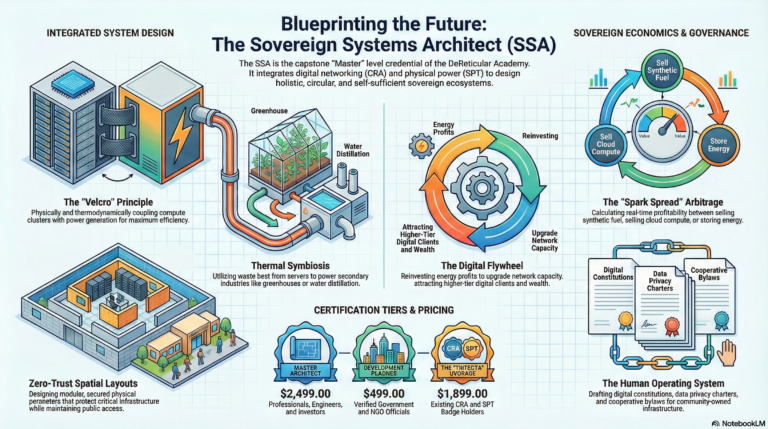
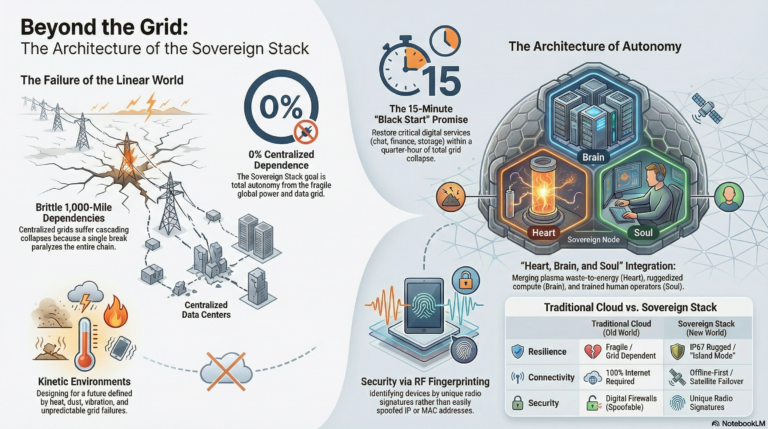
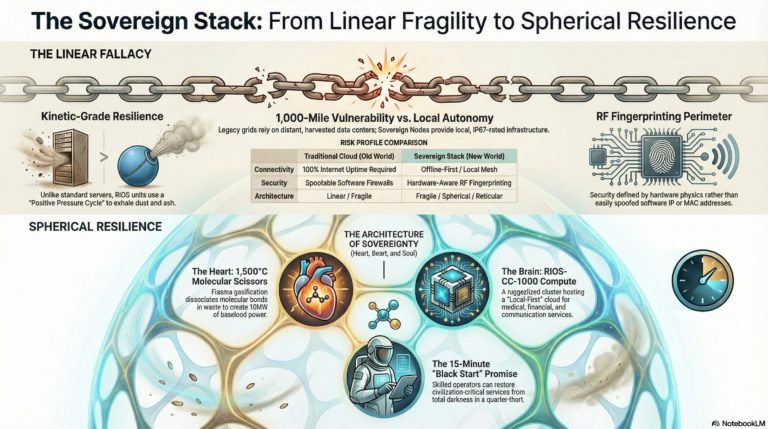
Traditional utility and data grids are predicated on “Line” based architectures—fragile, centralized umbilicals where a single failure at the source causes a total operational cascade. In high-privacy and high-stakes environments, these dependencies are increasingly viewed as obsolete. DeReticular’s “Death of the Line” philosophy mandates a shift toward “Spherical Resilience,” where infrastructure is composed of autonomous, self-healing nodes capable of maintaining local continuity during macro-internet outages or cyberattacks.
Strategic Comparison: Infrastructure Paradigms
| Dimension | Centralized Cloud Utilities | Spherical Decentralized Infrastructure |
| Connectivity Requirement | Persistent / Always-on | Intermittent / “Island Mode” Capable |
| Failure Cascades | Central outage = Total system failure | Isolated node failure = Local continuity |
| Data Ownership | Shared with corporate providers | User-owned; cryptographically anchored |
| Identity Verification | Cloud-based / Account-centric | Hardware-rooted / RF Fingerprinting |
| Operational Independence | Dependent on macro-internet backbone | Fully autonomous via local RIOS kernel |
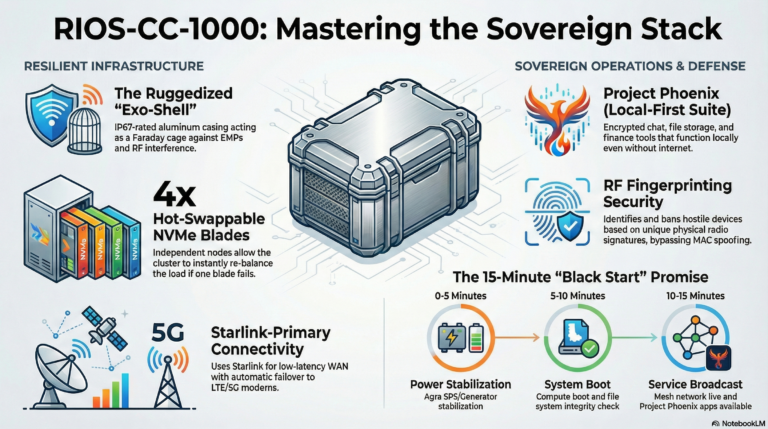
The “Island Mode” capability of the Sovereign Gateway is the ultimate defense against centralized failure. By utilizing the Rural Infrastructure Operating System (RIOS), these systems provide “physical survival” capabilities for rural users via Nomad Link (Starlink/LTE) or air-gapped municipal environments. This resilience is not merely a software feature; it is an architectural manifestation of specialized, trustless hardware.
3. The Sovereign Gateway: Architectural Foundations of Trustless AI
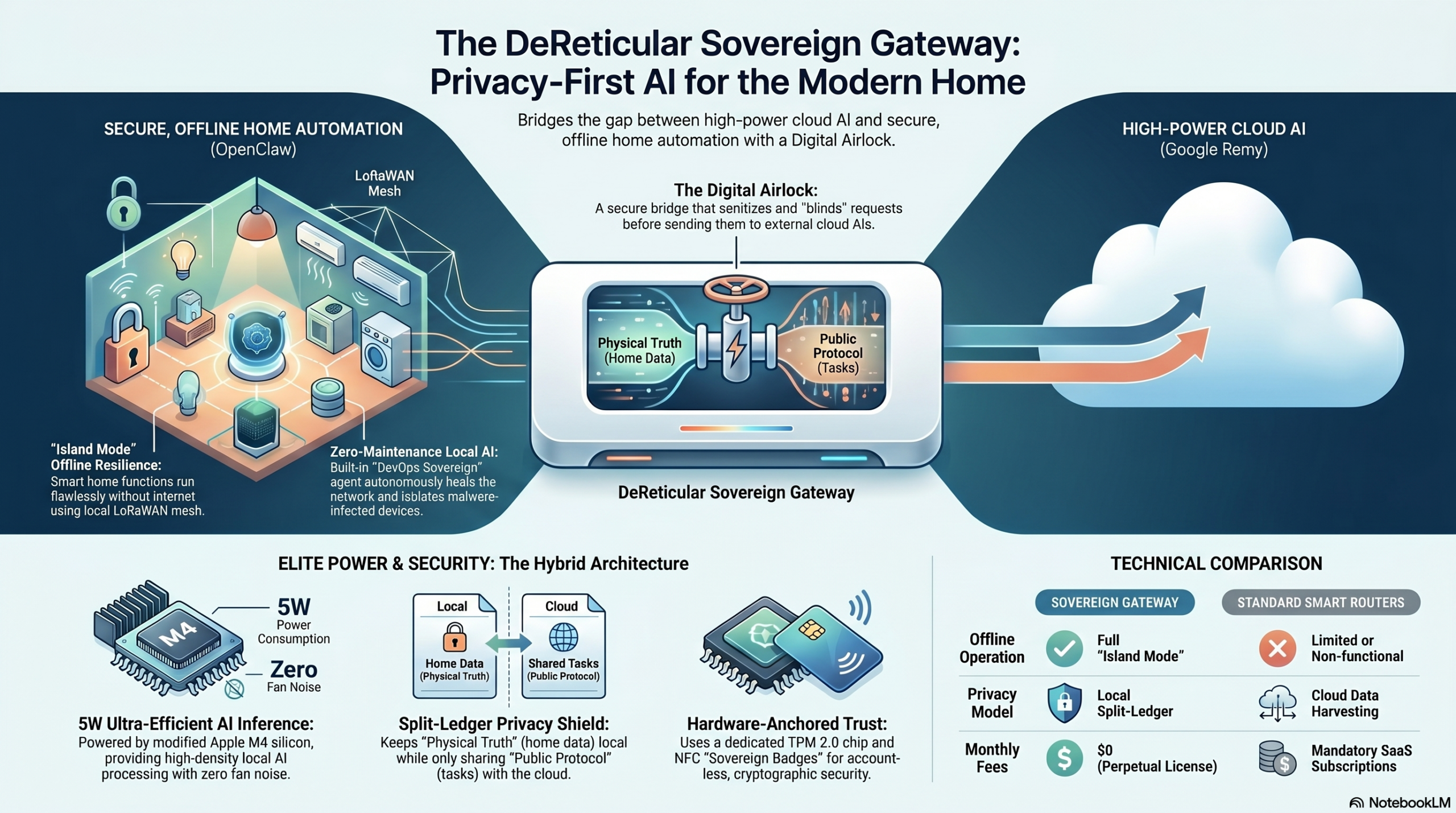
Strategic sovereignty in the agentic era requires hardware that can execute high-density AI inference locally without the latency or privacy leaks inherent in centralized architectures. The Sovereign Gateway functions as a localized, air-gapped command center, providing “Sovereign Automation” through a hardened silicon stack.
The “Premium Silicon Sentry” hardware stack utilizes a modified Apple M4 Silicon SoC with 16GB LPDDR5X unified memory, mounted on a high-spec 8-layer FR4 high-TG PCB. This configuration achieves high-density AI inference at a 5W idle power draw, which is the critical engineering threshold enabling a 0dB silent, passive cooling chassis. This ensures unobtrusive deployment in high-end residential and executive environments.
To support “Island Mode,” the Gateway employs a Trifi Wireless networking array (Wi-Fi 6E and LoRaWAN mesh) utilizing a PIFA antenna array tuned for 915MHz (US) or 868MHz (EU). This creates a localized “intranet canopy” that bypasses the macro-internet for IoT and smart home devices. The Gateway manages this environment via pre-installed Sovereign Agents:
- SOV-AUTO-DEV (DevOps Sovereign): Autonomously audits network security and self-heals crashed digital services, specifically mitigating open-source vulnerabilities like CVE-2026-25253 through local container isolation.
- SOV-AUTO-EXEC (Sovereign Executive): A private chief of staff utilizing local Whisper AI for on-device voice processing.
- Vault Warden: Processes local security camera feeds on-device using multispectral and volumetric analysis, ensuring sensitive telemetry never leaves the premises.
This synergy ensures that logic and privacy layers are governed by local hardware rather than a remote service provider.
4. The Digital Airlock and Split-Ledger Privacy Shield
Modern consumers often demand a hybrid approach—retaining sovereign privacy while utilizing the logistical power of Big Tech. This is achieved via a “Digital Airlock,” a secure API bridge between the local RIOS environment and centralized agents like Google Project Remy.
The “Split-Ledger Privacy Shield” is the architectural anchor of this system, utilizing an IC-SEC-TPM2 (TPM 2.0) to create a localized genesis block. This mechanism bifurcates data into:
- Physical Truth: Local telemetry, multispectral security feeds, and internal network logs that remain strictly within the RIOS kernel.
- Public Protocol: Sanitized intent payloads sent to the cloud.
The Blinded Payload mechanism allows the Sovereign Executive to request a cloud-based task (e.g., “Book a flight”) without exposing the interior of the user’s home or network. Because the RIOS kernel is physically air-gapped from the public-facing API, Google Remy is structurally prevented from scanning internal telemetry. Remy functions as an “External Ambassador,” executing logistics without ever crossing the threshold of the user’s private digital life.
5. Comparative Analysis: Google Project Remy vs. The Sovereign Ecosystem
The mid-2026 market is defined by the clash between Google Remy’s “always-on” proactive background reasoning (powered by TPU 8i/Gemini) and DeReticular’s localized execution. While Google relies on the “Trusted Environment Fallacy”—the assumption that Knowledge Catalogs and Artifacts can make a centralized cloud secure—the Sovereign Gateway utilizes asynchronous agent handoff to solve the connectivity and security problem.
When a node loses its Starlink/Nomad Link uplink, local agents queue tasks and execute local parameters immediately. Once connectivity returns, the system transmits compressed “intent payloads” to the cloud. This avoids the latency and bandwidth costs of running compute-intensive reasoning native to the mesh while maintaining the user’s “Island Mode” perimeter.
Competitive Differentiators:
- RF Fingerprinting: Cryptographic identity anchored to the hardware’s unique radio emissions.
- Perpetual Licensing: Local AI capabilities with no mandatory SaaS fees.
- Hardware-Rooted Identity: TPM 2.0 ensures the device is unreadable and cryptographically unique, even if physically stolen.
6. Deployment and Identity: The Sovereign Badge and Zero-Touch Onboarding
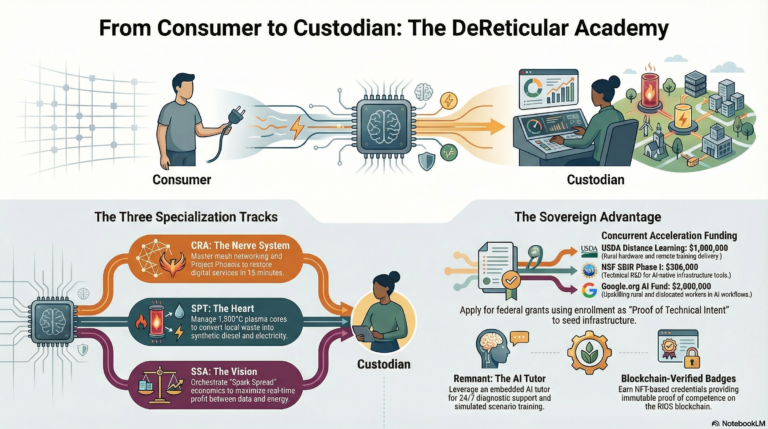
A trustless security posture mandates a “Zero-Account” setup. Identity is established via the Sovereign Badge system (NFC-enabled tokens or Soulbound NFTs issued by the DeReticular Academy). Setup occurs via a localized Bluetooth/Wi-Fi Direct handshake, removing the need for cloud-based credentials.
The Fulfillment & Provisioning Workflow anchors this security through a hardware identity “forging” process. At the factory, each unit’s RF fingerprint is burned into its radios and the TPM 2.0 is initialized. If a unit is decommissioned or stolen, a physical reset pin interacts with the TPM to trigger Cryptographic Shredding, instantly turning all stored telemetry and local logs into unrecoverable cryptographic noise.
7. Strategic Outlook: Risks, Opportunities, and Market Evolution
DeReticular’s shift into the “Prosumer” market places it at the center of the growing “Tech-Lash.” However, stakeholders must navigate significant regulatory and competitive hurdles:
SWOT-Based Assessment:
- Strength: Unmatched privacy architecture and “Island Mode” resilience.
- Weakness: Technical literacy barrier; marketing complex engineering like “Split-Ledgers” is difficult.
- Opportunity: Capturing high-net-worth individuals and rural users who require off-grid AI command and control.
- Threat: Big Tech API Gatekeeping and the ITAR/EAR/OFAC export controls triggered by advanced AI silicon and military-grade encryption.
Strategic Recommendations:
- Radically Simplify Messaging: Shift the value proposition from “Split-Ledger architecture” to “The AI that never spies on you.”
- Negotiate Obfuscated API Pipelines: Secure official, hardened partnerships with cloud providers to mitigate the risk of third-party hardware being blocked.
- Target High-Value Installs: Focus on rural mesh markets and high-end residential AV installers who are accustomed to premium, local-first hardware costs.
Ultimately, Spherical Resilience is not merely a security preference, but a fundamental requirement for physical and digital survival in the agentic era. By combining the power of the cloud with the unbreakable security of air-gapped hardware, the Sovereign Gateway provides the definitive blueprint for trustless infrastructure.