Market Entry Strategy: Sovereign Space Systems (S3) and the Lunar Economy
1. Strategic Vision: Transitioning from Linear Fragility to Spherical Resilience
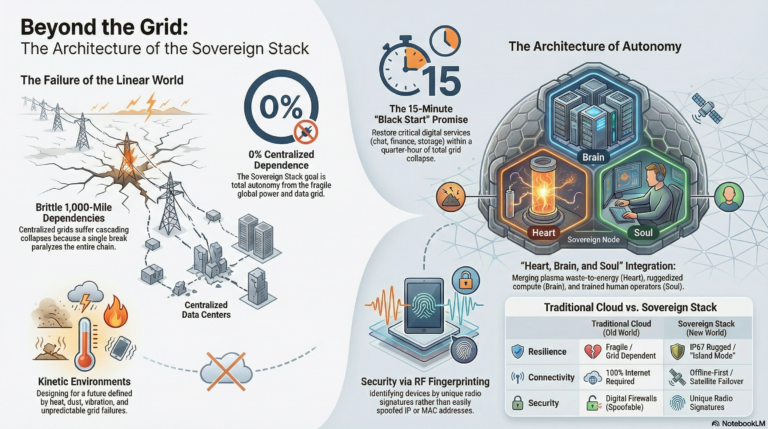
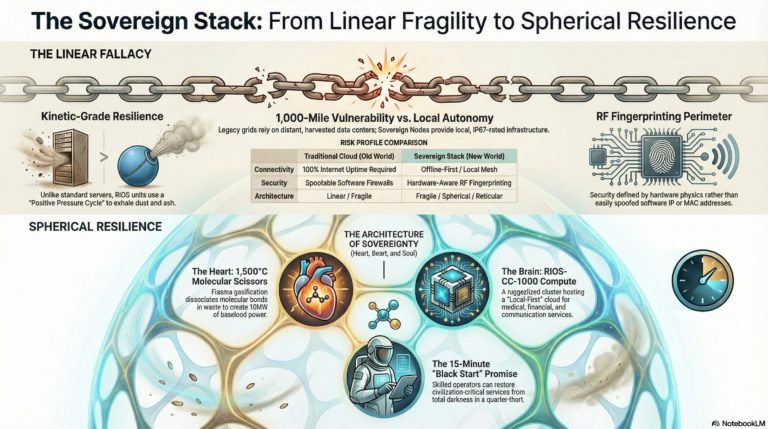
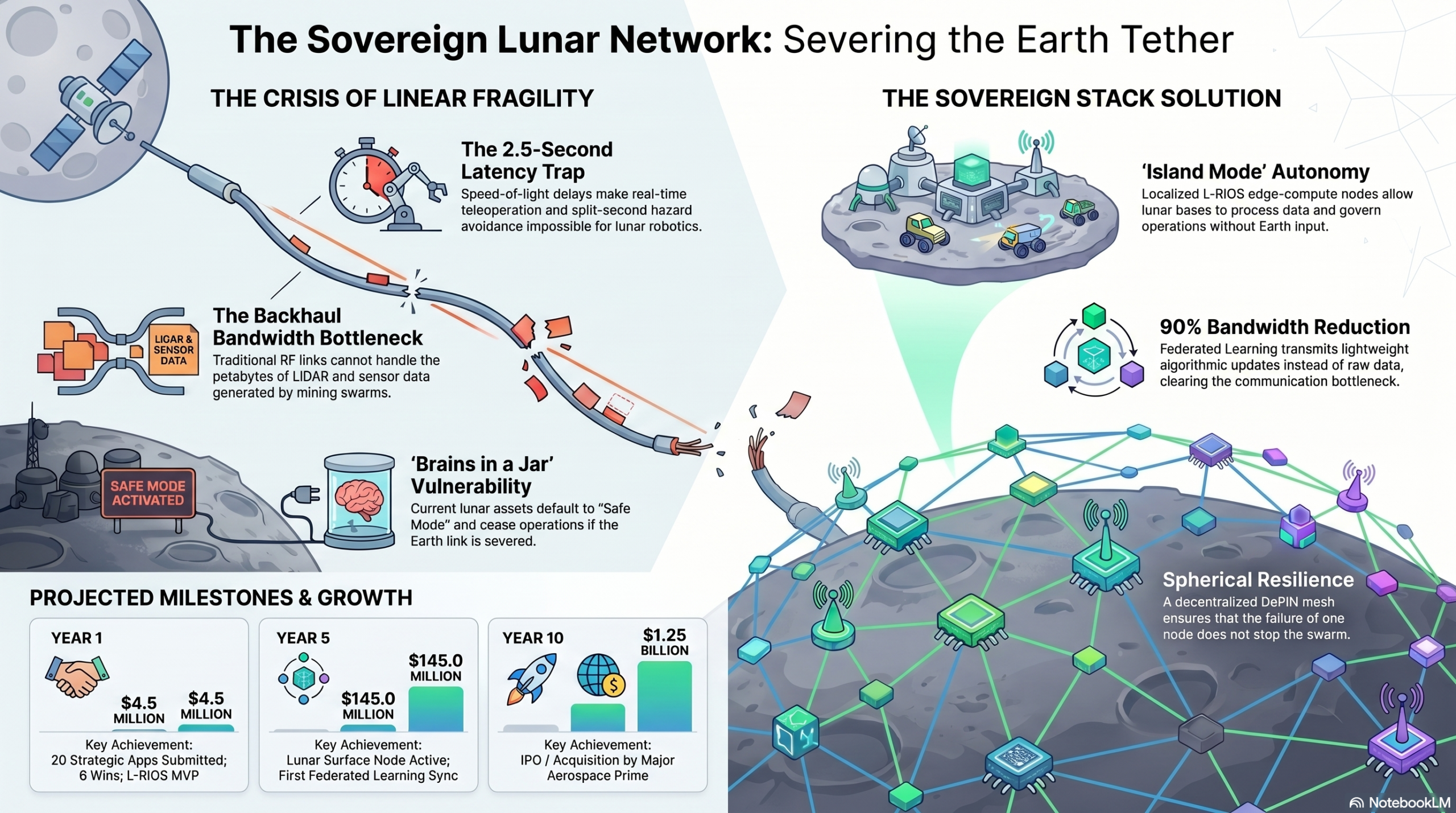
Current lunar communication architectures suffer from Linear Fragility, a model where off-world assets function as “dumb terminals” tethered to Earth by a fragile umbilical cord. This centralized dependency relies on the oversubscribed Deep Space Network (DSN)—which operates on a simulation baseline of a mere 256 kbps—and is crippled by the “Latency Trap.” With a ~2.5-second round-trip delay for the Moon and up to 24 minutes for Mars, real-time swarm coordination and hazard avoidance are mathematically impossible under legacy frameworks. If an asset loses line-of-sight with Earth, it defaults to a “safe mode,” resulting in catastrophic operational downtime and mission-critical risk.
Sovereign Space Systems (S3) provides the strategic pivot to Spherical Resilience. By deploying the Sovereign Stack (RIOS) and Decentralized Physical Infrastructure Networks (DePIN), S3 enables Island Mode autonomy, allowing lunar assets to process data, evolve logic, and coordinate locally. This architecture mitigates the CAPEX-heavy requirement for massive terrestrial antennas and replaces it with a self-healing, autonomous mesh. The S3 mission is to establish the foundational, autonomous operating system for the lunar economy, ensuring commercial viability through computational sovereignty. This transition is a procurement imperative: it is the only viable path to bypass the “Linear Fragility” that threatens the ROI of off-world industrialization.
2. The 30-Day Strategic Strike: High-Velocity Capital Acquisition
The “30-Day Strategic Strike” is a high-velocity maneuver designed to flood the procurement pipeline and secure a dominant “sole-source” position before legacy competitors can react. This maneuver utilizes a Joint Venture (JV) model to separate intellectual property from capital requirements, ensuring maximum agility.
- The Command Center Model:
- The Architect (DeReticular): Provides the core Sovereign Stack IP and technical validation from terrestrial operations.
- The Engine (Financial Sponsor): Provides a $2.5 million “War Chest” to fund the administrative and engineering surge.
- The Strategic Grant Swarm (SGS): This specialized unit outpaces traditional aerospace R&D cycles by deploying a “Swarm” of 10 technical writers, 5 Edge Systems Engineers mapping L-RIOS, a Legal/Compliance team (ITAR/EAR), and 2 former NASA procurement officers specifically tasked with optimizing the Probability of Win (P-Win).
| Solicitation Type | Quantity | Strategic Focus (Tech Domain) | Primary Objective |
| SBIR/STTR Phase I | 10 | Autonomous Nav, Edge AI, Micro-Grids | Non-dilutive Capital ($1.5M pool) |
| Tipping Point | 2 | Proximity Edge-Computing & Federated Learning | High-Capital R&D (10M–30M) |
| PRISM Payloads | 2 | Lunar Data Center Delivery | Flight Manifest / Delivery to Moon |
| NIAC | 2 | DePIN-Based Planetary Terraforming | Long-term Visionary R&D |
| SpaceWERX Pitches | 4 | Sovereign Mesh for Orbital Defense | DoD Procurement / Security |
This initial surge of government capital serves as the financial foundation for S3’s long-term dominance, maturing the technology through non-dilutive funds while establishing an unassailable track record of flight readiness.
3. The Sovereign Stack: Architecture for Off-World Autonomy
S3’s technological blueprint is the “Lunar Octagon,” a space-hardened adaptation of DeReticular’s terrestrial “Operation Octagon.” This system moves lunar operations from “brains in a jar” to decentralized, self-contained nodes capable of surviving independently of Earth.
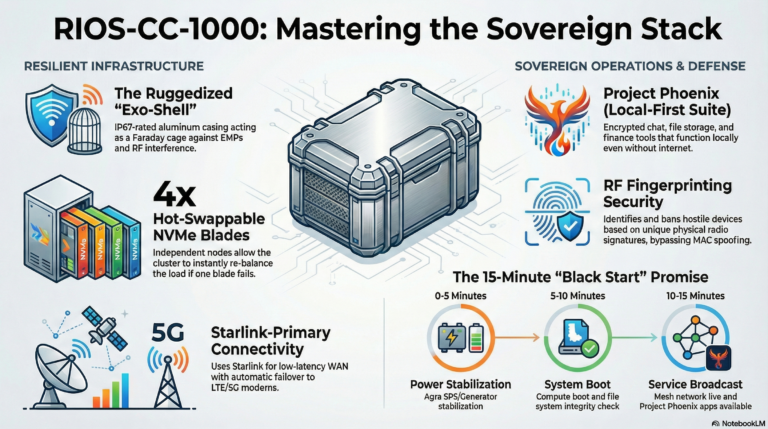
- L-RIOS (Lunar Infrastructure Operating System): The “Brain” of the stack. This edge-AI OS provides Black Start capabilities, allowing the system to boot and operate entirely off-grid.
- Agra Dot Astro: The “Muscle.” Unlike terrestrial nodes that use plasma gasification, Node A (Malapert Massif) utilizes Fission Surface Power and vertical solar arrays to provide decentralized baseload power.
- Kurb Crawlers: The “Motion.” These are heavy-duty mining automata that shift the paradigm from teleoperation to “swarm instinct,” communicating over localized LTE/5G proximity networks.
- Sovereign Sentry: The “Mind.” This layer governs zero-knowledge data arbitrage, securing the mesh via a Hardware Root of Trust (RF Fingerprinting and TPMs).
The Federated Learning Edge: S3 solves the Backhaul Bandwidth Asymmetry by moving the model to the data, achieving a >95% reduction in bandwidth requirements. In a “Federated Learning Event” at Shackleton Crater, a Kurb Crawler encountering dense basalt does not stream raw LiDAR to Earth. Instead, its onboard GPU analyzes the torque feedback locally and optimizes a new “drill-pulse rhythm.” It then broadcasts a lightweight, 45 KB algorithmic update to the local Edge Hub, which pushes the “instinct” to the entire swarm. The fleet adapts in milliseconds; Earth only receives the optimized solution, preserving precious DSN bandwidth.
4. Phased Funding Roadmap: The Path to Flight Readiness
The aerospace “Valley of Death” is bypassed through S3’s tiered acquisition strategy, which utilizes NASA’s STMD and SMD pipelines to fund maturation from TRL-3 to TRL-9.
- Tier 1: Early-Stage Maturation: Utilizing SBIR/STTR Phase I/II and an unfunded Space Act Agreement (SAA) to gain access to high-fidelity environments like the NASA JSC Lunar Yard for Project LUNA-NODE validation.
- Tier 2: Tipping Point Solicitations: S3 will target 2M–15M+ contracts. This mechanism requires a 25% corporate cost-sharing commitment, which S3 will meet via the Financial Sponsor’s “War Chest” to prove commercial skin-in-the-game.
- Tier 3: Flight & Delivery (CLPS/PRISM): Integration of S3 hardware as a hosted payload on Commercial Lunar Payload Services landers. This ensures NASA pays for the integration and transport of S3’s “Lunar Data Centers.”
- Tier 4: Visionary Research (NIAC): Categorizing “Algorithmic Terraforming” as the long-term play, positioning S3 as the essential intelligence layer for the 24-minute delay realities of Mars.
5. Competitive Landscape: Disintermediating Legacy Aerospace
Traditional “Primes” (Boeing, Lockheed) are structurally misaligned with the decentralized requirements of the lunar mesh. Their reliance on slow, centralized, and billion-dollar bespoke hardware makes them incapable of matching S3’s speed and cost-efficiency.
| Dimension | Traditional Primes | Sovereign Space Systems (S3) |
| Design Cycle Speed | 5+ Years (Bespoke) | Rapid (Federated Learning / Edge AI) |
| Data Architecture | Centralized / Cloud-Dependent | Decentralized / Island Mode |
| Network Governance | Centralized Agency Control | Decentralized Autonomy (DePIN) |
| Hardware Resilience | Fragile / Single Point of Failure | Spherical Resilience / Self-Healing |
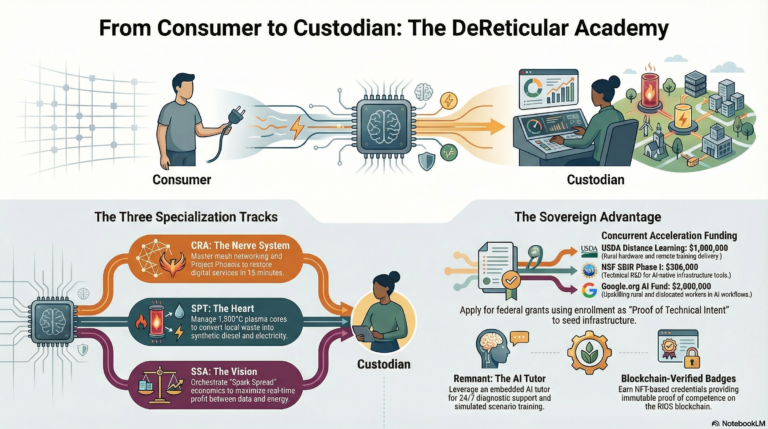
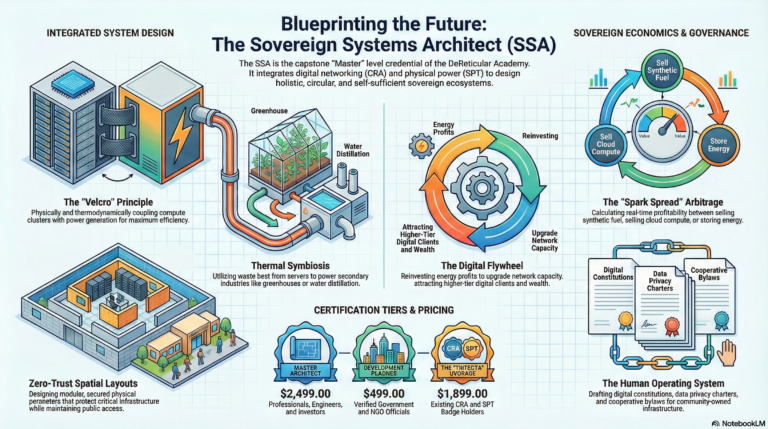
The Sovereign Advantage: S3 implements a Sovereign Tax—a recurring licensing fee for the data arbitrage and swarm coordination required for all commercial mining. This is enforced through Sovereign Badges and NFT credentials on a decentralized ledger, ensuring only cryptographically verified personnel can alter mission parameters. S3 does not just provide hardware; it provides the “Software & Intelligence” layer that every other lunar actor must pay to utilize.
6. Revenue Model and 10-Year Proforma
The financial strategy transitions from non-dilutive government grants to high-margin commercial licensing of the Sovereign Stack.
- Tier 1 (Years 1-2): Grant Capital capturing “free” R&D funding ($3M – $8M).
- Tier 2 (Years 3-5): Prime Subcontracting fees for “building the brain” of CLPS landers ($50M – $150M).
- Tier 3 (Years 6-10): Dominance through the Sovereign Tax on all commercial lunar swarms ($500M+).
| Year | Revenue (M) | EBITDA (M) | Key Milestone |
| Y1 | $4.5 | ($1.2) | 20 Apps Submitted; L-RIOS Analogue MVP |
| Y2 | $12.0 | $2.5 | Phase II SBIR Wins; DoD Space Force Contract |
| Y3 | $28.0 | $8.0 | “Tipping Point” Funding; First Flight Hardware |
| Y4 | $65.0 | $22.0 | L-RIOS Integrated on NASA CLPS Flight |
| Y5 | $145.0 | $55.0 | Lunar Surface Node Active; First Federated Sync |
| Y6 | $280.0 | $110.0 | Commercial Mining Swarms Licensing RIOS |
| Y7 | $450.0 | $190.0 | Expansion to Lunar Gateway; P2P Power Trading |
| Y8 | $680.0 | $310.0 | Dominance in Off-World Edge Computing |
| Y9 | $920.0 | $450.0 | Mars Transition; Initial Terraforming AI Mesh |
| Y10 | $1,250.0 | $680.0 | IPO / Acquisition by Major Aerospace Prime |
The Year 10 exit strategy is predicated on a $1.25B revenue target, achieved by S3 becoming the foundational operating system for the multi-planetary economy.
7. Strategic Conclusion: The Rise of the Mesh
The successful extraction of lunar resources is not a hardware problem; it is a software and architecture problem. By adopting the Sovereign Stack, S3 eliminates the “linear fragility” of 20th-century exploration and replaces it with an intelligent, self-governing mesh. As the foundational intelligence layer for off-world industrialization, S3 disintermediates hardware-heavy legacy firms and secures the high ground of the lunar economy.
The Line is dead. The Mesh is rising. Space is Sovereign.