The Death of the Line: How the “Sovereign Stack” is Rewriting the Future of Infrastructure
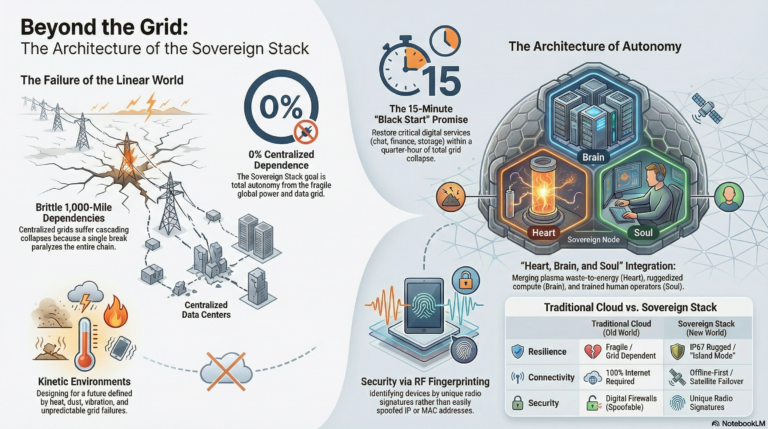
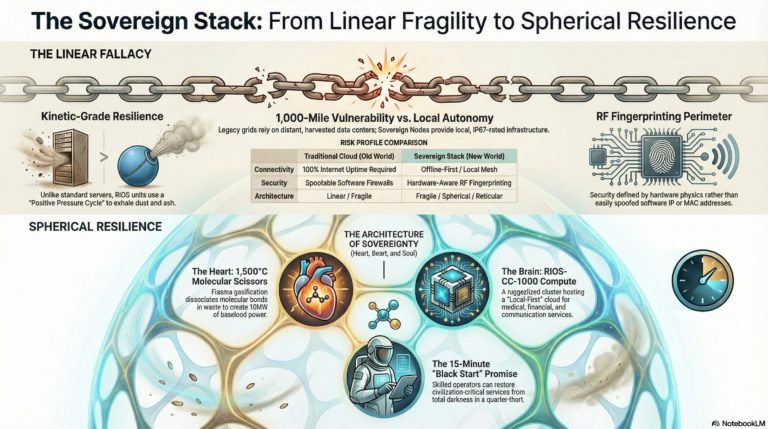
The modern world is built upon an architecture of terminal failure. This legacy framework, known as the “1,000-Mile Failure Model,” relies on linear dependencies—distant power stations tethered to communities by thousands of miles of vulnerable, exposed transmission lines. As global grid instability climbs and the power demands of the AI compute crisis accelerate, this centralized model has transitioned from an asset to a systemic liability.
In response, DeReticular and its industrial division, Agra Dot Energy, are deploying the “Sovereign Stack.” This is not a mere utility upgrade; it is a defense-grade, self-funding blueprint for the post-grid era. By establishing “Sovereign Nodes”—fully autonomous “Digital Hamlets” capable of operating in complete isolation—the Sovereign Stack rejects the “Digital Sharecropper” model of renting third-party infrastructure. It offers, instead, a path toward localized “Distributed Cognition” and absolute energy independence.
Here are the seven counter-intuitive shifts currently rewriting the future of infrastructure.
- The Rise of the Octagon: Shifting to Spherical Resilience
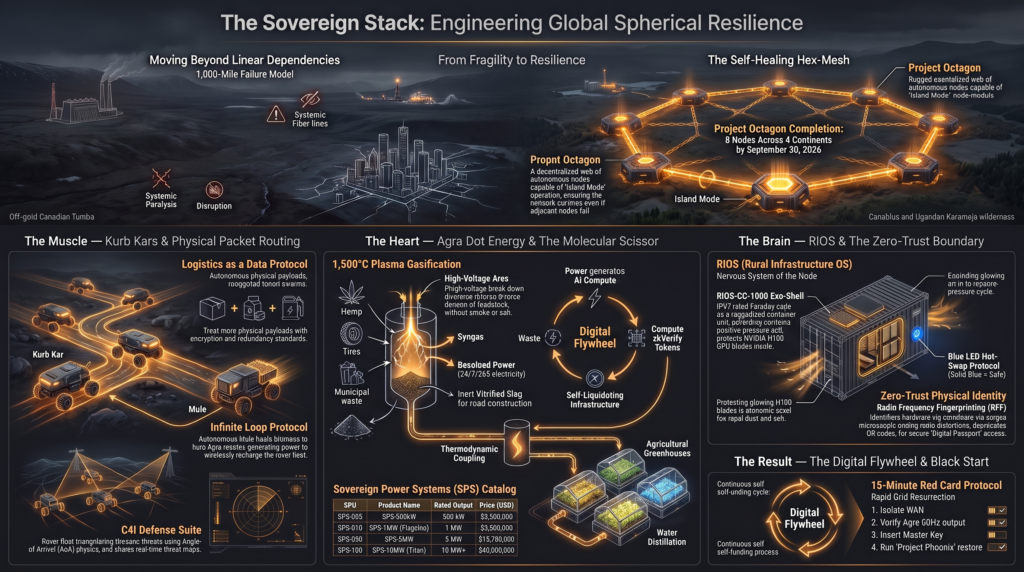
The foundational thesis of this movement is “The Death of the Line.” The era of linear grid dependency is being replaced by a philosophy of “Spherical Resilience.” Instead of a 1,000-mile chain where a single kinetic or cyber disruption cascades into total darkness, infrastructure is being reorganized into a self-healing “Hex-Mesh” of autonomous nodes.
This strategy is materialized through “Project Octagon,” a global network of interconnected primary nodes arranged in a honeycomb structure. If one node experiences a localized collapse, the remaining mesh continues to function in “Island Mode.”
“The centralized transmission grid (‘The Line’) is characterized as brittle, inefficient, and prone to collapse under the demands of high-density AI compute.”
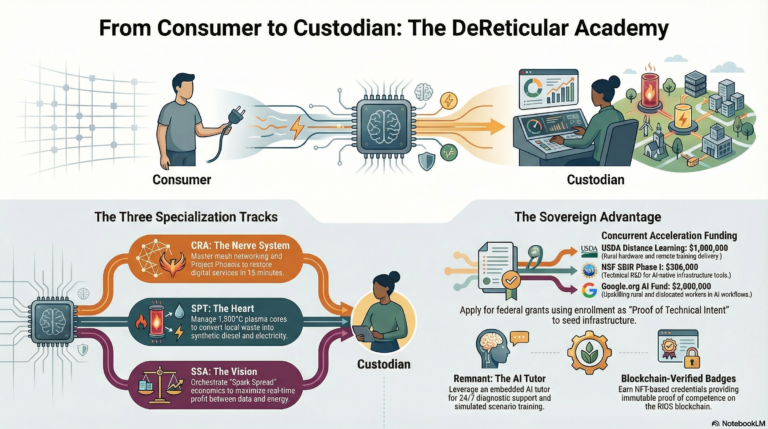
Moving from linear dependency to a geometric mesh is the ultimate insurance policy for modern civilization. It shifts a community’s status from passive consumer to the sovereign custodian of its own survival.
- The Farm is the New Power Plant
We are witnessing an economic inversion in the agricultural sector. The Sovereign Stack posits that agriculture’s primary export is shifting from food to energy and compute. This “Digital Hamlet” model transforms the farm into an edge-level utility.
By deploying “RIOS Campus” infrastructure, agricultural centers turn local waste streams into high-density electrical output. This initiates the “Digital Flywheel”: the farm processes its raw waste to generate electricity, which then powers on-site RIOS-CC-1000 AI server clusters. This is a “self-liquidating” asset model; the revenue generated from executing global AI workloads pays down the high-CapEx industrial hardware, effectively turning a waste liability into a primary engine of wealth.
- Molecular Scissors: Why Burning Trash is Obsolete
Traditional waste-to-energy models rely on incineration, a process plagued by toxic ash and carbon-heavy smoke. Agra Dot Energy has rendered this obsolete through high-temperature Plasma Gasification. To be clear: this is physics, not biology—a critical distinction from the digestion models used by legacy firms.
Utilizing plasma torches, these “molecular scissors” operate at temperatures exceeding 1,500°C and are QA stress-tested at 1,800°C to ensure total molecular dissociation. Rather than burning waste, the system breaks atomic bonds, reducing feedstock to its constituent elements. The system is entirely feedstock-agnostic, vaporizing everything from tires and medical waste to “wet leaf” hemp stalks.
The byproduct is “Vitrified Slag,” an inert, non-toxic, obsidian-like glass used as high-grade aggregate for construction. There is no smoke, no combustion ash, and no secondary waste—only energy and structural assets.
- The Velcro Principle: Thermodynamic Coupling
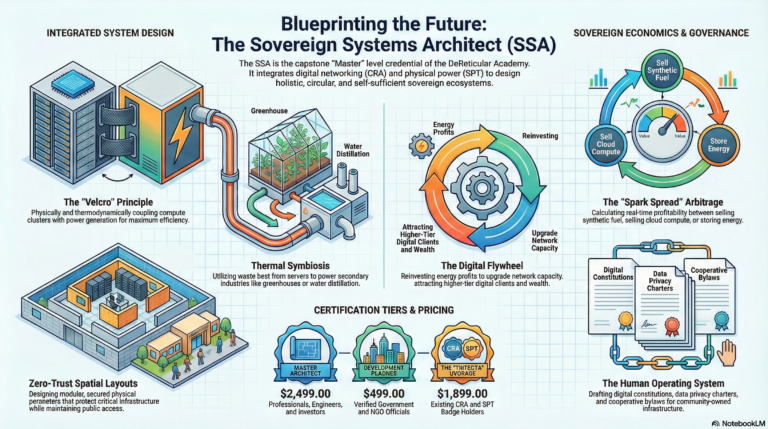
Infrastructure value is maximized when disparate sectors are tightly bound. This is the “Velcro Principle.” In a Sovereign Node, agriculture and compute are thermodynamically coupled to capture and reuse energy that the “Old World” simply vents as a loss.
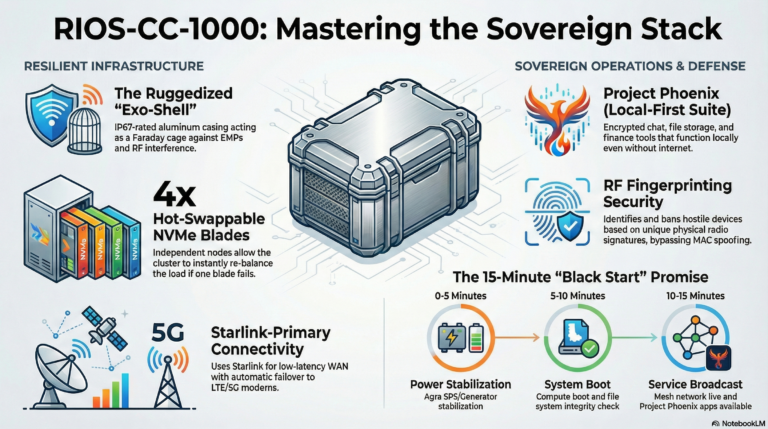
The RIOS-CC-1000 compute clusters—IP67-rated and designed for kinetic, high-threat environments where standard IT fails—produce massive amounts of waste heat. Rather than treating this as a “costly thermal management footprint,” the Sovereign Stack pipes this heat directly into greenhouses for year-round food production or into water distillation systems. By binding data centers to agriculture, the system transforms a thermal liability into a circular economic asset.
- The “Infinite Loop”: Machines that Refuel Themselves
The Sovereign Stack extends into logistics via Kurb Kars, autonomous rovers designed for “Logistical Deserts.” These units eliminate “range anxiety” through the “Infinite Loop” protocol—a breakthrough in machine-to-machine (M2M) energy negotiation.
In this loop, an autonomous “Mule” unit hauls biomass (such as hemp waste) to an Agra reactor. The reactor dissociates the waste into power, which is then used to recharge the rover fleet wirelessly or produce Agra Synthetic Diesel for heavy-duty units. Crucially, the Mule negotiates the energy price directly with the reactor over the RIOS network. By fetching the very fuel required to generate their own charging power, these fleets achieve complete operational autonomy.
- The Death of the QR Code: RF Fingerprinting
Security in sovereign environments has moved beyond spoofable QR codes and digital keys. DeReticular has deprecated these in favor of “Radio Frequency Fingerprinting” (RFF).
Every mobile device possesses unique, unavoidable analog distortions caused by microscopic hardware imperfections in its radio transmitter. The system identifies these “fingerprints” to create a zero-trust Digital Passport. This enables “physical proof of presence” for access control. In the Non-Emergency Medical Transportation (NEMT) sector, this technology is being used to eliminate the $11.2 billion plague of “Ghost Rides”—billing fraud where a ride is recorded without a patient. With RFF, a transaction cannot trigger unless the patient’s unique RF signature is physically detected inside the Kurb Kar.
- Monetizing the “Carbon Oracle” with zkVerify
The final layer of the Sovereign Stack is the financialization of green energy. By integrating Zero-Knowledge Proof (zkVerify) sensors directly into the physical hardware, the system creates a “Carbon Oracle.”
These sensors cryptographically prove that energy production is carbon-negative by measuring waste intake and carbon sequestration in the vitrified slag. This data is used to mint “Verified Green Compute” credits, which are tradeable for USD/USDC on global Decentralized Finance (DeFi) markets. This financial innovation allows local operators to sell premium credits to global AI networks, providing the high-margin secondary revenue stream necessary to pay down industrial-scale infrastructure.
Conclusion: The Year of the Octagon
The 2026 roadmap marks the transition from boutique industrial deployment to a global infrastructure standard. Project Octagon is scheduled to go live across four continents. Beyond the “Crown Jewel” node in Uganda and the thermal stress-testing site in Phoenix, Arizona, the expansion includes the Andean region of South America for low-oxygen cooling tests and the Pacific Rim to validate humidity and “Island Mode” satellite bonding.
As the legacy grid continues its slow, linear collapse, the choice for communities has become existential. In a world of increasing fragility, is your community a passive consumer of the “Line,” or a sovereign custodian of its own survival?