
Infrastructure Deployment Prospectus: Decoupling Compute from the Grid
1. The Permitting Wall: Deconstructing the Centralized Grid Crisis
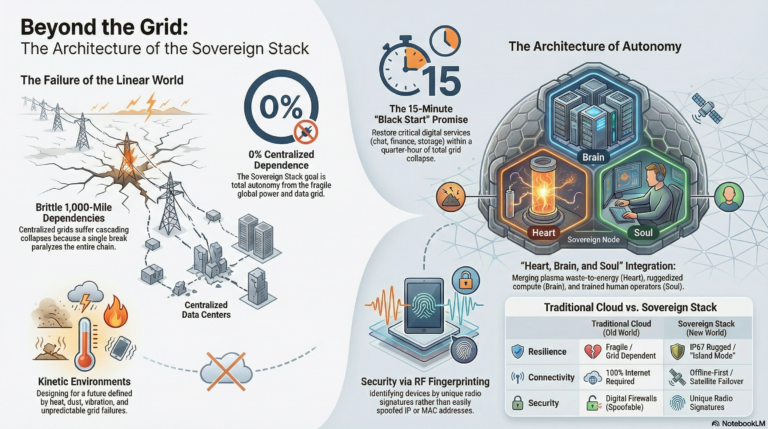
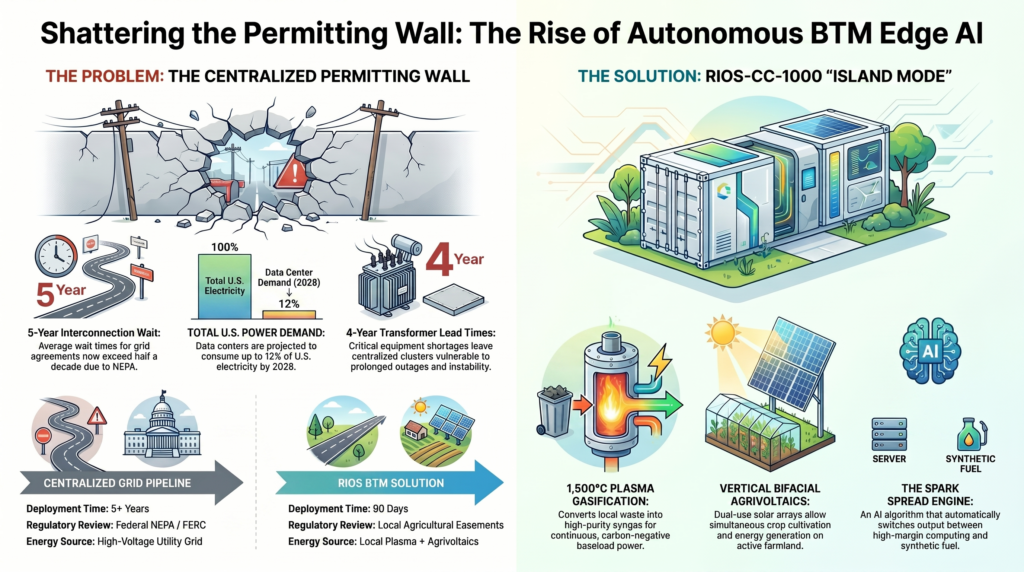
The primary strategic barrier to scaling artificial intelligence is no longer silicon architecture or algorithmic efficiency; it is the “Permitting Wall.” This represents the physical and regulatory stagnation of the centralized electric grid, where interconnection queues managed by regional transmission organizations now exceed five years due to National Environmental Policy Act (NEPA) review timelines. For industrial stakeholders, the centralized model is now a liability. In the 2026–2028 window, the grid is physically incapable of expanding at the velocity required to meet the projected surge in power demand. Relying on legacy infrastructure introduces unacceptable lead-time risks that threaten the very existence of high-growth AI ventures.
Centralized Grid Fragility Metrics
| Metric | Current Grid Realities | Projected 2028 Demand / Status |
| Interconnection Wait Time | > 5 Years (FERC tracked) | Insurmountable for AI scaling velocity |
| Environmental Review | 4.5 Years per NEPA EIS | Baseline for new transmission lines |
| Equipment Lead Times | 3–4 Years for high-voltage transformers | Critical supply chain bottleneck |
| National Consumption | ~2–3% (Historical Data Centers) | 7%–12% of total US electricity |
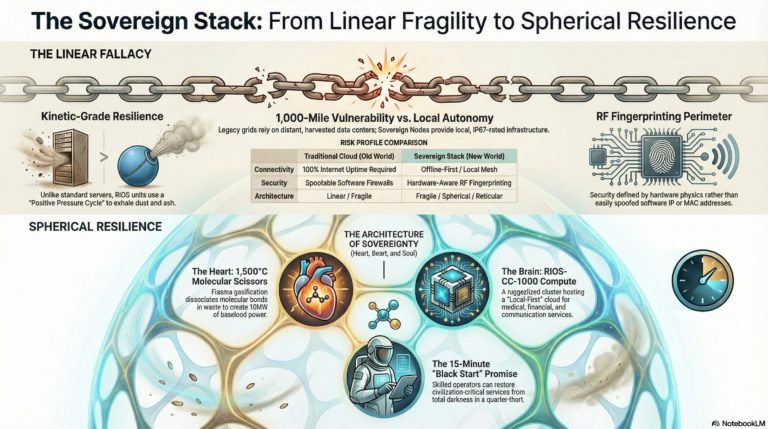
Beyond lead times, the Cybersecurity and Infrastructure Security Agency (CISA) and the White House Task Force have identified the centralized concentration of load centers as a tier-one national security risk. The RIOS-CC-1000 addresses these through a “hardened edge node” architecture that mitigates:
- Single-Point-of-Failure Vulnerabilities: Decoupling massive clusters from a fragile, aging macro-grid.
- Regional SCADA Risks: Eliminating exposure to coordinated cyberattacks on regional utility control systems.
- Physical Fragility: Resolving the risk of prolonged outages caused by extreme weather and the global shortage of step-up transformers.
This crisis is compounded by federal policy stagnation. While the $42.5 billion BEAD program is mired in permitting disputes, the USDA REAP grant freeze on March 31, 2026, has paralyzed traditional rural clean energy financing. These systemic failures necessitate an immediate transition to the Sovereign Stack: a structurally independent, off-grid architecture. The RIOS-CC-1000 is the specific architectural response to this collapse, enabling rapid deployment behind-the-meter.
2. The RIOS-CC-1000: Modular “Island Mode” Infrastructure
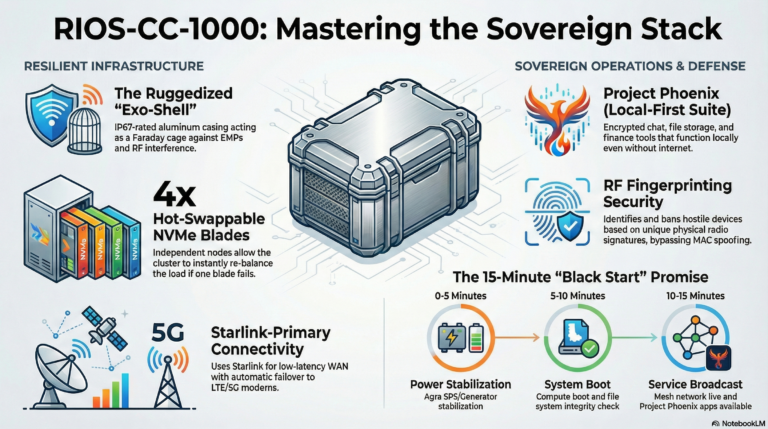
To achieve true computational self-determination, infrastructure must adopt an “Island Mode” operational philosophy. This approach ensures that local inference and decision-making continue unabated, regardless of the state of the macro-grid or long-haul fiber stability.
Physical Specifications
The RIOS-CC-1000 is a ruggedized environment designed for high-density performance in any climatic condition:
- 10ft ISO High-Cube Shell: Housed in a NEMA 4X sealed enclosure coated in ceramic-based heat-reflective paint to minimize solar gain.
- Dual-Compartment Vault Design: Segregates the Power & Storage Vault (grid-forming inverters and 400 kWh LFP battery) from the Compute Core.
- Honeywell PTM7950 Phase-Change Material: Utilizes advanced thermal interface material that transitions from solid to liquid at 45°C to maximize heat transfer efficiency.
Sovereign Sentry Pro: Advanced Thermal Engineering
The Sovereign Sentry Pro nodes utilize a fanless, anodized aluminum monoblock chassis achieving 8.5 W/mK conductivity. So what? By removing mechanical fans, the system eliminates the primary point of mechanical failure and dust infiltration, effectively protecting the asset’s Capex and ensuring longevity in harsh environments. Furthermore, this design minimizes the parasitic power load to a mere 5W per node, ensuring that nearly 100% of generated energy is dedicated to revenue-generating compute.
Operational Resilience: TriFi and RIOS Core
Connectivity is maintained via a private “TriFi” mesh network (5.8 GHz and 6 GHz bands). Powered by the RIOS Core microkernel, the system enables local ledger validation and autonomous inference. This architecture guarantees 100% uptime, as the node does not require a constant link to centralized cloud platforms to maintain operational integrity. This hardware layer is supported by a sovereign energy generation system.
3. The Energy Muscle Layer: Plasma Gasification and Agrivoltaic Integration
The strategic advantage of the Sovereign Stack is its ability to bypass industrial utility zoning. By utilizing “Active Agricultural” classifications, sites are deployed under Agricultural Easement protections, avoiding the years-long permitting cycles required for traditional industrial data centers.
1,500°C Plasma Gasification by Agra Dot Energy
The system utilizes a high-temperature thermal plasma reactor engineered by Agra Dot Energy to convert waste into clean energy:
- Molecular Cracking: An ionized gas arc exceeding 1,500°C breaks carbonaceous molecular bonds into elemental constituents.
- NIR Spectroscopy Tuning: Real-time Near-Infrared sensors analyze feedstock moisture and carbon content, allowing the system to adjust arc intensity.
- Efficiency Optimization: This real-time tuning increases total energy output by 30–43% over standard low-temperature gasification.
Vertical Bifacial Agrivoltaic Arrays
Complementing the gasifier are N-type bifacial solar panels installed vertically at 7-meter intervals. This spacing allows standard agricultural machinery to cultivate crops directly between rows. So what? This configuration achieves a Land Equivalent Ratio (LER) of 1.2, meaning the land is 20% more productive than if used for farming alone. This LER is the legal “silver bullet” that maintains the property’s active agricultural status, transforming a potential 5-year industrial permitting battle into a standard agricultural equipment installation and de-risking the project’s timeline by up to 90%.
Byproduct Monetization
The plasma process generates four distinct revenue streams:
| Output | Industrial/Agricultural Use Case |
| Syngas | Fed to off-grid engines for local, carbon-negative electricity. |
| ASF™ | Refined via Micro-GTL into sulfur-free diesel and jet fuels. |
| Biochar | Pure carbon used to enhance soil water and nutrient retention. |
| Vitrified Slag | Inert glass-like aggregate sold for high-tensile road construction. |
4. The Mathematical Optimization Layer: The Spark Spread Engine
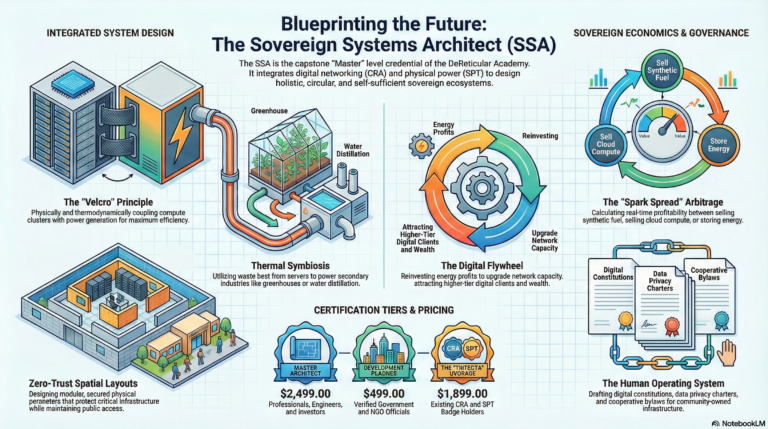
Managed by the Sovereign Sentry Pro, the Spark Spread Engine protects asset value through real-time energy arbitration, routing every generated kilowatt to its most profitable use case.
Mathematical Formulation for Net Yield (\Pi(t))
The objective function for maximizing net yield is defined as:
\max_{a(t)} \quad \Pi(t) = a(t) \cdot P_{\text{total}}(t) \cdot \left[ V_{\text{compute}}(t) – C_{\text{fuel}}(t) \right] + \left( 1 – a(t) \right) \cdot P_{\text{total}}(t) \cdot \left[ V_{\text{ASF}}(t) – C_{\text{fuel}}(t) \right]
Subject to:
- 0 \le a(t) \le 1 (Arbitrage allocation factor)
- a(t) \cdot P_{\text{total}}(t) \le P_{\text{compute, max}} (Compute capacity limits)
- (1 – a(t)) \cdot P_{\text{total}}(t) \le P_{\text{GTL, max}} (Gas-to-Liquid intake limits)
- \text{SOC}_{\text{min}} \le \text{SOC}(t) \le \text{SOC}_{\text{max}} (Battery safety limits)
Scenario Analysis
- Network Outage: If external connectivity fails, V_{\text{compute}} drops. The engine automatically routes 100% of syngas to ASF™ production, capitalizing on local fuel markets.
- Compute Demand Spike: When AI inference or DePIN token demand increases, the Sovereign Sentry Pro shifts a(t) to 1, routing all power to GPU processing to maximize high-velocity digital revenue.
5. Financial Frameworks and Regulatory Bypass Strategies
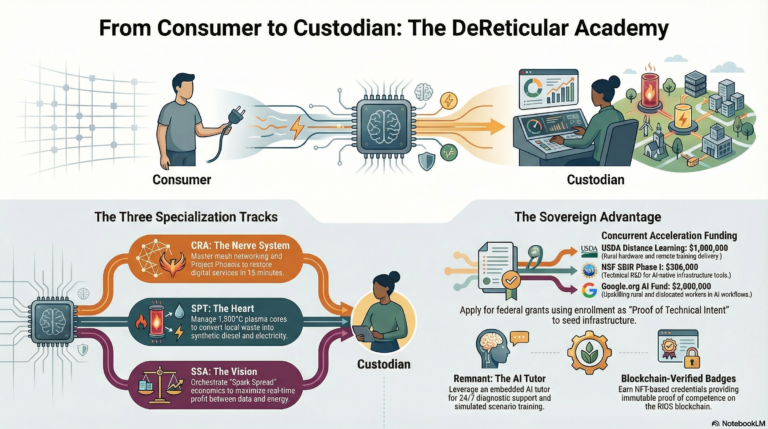
The Sovereign Stack utilizes three primary funding mechanisms to shift from CAPEX-heavy procurement to self-funding, high-velocity models.
- Node-as-a-Service (NaaS): Primarily for for-profit entities, this revenue-share model allows for installation with zero down payment. Hardware costs are amortized through a percentage of the automated Spark Spread revenue generated on-site.
- S-P3 & IRA Section 6417 (Direct Pay): This is a razor-sharp tool for non-profit cooperatives and agricultural collectives. Under “Direct Pay,” tax-exempt organizations receive 30–50% cash refunds from the federal government for the clean energy components of the RIOS system.
- Intercompany Sovereign Debt: DeReticular acts as the central financier, issuing low-interest debt to local cooperatives to ensure the infrastructure remains a community-owned asset and avoids predatory external credit.
6. The 90-Day Execution Roadmap
Competitive advantage in the AI era is defined by deployment velocity. The following timeline outlines the path from audit to activation in a single fiscal quarter.
Stage 1: Days 1–30 (Asset Audit)
- Audit of agricultural/municipal waste streams to verify daily feedstock availability.
- GIS mapping of local energy resources and computational demand profiles.
- Initial feasibility study for vertical agrivoltaic spacing and crop alignment.
Stage 2: Days 31–60 (Legal & Tax Framing)
- Formation of a local cooperative or Sovereign-Public-Private Partnership (S-P3).
- Setup of DAO governance to manage local energy distribution and revenue.
- Execution of NaaS leaseback agreements and submission to federal Section 6417 “Direct Pay” portals.
Stage 3: Days 61–90 (Deployment & Activation)
- Delivery of RIOS-CC-1000 High-Cube containers to the site via flatbed tow trucks.
- Installation of vertical bifacial arrays and ignition of the Agra Dot Energy plasma reactor.
- Activation of “Island Mode” via RIOS Core, the TriFi mesh network, and the Spark Spread engine.
The implementation of this blueprint marks a definitive shift from centralized dependency to absolute computational and energetic self-determination, shattering the Permitting Wall for good.