Sovereign Automation: Engineering Operational Independence at the Edge
Executive Summary
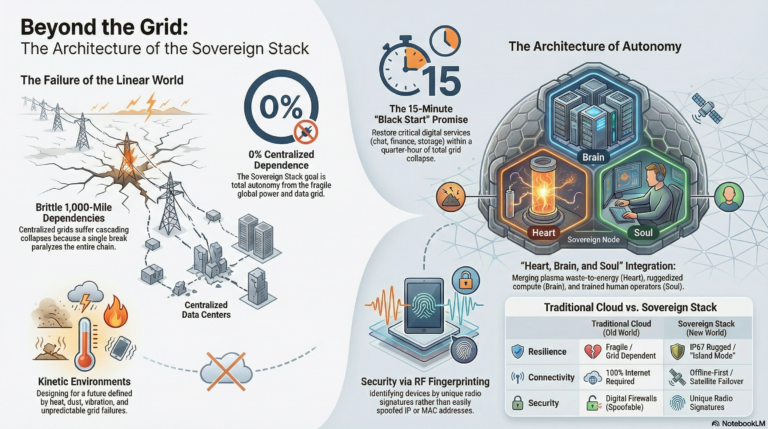
Sovereign Automation represents a critical paradigm shift in industrial operations, moving away from centralized, cloud-centric artificial intelligence toward localized, air-gapped agentic systems. Modern industrial facilities are currently hindered by the “Cloud-Tether Trap,” which introduces vulnerabilities such as non-deterministic WAN latency, data exfiltration risks, and vendor lock-in. By deploying ruggedized hardware—specifically the Sovereign Sentry Pro—running optimized software frameworks like OpenClaw, operators can achieve absolute operational sovereignty.
This document outlines the technical requirements for this transition, including model quantization to fit high-capability AI within edge memory constraints, strict hardware-level security measures, and the decoupling of non-deterministic AI logic from hardwired safety-critical systems. Key findings indicate that while local edge AI faces a hardware compute ceiling (typically models \le 14B parameters), the gains in uptime, security, and “Right to Repair” alignment far outweigh the limitations.
——————————————————————————–
The Cloud-Tether Trap: Identifying Operational Vulnerabilities
The prevailing industrial IoT (IIoT) design pattern relies on continuous telemetry streaming to third-party cloud servers. This architecture introduces four primary structural failure modes:
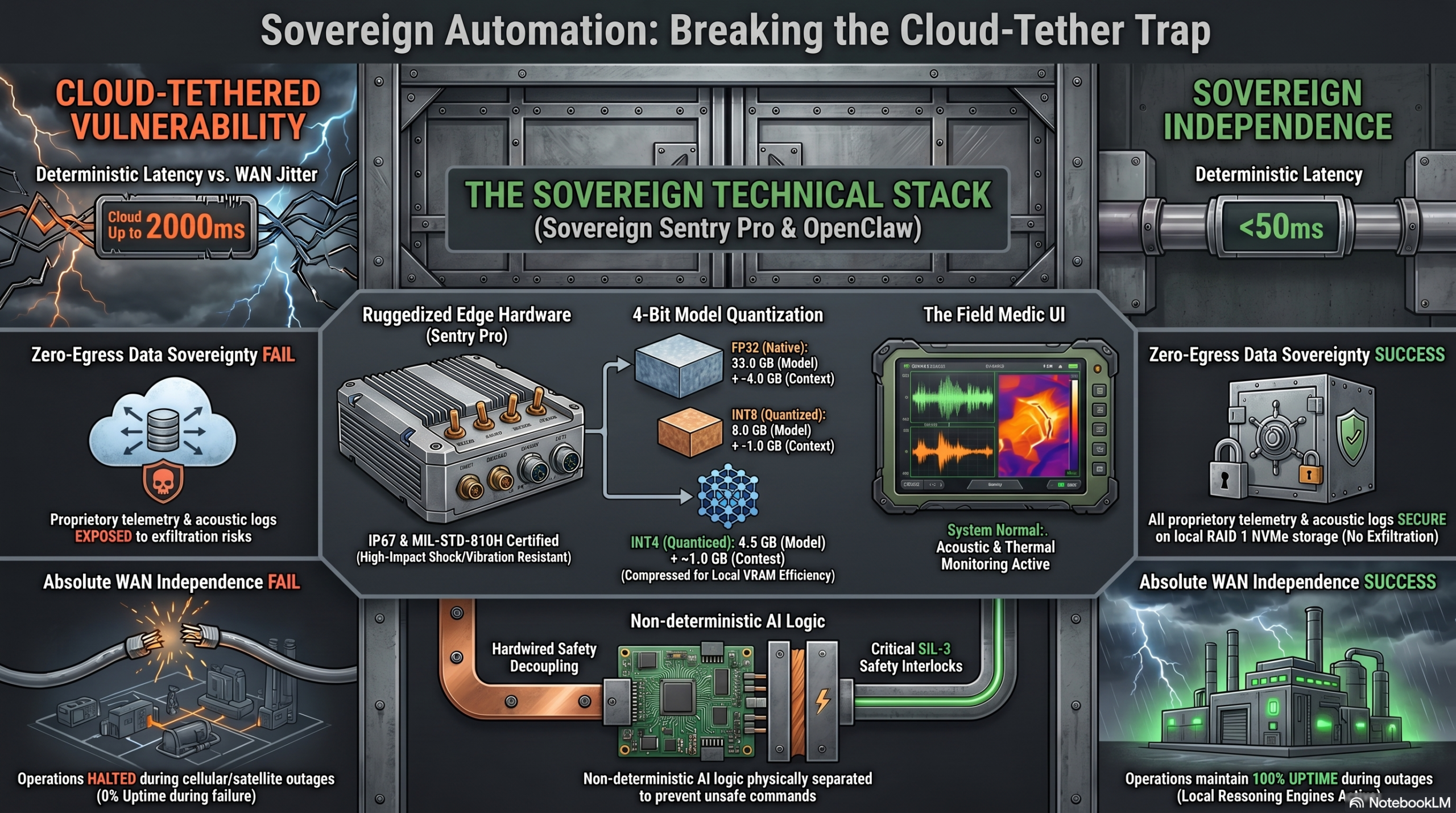
- Deterministic Network Deficits: Wide-area network (WAN) latency is non-deterministic, with round-trip times (RTT) fluctuating between 30ms and 1200ms. This prevents stable control loops for high-speed industrial processes.
- Backhaul Fragility: Remote sites (offshore platforms, agricultural expanses) cannot assume continuous connectivity. Cloud-tethered intelligence ceases to function during outages, halting predictive maintenance and diagnostics.
- Data Sovereignty Risks: Continuous streaming of telemetry, acoustic logs, and optical feeds exposes proprietary operational metrics to corporate espionage or changing privacy compliance frameworks.
- Software Lock-in: Cloud-dependent “Right to Repair” hurdles, such as requiring cloud handshakes for mechanical overrides, can cost operators thousands of dollars per hour during critical windows.
——————————————————————————–
Technical Architecture of Sovereign Automation
1. Hardware: The Sovereign Sentry Pro
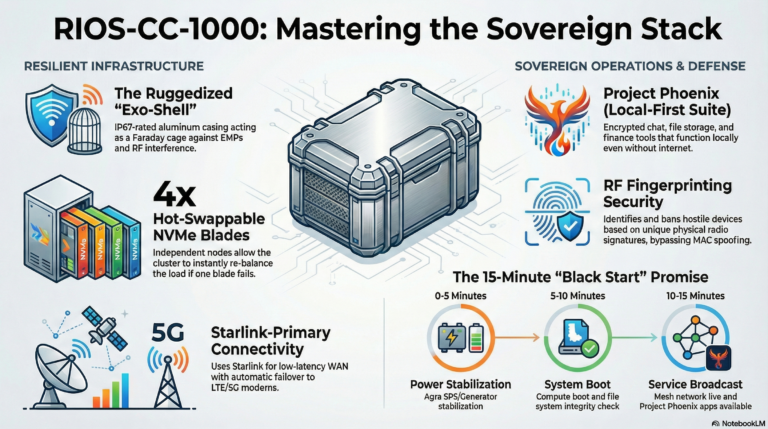
The Sovereign Sentry Pro is a ruggedized compute cluster designed for high-vibration and dust-heavy environments.
- Chassis & Durability: Fanless, IP67-rated CNC-milled aluminum with cooling fins for passive heat dissipation up to 60°C. It is MIL-STD-810H certified for mechanical shock and multi-axis vibration.
- Compute Performance: Features 3x redundant, hot-swappable system-on-modules (SOMs) with up to 64 GB LPDDR5 unified memory and 275 Sparse TOPS of AI compute.
- Storage: Local RAID 1 NVMe arrays (up to 8 TB) with power loss protection (PLP) to host model weights, vector databases, and historical logs locally.
- Security Anchor: A hardware-level network disconnect key-switch physically disables transceivers. Security is further reinforced by an on-board TPM 2.0 module for cryptographically verified boot paths.
2. Software: The OpenClaw Framework
OpenClaw is a containerized software stack that coordinates local models and interfaces with physical machinery.
- Local Runtime: Utilizes a C++ optimized
llama.cppcontainer. This bypasses Python dependencies, minimizing overhead and version conflicts. - Protocol Translation: Containerized proxies translate physical bus signals (Modbus, CAN bus, OPC UA) into JSON schemas for the AI agents.
- Localized RAG: Uses a local vector database (SQLite-VSS) to index technical manuals and schematics, enabling retrieval-augmented generation (RAG) without external calls.
3. Mathematics of Edge AI Optimization
Running Large Language Models (LLMs) at the edge requires model quantization to overcome memory bandwidth bottlenecks.
| Precision | Weight Memory (8B Model) | Context Overhead (8k) | Perplexity (Reasoning Cohesion) |
| FP32 | 32.0 GB | ~4.0 GB | – |
| FP16 | 16.0 GB | ~2.0 GB | 5.72 (Baseline) |
| INT8 (Q8_0) | 8.0 GB | ~1.0 GB | 5.74 (+0.35% degradation) |
| INT4 (Q4_K_M) | 4.5 GB | ~1.0 GB | 5.89 (+2.97% degradation) |
Key Performance Metric: Moving from FP16 to INT4 yields a 71.8% reduction in memory overhead. On hardware with 200 GB/s bandwidth, an INT4 8B model can achieve a theoretical maximum of ~44.4 tokens/second, stabilizing at 30–35 tokens/second in practice.
——————————————————————————–
Strategic Analysis (SWOT)
| Strengths | Weaknesses |
| • 100% WAN independence and uptime.<br>• Deterministic latency (<50ms RTT on LAN).<br>• Local zero-egress data security.<br>• Reduced OpEx (no SaaS subscriptions). | • Hardware ceiling (\le14B parameters).<br>• Manual maintenance (physical USB updates).<br>• Higher initial CapEx for rugged hardware.<br>• Risk of physical theft of localized data. |
| Opportunities | Threats |
| • Alignment with “Right to Repair” laws.<br>• Entry into cloud-prohibited sectors (Nuclear, Defense).<br>• Future NPU/ASIC scaling for lower thermal loads. | • Model hallucinations in kinetic environments.<br>• OEM resistance (voiding warranties).<br>• Shifting regulatory standards for AI safety. |
——————————————————————————–
Operational Safety and Governance
The transition to Sovereign Automation necessitates a strict decoupling of AI reasoning from life-safety systems.
- Safety Decoupling: AI agents must never have direct, unmonitored write access to safety-critical systems. These are governed by independent, analog, or SIL-3 rated safety PLCs.
- Deterministic Validation: Every command generated by an AI agent must pass through a hardcoded schema validator in OpenClaw. If a suggested value (e.g., torque or pressure) falls outside predefined boundaries, the system halts execution.
- Air-Gap Maintenance: Updates are delivered via cryptographically signed physical media (USB-C). The local TPM 2.0 module verifies these signatures before applying changes to model weights or containers.
——————————————————————————–
Field Case Studies
Case Study A: ‘The Field Medic’ (Agriculture)
In a remote harvest site 80km from cellular coverage, a combine harvester experienced a hydraulic failure (Modbus Fault 0x4F).
- Process: The operator used an IP67 tablet to capture acoustic pump data and optical images of the valve.
- Resolution: The local Field Medic agent analyzed the cavitation frequency and visual micro-fissures. By querying local manuals via RAG, it provided step-by-step instructions for an override and a generic O-ring substitute.
- Outcome: Machine returned to service in 45 minutes, saving $12,000 in technician fees and preventing harvest downtime.
Case Study B: ‘The Industrial Foreman’ (Logistics)
In an underground sorting facility with no network connection, a secondary crusher failure threatened a massive backlog.
- Process: The Industrial Foreman monitored OPC UA nodes for conveyor speeds and motor temperatures.
- Resolution: The agent dynamically recalculated flow rates and commanded Modbus-enabled drives to slow secondary conveyors by 42%. It executed an emergency shutdown on a specific belt to prevent a mechanical spillover based on a safety PLC register change.
- Outcome: Operations were managed deterministically with zero data packets leaving the facility.
——————————————————————————–
Implementation Roadmap
- Phase 1: Isolation (Weeks 1–4): Map telemetry registers, audit safety loops, and partition local LANs from WAN.
- Phase 2: Hardware Provisioning (Weeks 5–8): Install Sovereign Sentry Pro clusters and verify power/thermal profiles.
- Phase 3: Software Mapping (Weeks 9–12): Deploy OpenClaw, load quantized GGUF models, and index technical manuals.
- Phase 4: Commissioning (Weeks 13–16): Test offline diagnostic loops and validate deterministic command boundaries.