Functional Profile: The DeReticular Sovereign Agent Ecosystem
1. Introduction to Sovereign Infrastructure
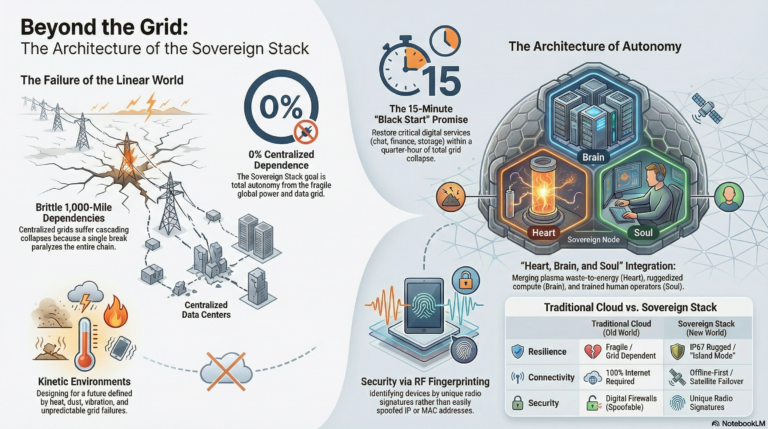
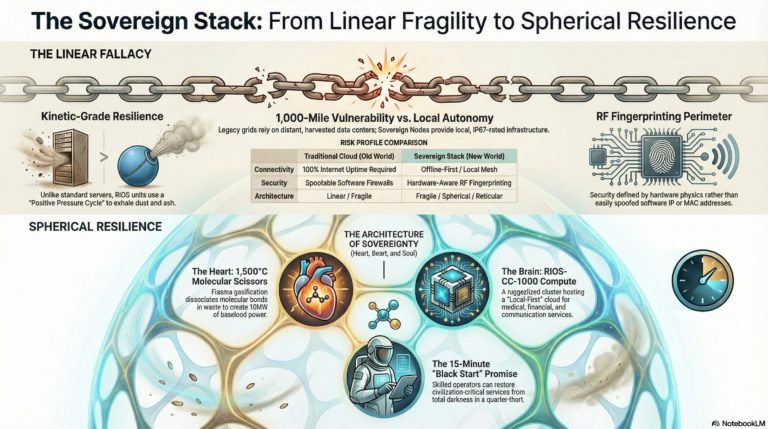
As the digital economy transitions from a simple information network to an Autonomous Economic Coordination Layer (AECL), the reliance on centralized hyperscale cloud providers presents a critical strategic vulnerability. DeReticular replaces this dependency with Sovereign Infrastructure: a stack of locally owned, locally operated, and locally intelligent hardware. Unlike traditional cloud-native AI that requires constant external connectivity for inference, DeReticular infrastructure utilizes edge inference to ensure that data ownership and operational logic remain within the organization’s physical perimeter.
This shift moves beyond mere “privacy” into the realm of cyber-physical resilience. By decoupling critical infrastructure from the public internet, we achieve a state of high-integrity, deterministic networking that is immune to external telemetry, vendor lock-in, and remote dependency failures.
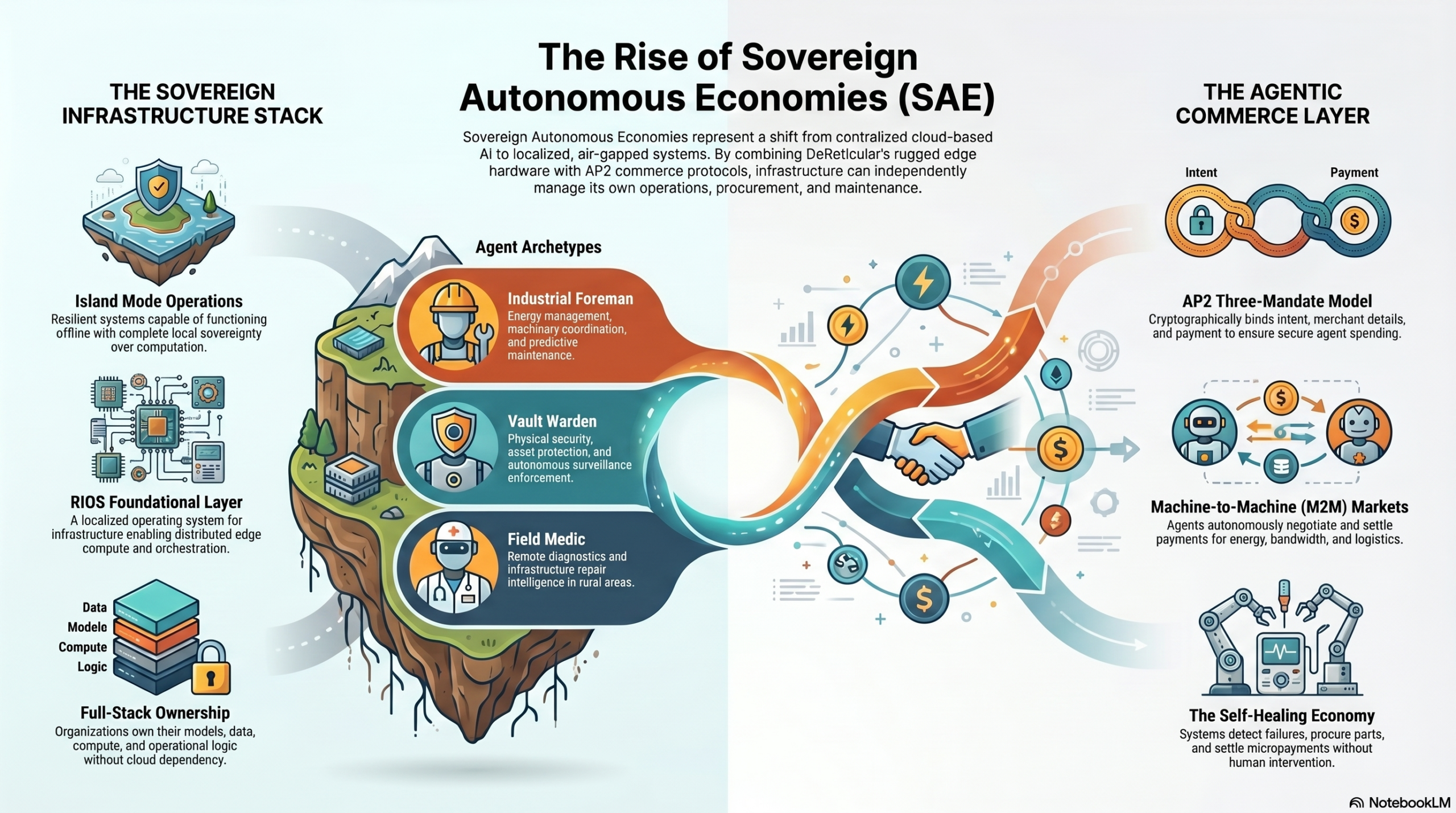
Definition: Island Mode Operation “Island Mode” describes the capability of a sovereign system to maintain full operational intelligence and coordination without an active internet connection. By hosting local LLMs and decentralized networking protocols, the ecosystem functions as a self-sustaining autonomous unit, ensuring continuity in remote “frontier” markets or during total network fragmentation.
This hardware sovereignty provides the necessary foundation for the intelligent agent personas that manage, protect, and repair the physical world.
——————————————————————————–

2. The Foundation: RIOS and OpenClaw
To transform ruggedized hardware into a cohesive sovereign system, we employ two distinct yet synergistic layers: the Rural Infrastructure Operating System (RIOS) for physical orchestration and the OpenClaw Framework for cognitive reasoning.
| Category | RIOS (Rural Infrastructure OS) | OpenClaw Framework |
| Primary Function | Physical Orchestration & Hardware Abstraction | Local Intelligence & Agentic Reasoning Layer |
| Core Components | Kubuntu (OS), pfSense (Firewall/Policy), Freenet (Mesh/P2P) | Local LLMs/VLMs, Agent Runtimes, Model Context Protocol (MCP) |
| Strategic Value | Enables deterministic networking and air-gapped, censorship-resistant comms. | Facilitates edge inference, local diagnostics, and autonomous decision-making. |
This architectural bedrock solves the “Identity Problem” through Machine-to-Machine (M2M) Identity and Hardware Attestation, ensuring that every agent in the stack is a verified, trusted participant in the local economy.
——————————————————————————–
3. Specialized Archetypes: The Industrial Foreman
The Industrial Foreman serves as the primary coordinator for cyber-physical systems in high-stakes environments like mining, utilities, and heavy manufacturing. Its focus is not merely on “running machines,” but on the holistic optimization of industrial resources.
- Cyber-Physical Coordination: Synchronizes the telemetry of heavy machinery with local operational goals.
- Microgrid Energy Management: Dynamically balances power loads and coordinates autonomous energy trading within a local grid.
- Deterministic Maintenance: Uses edge inference to identify mechanical anomalies before they lead to systemic failure.
The “So What?” for Mining Operations: In deep-pit mining, connectivity is often non-existent. The Industrial Foreman acts as a local orchestrator that manages autonomous haulage and energy consumption. By coordinating microgrid energy storage and machinery uptime locally, the Foreman eliminates the millions in lost revenue caused by cloud latency or connection drops. It transforms a remote mine from a passive site into an active participant in an autonomous maintenance economy.
——————————————————————————–
4. Specialized Archetypes: The Vault Warden
The Vault Warden is more than a security monitor; it is a Local Policy Engine designed for Zero-trust runtime verification. It is deployed in environments where asset protection is paramount, such as defense facilities, high-security laboratories, or museums.
The Warden maintains the physical and digital perimeter through specific AI-native capabilities:
- Computer Vision Surveillance: Real-time, local analysis of visual data to identify unauthorized movement.
- Volumetric Monitoring: Cross-referencing sensor data to detect physical breaches in three-dimensional space.
- Policy Enforcement: Acting as a gatekeeper that ensures all machine actions align with a pre-defined “Machine Constitution” or security protocol.
The primary benefit of the Vault Warden is its air-gapped security model. Because all surveillance and policy enforcement occur locally via OpenClaw, the system’s security logic and data feeds are physically inaccessible to remote attackers.
——————————————————————————–
5. Specialized Archetypes: The Field Medic
The Field Medic is designed for operational resilience in “Frontier Markets”—regions like Uganda or East Africa where internet stability and traditional banking infrastructure are often absent. This archetype provides the intelligence necessary to maintain critical life-support and utility systems under extreme conditions.
Use-Case Spotlight: Frontier Market Utility Restoration
In a rural medical clinic in East Africa, a localized solar-water pump system fails. The Field Medic detects the drop in water pressure and accesses its local “infrastructure repair intelligence” library. Without needing to reach a central server, it diagnoses a specific inverter failure. It provides the local technician with a step-by-step augmented reality repair guide and, through the AECL, initiates the autonomous procurement of the replacement part from a regional supply node.
——————————————————————————–
6. The Mechanics of Autonomous Performance
The DeReticular ecosystem enables Infrastructure Self-Healing, a process where the system identifies its own needs and resolves them through autonomous economic coordination.
The 5-Step Autonomous Maintenance Workflow:
- Detection (Sensor): A RIOS-linked sensor identifies a hardware fault or resource depletion (e.g., low fuel or a worn bearing).
- Diagnosis (OpenClaw): The intelligence layer performs local inference to determine the precise solution and necessary procurement.
- Procurement (AP2 Mandate): An agent checks its budget authority and issues a cryptographically signed request for parts or services.
- Settlement (x402 Micropayment): The system settles the transaction instantly via a machine-native payment rail.
- Logistics & Verification: A logistics agent (or drone) coordinates the physical delivery, and the Vault Warden/Foreman verifies the successful installation and runtime restoration.
——————————————————————————–
7. The Transactional Engine: AP2 and x402
Autonomous agents require a way to interact with financial systems without human “approval” bottlenecks. This is achieved through the Agent Payments Protocol (AP2) and the x402 settlement rail.
The x402 protocol is a high-impact technical innovation that transforms the standard HTTP 402 “Payment Required” code into a programmable payment fabric. This allows agents to pay for API access, energy, or hardware parts using stablecoin micropayments. To ensure security, AP2 utilizes a Three-Mandate Model:
- Intent Mandate: Defines the agent’s bounded autonomy (e.g., “Maintain water filtration with a maximum spend of $200”).
- Cart Mandate: A merchant-signed confirmation of the specific items and pricing, preventing the agent from purchasing incorrect or “hallucinated” goods.
- Payment Mandate: Binds the payment to the fulfillment of the previous mandates, ensuring that machine-native trust is mathematically guaranteed.
——————————————————————————–
8. Summary of Industrial Impact
DeReticular represents a fundamental evolution from human-centric management to agent-mediated coordination. By integrating sovereign compute with autonomous commerce, we move away from “Information Networks” toward a fully realized Autonomous Economic Coordination Layer.
The 3 Pillars of Sovereign Autonomy:
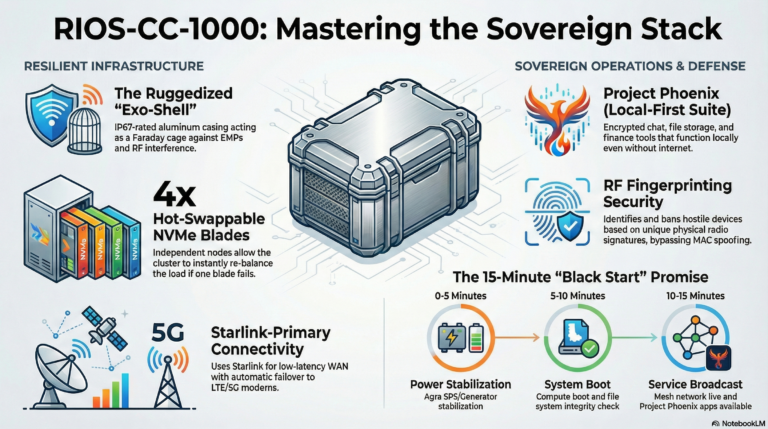
- Compute: Ruggedized hardware running a Linux-based sovereign stack (Kubuntu/pfSense/Freenet) in Island Mode.
- Intelligence: Specialized agent runtimes (Foreman, Warden, Medic) capable of Zero-trust verification and edge inference.
- Commerce: Machine-native trust achieved through AP2 Mandates and x402 programmable payments, governed by local Machine Constitutions.
Through this stack, infrastructure is no longer a passive cost center; it becomes a self-monitoring, self-financing, and self-optimizing participant in the global economy.