DeReticular and the Rural Infrastructure Operating System (RIOS) A Technical Briefing
Executive Summary
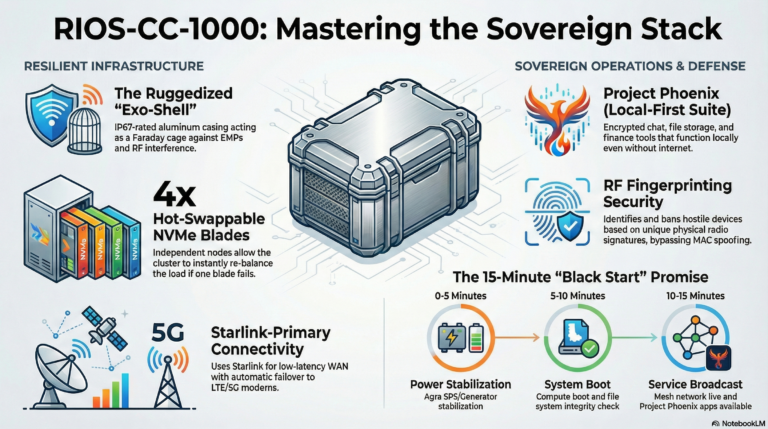
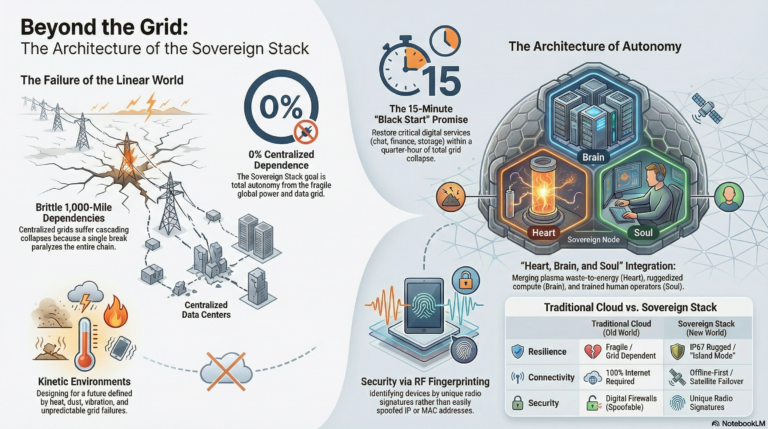
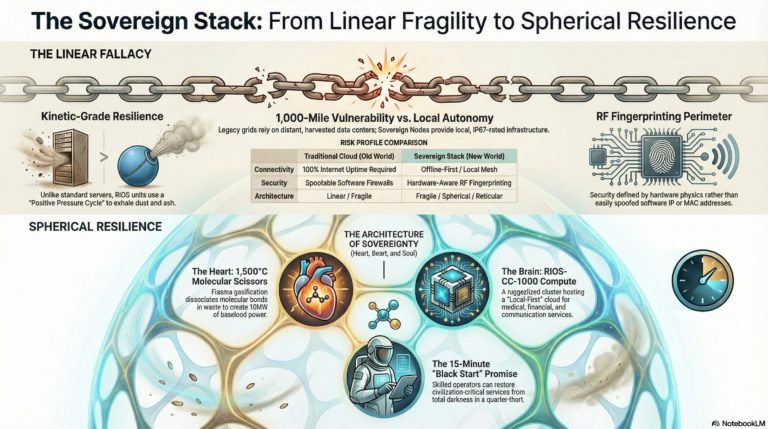
DeReticular is a decentralized research and innovation platform (venture studio) focused on replacing vulnerable, centralized utility grids—the “Linear Fragility” model—with a resilient, node-based “Spherical Resilience” model. The core of this initiative is the Rural Infrastructure Operating System (RIOS), an AI-native “Sovereign Stack” that manages energy, data, and logistics for off-grid environments.
The critical innovation within RIOS is its Trustless Identity layer. By utilizing a Hardware Root of Trust—specifically Radio Frequency Fingerprinting (RFF) and TPM 2.0 chips—DeReticular anchors digital data to physical reality, effectively solving the “Oracle Problem” for decentralized networks. The system integrates a “Dual-Stack” approach using Hyphanet (Legacy Freenet) for static, anonymous publishing and the New Freenet (Locutus, 2023) for dynamic, zero-gas smart contracts and real-time state management.
Ultimately, RIOS provides a “Civilization-in-a-Box” capable of verifying the uniqueness, liveness, and provenance of both machines and humans without reliance on centralized cloud servers or national grids.
——————————————————————————–
1. The DeReticular Framework
DeReticular operates as a venture studio helping founders build applications on decentralized hardware. Its philosophy, “The Death of the Line,” argues that long-distance supply chains and power lines are obsolete points of failure.
The “Trinity Stack”
RIOS orchestrates three fundamental resources to maintain “Island Mode” (total off-grid capability):
| Layer | Component | Function |
| The Heart | Agra Energy | Waste-to-energy plasma gasification providing 10MW+ base-load power. |
| The Brain | RIOS (OS) | AI-native intelligence managing energy, data, and logistics. |
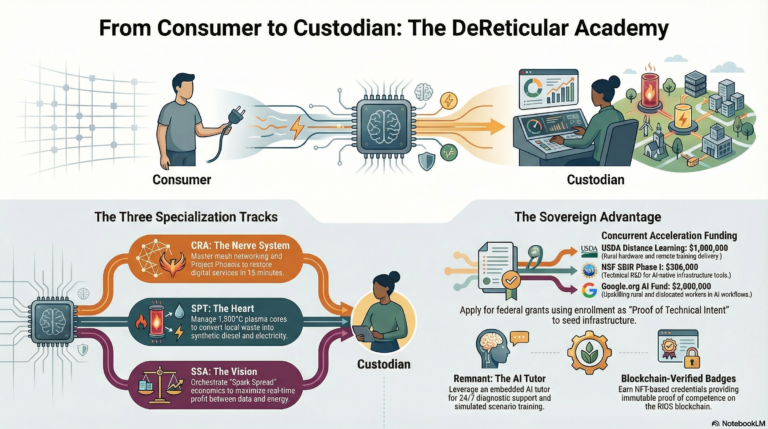
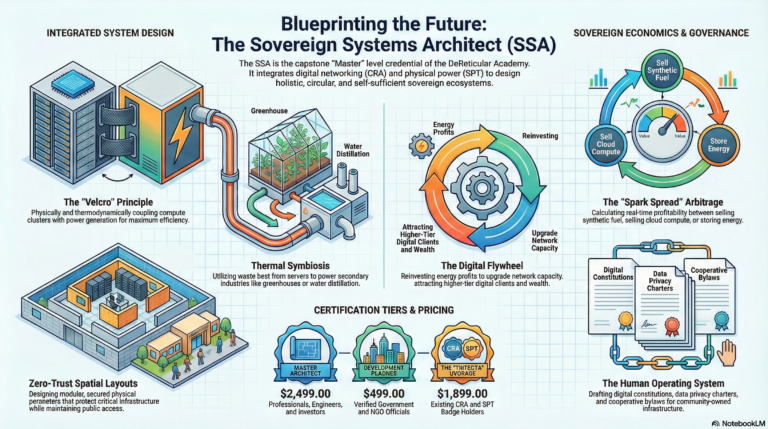
| The Soul | DeReticular Academy | Training “Sovereign Systems Architects” to maintain the nodes. |
Ecosystem Tools
- Kurb Kars: Autonomous electric pods for rural logistics and medical transport.
- Trifi Wireless: A private mesh network (WiFi 7 & 5G) providing local connectivity independent of the internet backbone.
- Project Octagon: A strategic deployment of eight global “Sovereign Nodes” (e.g., Texas, Uganda, Canada) to prove off-grid viability in diverse climates.
2. Trustless Identity and the Hardware Root of Trust
DeReticular distinguishes between “Trusted Identity” (relying on a central authority like a bank) and “Trustless Identity” (relying on cryptographic and physical proof). RIOS utilizes a “Machine-First” identity model.
Physical Layer Verification
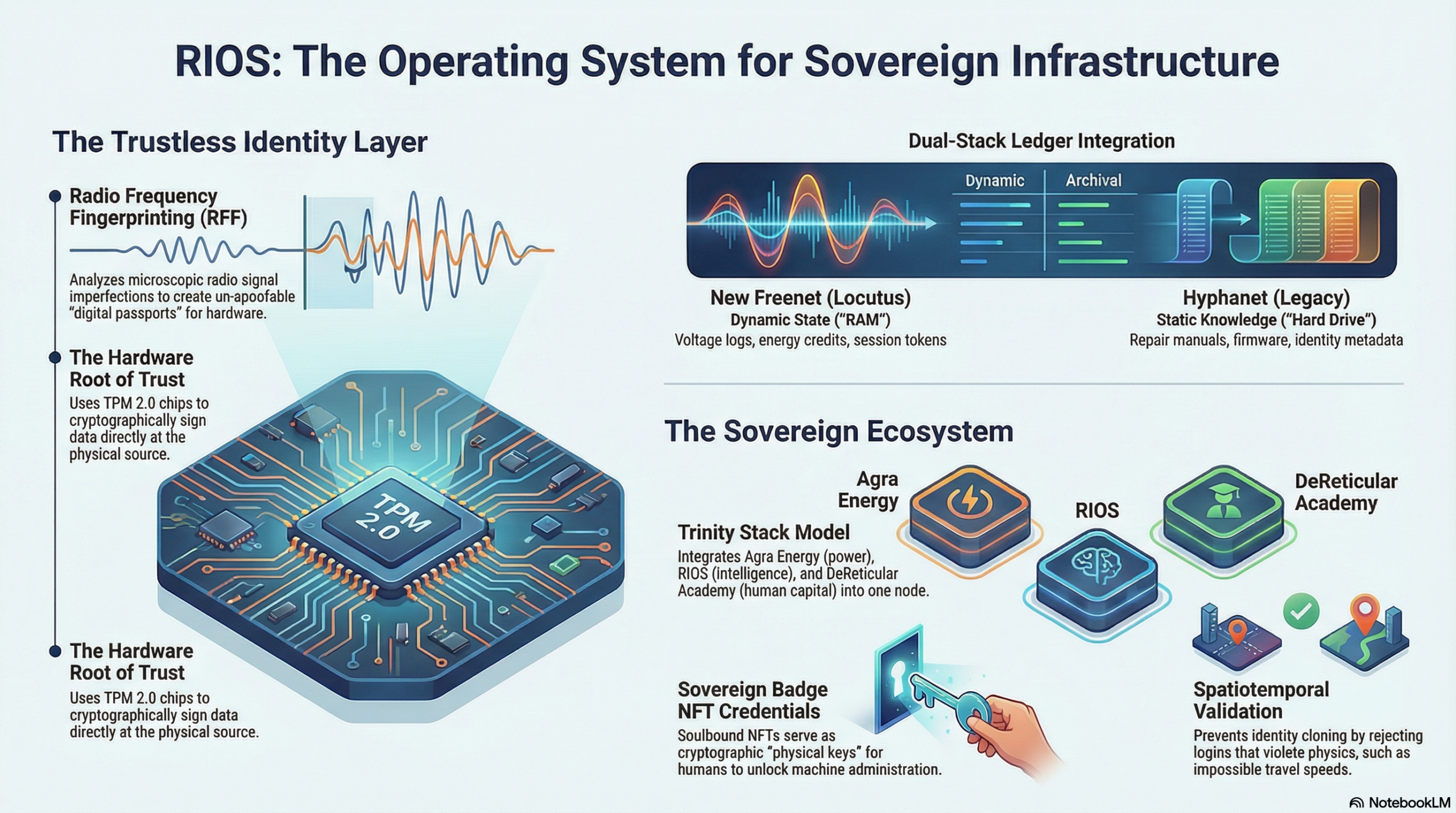
- Radio Frequency Fingerprinting (RFF): Every electronic device has unique, microscopic manufacturing imperfections in its circuitry that emit a specific “hum.” RIOS scans this fingerprint to create an “un-spoofable” digital passport.
- TPM 2.0 (Trusted Platform Module): A secure crypto-processor with a non-exportable private key “burned” into the hardware. This allows the machine to sign data, proving that the information (e.g., energy output) originated from a specific, verified physical device.
Solving the “Oracle Problem”
The “Oracle Problem” refers to the difficulty of ensuring that data entered into a blockchain matches physical reality. RIOS solves this by requiring data to be cryptographically signed by a Hardware Oracle (the TPM/RFF-verified machine) before it is accepted by the network.
——————————————————————————–
3. Decentralized Protocol Integration: Freenet and Hyphanet
RIOS leverages both generations of Freenet to manage its data layer, choosing the specific strengths of each for different functions.
The Dual-Stack Strategy
- Hyphanet (Legacy Freenet): The Static Layer
- Function: Used for archival and censorship-resistant publishing.
- Use Case: Hosting local “freesites” (medical wikis, repair manuals) and storing immutable human identity metadata (Sovereign Badges).
- Identity Role: Provides “Static Anonymity” for human operators while keeping their certifications public and verifiable.
- New Freenet (Freenet 2023 / Locutus): The Dynamic Layer
- Function: High-speed state management and WebAssembly (Wasm) smart contracts.
- Use Case: Real-time logging of industrial data (e.g., “HempGrade” quality logs, voltage monitoring).
- Identity Role: Facilitates the “Zero-Gas Registry,” allowing high-volume data storage without the transaction fees associated with traditional blockchains like Ethereum.
——————————————————————————–
4. Human-Machine Orchestration: The Sovereign Badge
While machines are verified via hardware, human operators (technicians and admins) are authorized through Sovereign Badges.
- NFT-Based Credentials: The DeReticular Academy issues “Sovereign Badges” as Soulbound NFTs (non-transferable). These are functional smart contracts held in an operator’s non-custodial wallet.
- The Handshake: When an operator connects to a RIOS node, the node issues a cryptographic challenge. The operator signs this challenge using the private key associated with their Badge. The node verifies the badge locally—even without internet access—against its synced revocation list.
- Dual-Signed Objects: Critical events (e.g., a manual power override) generate logs signed by both the machine’s TPM and the human’s Sovereign Badge, creating an absolute “Trustless Chain of Custody.”
——————————————————————————–
5. Network Security: Polling and Provenance
RIOS prevents “Sybil” attacks (creating fake nodes) and “Double-Spend” attacks on identity (an identity existing in two places at once) through rigorous spatiotemporal validation.
Global Identity Polling
Instead of broadcasting to all nodes, a RIOS node queries the New Freenet Distributed Hash Table (DHT) for an identity’s State Contract.
- Physics Violation Detection: If the State Contract shows a user was active in Arizona two minutes ago, but they are attempting to log in to a node in Texas, the system calculates the “Teleportation” required. If the velocity exceeds the max believable limit (V_{max}), the connection is rejected as a cloning attack.
Provenance Tracking
- Topology Awareness: RIOS uses “Exit Visas”—signed packets from a previous node—to prove a contiguous physical path through the mesh.
- Zero-Knowledge Proofs (ZKPs): To maintain privacy, RIOS may use zk-SNARKs to prove a user came from a valid adjacent node without revealing the user’s specific location history to the node operator.
——————————————————————————–
6. Broader Context: Software and Staking Models
Operating Systems for Freenet
There is currently no mainstream Linux distribution that pre-installs both Kubuntu (KDE Plasma) and Freenet/Hyphanet.
- MOFO Linux: Formerly the best “out-of-the-box” candidate, though Freenet was reportedly removed in version 9.7 (Feb 2026) to reduce file size.
- Recommended Setup: Manual installation of Java and the Hyphanet jar file on a stable distribution like Kubuntu.
Identity Staking Models
DeReticular’s hardware-based trust serves as an alternative to Identity Staking, a Web3 mechanism where users lock tokens to vouch for their uniqueness.
| Model | Mechanism | Logic |
| Self-Staking | Lock tokens (e.g., Gitcoin) | “I am willing to lose money if I am a bot.” |
| Social Staking | Vouching (e.g., Kleros) | “I trust this person; I stake my tokens on them.” |
| Validation Staking | Turing tests (e.g., Idena) | “I have money and a human brain (time).” |
Critique: While staking avoids invasive biometrics (like Worldcoin’s iris scans), it faces the risk of “Plutocracy,” where identity becomes a luxury good accessible only to those with capital. DeReticular avoids this by anchoring trust in physical hardware performance and educational certification (Academy).
7. SWOT and Gap Analysis of the RIOS Identity Model
| Strengths | Weaknesses |
| Physical-Digital Bridge: Solves the Oracle Problem via RFF and TPM. | Reliance on Alpha Software: New Freenet (2023) is explicitly experimental. |
| Offline Resilience: Designed for “Island Mode” and mesh partitioning. | Hardware Dependency: Security fails if specialized TPM/RFF components are compromised. |
| Opportunities | Threats |
| Regulatory Compliance: Fits EU Deforestation Regulation (EUDR) provenance needs. | Regulatory Hostility: Governments may view “sovereign” darknet tech as a threat. |
| DePIN Trend: Positioned as the OS for the Decentralized Physical Infrastructure market. | RFF Spoofing: Advancement in AI could lead to “Deepfake” radio frequency attacks. |
Identified Gaps
- Application Layer: RIOS has a powerful backend but lacks a thriving ecosystem of user-friendly apps for non-technical users. The “Flood the Forge” campaign aims to address this.
- Technology Maturity: The underlying protocols (Locutus) are in active development, creating a tension between innovation and the 99.999% uptime required for critical utility infrastructure.