The Economic and Spatial Architecture of Rural Knowledge and Precision Production
Executive Summary
Rural America is undergoing a fundamental structural transformation, moving away from a century-old extractive model toward a decentralized, knowledge-based economy. This shift is driven by the deployment of symmetrical gigabit fiber and cloud-integrated tools, enabling the rise of the Distributed Micro-Enterprise (DME). However, this evolution is not uniform. A sharp divergence has emerged between “Amenity/Exurban” corridors—which face hyper-gentrification and workforce displacement—and “Isolated/Interior” communities, which are caught in a “Three-Way Trap” of housing obsolescence, actuarial retreat (insurance withdrawal), and administrative incapacity.
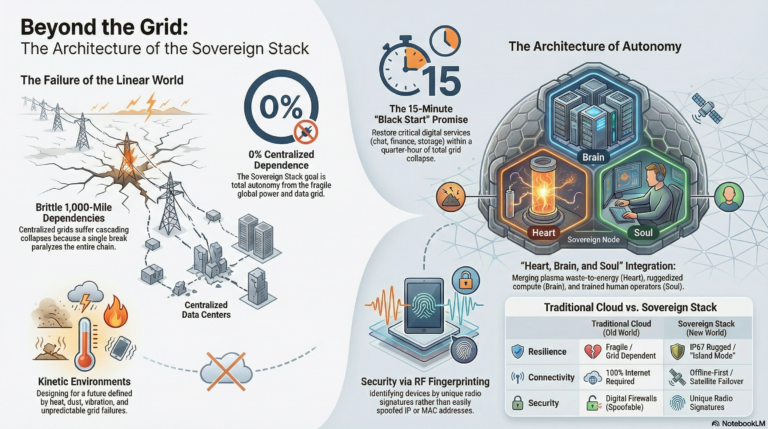
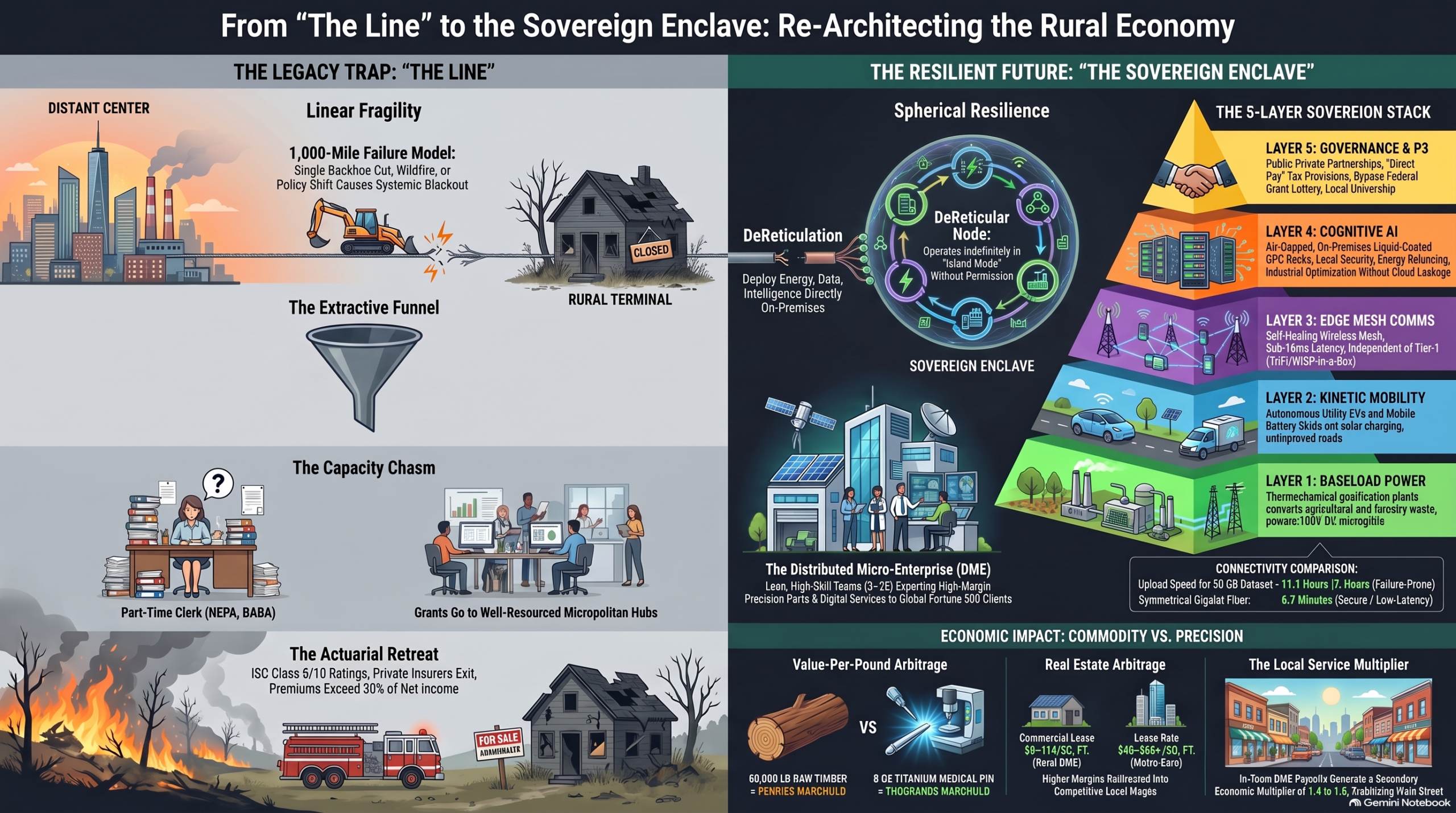
The briefing document outlines how rural communities can bypass legacy constraints by leveraging real estate arbitrage, cooperative infrastructure models, and “DeReticulation”—the process of moving from fragile, 1,000-mile supply chains to sovereign, resilient nodes.
- The Distributed Micro-Enterprise (DME) Model
The DME represents a resilient alternative to traditional industrial recruitment. Rather than relying on large-scale corporate employers that are prone to capital flight, DMEs consist of lean, highly skilled teams (3 to 25 employees) that export high-margin services globally while anchoring operations in small-town downtowns.
The Technical Prerequisite: Symmetrical Gigabit Architecture
- The Upload Bottleneck: Modern enterprise workflows require high upload capacity. A 50 GB dataset takes over 11 hours to upload on legacy 10 Mbps cable but under 7 minutes on a symmetrical 1 Gbps fiber link.
- Operational Connectivity: Low latency (below 15ms) enables real-time CAD/CAM co-authoring, cloud-native ERP systems, and remote machine telemetry.
The Economic Arbitrage of Real Estate
Operating in a small-town core offers significant operating leverage over metropolitan centers.
Expense Category Tier-1 Metro Core Small-Town Main Street Rural Arbitrage Savings
Commercial Rent (per sq. ft.) $65.00 $11.00 -83.1%
Property Tax Pass-Through 12–18 1.50–3.00 -75% to -80%
Annual Cost per Workstation $23,500 $3,600 -84.7%
- Industry Pillars of the Rural Knowledge Economy
The rural economic reorientation focuses on four primary sectors that decouple commercial scalability from physical geography:
- Specialized Financial and Forensic Services: Boutique firms specializing in cross-border tax, R&D credit defense, and forensic blockchain auditing.
- Environmental and Geospatial Engineering: Processing drone-captured LiDAR and multispectral datasets for national infrastructure and hydrological modeling.
- Distributed Software and Digital Media: Cloud-native API integration and real-time 3D creation (Unreal/Unity) for architectural visualization and VFX pipelines.
- Precision Light Manufacturing: Using 5-axis CNC machining and additive manufacturing (3D printing) to produce low-volume, high-margin components for aerospace, medical, and defense sectors.
- The “Three-Way Trap” of Isolated Interior Communities
Approximately 1,250 “Non-Core” counties face a compounding systemic failure that prevents them from absorbing modernization capital.
I. Housing Stock Obsolescence and the Appraisal Gap
- Construction Cost Inversion: In isolated areas, building costs range from 220–320/sq. ft. due to remote supply chains. However, completed homes appraise at only 90–140/sq. ft. based on local “comps.”
- The Underwriting Impasse: Banks cannot finance construction loans with such massive collateral shortfalls, halting private residential development and leaving communities with decaying pre-1970 housing stock.
II. The Interior Actuarial Retreat
- Insurance Withdrawal: National carriers are pulling back from rural ZIP codes due to “unmapped” convective storms, wind events, and wildfires.
- The ISO Rating Collapse: Depleted volunteer fire department rosters and aging water systems result in ISO Public Protection Classification (PPC) ratings of Class 9 or 10 (functionally unprotected). This causes annual premiums to surge from $1,200 to $7,500, triggering mortgage defaults.
III. The Administrative Capacity Chasm
- The “Two-Desk” Town Hall: Most non-core towns rely on a single part-time clerk. Navigating complex federal mandates (NEPA, BABA, Section 106) is functionally impossible.
- Data Inequity: Small towns lacked the GIS staff to challenge the FCC National Broadband Map. Consequently, thousands of truly unserved addresses were marked as “served,” disqualifying them from priority BEAD funding.
- Infrastructure: The Cooperative Model
Where private capital refuses to go due to low density, Rural Electric Cooperatives (RECs) have emerged as transformative anchors.
- Density Paradox: Investor-owned utilities (IOUs) average 34–40 customers per mile, while RECs operate sustainably at only 7–8 customers per mile.
- The Smart Grid Foundation: Co-ops began stringing fiber to monitor substations (SCADA) and meters (AMI). This middle-mile architecture is now being used to provide last-mile gigabit fiber to members.
- Trust and Penetration: RECs regularly achieve subscription “take-rates” of 65% to 80% within three years, far exceeding commercial telecom estimates.
- Regional Crisis Archetypes
The systemic trap manifests differently across distinct geographic sub-typologies:
- Central Appalachia: Defined by steep hollow topography, a 70%+ decline in coal production, and severe natural population decrease.
- Southern Black Belt: Characterized by “Heirs’ Property” (fractionated titles without wills) and heavy clay soils that cause widespread septic and wastewater system failures.
- Western High Plains: Faces “volumetric utility insolvency,” where massive road/bridge mileage must be funded by fewer than 1,500 aging ratepayers.
- Northern Forest Borderlands: Confronts pre-1970 housing degradation in harsh lake-effect snow zones, coupled with an aging workforce (median age ~57).
- Synthesis: The Sovereign Enclave and DeReticulation
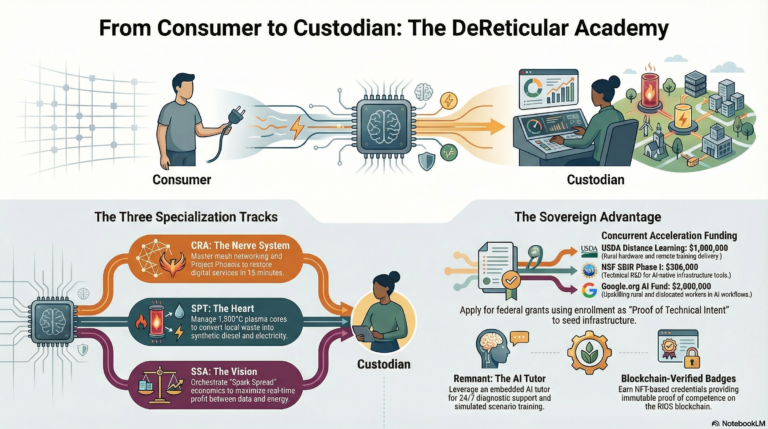
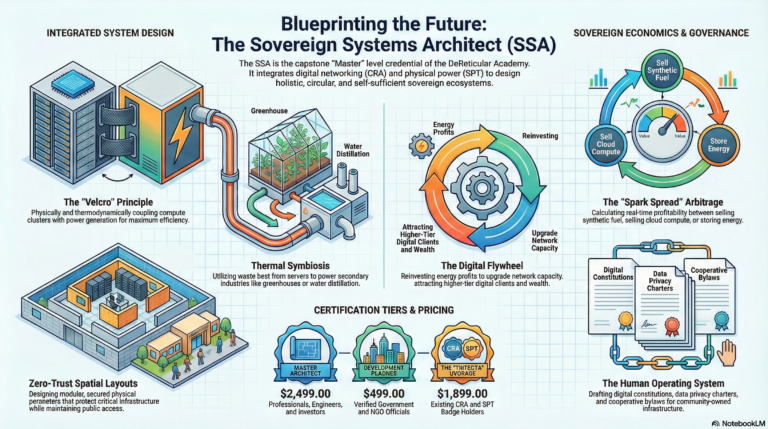
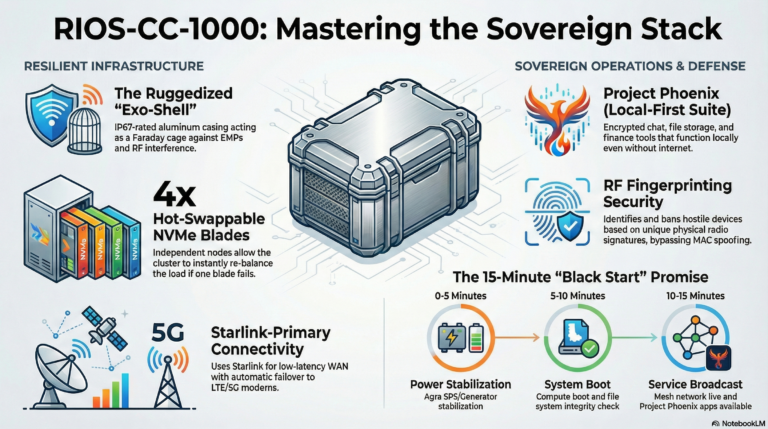
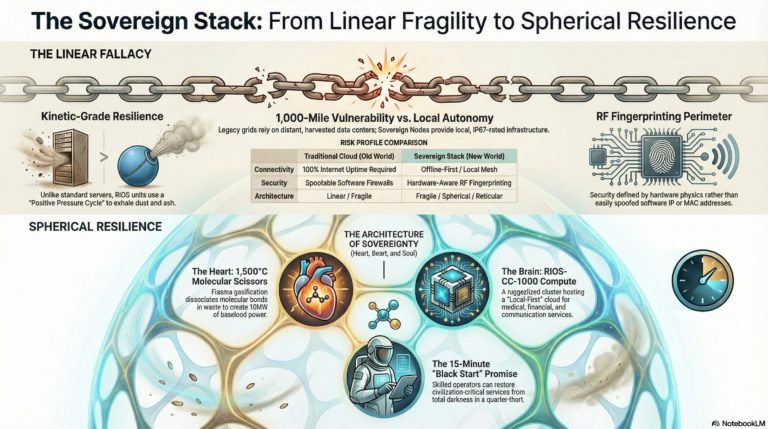
The document advocates for “DeReticulation”—severing dependency on fragile, centralized networks in favor of “Island Mode” resilience through the Sovereign Stack:
- Baseload Power: Local 700V DC microgrids using thermochemical gasification of agricultural waste.
- Kinetic Mobility: Autonomous utility EVs and mobile battery skids.
- Edge Mesh Comms: Self-healing wireless networks (TriFi) to bypass corporate fiber delays.
- Cognitive Intelligence: Air-gapped, on-premises AI nodes (Remnant architecture) to manage municipal telemetry and industrial toolpaths without cloud dependency.
- Governance: Transitioning from “smokestack chasing” to fostering indigenous micro-fabs and adopting form-based, mixed-use zoning codes for historic downtown adaptive reuse.
“The towns that survive the next twenty-five years will not be the ones that wrote the best grant applications to federal agencies. They will be the ones that had the courage to DeReticulate—the ones that built sovereign power, deployed their own communications, and turned their Main Streets into precision micro-manufacturing engines.”