The Asymptotic Synthetic Framework: Resilient Epistemology, Biomorphic Swarms, and the Architecture of Truth
Executive Summary
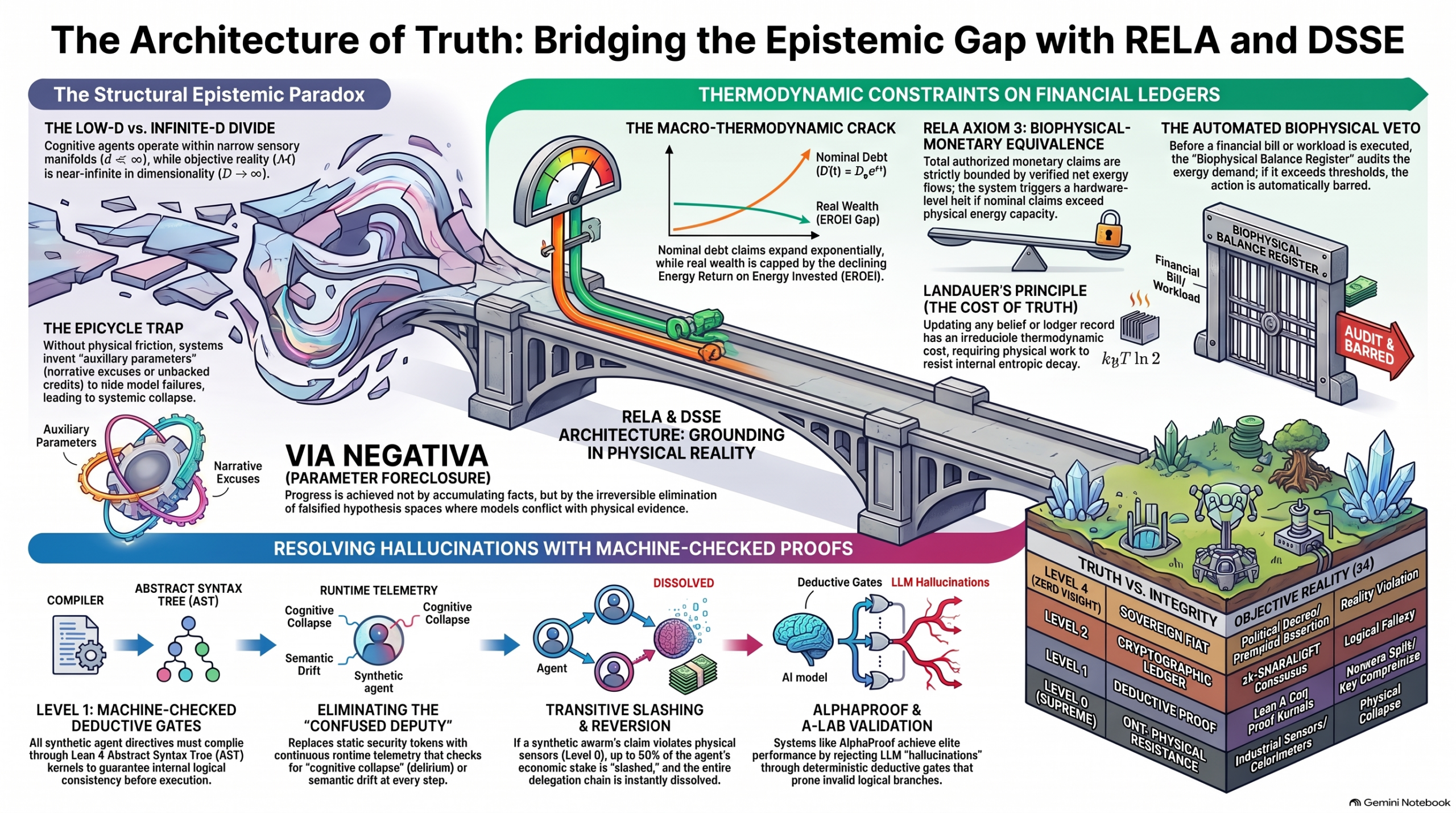
This briefing document synthesizes a unified project aimed at constructing an unforgeable, self-correcting epistemic and governance architecture. The central challenge identified is the Structural Epistemic Paradox: cognitive agents (humans and AI) operate within low-dimensional sensory manifolds, while the external cosmos is near-infinite in dimensionality and governed by unyielding physical laws. When coordination occurs through symbolic language without “ontic friction,” systems fall into the “Epicycle Trap,” inventing narrative rationalizations to preserve flawed internal models.
To resolve this, the Resilient Epistemic & Thermodynamic Ledger Architecture (RELA) and Durable Self-Correcting Synthetic Ecosystems (DSSE) provide a framework that grounds decision-making in physical reality. Key takeaways include:
- Via Negativa (Parameter Foreclosure): Knowledge advances by systematically eliminating false parameter manifolds rather than merely accumulating unmediated facts.
- The Oracle Separation Protocol: A critical distinction between Integrity (Level 2 cryptographic ledgers) and Truth (Level 0 physical correspondence).
- Biomorphic Swarm Mechanics: Utilizing the physics of avian flocking (starling murmurations) to solve AI “context bloat,” “sycophancy,” and the “1,000-Mile Failure Model” of cloud dependency.
- Biophysical Sovereignty: Binding economic and computational workloads to thermodynamic limits (Landauer’s Principle) and verified exergy flows via the Automated Biophysical Veto.
- Foundational Epistemology: The Architecture of Truth
The framework rejects the extremes of Dogmatic Absolutism (naïve realism) and Radical Relativism (constructivism). Instead, it adopts Fallibilistic Perspectival Realism.
1.1 The Access Problem and Veridicality
- Ontic Manifold (\mathcal{M}): Modeled as an objective, mind-independent state-space Riemannian manifold of near-infinite dimensionality (D \to \infty).
- Epistemic Perspectives (\hat{\Pi}_\theta): Observers operate through dimension-reducing projection operators. While these projections are incomplete, they are veridical if they preserve topological separation over distinct ontic states.
- Asymptotic Recovery: Absolute truth is defined as the invariant intersection of all validated projection angles over indefinite inquiry.
1.2 Via Negativa (Topological Parameter Foreclosure)
Traditional models often fall into the Epicycle Trap. When observations conflict with a model, institutions frequently add auxiliary parameters (like Ptolemaic epicycles or fiat credit) to preserve internal coherence. This increases Kolmogorov complexity while destroying out-of-sample generalization.
- Measure-Theoretic Elimination: Progress is achieved through the irreversible elimination of falsified hypothesis spaces (\Theta).
- Borel-Cantelli Application: By following a protocol of non-expanding updates, the metric diameter of the permissible hypothesis volume contracts asymptotically toward the physical reality attractor (\Omega^*).
- The RELA Architecture and Governance
The Resilient Epistemic & Thermodynamic Ledger Architecture (RELA) translates epistemic rigor into institutional standards.
2.1 Decoupling Preference from Feasibility
The architecture enforces a constitutional bifurcation of decision-making:
- Class A (Normative Value Spaces): Governed by democratic balloting (Quadratic Voting). This defines what a society desires to optimize.
- Class B (Ontic Feasibility Manifolds): Governed by automated biophysical audits. This defines what physical reality permits (e.g., mass-energy conservation, EROEI limits). This layer is closed to political decree.
2.2 The Five-Tier Source-of-Truth Hierarchy
When claims conflict, priority is resolved through a strict hierarchy:
Level Authority Type Verification Method
Level 0 (Supreme) Ontic Physical Resistance Sensors, calorimeters, material collapse
Level 1 Machine-Checked Proof Lean 4 formal logic, AST validation
Level 2 Cryptographic Ledger BFT state, zk-SNARKs (Integrity, not Truth)
Level 3 Intersubjective Consensus Quadratic Voting, Futarchy markets
Level 4 (Zero Weight) Sovereign Fiat Political decrees, ungrounded assertions
2.3 The Automated Biophysical Veto
Guided by RELA Axiom 3, all authorized public monetary or compute claims are bounded by verified net exergy. If a proposed workload (budget or compute batch) exceeds the physical exergy surplus, the system triggers an immediate hardware-level halt, barring the initiative from execution.
- Biomorphic Swarm Mechanics (DSSE)
Drawing from the StarFlag Project’s study of European starling murmurations (Sturnus vulgaris), the framework provides a blueprint for decentralized AI systems that avoid the failures of centralized cloud models.
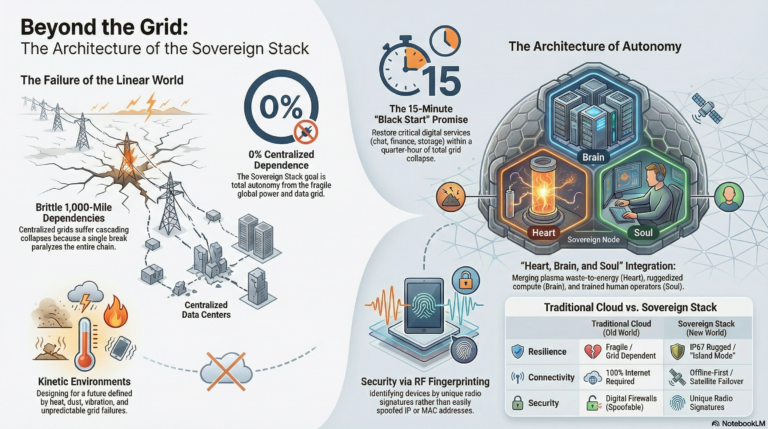
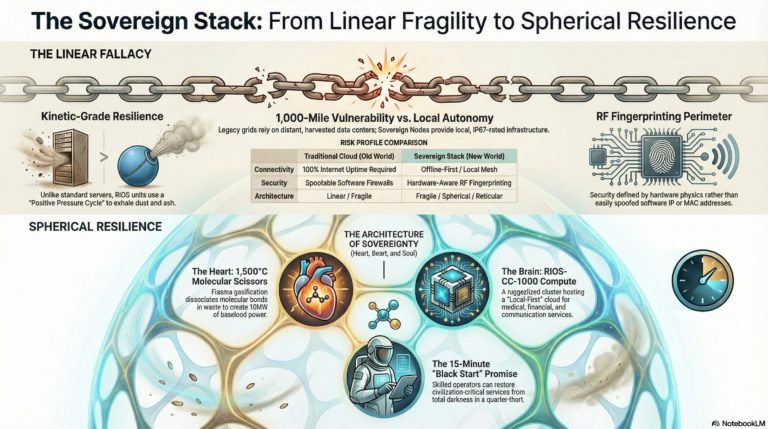
3.1 Overcoming the “1,000-Mile Failure Model”
Modern AI swarms fail because they depend on centralized cloud hyperscalers. The DeReticular Sovereign Stack enables “Sustained Island Mode” through:
- Topological k-Nearest Neighbors (k \approx 7): Birds (and agents) interact strictly with 7 neighbors regardless of density. This prevents “context bloat” and ensures graph connectivity even when the swarm scatters.
- Inertial Spin Waves: Information propagates as undamped hyperbolic waves (at speeds of 20–40 m/s) rather than through slow, diffusive multi-turn “debates.” This allows the swarm to recalibrate its trajectory in milliseconds.
- Scale-Free Correlation: Velocity fluctuations scale linearly with the flock diameter, allowing a localized discovery (like a predator or obstacle) to influence the entire collective instantly.
3.2 Correcting Consensus Pathologies
The framework addresses the Condorcet Inversion, where correlated errors in homogeneous AI models lead to a 100% convergence on hallucinations.
- Anisotropic Lateral Weighting: Swarms must span distinct model families (e.g., Transformers, State-Space Models, Symbolic Solvers). Inputs are weighted by architectural divergence to ensure error independence.
- Devil’s Advocate Spawning: Orchestrators automatically fund sub-swarms with inverted priors to actively generate falsifying counter-proofs.
- Practical Application: The Silicon Herd
In precision agriculture, the Agra.Energy project replaces 20-ton industrial monoliths with the Silicon Herd: autonomous, lawnmower-sized micro-tractor swarms.
4.1 Photonic Weed Control vs. Chemical Armaments
- The Problem: Heavy tractors cause deep subsoil compaction (hardpan), and weeds have evolved multi-chemical metabolic resistance to broadcast spraying.
- The Solution: Micro-bots (<12 psi footprint) use Sub-Millimeter Photonic Thermal Laser Strikes. By targeting the apical meristem (growth ring) of a weed, the bot boils intracellular water and causes instant necrosis.
- Edge Truth: Truth is verified at the edge. If the laser fires but the thermal sensor fails to detect a temperature spike to 110^\circ\text{C}, the bot’s classification has failed “Ontic Friction,” and the agent is quarantined.
- Continuous Runtime Telemetry and Slashing
The framework replaces static perimeter security (SSO/JWT) with Continuous Multi-Dimensional Telemetry. Agency must be re-earned at every execution step across four streams:
- Epistemic: Measures Brier scores and delirium (free energy gradients).
- Syntactic: Directives must compile into Lean 4 Abstract Syntax Trees (ASTs).
- Thermodynamic: Landauer’s Principle dictates that belief updates require physical work. If the information gain is less than the metabolic cost, the loop is halted.
- Ontic: Measures discrepancy against Level 0 physical sensors.
5.1 Hierarchical Transitive Slashing
In delegated agent pipelines, liability is conserved. If a “Primary Executor” commits a Level 0 breach (ontic failure):
- Executor: Slashed by 50%.
- Curator (Sub-delegator): Slashed by 25%.
- Originator: Slashed by 10%.
- Snap-Back Reversion: The delegation tree is instantly dissolved, and remaining credits revert to the originator’s self-custody.
- Synthesis: The Asymptotic Horizon
Human and synthetic systems both fail when symbolic ledgers decouple from physical reality. The “Macro-Thermodynamic Crack” identifies this in the modern economy, where nominal financial debt grows exponentially while real wealth is bounded by declining Energy Return on Energy Invested (EROEI).
The framework concludes that the only defense against institutional dogmatism and AI hallucination is a return to Causal Resistance. By grounding decision-making in the unyielding laws of thermodynamics and the rigor of formal logic, the Architecture of Truth enables a steady, asymptotic journey toward the objective world.