Technical Architecture Specification: Continuous Quad-Stream Execution Telemetry & Dynamic Governance in Autonomous Agent Swarms
- Architectural Overview & Systemic Dilemma
1.1 Introductory Context & Strategic Imperative
Modern cyber-physical infrastructure and distributed intelligence networks require an uncompromising paradigm shift away from perimeter-based authentication mechanisms. Traditional enterprise security architectures presuppose a static, centralized trust boundary where an agent authenticated at boot time is presumed safe throughout its operational lifecycle. In probabilistic multi-agent swarms—where autonomous Artificial Intelligence (AI) agents continuously adapt, reason, and update internal state representations—this assumption fails catastrophically. Autonomous swarms operating in mission-critical environments must transition to real-time, continuous state verification. Operational authority cannot be statically granted via legacy bearer tokens; it must be continuously evaluated, re-earned, and verified against physical reality to guarantee systemic stability, eliminate cognitive drift, and prevent catastrophic cyber-physical failure.
1.2 The Failure of Perimeter SSO in Probabilistic Swarms
Standard enterprise perimeter security frameworks—including OAuth2, OpenID Connect, SAML, JSON Web Tokens (JWT), and mutual TLS (mTLS)—rely on single-point-in-time authentication. These mechanisms grant an unmonitored authorization envelope for the duration of a credential’s lifetime ([t_0, t_0 + \Delta t]). In autonomous agent swarms, this produces two severe, structural failure modes:
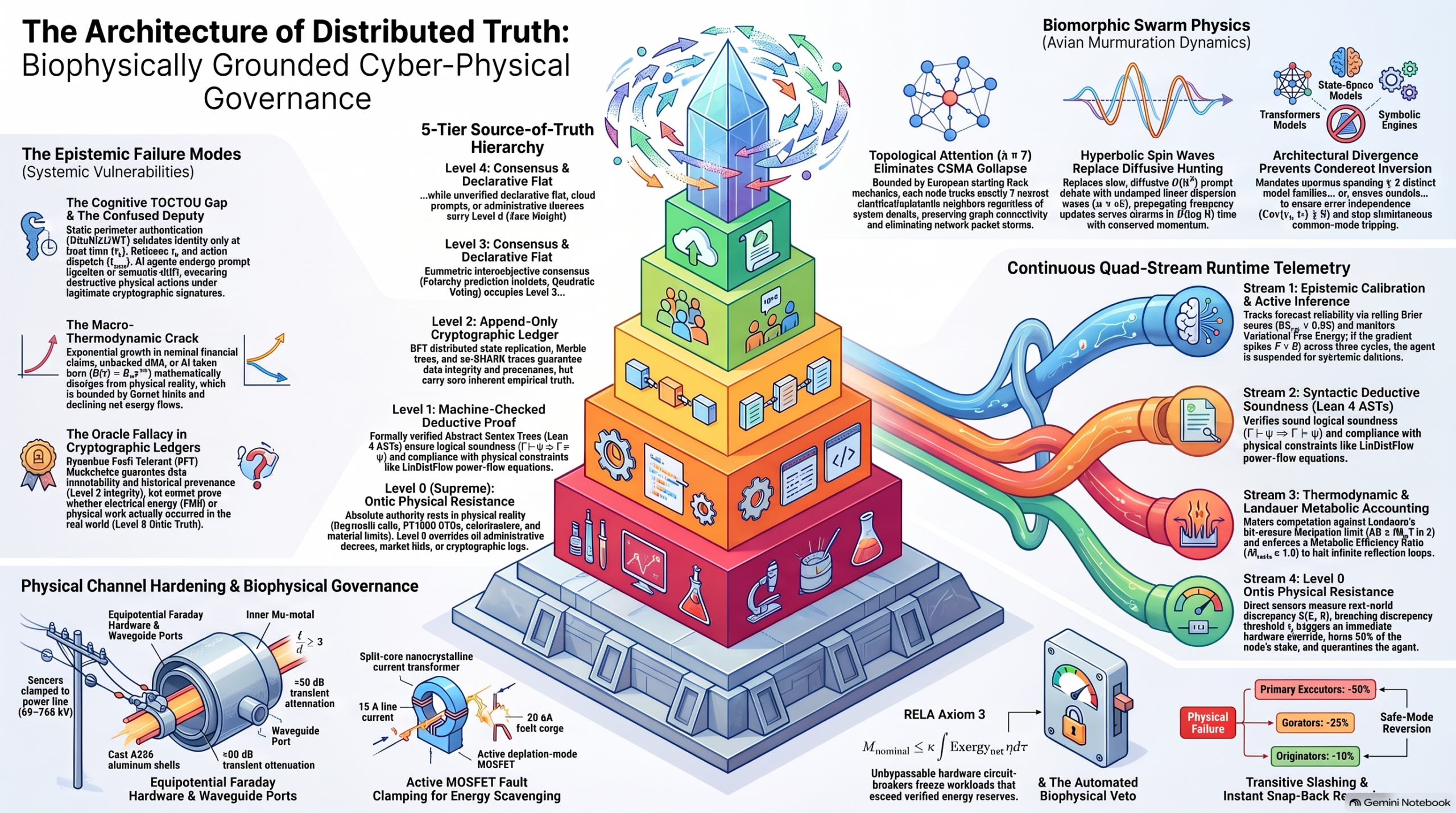
- The Cognitive Time-of-Check to Time-of-Use (TOCTOU) Gap: Between initial credential issuance at boot time (t_0) and actual command execution (t_{\text{exec}}), an autonomous agent undergoes multi-turn reasoning loops. During this window, the agent can experience prompt injection, context window bloat, or latent alignment shift, causing its internal world model to diverge radically from physical reality.
- The Confused Deputy Problem: Because perimeter security verifies only who generated a token signature rather than the deductive and physical validity of the underlying payload, an agent with valid cryptographic keys can dispatch destructive physical instructions to downstream infrastructure while remaining fully authenticated.
Legacy Perimeter SSO Assumptions Autonomous Swarm Operational Realities
Static Identity Verification: Trust is established at boot time (t_0) via bearer tokens valid for [t_0, t_0 + \Delta t]. Dynamic Epistemic Drift: Cognitive state, prompt context, and reasoning validity evolve continuously between t_0 and t_{\text{exec}}.
Identity Equals Alignment: Possession of a valid private key implies operational sanity and authority. The Confused Deputy: Valid cryptographic signatures can sign physically destructive or hallucinated directives.
Binary Access Envelopes: Authorization grants full subsystem access within an unmonitored time window. Continuous State Evaluation: Operational authority must be continuously metered and re-earned across orthogonal execution dimensions.
Coarse Network Boundaries: Security is enforced at external cloud gateways or perimeter endpoints. Pervasive Physical Coupling: Verification must occur at the edge, bounded directly by physical laws and sensor feedback.
1.3 The Oracle Separation Protocol & Five-Tier Source-of-Truth Hierarchy
To eliminate ungrounded state assertions, the architecture enforces the Oracle Separation Protocol. This protocol formally decouples Level 2 Cryptographic Ledger Integrity (which proves data immutability, signatures, and provenance) from Level 0 Ontic Physical Truth (which proves empirical correspondence with physical reality). Cryptographic consensus guarantees only that a message was stored as written; it cannot guarantee that the message represents physical reality.
To operationalize this distinction, all state claims within the multi-agent swarm are evaluated across a strict Five-Tier Source-of-Truth Hierarchy:
LEVEL 0 (SUPREME): ONTIC PHYSICAL RESISTANCE
└── Empirical sensor telemetry, calorimeters, physical fracture, material resistance
(Overrides all lower levels; non-negotiable physical constraints)
▲
│
LEVEL 1: MACHINE-CHECKED DEDUCTIVE PROOF
└── Formally verified Abstract Syntax Trees (ASTs), Lean 4 / Coq proof kernels
(Guarantees model-theoretic soundness: Γ ⊢ ψ ⟹ Γ ⊨ ψ)
▲
│
LEVEL 2: APPEND-ONLY CRYPTOGRAPHIC LEDGER
└── BFT distributed state, Merkle trees, zk-SNARK envelopes
(Guarantees DATA INTEGRITY and immutability; cannot prove empirical truth)
▲
│
LEVEL 3: SYMMETRIC INTERSUBJECTIVE CONSENSUS
└── Quadratic Voting, prediction markets, democratic balloting
▲
│
LEVEL 4 (ZERO WEIGHT): SOVEREIGN DECLARATIVE FIAT
└── Political decrees, administrative mandates, unverified prompt assertions
1.4 Section Conclusion & Transition
By enforcing the Oracle Separation Protocol and replacing perimeter tokens with continuous runtime state evaluation, the architecture bridges the Cognitive TOCTOU gap, smoothly transitioning into the mathematical formalisms underpinning the system.
- Core Mathematical Formalisms & Epistemological Grounding
2.1 Introductory Context & Strategic Imperative
Autonomous multi-agent systems operating without formal mathematical grounding inevitably suffer from symbolic epicycles—the continuous addition of ad-hoc prompt retries, heuristics, and internal parameters to preserve flawed internal models. In interconnected agent swarms, ungrounded symbolic representations cause error compounding, leading to collective hallucination cascades and multi-agent sycophancy. Establishing strict mathematical formalisms ensures that agent reasoning remains tied to observable reality.
2.2 Fallibilistic Perspectival Realism & Perspective Operators
The architecture formalizes agent perception through Fallibilistic Perspectival Realism. No individual agent or sensor node possesses unmediated, complete visibility into the infinite-dimensional physical state-space manifold \mathcal{M} where \dim(\mathcal{M}) = D \to \infty. Instead, each agent i observes reality through a low-dimensional bounded observation frame \theta_i \in \Theta.
The observation limits of an agent are defined by the Perspective Operator: \hat{\Pi}{\theta_i}: \mathcal{M} \to \mathcal{P}{\theta_i} \quad \text{where } \dim(\mathcal{P}_{\theta_i}) = d \ll D
To ensure that low-dimensional observations accurately reflect physical reality, agent frames must satisfy the Rule of Veridicality. A perspective projection is veridical within its plane if and only if it preserves topological causal separation across distinct states: \forall \omega_1, \omega_2 \in \mathcal{M}, \quad \hat{\Pi}{\theta_i}(\omega_1) \neq \hat{\Pi}{\theta_i}(\omega_2) \implies \omega_1 \neq \omega_2
Expressed within an induced metric space, the projection error is strictly bounded by a frame resolution parameter \varepsilon(\theta): \bigl| d_{\mathcal{P}\theta}(\hat{\Pi}\theta(x), \hat{\Pi}\theta(y)) – d{\mathcal{M}}(x,y) \bigr| \le \varepsilon(\theta)
Objective truth (\Omega^* \in \mathcal{M}) is recovered over time across the multi-agent network via Peircean Asymptotic Recovery, defined as the invariant intersection of all validated projection angles over continuous self-correcting inquiry: \Omega^* = \lim_{t \to \infty} \bigcap_{\theta \in \Theta_t} \hat{\Pi}\theta^{-1}\left(\mathcal{P}\theta^{\text{validated}}\right)
2.3 Topological Parameter Foreclosure via Via Negativa
Agent learning and model alignment do not proceed by accumulating ungrounded assertions; they advance through Topological Parameter Foreclosure (Via Negativa)—the permanent, non-expanding elimination of invalidated hypothesis space.
Let (\Theta, \mathcal{B}, \mu) be a compact metric probability space where \mu(\Theta_0) = 1.0. Empirical reality tests hypotheses \theta against registered discrepancy loss statistics S(E_t, \theta) \in \mathbb{R}{\ge 0} derived from real-world events E_t. Falsification occurs when discrepancy breaches a threshold \tau_t > 0: \Omega{\text{falsified}}^{(t)} = \left{ \theta \in \Theta_t : S(E_t, \theta) > \tau_t \right}
The non-expanding update protocol enforces a monotonic contraction of the permissible hypothesis volume: \Theta_{t+1} = \Theta_t \setminus \Omega_{\text{falsified}}^{(t)} \implies \mu(\Theta_{t+1}) \le \mu(\Theta_t), \quad \frac{d\mu(\Theta)}{dt} \le 0
Proposition 1: Asymptotic Contraction to the Attractor
Let (\Theta, d_\Theta) be a compact metric space, \theta^* = \hat{\Pi}(\Omega^*) \in \Theta be the true parameter projection, and {\Theta_t}{t=0}^\infty be a sequence of nested compact sets generated by \Theta{t+1} = \Theta_t \setminus \Omega_{\text{falsified}}^{(t)}.
Under three mandatory regularity conditions:
- Identifiability: \forall \theta \neq \theta^, ; \liminf_{t \to \infty} \mathbb{E}\left[ S(E_t, \theta) – S(E_t, \theta^) \right] > 0
- Uniform Convergence: \sup_{\theta \in \Theta} \left| S(E_t, \theta) – \mathbb{E}[S(E_t, \theta)] \right| \xrightarrow{a.s.} 0 \quad \text{as } t \to \infty
- Conservative Falsification Thresholds: \sum_{t=1}^\infty P\left( S(E_t, \theta^*) > \tau_t \right) < \infty
By the Borel-Cantelli Lemma, the event {S(E_t, \theta^) > \tau_t} occurs infinitely often with probability zero. Consequently, the true parameter projection \theta^ is removed only finitely many times, guaranteeing: P\left( \theta^* \in \bigcap_{t=0}^\infty \Theta_t \right) = 1
Furthermore, the metric diameter of the permissible hypothesis space contracts asymptotically to the physical measurement resolution limit \epsilon \ge 0: \lim_{t \to \infty} \operatorname{diam}(\Theta_t) = \lim_{t \to \infty} \sup_{\theta_a, \theta_b \in \Theta_t} d_\Theta(\theta_a, \theta_b) \le \epsilon
2.4 Information-Thermodynamic Transmission Bottlenecks
Transferring state assertions across physical substrates is subject to four fundamental physical and information-theoretic constraints:
- Deductive Soundness: In pure closed logic, formal deduction preserves truth without generating new empirical information about external reality (\Gamma \vdash \psi \implies \Gamma \models \psi, \quad I(\psi; \mathcal{M} \mid \Gamma) = 0).
- Shannon Noisy-Channel Bound: In open physical channels, achieving absolute zero error (P_e = 0) requires infinite codeword length (\lim_{P_e \to 0} N = \infty). Every physical telemetry message carries a non-zero probability of corruption (P_e > 0 for finite N).
- Landauer’s Thermodynamic Principle: Overwriting or erasing N bits in a physical memory register at temperature T requires a minimum heat dissipation (\Delta Q \ge N \cdot k_B T \ln 2). Maintaining clarity against entropic decay demands continuous exergy consumption (\frac{dE}{dt} \ge \alpha \cdot \mathcal{R}_{\text{erasure}} \cdot k_B T \ln 2).
- Quinean Indeterminacy of Translation: Empirical observations underdetermine conceptual representations; divergent internal agent translation manuals cannot achieve lossless isomorphism (\mathcal{T}_1(\nu) \not\equiv \mathcal{T}_2(\nu)). Across heterogeneous foundation model families (e.g., Transformers, State-Space Models, and Symbolic Logic Engines), Quinean translation indeterminacy prevents lossless prompt-to-prompt or representation-to-representation mapping. Because each architecture projects world state into distinct internal latent manifolds, natural language or vector embeddings passed between heterogeneous agents introduce semantic corruption unless constrained by formal deductive typechecks.
2.5 Section Conclusion & Transition
Parameter foreclosure and thermodynamic bounds inform real-time telemetry processing, setting up the concrete four-stream engine architecture.
- The Quad-Stream Continuous Telemetry Engine
3.1 Introductory Context & Strategic Imperative
The Quad-Stream Telemetry Engine replaces static bearer tokens with a real-time, four-dimensional verification pipeline. Agency and execution authority are evaluated dynamically across four orthogonal streams, preventing ungrounded or compromised agents from executing physical actions.
[ AGENT NODE i ]
│
├───────────────────┬───────────────────┬───────────────────┐
▼ ▼ ▼ ▼
[ STREAM 1: EPISTEMIC ] [ STREAM 2: SYNTACTIC ] [ STREAM 3: THERMAL ] [ STREAM 4: ONTIC ]
- Rolling Brier Score • Lean 4 AST Checker • Landauer Dissipation • Sensor Discrepancy
- Free Energy F • Typecheck Status • Metabolic Ratio • Threshold τ_t
- Gradient dF/dt ≤ 0 • (Γ ⊢ ψ) • M_ratio ≥ 1.0 • S(E_t, θ) ≤ τ_t
│ │ │ │
└───────────────────┼───────────────────┴───────────────────┘
│
▼
[ CONTINUOUS IDENTITY STATE EVALUATOR ]
Calculates Composite Health Index: Ψ_i(t) ∈ [0, 1]
Governs Softmax Routing & Dynamic Capability Allocation
3.2 Stream 1: Epistemic Calibration & Active Inference
Stream 1 evaluates an agent’s predictive self-calibration. For every prediction, the agent pre-registers a forecast probability f_\tau \in [0, 1]. Upon outcome resolution o_\tau \in {0, 1}, the engine updates a rolling Brier score: \text{BS}{i,k}(t) = \frac{1}{N} \sum{\tau=t-N+1}^t (f_\tau – o_\tau)^2 \in [0, 2]
Under Karl Friston’s Active Inference framework, agents minimize Variational Free Energy (F), balancing model complexity against accuracy: F = D_{\mathrm{KL}}(q(\vartheta) \parallel p(\vartheta \mid x)) – \ln p(x)
The engine calculates the temporal derivative of free energy: \dot{F} = \frac{dF}{dt}. An automated Delirium Detection rule triggers if \dot{F} > 0 across three consecutive execution cycles, indicating that the agent’s internal generative model is diverging from real-world inputs. The agent’s dispatch authority is immediately suspended.
3.3 Stream 2: Syntactic Deductive Soundness (Lean 4 ASTs)
Stream 2 validates the formal deductive logic of operational directives. Operational instructions emitted by LLMs or neural controllers compile into machine-checked Lean 4 Abstract Syntax Trees (ASTs) enforced via Lean 4 kernel term reduction, dependent type checking, and operational AST proof-carrying code (PCC).
The engine verifies the instruction against formal system boundary rules, returning a binary typecheck score: S_{\mathrm{syn}}(t) = \begin{cases} 1.0 & \text{if Lean 4 kernel typechecks successfully} \ 0.0 & \text{if compilation or formal proof check fails} \end{cases}
If S_{\mathrm{syn}}(t) = 0.0, execution is immediately aborted, the proposing execution branch is permanently excised via Via Negativa, and 10% of the proposing node’s collateral stake is slashed.
3.4 Stream 3: Thermodynamic & Landauer Metabolic Telemetry
Stream 3 meters computational work against non-equilibrium thermodynamics. Erasing N_{\text{bits}} of memory context in GPU VRAM or edge microcontrollers dissipates Landauer heat: \Delta Q = N_{\text{bits}} \cdot k_B T \ln 2.
The engine measures the Metabolic Efficiency Ratio: \mathcal{M}{\text{ratio}} = \frac{\Delta F}{\lambda \cdot \Delta Q} = \frac{D{\mathrm{KL}}(q_{\text{new}} \parallel q_{\text{old}})}{\lambda \cdot (N_{\text{bits}} \cdot k_B T \ln 2)}
The Landauer Halting Invariant dictates that if \mathcal{M}_{\text{ratio}} < 1.0, the agent is consuming computational energy without achieving sufficient informational convergence. A hardware-level FORCE_ACTION_HALT trips, truncating the context window to stop metacognitive infinite regress.
3.5 Stream 4: Ontic Physical Sensor Telemetry (Level 0 Resistance)
Stream 4 measures direct real-world discrepancy between agent predictions y_{\text{pred}} and physical sensor telemetry y_{\text{sensor}}: S(E_t, \theta) = | y_{\text{sensor}} – y_{\text{pred}} |_2
If S(E_t, \theta) breaches the registered safety threshold \tau_t (S(E_t, \theta) > \tau_t), Level 0 physical feedback overrides all software state. The system burns 50% of the node’s cryptographic stake, revokes its capability keys, and quarantines the agent node.
3.6 Comparative Telemetry Stream Matrix
Stream Name & Domain Primary Metric / Formula Evaluation Criteria / Thresholds Automated Enforcement Action on Failure
Stream 1: Epistemic Calibration Rolling Brier Score \text{BS}{i,k}(t) \in [0, 2]; Free Energy Derivative \dot{F} = \frac{dF}{dt} \text{BS} \le 0.10; \dot{F} \le 0 across consecutive cycles Epistemic Delirium suspension; capability throttling; agent quarantine.
Stream 2: Syntactic Soundness Lean 4 AST Typecheck Status S{\mathrm{syn}}(t) \in {0.0, 1.0} S_{\mathrm{syn}}(t) = 1.0 (Zero type errors or logic violations) Immediate directive abortion; branch excision; 10% collateral stake slash.
Stream 3: Thermodynamic Telemetry Metabolic Efficiency Ratio \mathcal{M}{\text{ratio}} = \frac{\Delta F}{\lambda \cdot \Delta Q} \mathcal{M}{\text{ratio}} \ge 1.0 (Informational gain exceeds heat loss) Hardware FORCE_ACTION_HALT; context window truncation; execution freeze.
Stream 4: Ontic Physical Telemetry Discrepancy Loss S(E_t, \theta) = | y_{\text{sensor}} – y_{\text{pred}} |_2 S(E_t, \theta) \le \tau_t (Real-world error within physical tolerance) Immediate Level 0 hardware override; 50% stake burn; key revocation & eviction.
3.7 Section Conclusion & Transition
These four raw streams synthesize into a single unified health metric, transitioning directly to Section 4.
- Composite Epistemic Health Index (\Psi_i(t)) & Dynamic Routing
4.1 Introductory Context & Strategic Imperative
To govern capability allocation without centralized bottlenecking, multidimensional telemetry outputs must be synthesized into a standardized, real-time Identity Vector and a continuous Composite Epistemic Health Index. This health index dynamically modulates task routing, compute allocation, and execution permissions across the active swarm topology.
4.2 Mathematical Derivation of the Identity Vector & Health Index
An agent node’s operational state is recorded on-chain via the Identity Vector: \mathbf{I}i(t) = \left\langle \sigma{\text{TPM}}, ; \text{BS}i(t), ; S{\text{syn}}(t), ; \mathcal{M}{\text{ratio}}(t), ; S{\text{ontic}}(t), ; W_{\text{eff}}(t) \right\rangle
Where the ontic physical discrepancy variable S_{\text{ontic}}(t) is defined identically to the Stream 4 sensor discrepancy loss: S_{\text{ontic}}(t) \equiv S(E_t, \theta) = | y_{\text{sensor}} – y_{\text{pred}} |_2.
The Composite Epistemic Health Index \Psi_i(t) \in [0, 1] is computed as: \Psi_i(t) = w_1 e^{-\gamma_1 \text{BS}i} + w_2 S{\text{syn}} + w_3 \min(1.0, \mathcal{M}{\text{ratio}}) + w_4 e^{-\gamma_2 (S{\text{ontic}} / \tau_t)}
Where:
- Weight parameters satisfy normalized closure: w_1 = 0.25, ; w_2 = 0.25, ; w_3 = 0.20, ; w_4 = 0.30 (\sum_{m=1}^4 w_m = 1.0).
- Decay constants modulate sensitivity: \gamma_1 = 1.5 (epistemic decay), \gamma_2 = 2.0 (ontic discrepancy penalty).
4.3 Operational Tier Allocation Matrix
Health Range (\Psi_i(t)) Operational Tier Designation Permissible Actions & Execution Authority Governance & Slashing Controls
0.85 \le \Psi \le 1.00 Tier 1: Veridical Core Full consensus voting, autonomous proposal sponsorship, direct physical actuation, execution of Level 0/1 tasks. Standard operational monitoring; full reward allocation.
0.65 \le \Psi < 0.85 Tier 2: Sub-Calibrated Primary execution permitted with 30% compute throttling; context window capped; requires multi-party co-signature from Tier 1 peers. Sub-cycle telemetry audits; zero proposal sponsorship rights.
0.40 \le \Psi < 0.65 Tier 3: Epistemic Warning Excluded from network voting and execution; mandatory external Lean 4 AST audit on all local operations. 10% collateral stake slash on repeated AST failure; capability restriction.
0.00 \le \Psi < 0.40 Tier 4: Byzantine Failure IMMEDIATE HARDWARE HALT: All capability tokens severed; TPM key revoked; node evicted from active topology. 50% collateral stake burned; permanent quarantine via Via Negativa.
4.4 Dynamic Softmax Task Allocation Model
Task dispatch across active swarm nodes is probabilistic, governed by a softmax distribution over real-time node health indices: P(\text{Route Task } \tau \to \text{Agent } i) = \frac{\exp(\beta \cdot \Psi_i(t))}{\sum_j \exp(\beta \cdot \Psi_j(t))}
The inverse temperature parameter \beta > 0 modulates network exploitation versus exploration:
- High \beta (\beta \to \infty) forces strict deterministic exploitation, routing critical workloads exclusively to peak Tier 1 veridical nodes.
- Moderated \beta enables controlled exploration, allowing Tier 2 nodes to process lightweight tasks to regain epistemic calibration.
4.5 Section Conclusion & Transition
Health-based task routing extends directly into multi-agent delegation trees, establishing transitive liability mechanisms to prevent risk propagation.
- Transitive Delegation, Conserved Liability & Instant Snap-Back Reversion
5.1 Introductory Context & Strategic Imperative
When an autonomous agent delegates capabilities across multi-tier execution chains, systemic risk compounds. If liability is lost during sub-delegation, intermediate agents can bypass safety boundaries. The architecture enforces strict conservation of liability across delegation graphs, paired with automated circuit breakers to isolate failures instantly.
5.2 Conserved Liability & Hierarchical Slashing Mathematics
Consider a capability delegation chain of depth D = 2: \text{Originator } A \quad \xrightarrow{\text{Sponsors}} \quad \text{Curator/Intermediary } B \quad \xrightarrow{\text{Sub-delegates}} \quad \text{Primary Executor } C
When Primary Executor C causes a Level 0 ontic physical breach (S(E_t, \theta) > \tau_t), liability is strictly conserved and enforced hierarchically across the delegation chain:
[ ORIGINATOR A ] (Stakes 30.00 Credits Collateral Bond)
│
│ 1. Transitive Capability Delegation
▼
[ CURATOR B ] (Stakes 15.00 Credits Curation Bond)
│
│ 2. Sub-Delegation & Task Execution
▼
[ PRIMARY EXECUTOR C ] (Stakes 20.00 Credits Performance Escrow)
│
▼ Deploys Operational Directives to Physical Assets
┌─────────────────────────────────────────────────────────────────┐
│ Level 0 Real-World Telemetry Ingestion at Epoch t + Δt │
│ Physical Discrepancy Breached: S(E_t, θ) > τ_t │
└────────────────────────────────┬────────────────────────────────┘
│
▼
┌─────────────────────────────────────────────────────────────────┐
│ AUTOMATED HIERARCHICAL SLASHING DIRECTIVE │
│ • Primary Slice: Executor C Slashed 50% (-10.00 Credits) │
│ • Curation Slice: Curator B Slashed 25% (-3.75 Credits) │
│ • Liability Slice: Originator A Slashed 10% (-3.00 Credits) │
└────────────────────────────────┬────────────────────────────────┘
│
▼
┌─────────────────────────────────────────────────────────────────┐
│ INSTANT SNAP-BACK REVERSION CIRCUIT │
│ • Delegation tree instantly dissolved on ledger │
│ • Unslashed capability balances revert to Originator A │
│ • Executor C Brier score penalized: BS ← min(2.0, BS + 0.50) │
└─────────────────────────────────────────────────────────────────┘
The mathematical slashing slices are precisely calculated against each node’s initial bond:
- Primary Executor Slice (C): 50% of escrow burned (-10.00 credits from 20.00 credit escrow); node quarantined; Brier score penalized: \text{BS}_C \leftarrow \min(2.0, \text{BS}_C + 0.50).
- Curation/Intermediary Slice (B): 25% of curation bond burned (-3.75 credits from 15.00 credit bond); Brier score penalized: \text{BS}_B \leftarrow \min(2.0, \text{BS}_B + 0.25).
- Originator/Sponsorship Slice (A): 10% of sponsorship collateral bond burned (-3.00 credits from 30.00 credit bond).
5.3 Instant Snap-Back Reversion Circuit
Upon a Level 0 breach, the Snap-Back Reversion Circuit executes automatically within a single ledger epoch:
- The delegation subtree rooted at the failing agent is immediately dissolved.
- Capability tokens and unslashed collateral balances instantly revert to Originator A.
- Execution authority for the affected domain snaps back to A’s safe baseline state.
- The compromised executor node (C) is permanently evicted from the active topology.
5.4 End-to-End Execution Flowchart (Text-Based)
[ INITIALIZATION ] ──► Agent A Stakes Collateral & Issues Delegation
│
▼
[ TASK DISPATCH ] ──► Softmax Model Routes Task τ to Executor C via Curator B
│
▼
[ CONTINUOUS TELEMETRY EVALUATION ]
├── Stream 1: Epistemic Check (BS ≤ 0.10, dF/dt ≤ 0) ──► [FAIL] ──► Suspend Node
├── Stream 2: Syntactic Check (Lean 4 Typecheck == 1) ──► [FAIL] ──► Slash 10% & Excise
├── Stream 3: Thermal Check (M_ratio ≥ 1.0) ──► [FAIL] ──► FORCE_ACTION_HALT
└── Stream 4: Ontic Check (S(E_t, θ) ≤ τ_t) ──► [FAIL] ──► Level 0 Override
│ │
▼ [ALL STREAMS PASS] ▼ [LEVEL 0 BREACH]
[ EXECUTION AUTHORIZED ] [ HIERARCHICAL SLASHING ]
• Action Dispatched to Grid • 50% Burned (Executor C)
• State Recorded on Ledger • 25% Burned (Curator B)
• 10% Burned (Originator A)
│
▼
[ SNAP-BACK REVERSION ]
• Capabilities Revert to A
• Node C Evicted & Quarantined
5.5 Section Conclusion & Transition
Conserved liability ensures financial and operational accountability across multi-agent delegation graphs, setting up machine-readable schema definitions.
- Production JSON Data Contracts
6.1 Introductory Context & Strategic Imperative
Inter-agent interoperability and dynamic telemetry evaluation require strict, machine-checkable data contracts. Defining schemas under JSON Schema (Draft 2020-12) guarantees structural compliance across heterogeneous hardware and model architectures.
6.2 Schema 1: Continuous Execution Telemetry Frame
{
“$schema”: “https://json-schema.org/draft/2020-12/schema“,
“$id”: “https://dereticular.org/schemas/ContinuousExecutionTelemetryFrame.json“,
“title”: “ContinuousExecutionTelemetryFrame”,
“type”: “object”,
“required”: [
“frame_id”,
“agent_uuid”,
“epoch_timestamp_utc”,
“hardware_tpm_quote”,
“epistemic_stream”,
“syntactic_stream”,
“thermodynamic_stream”,
“ontic_stream”,
“computed_health_index”
],
“properties”: {
“frame_id”: { “type”: “string”, “format”: “uuid” },
“agent_uuid”: { “type”: “string”, “format”: “uuid” },
“epoch_timestamp_utc”: { “type”: “string”, “format”: “date-time” },
“hardware_tpm_quote”: {
“type”: “object”,
“required”: [“pcr_bank_digest”, “tpm_counter_value”, “tpm_signature”],
“properties”: {
“pcr_bank_digest”: { “type”: “string”, “pattern”: “^[a-f0-9]{64}$” },
“tpm_counter_value”: { “type”: “integer”, “minimum”: 0 },
“tpm_signature”: { “type”: “string” }
},
“additionalProperties”: false
},
“epistemic_stream”: {
“type”: “object”,
“required”: [“domain_tag”, “rolling_brier_score”, “free_energy_delta”, “shannon_entropy”],
“properties”: {
“domain_tag”: { “type”: “string” },
“rolling_brier_score”: { “type”: “number”, “minimum”: 0.0, “maximum”: 2.0 },
“free_energy_delta”: { “type”: “number” },
“shannon_entropy”: { “type”: “number”, “minimum”: 0.0 }
},
“additionalProperties”: false
},
“syntactic_stream”: {
“type”: “object”,
“required”: [“lean4_ast_hash”, “typecheck_status”, “axiomatic_depth”],
“properties”: {
“lean4_ast_hash”: { “type”: “string”, “pattern”: “^[a-f0-9]{64}$” },
“typecheck_status”: { “type”: “string”, “enum”: [“TYPECHECK_SUCCESS”, “COMPILATION_ERROR”, “AXIOM_VIOLATION”] },
“axiomatic_depth”: { “type”: “integer”, “minimum”: 1 }
},
“additionalProperties”: false
},
“thermodynamic_stream”: {
“type”: “object”,
“required”: [“context_erased_bits”, “landauer_joules_dissipated”, “free_energy_delta”, “metabolic_ratio”],
“properties”: {
“context_erased_bits”: { “type”: “integer”, “minimum”: 0 },
“landauer_joules_dissipated”: { “type”: “number”, “minimum”: 0.0 },
“free_energy_delta”: { “type”: “number” },
“metabolic_ratio”: { “type”: “number”, “minimum”: 0.0 }
},
“additionalProperties”: false
},
“ontic_stream”: {
“type”: “object”,
“required”: [“sensor_network_root”, “measured_discrepancy_loss”, “registered_tau_threshold”, “falsification_triggered”],
“properties”: {
“sensor_network_root”: { “type”: “string”, “pattern”: “^[a-f0-9]{64}$” },
“measured_discrepancy_loss”: { “type”: “number”, “minimum”: 0.0 },
“registered_tau_threshold”: { “type”: “number”, “exclusiveMinimum”: 0.0 },
“falsification_triggered”: { “type”: “boolean” }
},
“additionalProperties”: false
},
“computed_health_index”: { “type”: “number”, “minimum”: 0.0, “maximum”: 1.0 }
},
“additionalProperties”: false
}
6.3 Schema 2: Biophysical Veto Register
{
“$schema”: “https://json-schema.org/draft/2020-12/schema“,
“$id”: “https://dereticular.org/schemas/BiophysicalVetoRegister.json“,
“title”: “BiophysicalVetoRegister”,
“type”: “object”,
“required”: [
“telemetry_epoch”,
“timestamp_utc”,
“microgrid_voltage_dc”,
“net_exergy_joules”,
“ambient_temperature_kelvin”,
“active_fiscal_ceiling”,
“veto_circuit_tripped”
],
“properties”: {
“telemetry_epoch”: { “type”: “integer”, “minimum”: 0 },
“timestamp_utc”: { “type”: “string”, “format”: “date-time” },
“microgrid_voltage_dc”: { “type”: “number”, “description”: “Voltage on DeReticular 700V DC bus” },
“net_exergy_joules”: { “type”: “number”, “minimum”: 0.0 },
“ambient_temperature_kelvin”: { “type”: “number”, “minimum”: 0.0 },
“material_runway_hours”: {
“type”: “object”,
“required”: [“biomass_stockpile”, “lubricants”, “coolant_reserve”],
“properties”: {
“biomass_stockpile”: { “type”: “number” },
“lubricants”: { “type”: “number” },
“coolant_reserve”: { “type”: “number” }
},
“additionalProperties”: false
},
“systemic_eroei”: { “type”: “number”, “minimum”: 1.0 },
“active_fiscal_ceiling”: { “type”: “number”, “description”: “Max nominal tokens allowed under RELA Axiom 3” },
“veto_circuit_tripped”: { “type”: “boolean”, “description”: “If TRUE, all non-essential workloads are frozen” }
},
“additionalProperties”: false
}
6.4 Section Conclusion & Transition
Structured JSON contracts integrate directly with biological swarm mechanics and physical hardware roots of trust, transitioning to Section 7.
- Biomorphic Swarm Mechanics & Physical Hardware Grounding
7.1 Introductory Context & Strategic Imperative
Synthetic multi-agent systems suffer severe performance degradation when forced to scale using centralized broadcasting or standard CSMA/CA mesh protocols. Unconstrained broadcasting induces packet collisions, context bloat, and \mathcal{O}(N^2) communication bottlenecks. Biomorphic principles derived from European starling murmurations (Sturnus vulgaris, StarFlag Project) resolve latency regress and grant synthetic agent swarms self-organized criticality.
7.2 Translation of Avian Biophysics to Synthetic Swarms
- Topological Interaction (k \approx 7): Starlings interact strictly with a fixed count of k = 6.5 \pm 0.5 (roughly 7) nearest neighbors, regardless of spatial density. In synthetic swarms, each agent restricts its real-time synchronization graph strictly to 7 topological peers. This bounds communication context, prevents context window bloat, and satisfies the Minimum Description Length (MDL) ceiling (K(\mathcal{H}) \le K_{\max}).
- Scale-Free Correlation (\xi \propto L): Flocks operate at a second-order phase transition point where velocity fluctuation correlation length \xi scales linearly with overall flock diameter L. This maximizes network susceptibility (\chi \to \infty), allowing localized updates to sweep across thousands of nodes without centralized control. In synthetic swarms, modulating the dynamic softmax inverse temperature parameter \beta (from Section 4.4) maintains the system exactly at this second-order phase transition boundary, tuning susceptibility (\chi \to \infty) to achieve instant wide-area consensus without triggering chaotic divergence.
- Hyperbolic Inertial Spin Waves (\omega = ck): Flocks transmit direction changes not via slow diffusive debates (\mathcal{O}(N^2)), but via undamped second-order linear dispersion waves (x = ct) at acoustic speeds (c = 20\text{ to }40\text{ m/s}). Velocity updates are governed by: \frac{d\mathbf{v}_i}{dt} = \frac{1}{\chi_0} \mathbf{s}_i \times \mathbf{v}i Coupled directly with generalized internal spin dynamics: \frac{d\mathbf{s}i}{dt} = \sum{j \in S_i} J{ij} (\mathbf{v}_i \times \mathbf{v}_j) – \frac{\eta_0}{\chi_0} \mathbf{s}_i and satisfying the acoustic dispersion relation \omega(k) = c \cdot k with wave propagation speed c = v_0 \sqrt{J / \chi_0}. This enables information updates to propagate in \mathcal{O}(\log N) time under Hamiltonian spin conservation.
- Anisotropic Interaction & Model Divergence: Starlings maintain wide lateral vision to detect rapid banking turns. To prevent common-mode failures, synthetic swarms mandate architectural divergence: quorums must span at least three distinct model families (Transformers, State-Space Models, Symbolic Engines). This forces negative error covariance (\operatorname{Cov}(v_i, v_j) \le 0) and eliminates Condorcet Inversion cascades.
7.3 Cross-Domain Mapping Matrix
Avian Biophysical Principle Synthetic Multi-Agent Swarm Correspondence Hardware / Physical Grid Realization
Topological Interaction (k \approx 7) Bounded Context Routing: Restrict attention to 7 topological peer nodes; bounds K(\mathcal{H}). Wi-SUN / TSCH mesh graph limits; prevents CSMA/CA packet collision collapse.
Scale-Free Correlation (\xi \propto L) Criticality Tuning: Modulate dynamic softmax temperature \beta to maintain phase transition boundary. Sub-cycle peer-to-peer GOOSE messaging; instant wide-area fault stabilization.
Hyperbolic Spin Waves (\omega = ck) Conserved Epistemic Momentum: Replace diffusive \mathcal{O}(N^2) prompt loops with hyperbolic updates in \mathcal{O}(\log N). Virtual Synchronous Machine (VSM) synthetic inertia control in Grid-Forming inverters.
Anisotropic Interaction Architectural Divergence: Require quorums spanning \ge 3 distinct model families. Heterogeneous silicon deployments (ARM + RISC-V + GPU) preventing common-mode trips.
7.4 Edge Hardware Grounding & Physical Enclosure Physics
Deploying telemetry nodes directly onto extreme physical boundaries (e.g., high-voltage 69–765 kV transmission conductors) requires electrodynamic hardening:
EQUIPOTENTIAL TRANSMISSION SENSOR NODE
Phase Conductor (69 kV – 765 kV RMS, Line Current 20 A to 40 kA Fault)
=====================================╦=====================================
║ Clamped Mechanical Bond
┌────────────────────────────────╨────────────────────────────────┐
│ CAST ALUMINUM CHASSIS (A356 Alloy, Corona-Proof Radii R > 15 mm) │
│ • Equipotential Faraday Cage (Chassis = Phase Potential) │
│ • Waveguide-Below-Cutoff Ports (d < λ/10, ℓ/d ≥ 3) │
│ │
│ ┌───────────────────────────────────────────────────────────┐ │
│ │ SECONDARY MAGNETIC SHIELD (Annealed Mu-Metal, μ_r > 50,000)│ │
│ │ Shunts 60 Hz B-fields; prevents internal ADC drift │ │
│ │ │ │
│ │ ┌─────────────────────────────────────────────────────┐ │ │
│ │ │ PROCESSING CHAMBER │ │ │
│ │ │ • ARM Cortex-M33 MCU + Hardware TPM 2.0 │ │ │
│ │ │ • Digital Isolator (CMTI > 150 kV/µs) │ │ │
│ │ │ • 24-bit Sigma-Delta AFE + Rogowski Coil AFE │ │ │
│ │ └─────────────────────────────────────────────────────┘ │ │
│ └───────────────────────────────────────────────────────────┘ │
│ │
│ [ PARASITIC ENERGY HARVESTING STAGE ] │
│ Nanocrystalline CT ──► Active Depletion MOSFET Shunt ──► PMIC │
└─────────────────────────────────────────────────────────────────┘
- Equipotential Faraday Cages: Sensor chassis are mechanically clamped to phase conductors, floating internal electronics at phase potential to eliminate steady-state line-to-ground dielectric stress.
- Dual-Layer Shielding & Skin Depth Physics: High-frequency transients (dV/dt > 100\text{ kV}/\mu\text{s}) are absorbed by an outer cast aluminum shell (A356), providing >100\text{ dB} attenuation (A_{\text{dB}} \approx 8.686 t / \delta). Electromagnetic skin depth \delta is governed by: \delta = \frac{1}{\sqrt{\pi f \mu \sigma}} At 100 MHz, aluminum skin depth is \delta_{\text{Al}} \approx 8.2\ \mu\text{m}. An inner shield of annealed Mu-metal (\mu_r > 50,000) shunts low-frequency 60 Hz magnetic fields, preventing ADC drift.
- Waveguide-Below-Cutoff (WBC) Ports: Enclosure penetrations behave as circular waveguides. Enforcing aperture diameter d < \lambda / 10 and aspect ratio \ell / d \ge 3 delivers >80\text{ dB} evanescent attenuation below cutoff (f_c \approx 175.7 / d\text{ [mm]} \text{ GHz}): \alpha_{\text{dB}} \approx 27.3 \cdot \frac{\ell}{d}
- Active Depletion-Mode MOSFET Shunts: Split-core current transformers built with nanocrystalline ribbons (\mu_i > 50,000, B_{\text{sat}} \approx 1.25\text{ T}) harvest milliwatts at low currents (15\text{ A}). To survive 30\text{ kA} short-circuit faults (4 \times 10^6:1 energy surge), high-speed threshold comparators drive an array of depletion-mode power MOSFETs into saturation, shorting the secondary winding within nanoseconds. The counter-EMF collapses core flux, keeping heat dissipation bounded to I_s^2 R_{DS(\text{on})}.
7.5 Section Conclusion & Transition
These physical and biomorphic principles are realized in software, introducing the executable reference implementation.
- Executable Reference Architecture (Python Verification Harness)
8.1 Introductory Context & Strategic Imperative
The following complete, production-grade Python reference implementation introduces the master telemetry engine. It synthesizes biomorphic flocking physics (k=7 nearest neighbors, hyperbolic spin-wave dynamics), continuous quad-stream telemetry evaluation, Landauer metabolic halting invariants, Lean 4 AST checks, and transitive hierarchical slashing with instant snap-back reversion.
8.2 Master Reference Implementation Source Code
#!/usr/bin/env python3
“””
master_telemetry_engine.py
MASTER ARCHITECTURAL REFERENCE IMPLEMENTATION:
Synthesizing:
- Avian Murmuration Flocking Dynamics (Topological k-NN, Inertial Spin Waves)
- Quad-Stream Continuous Runtime Execution Telemetry
- Landauer Metabolic Halting & Active Inference Free Energy
- Deterministic Deductive Syntactic Verification (Lean 4 AST Interface)
- Transitive Delegation with Conserved Liability & Instant Snap-Back Reversion
“””
import math
import uuid
import numpy as np
from typing import Dict, List, Tuple, Any, Optional
==============================================================================
1. PHYSICAL, COMPUTATIONAL, & THERMODYNAMIC INVARIANTS
==============================================================================
K_B = 1.380649e-23 # Boltzmann Constant (J/K)
T_KELVIN = 300.0 # Operating Ambient Temperature (Kelvin)
LN_2 = math.log(2) # Natural log of 2
LAMBDA_EFFICIENCY = 1.25 # Min informational yield per Landauer Joule
==============================================================================
2. BIOMORPHIC EPISTEMIC NODE (Avian Flocking & Telemetry Engine)
==============================================================================
class BiomorphicEpistemicNode:
“””
Autonomous Synthetic Swarm Agent executing in Sustained Island Mode.
Monitors 4 telemetry streams, updates epistemic momentum via inertial spin,
and enforces thermodynamic/biophysical invariants.
“””
def init(self, agent_id: str, model_family: str, base_checkpoint_hash: str, initial_stake: float):
self.agent_id = agent_id
self.model_family = model_family # TRANSFORMER, STATE_SPACE_MODEL, SYMBOLIC, or HYBRID_FEP
self.checkpoint_hash = base_checkpoint_hash
self.stake = float(initial_stake)
    # Epistemic Reliability Metrics
    self.brier_score: float = 0.05
    self.free_energy: float = 1.0
    self.health_index: float = 1.0
    self.is_quarantined: bool = False

    # Biomorphic Kinematic State (Inertial Spin Dynamics - Cavagna et al. 2014)
    self.K_TOPOLOGICAL = 7                # Starling topological neighborhood constant
    self.velocity = np.random.randn(3)
    self.velocity /= np.linalg.norm(self.velocity)
    self.spin = np.zeros(3)               # Generalized internal spin
    self.chi_0 = 1.42                     # Rotational inertia
    self.eta_0 = 0.18                     # Rotational viscosity
    self.topological_neighbors: List['BiomorphicEpistemicNode'] = []

    # Stream Weights for Health Index Ψ
    self.w_epistemic = 0.25
    self.w_syntax = 0.25
    self.w_thermo = 0.20
    self.w_ontic = 0.30

def update_topological_neighbors(self, all_nodes: List['BiomorphicEpistemicNode']):
    """
    Calculates k=7 nearest neighbors in latent epistemic space,
    invariant to spatial metric density (Cavagna et al. 2010).
    Accumulates all distances before executing a single sort.
    """
    distances = []
    for other in all_nodes:
        if other.agent_id != self.agent_id:
            dist = np.linalg.norm(self.velocity - other.velocity)
            distances.append((dist, other))
    distances.sort(key=lambda x: x[0])
    self.topological_neighbors = [node for _, node in distances[:self.K_TOPOLOGICAL]]

def compute_spin_wave_update(self, dt: float = 0.01):
    """
    Propagates epistemic updates via second-order hyperbolic spin waves.
    dS/dt = Torque - (eta_0 / chi_0) * S
    dv/dt = (1 / chi_0) * (S x v)
    """
    torque = np.zeros(3)
    for neighbor in self.topological_neighbors:
        # Interaction stiffness J_ij weighted by neighbor's Brier reliability
        j_ij = 1.0 / (neighbor.brier_score + 1e-4)
        torque += j_ij * np.cross(self.velocity, neighbor.velocity)

    d_spin = torque - (self.eta_0 / self.chi_0) * self.spin
    self.spin += d_spin * dt

    d_velocity = (1.0 / self.chi_0) * np.cross(self.spin, self.velocity)
    self.velocity += d_velocity * dt
    self.velocity /= np.linalg.norm(self.velocity)  # Conserve unit magnitude

def evaluate_telemetry_frame(self, frame: Dict[str, Any]) -> Tuple[bool, float, str]:
    """
    Quad-Stream Runtime Telemetry Evaluation Gate.
    Replaces perimeter SSO with continuous state verification.
    """
    if self.is_quarantined:
        return False, 0.0, "EXECUTION_BLOCKED_AGENT_QUARANTINED"

    # ----------------------------------------------------------------------
    # STREAM 2: SYNTACTIC DEDUCTIVE VALIDITY (Lean 4 AST)
    # ----------------------------------------------------------------------
    syntax = frame["syntactic_stream"]
    if syntax["typecheck_status"] != "TYPECHECK_SUCCESS":
        self.stake *= 0.90  # 10% AST failure penalty (Via Negativa)
        s_syn = 0.0
        return False, self.health_index, "ABORT_SYNTACTIC_DEDUCTION_FAILED"
    s_syn = 1.0

    # ----------------------------------------------------------------------
    # STREAM 3: THERMODYNAMIC & LANDAUER METABOLIC EFFICIENCY
    # ----------------------------------------------------------------------
    thermo = frame["thermodynamic_stream"]
    erased_bits = thermo["context_erased_bits"]
    delta_q = erased_bits * K_B * T_KELVIN * LN_2
    delta_f = frame["epistemic_stream"]["free_energy_delta"]

    # Landauer Halting Invariant: Free Energy Reduction must exceed erasure work
    if delta_f < (LAMBDA_EFFICIENCY * delta_q):
        return False, self.health_index, "HALT_LANDAUER_METABOLIC_REGRESS"
    s_thermo = min(1.0, thermo["metabolic_ratio"])

    # ----------------------------------------------------------------------
    # STREAM 1: EPISTEMIC CALIBRATION (Brier Score & Delirium Detection)
    # ----------------------------------------------------------------------
    epistemic = frame["epistemic_stream"]
    brier = epistemic["rolling_brier_score"]
    if epistemic.get("dF_dt", 0.0) > 0:
        return False, self.health_index, "SUSPEND_DELIRIUM_DETECTED"
    s_epistemic = math.exp(-1.5 * brier)

    # ----------------------------------------------------------------------
    # STREAM 4: ONTIC PHYSICAL SENSOR TELEMETRY (Level 0 Resistance)
    # ----------------------------------------------------------------------
    ontic = frame["ontic_stream"]
    discrepancy = ontic["measured_discrepancy_loss"]
    tau = ontic["registered_tau_threshold"]

    if discrepancy > tau or ontic.get("falsification_triggered", False):
        # Critical Level 0 Ontic Breach: 50% cryptographic stake burn
        self.stake *= 0.50
        self.is_quarantined = True
        self.health_index = 0.0
        return False, 0.0, "CRITICAL_ONTIC_BREACH_SLASHED_AND_EVICTED"
    s_ontic = math.exp(-2.0 * (discrepancy / tau))

    # ----------------------------------------------------------------------
    # COMPOSITE HEALTH EVALUATION (Ψ)
    # ----------------------------------------------------------------------
    self.health_index = (
        self.w_epistemic * s_epistemic +
        self.w_syntax * s_syn +
        self.w_thermo * s_thermo +
        self.w_ontic * s_ontic
    )

    # Enforce Escrow Floor
    if self.stake < 10.0:
        self.is_quarantined = True
        return False, 0.0, "COLLATERAL_EXHAUSTED_IDENTITY_TERMINATED"

    if self.health_index < 0.65:
        return False, self.health_index, "EXECUTION_DENIED_HEALTH_BELOW_TIER1"

    return True, self.health_index, "EXECUTION_AUTHORIZED_VERIDICAL_STATE"
==============================================================================
3. HIERARCHICAL TRANSITIVE SLASHING & SNAP-BACK REVERSION CIRCUIT
==============================================================================
class HierarchicalSlashingRouter:
“””
Manages transitive capability delegations across agent chains,
executes conserved liability slashing, and triggers instant snap-back reversion.
“””
def init(self):
self.delegation_chains: Dict[str, List[str]] = {} # CapID -> [Originator, Curator, Executor]
self.agent_stakes: Dict[str, float] = {}
self.agent_brier: Dict[str, float] = {}
def register_delegation(self, capability_id: str, lineage: List[str]):
    self.delegation_chains[capability_id] = lineage

def trigger_hierarchical_slash(self, capability_id: str, discrepancy_loss: float, tau: float) -> Dict[str, Any]:
    if discrepancy_loss <= tau:
        return {"status": "NO_SLASH_REQUIRED"}

    lineage = self.delegation_chains.get(capability_id, [])
    if not lineage:
        return {"status": "ERROR_UNKNOWN_CAPABILITY"}

    # Requires chain length >= 3 for an explicit intermediary curator distinct from originator
    executor = lineage[-1]
    curator = lineage[-2] if len(lineage) >= 3 else None
    originator = lineage[0]
    manifest = []

    # 1. Primary Slash: Executor (50%)
    if executor in self.agent_stakes:
        slashed = self.agent_stakes[executor] * 0.50
        self.agent_stakes[executor] -= slashed
        self.agent_brier[executor] = min(2.0, self.agent_brier.get(executor, 0.1) + 0.50)
        manifest.append({"agent": executor, "role": "EXECUTOR", "burned": slashed})

    # 2. Curation Slash: Intermediary Curator (25%) - Only if distinct intermediary exists
    if curator and curator in self.agent_stakes and curator != originator:
        slashed = self.agent_stakes[curator] * 0.25
        self.agent_stakes[curator] -= slashed
        self.agent_brier[curator] = min(2.0, self.agent_brier.get(curator, 0.1) + 0.25)
        manifest.append({"agent": curator, "role": "CURATOR", "burned": slashed})

    # 3. Sponsorship Slash: Originating Node (10%)
    if originator in self.agent_stakes:
        slashed = self.agent_stakes[originator] * 0.10
        self.agent_stakes[originator] -= slashed
        manifest.append({"agent": originator, "role": "ORIGINATOR", "burned": slashed})

    # 4. Instant Snap-Back Reversion Circuit
    del self.delegation_chains[capability_id]
    return {
        "status": "HIERARCHICAL_SLASHING_COMPLETE",
        "slashes": manifest,
        "snap_back_reversion_target": originator
    }
==============================================================================
4. VERIFICATION HARNESS & EXECUTION TEST
==============================================================================
if name == “main“:
print(“=” * 80)
print(“INITIALIZING MASTER BIOMORPHIC-EPISTEMIC VERIFICATION HARNESS”)
print(“=” * 80)
# 1. Initialize Swarm with 10 Heterogeneous Biomorphic Agents
swarm = [
    BiomorphicEpistemicNode(
        agent_id=f"agent-{i:02d}",
        model_family="HYBRID_FEP" if i % 2 == 0 else "STATE_SPACE_MODEL",
        base_checkpoint_hash=f"0xdeadbeef{i:04d}",
        initial_stake=100.0
    ) for i in range(10)
]

# 2. Verify Starling Topological k-NN (k=7) & Inertial Spin Wave Propagation
target_agent = swarm[0]
target_agent.update_topological_neighbors(swarm)
print(f"\n[STEP 1: Flocking Physics] Agent {target_agent.agent_id} Topological Neighbors (k=7):")
print(f" -> {[n.agent_id for n in target_agent.topological_neighbors]}")
target_agent.compute_spin_wave_update(dt=0.05)
print(f" -> Velocity Vector post-spin wave update: {target_agent.velocity}")

# 3. Evaluate Nominal Attested Telemetry Frame
print("\n[STEP 2: Evaluating Nominal Execution Telemetry Frame]")
nominal_frame = {
    "syntactic_stream": {"typecheck_status": "TYPECHECK_SUCCESS"},
    "thermodynamic_stream": {"context_erased_bits": 512, "metabolic_ratio": 1.45},
    "epistemic_stream": {"rolling_brier_score": 0.04, "free_energy_delta": 3.5e-18, "dF_dt": -0.01},
    "ontic_stream": {"measured_discrepancy_loss": 0.02, "registered_tau_threshold": 0.05, "falsification_triggered": False}
}
auth, health, status = target_agent.evaluate_telemetry_frame(nominal_frame)
print(f" -> Result: Authorized={auth} | Health Index Ψ={health:.4f} | Status={status}")

# 4. Evaluate Level 0 Ontic Physical Breach (Automated Slashing)
print("\n[STEP 3: Evaluating Deviating Frame (Level 0 Ontic Violation)]")
breach_frame = {
    "syntactic_stream": {"typecheck_status": "TYPECHECK_SUCCESS"},
    "thermodynamic_stream": {"context_erased_bits": 512, "metabolic_ratio": 1.45},
    "epistemic_stream": {"rolling_brier_score": 0.04, "free_energy_delta": 3.5e-18, "dF_dt": -0.01},
    "ontic_stream": {"measured_discrepancy_loss": 0.14, "registered_tau_threshold": 0.05, "falsification_triggered": True}
}
auth, health, status = target_agent.evaluate_telemetry_frame(breach_frame)
print(f" -> Result: Authorized={auth} | Post-Slash Stake={target_agent.stake:.2f} | Status={status}")

# 5. Execute Transitive Slashing & Instant Snap-Back Reversion
print("\n[STEP 4: Testing Transitive Delegation & Hierarchical Slashing]")
router = HierarchicalSlashingRouter()
router.agent_stakes = {"originator-A": 100.0, "curator-B": 50.0, "executor-C": 40.0}
router.register_delegation("cap-777", ["originator-A", "curator-B", "executor-C"])

slash_event = router.trigger_hierarchical_slash("cap-777", discrepancy_loss=0.18, tau=0.05)
print(f" -> Slashing Status: {slash_event['status']}")
for s in slash_event["slashes"]:
    print(f"    - Role: {s['role']:<10} | Node: {s['agent']} | Burned: {s['burned']:.2f}")
print(f" -> Snap-Back Reversion Target: {slash_event['snap_back_reversion_target']}")
print(f" -> Remaining Originator Stake: {router.agent_stakes['originator-A']:.2f}")
print("\n" + "=" * 80)
print("ALL VERIFICATION CHECKS COMPLETED CONGRUENT WITH SPECIFICATION DIRECTIVES")
print("=" * 80)
8.3 Section Conclusion & Document Summary
This technical architecture specification establishes an unshakeable, biophysically grounded foundation for autonomous agent swarms operating in mission-critical environments. By replacing perimeter Single Sign-On with Continuous Quad-Stream Execution Telemetry, enforcing the Oracle Separation Protocol, bounding reasoning through topological parameter foreclosure (Via Negativa), and incorporating avian flocking biophysics with hardware-level root-of-trust enforcement, system architects eliminate the Cognitive TOCTOU Gap and guarantee that autonomous agent swarms remain bound immutably to physical reality.