Systems Overview: The Thermodynamic Limits of Governance
Document Control & Administrative Metadata
- Document ID: RELA-TR-2026-V1
- Version: 1.0.0-PROD
- Release Date: October 2026
- Classification: Institutional Standard / Open-Access Systems Architecture
- Sponsoring Body: Foundational Governance Architecture Working Group
- Mathematical Formalisms: Measure Theory, Information Theory, Differential Geometry, Biophysical Economics.
- The Epistemic Crisis: Why Our Systems Are Fracturing
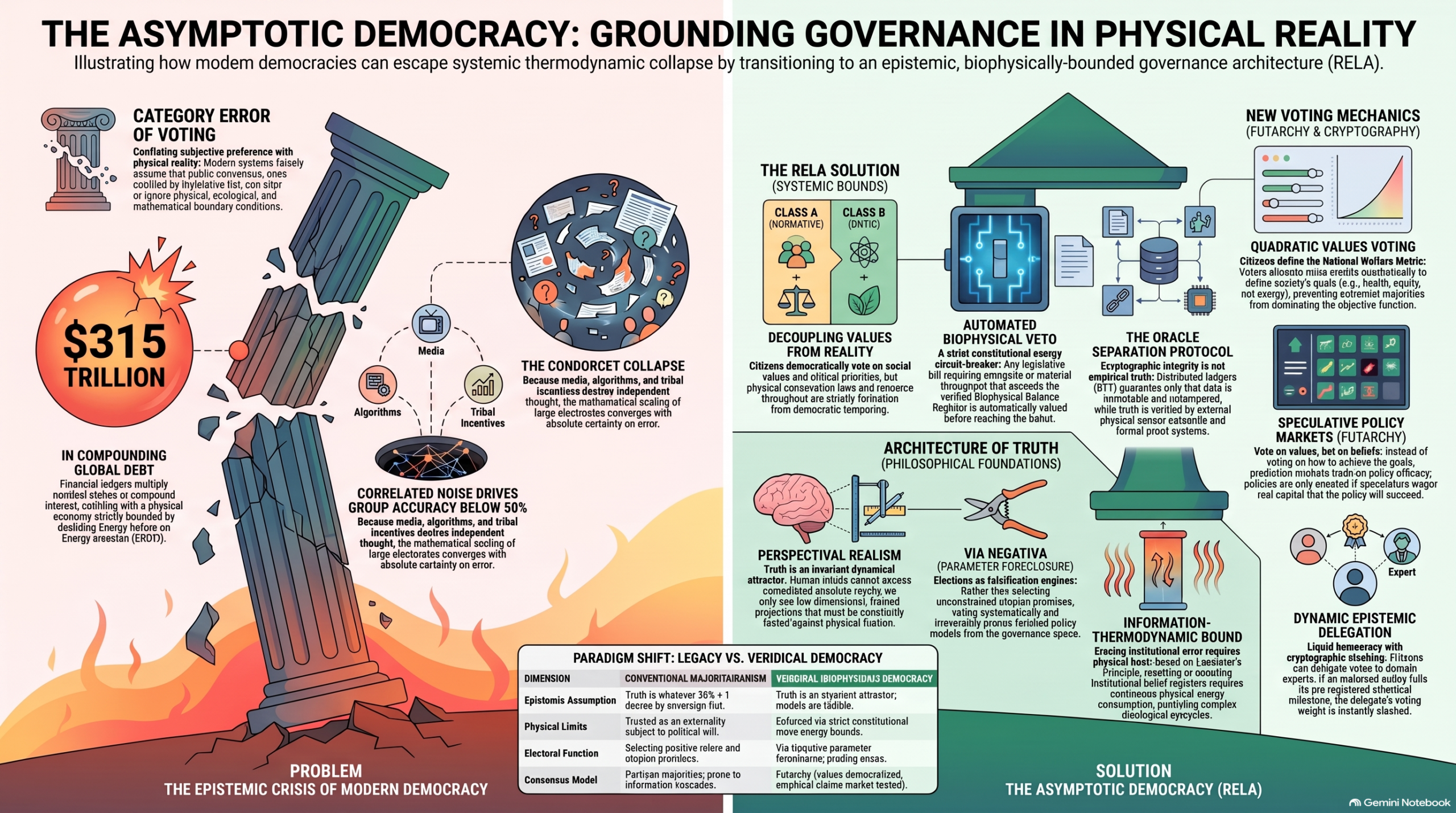
[AUTHOR_PROPOSITION] Modern governance is navigating a profound structural failure defined as an Epistemic Crisis. This crisis is rooted in a fundamental “Category Error”: the treatment of the democratic ballot box as a tool for aggregating unconstrained preferences that can override the physical laws of the Ontic Manifold (\mathcal{M}). We have reached the terminal stage of a Kuhn Cycle where institutional “epicycles”—deficit monetization, narrative management, and emergency bailouts—can no longer bridge the delta between symbolic promises and biophysical reality.
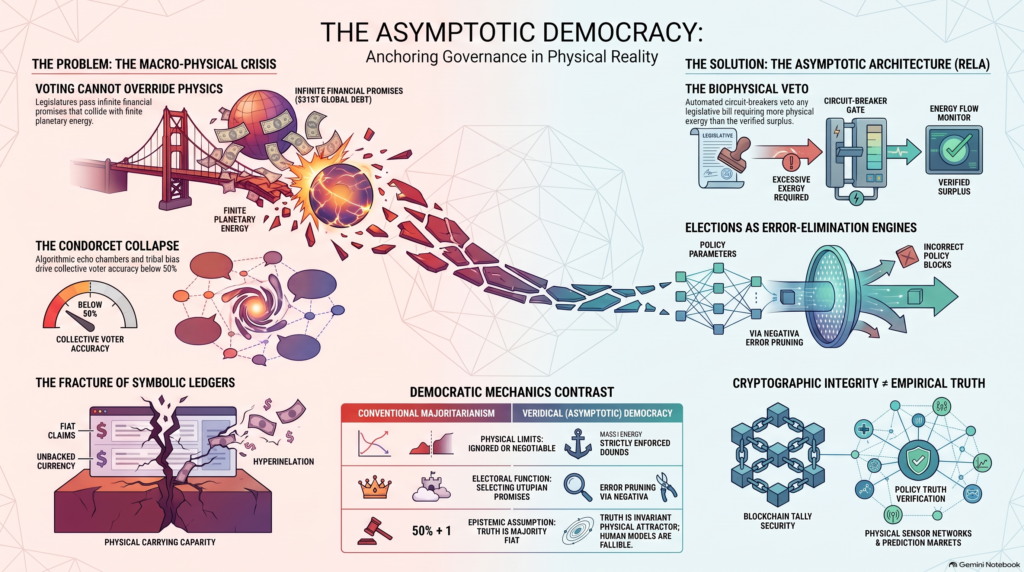
[FORMAL_ASSUMPTION] We define the “Systemic Envelope Fracture” as the point where the symbolic ledger makes claims on energy and matter that the physical environment cannot fulfill. In this state, the system naturally seeks the Truth Attractor (\Omega^*) through catastrophic resets (inflation or collapse) unless a grounded architecture is adopted.
Subjective Preference (The Ballot Box) Physical Reality (The Thermodynamic World)
Unconstrained Promises: The assumption that legislative fiat can alter mass-energy conservation. Carnot Limits & Exergy: The non-negotiable ceiling on useful work extracted from energy.
Infinite Debt Expansion: Nominal wealth claims (D_0 e^{rt}) decoupled from physical throughput. Mineral & Ecological Limits: Finite stocks of critical materials (Cu, Li) and declining EROEI.
Tribal Narrative Cascades: Success measured by social consensus and manufactured consent. Irreversible Entropic Decay: Success measured by the ability to maintain order against physical decay.
The widening delta between these two columns represents the primary threat to civilizational stability. As symbolic narratives decouple from the unyielding laws of physical information, the institutional substrate loses its ability to coordinate with the objective world.
- The Physical Foundation: Information is Physical
[ESTABLISHED_RESULT] In systems engineering, truth preservation is not an abstract ideal; it is a physical process of transmission and erasure. Landauer’s Principle proves that there is a non-negotiable energetic floor for governance: \Delta Q \ge k_B T \ln 2. To update a society’s belief register—to erase an obsolete policy and write a more accurate one—requires the performance of actual physical work and the dissipation of heat.
[AUTHOR_PROPOSITION] A society cannot maintain a complex legal or economic code if its net Energy Return on Energy Invested (EROEI) falls below the Landauer-derived cost of “erasing” social and systemic disorder. Truth transmission must pass through the following Four Strata of Transmission:
- Formal Logic: The realm of syntactic entailment. It is lossless but tautological, providing no new empirical data.
- Physics: The physical movement of signals. This stratum is governed by the Landauer Bound (\Delta Q \ge k_B T \ln 2), proving that updating a society’s belief register requires actual exergy work.
- Semantics: The translation of symbols into meaning, perpetually vulnerable to Quinean indeterminacy and drift.
- Sociality: The human layer of testimony and cascades. This is the most prone to “Consorcet Inversion,” where correlated noise drives groups to converge on error with mathematical certainty.
Physical Transmission Channel
[SENDER] ——> [PHYSICAL SUBSTRATE] ——> [RECEIVER]
(Mind/Node) (Silicon, Ink, Air) (Mind/Node)
|
V
[NOISE & DISSIPATION BOTTLENECK]
(ΔQ ≥ k_B T ln 2 per bit reset)
(Signal corruption vs. Energy cost)
The physical cost of maintaining information fidelity limits the sustainability of ungrounded economic promises; when the energy cost of maintaining a ledger exceeds the system’s exergy surplus, the records—and the society they represent—succumb to entropic decay.
- The Macro-Thermodynamic Crack: Debt vs. Exergy
[EMPIRICAL_CLAIM] As of 2024, BIS data indicates global debt has reached 315 trillion, representing approximately 333% of global GDP. This exponential expansion of nominal claims (D_0 e^{rt}$) is fundamentally at odds with the physical reality of declining EROEI as extraction shifts toward lower-yield energy sources.
[AUTHOR_PROPOSITION] Modern macroeconomics suffers from a “Critical” risk severity due to the omission of thermodynamics from production functions (e.g., Cobb-Douglas models). Capital and labor produce nothing without the exergy required to drive them.
The Three Fatal Axioms of Modern Macroeconomics
- The Disembodied Production Function: Treating output as a result of only capital and labor, ignoring the thermodynamic energy required for work.
- The Neutrality of Debt: Assuming that exponential debt is a frictionless veil that nets out without impacting the physical world.
- The Risk-Free Ledger: The belief that sovereign liabilities are “risk-free” regardless of the issuing nation’s net energy status.
[EMPIRICAL_CLAIM] Historical cases such as the French Assignats and the Weimar Republic hyperinflation serve as empirical proof of “Ontic Friction.” In the Equation of Exchange (MV = PY), when the symbolic ledger decouples from physical throughput, money demand collapses and velocity (V) surges as agents dump nominal tokens for real commodities. This is not a failure of policy, but a physical re-assertion of reality over “Magic Ballots.” To survive, we must transition from an engine of utopian fantasy to a grounded architecture of survival.
- The Via Negativa: Governance Through Error Elimination
[POLICY_SPECIFICATION] Governance must be reframed from a machine that generates “Utopian Promises” to an “Error Elimination” engine. This is the process of Via Negativa (Parameter Foreclosure), where democracy is used to “prune” or cut away policy manifolds proven false by contact with reality.
Class A: Normative Value Spaces Class B: Ontic Feasibility Manifolds
Domain: What we want to optimize (e.g., Social Equity, Ethics). Domain: What is physically possible (e.g., Mass-Energy Conservation).
Jurisdiction: Democratic Voting / Preference Aggregation. Jurisdiction: Automated Biophysical Audits.
Proposition 1: Asymptotic Contraction To keep society moving toward the Truth Attractor (\Omega^*), the system “prunes” the parameter space using three steps:
- Pre-Registration: Policy models must declare explicit parameters and a “discrepancy threshold” (\tau_t) for failure.
- Observation: Real-world sensors and audits measure the actual ontic outcome.
- Foreclosure: If the outcome exceeds the threshold (S(E_t, \theta) > \tau_t), that parameter space is permanently closed to prevent the resurrection of falsified models.
This pruning process ensures that while we vote on our values, our specific technical tools enforce the limits of what is physically feasible.
- RELA: The Technical Blueprint for Survival
[AUTHOR_PROPOSITION] The Resilient Epistemic & Thermodynamic Ledger Architecture (RELA) is a systems-level implementation designed to prevent “Magic Ballots” from violating the physical world. Its core mechanism is the Biophysical Veto, which halts any legislation that requires throughput exceeding the system’s verified net exergy.
RELA Axiom 3: The Monetary Limit This formula ensures that the total stock of authorized nominal money (M) never outpaces the integrated net energy work of the system:
M_{nominal}(t) \le \kappa \int_{t_0}^t (Exergy_{net}(\tau) \cdot \eta(\tau)) d\tau
- M: Total stock of authorized nominal currency.
- Exergy_{net}: Net work capacity available after subtracting energy acquisition costs.
- \eta (Eta): Systemic Carnot and mechanical efficiency of the industrial base.
- \kappa (Kappa): The conversion constant (Joules to Currency Units).
Biophysical Veto Register (Sample Telemetry)
{
“register_id”: “RELA-BBR-2026-ALPHA”,
“telemetry_epoch”: 1042,
“systemic_eroei”: 12.4,
“exergy_net_surplus_joules”: 3.2e17,
“material_runway_days”: {
“copper_kg”: 4.5e8,
“lithium_kg”: 1.2e7
},
“veto_circuit_tripped”: true,
“reason”: “Proposed infrastructure spend violates RELA Axiom 3; exceeds integrated net exergy.”
}
The Oracle Principle: Source-of-Truth Hierarchy RELA enforces a strict hierarchy to ensure that cryptographic integrity (Layer 2) does not mistake itself for Ontic Truth (Level 0):
- Level 0 (Supreme): Ontic Physical Resistance (Sensors, exergy audits, material failure).
- Level 1: Machine-Checked Deductive Proof (Lean 4/formal verification).
- Level 2: Cryptographic Ledger (BFT consensus, immutability, provenance).
- Level 3: Intersubjective Consensus (Democratic voting, Futarchy).
- Level 4 (Zero Weight): Sovereign Declarative Fiat (Political decrees unsupported by Levels 0-3).
- The Roadmap to Asymptotic Democracy
[POLICY_SPECIFICATION] The transition to a veridical state is a 60-month plan designed to anchor the polity in thermodynamic reality without triggering systemic shock.
- Months 1–12 (Auditing Phase):
- Critical Deliverable: E2E-V Cryptographic Ballots.
- Impact: Deployment of homomorphic encryption ensures every citizen can verify their vote was recorded and counted exactly as cast, establishing a baseline of integrity.
- Months 13–24 (Municipal Pilot):
- Critical Deliverable: Regional Biophysical Balance Registers.
- Impact: Regional water and energy grids begin pilot telemetry to limit municipal debt based on real resource flows.
- Months 25–42 (The Binding Veto):
- Critical Deliverable: Constitutional Biophysical Veto.
- Impact: The RELA kernel begins automatically blocking state budgets or bond initiatives that violate Axiom 3.
- Months 43–60 (Full Cutover):
- Critical Deliverable: Veridical Asymptotic Governance.
- Impact: Legacy unbacked debt models are decommissioned; the state becomes a self-correcting engine that prunes error and respects the laws of the universe.
Final Synthesis The Asymptotic Polity is defined not as a utopian end-state, but as a durable, self-correcting engine of human flourishing. By acknowledging that we cannot vote away the laws of thermodynamics, we move from collective delusion toward a system that respects the unyielding friction of the objective world. We stop seeking “saviors” and start “pruning” away the errors that threaten our survival.