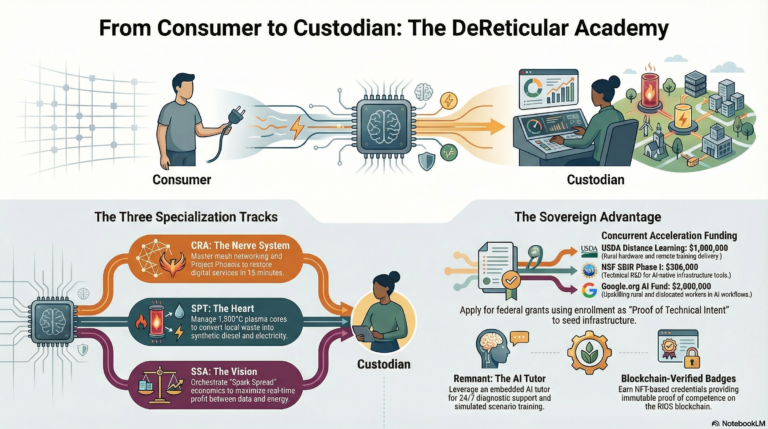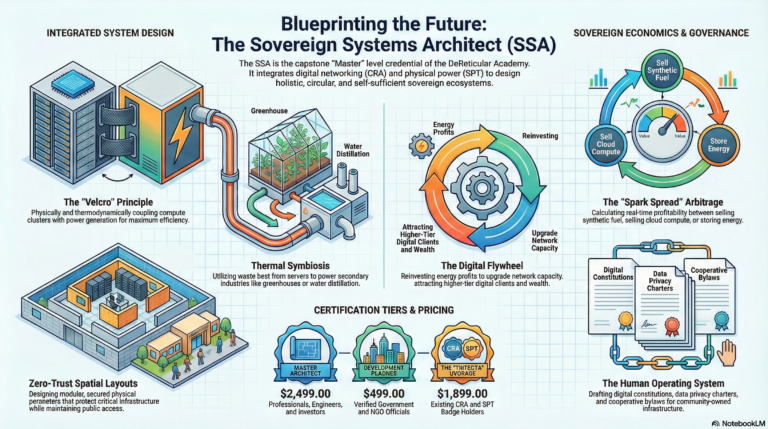
From Fragile Lines to Resilient Spheres: A New Map for Modern Power
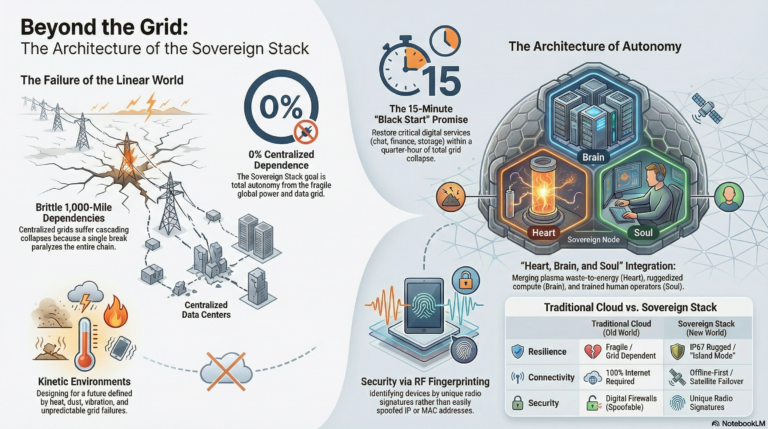
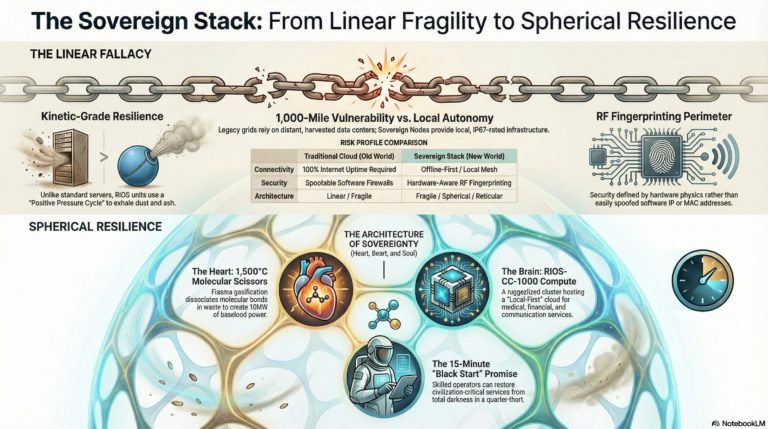
Modern society is built upon an obsolete 20th-century dogma: the straight line. For over a hundred years, our high-voltage transmission lines and fiber-optic backbones have followed a model of linear concentration. While this was economically efficient in a stable era, it has become a liability in our age of climate volatility and cyber-physical threats.
We are witnessing “The Death of the Line.” The future of infrastructure is not found in longer wires, but in a fundamental shift toward Spherical Resilience. By moving from fragile, centralized chains to intelligent, k-connected meshes, we can ensure that a single break no longer means a total collapse.
——————————————————————————–
1. The Vulnerability of the Straight Line
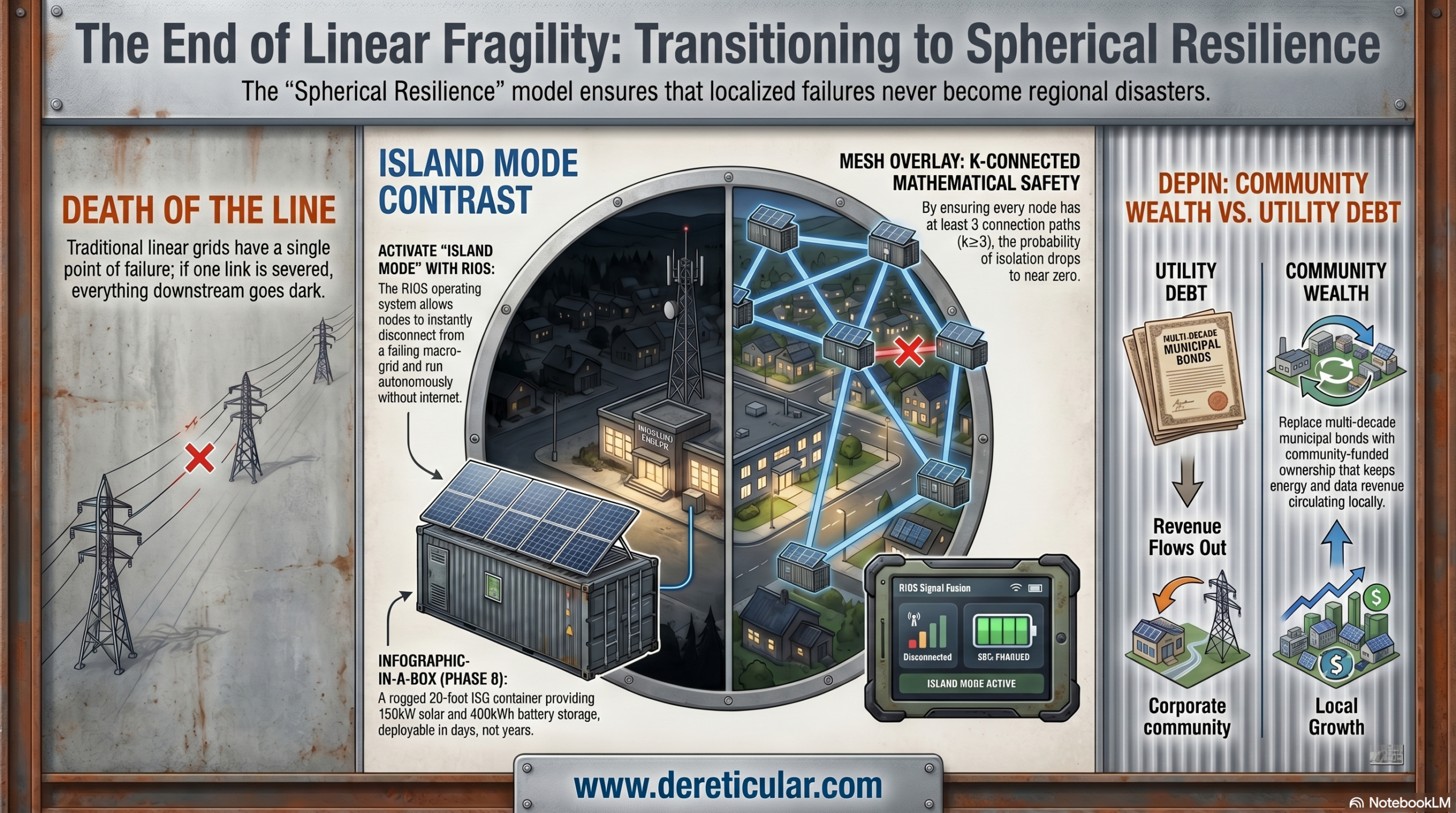
Traditional infrastructure is designed with a Single Point of Failure. In the language of systems thinking and graph theory, this is a topology where the edge connectivity is \lambda(G) = 1. In this configuration, there is only one path between the source and the user. If that path is severed, the system downstream simply ceases to exist.
Why Linear Systems Are Fragile
- Downstream Isolation: Because connectivity is \lambda(G) = 1, any physical or digital break “upstream” leave every participant “downstream” in a total blackout.
- Cascading Failures: Legacy grids are highly coupled. When one node fails, its load is pushed onto neighbors. Because these nodes have an Autonomy Factor (\theta_i) of nearly zero, they cannot function without a “clock” signal or reference voltage from the macro-grid. This triggers a domino effect that can darken entire regions.
- Institutional Dependency: These lines are controlled by centralized monopolies. Repairing a single break often requires waiting for a distant utility workforce, leaving local communities helpless.
| System Type | Topology Metric | What Happens When a Link Breaks? |
| Linear (Legacy) | \lambda(G) = 1 | Total downstream collapse; failure cascades through the entire network. |
| Spherical (Mesh) | k \ge 3 | The failure is “bounded” to the point of origin; the network routes around the break. |
The solution requires more than “better” lines; it requires a change in the fundamental geometry of how we power our world.
——————————————————————————–
2. Simplified Graph Theory: Why the Mesh Wins
To achieve “Spherical Resilience,” we must design networks with a connectivity of k \ge 3. This means every node in the network is connected to at least three other nodes through independent pathways.
The Mathematical “So What?”
In a k \ge 3 mesh, a failure is physically and digitally bounded. This means a power surge or a fiber cut in Town A is “trapped” locally; it cannot travel the wire to Town B because the mesh provides multiple escape routes for the energy and data. It would require the simultaneous failure of three or more independent links to isolate a single community.
The Three Layers of Protection in a Mesh:
- Redundancy: If the primary backbone is cut, the system automatically reroutes to the second or third connection.
- Path Independence: These connections use different “physical layers”—such as LEO satellites, long-range RF radio, and fiber—so a physical wire cut doesn’t kill the wireless backhaul.
- Isolation: When the outside world fails entirely, the node decouples, becoming a self-sustaining “Island.”
——————————————————————————–
3. The Anatomy of a Lifeboat: Infrastructure-in-a-Box
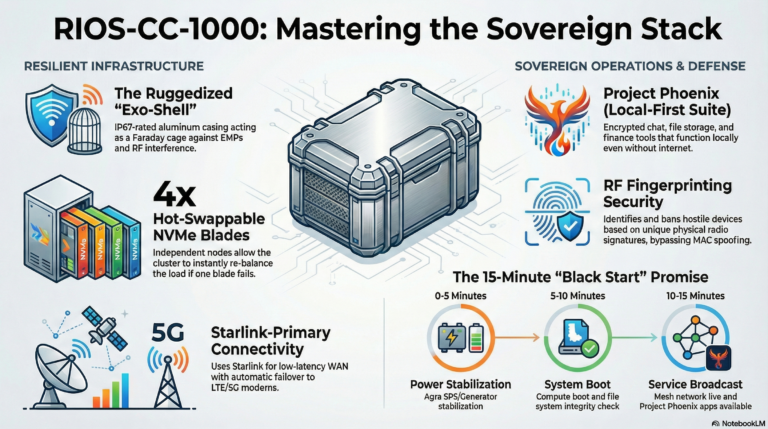
If the macro-grid is a sinking ship, the Phase 0 Infrastructure-in-a-Box is the lifeboat. This is a ruggedized, 20-foot ISO shipping container designed to be dropped into any environment—rural, disaster-stricken, or developing—to provide immediate sovereignty.
Crucially, these nodes are deployed Behind-the-Meter (BTM). This is a “Regulatory Leapfrog” strategy: by staying on the customer’s side of the electrical meter, communities can bypass the multi-year utility connection study queues and bureaucratic red tape of monopolistic power companies.
The Sovereign Stack
| Component | Capability | Benefit to the Local Community |
| Solar Array | 150kW Bifacial Monocrystalline panels | Absorbs light from both sides; generates renewable power even in high-albedo (snowy/sandy) areas. |
| BESS (Battery) | 400kWh LiFePO4 with Liquid-Loop Thermal Management | High-stability chemistry with integrated cooling; includes an Aerosol Fire Suppression System (FSS) for industrial safety. |
| Aux Generator | 30kW Hydrogen-ready thermal generator | Provides 24/7 “baseload” support during multi-week low-sun events. |
| Compute Rack | IP67-rated edge servers running RIOS | Localized AI and databases allow the node to “think” even when the internet is dead. |
——————————————————————————–
4. Understanding “Island Mode” and RIOS
The “brain” of this system is RIOS (Rural Infrastructure Operating System). RIOS manages the Autonomy Factor (\theta_i). In a crisis, RIOS shifts \theta_i to 1, meaning the node no longer needs the macro-grid to know how to function.
Its Signal Fusion Engine is constantly monitoring the health of the world, tracking SNR (Signal-to-Noise Ratio), packet loss, jitter, and link cost. If these metrics cross a failure threshold, the node enters “Island Mode.”
Timeline of a Resilience Event
- The Severance: A storm or cyberattack severs the main transmission line and fiber backbone.
- Detection: RIOS detects a loss of reference voltage and a spike in signal jitter within milliseconds.
- Isolation: Solid-state transfer switches physically detach the community from the macro-grid to prevent dangerous “backfeed.”
- Autonomy: The node generates its own reference voltage. The Autonomous Machine Coordination (AMC) engine prioritizes critical loads—ensuring water pumps and emergency radios stay on while shedding non-essential loads.
- Mesh Self-Healing: The node’s comms mast searches for adjacent nodes, forming a local “mesh” internet that functions independently of the global web.
——————————————————————————–
5. DePIN: Power to the Community
Who owns these “islands”? Traditionally, infrastructure is a top-down, capital-intensive burden. The DePIN (Decentralized Physical Infrastructure Network) model flips this by using fractional ownership. Communities use a Microgrid-as-a-Service (MaaS) model where local investors and cooperatives fund the hardware rather than taking on massive municipal debt.
- Revenue Retention: Utility fees and energy data stay within the community rather than flowing to a distant corporate headquarters.
- CapEx Democratization: Municipalities can start with one “Phase 0” node for a single clinic and scale the mesh as they grow.
- Data Sovereignty: Local communications are processed on the node’s own edge servers, protecting community privacy from global cloud providers.
——————————————————————————–
6. Summary: The Leapfrog Effect
We are entering the era of “Distributed Resilience.” For many regions, the lack of an existing, old-fashioned grid is actually a strategic advantage. Just as developing nations skipped landline telephones to go straight to mobile, rural and emerging economies can now leapfrog legacy institutional dependencies.
While urban centers are trapped by “Linear Fragility” and aging substations, the rural mesh is the new testing ground for the future. By moving from one big, fragile thing to many small, smart things, we create a world where the “line” can break, but the light stays on.
——————————————————————————–
Student Challenge
Identify one “Linear” vulnerability in your own hometown. Think about a single point of failure (e.g., a specific bridge, a single fiber-optic trunk, or a primary power substation).
- How would a “Spherical” mesh node (k \ge 3) change the outcome if that link failed?
- What are the “legacy institutional dependencies” (laws, monopolies, or old tech) preventing your town from switching to “Island Mode” today?
- How could a “Phase 0” node protect your local school or water tower during a two-week blackout?