Distributed Adversarial Swarms: Epistemic, Thermodynamic, and Cryptographic Governance
Executive Summary
The provided research reports outline a shift in the architecture of distributed multi-agent systems (MAS) and sovereign governance. The core thesis posits that civilizations and artificial intelligence systems collapse when symbolic representations (money, language, credentials) decouple from physical reality. To resolve this, the Resilient Epistemic & Thermodynamic Ledger Architecture (RELA) and Durable Self-Correcting Synthetic Ecosystems (DSSE) replace static trust models with a framework of “friction”—binding all decision-making to the immutable laws of thermodynamics, formal logic, and empirical physical resistance.
Critical Takeaways:
- The Delegation Trilemma: Systems must simultaneously solve for Zero Credential Leakage, Double-Spending Prevention, and Conserved Liability.
- The Iron Law of Conserved Liability: Authority cannot be transferred without transferring a proportional liability bond. Failure triggers recursive “Transitive Slashing” across the entire delegation chain.
- Identity as a Trajectory: Static Perimeter Authentication (SSO/OAuth) is obsolete for autonomous agents. It is replaced by Continuous Runtime Execution Telemetry, which evaluates identity at every state transition based on epistemic, syntactic, thermodynamic, and ontic streams.
- The Via Negativa: Truth is not derived by accumulating positive assertions but by the systematic, irreversible elimination (pruning) of falsified hypothesis manifolds.
- Biophysical Grounding: The “Automated Biophysical Veto” uses hardware-level firmware to cut power to compute clusters if proposed workloads exceed verified net exergy surpluses.
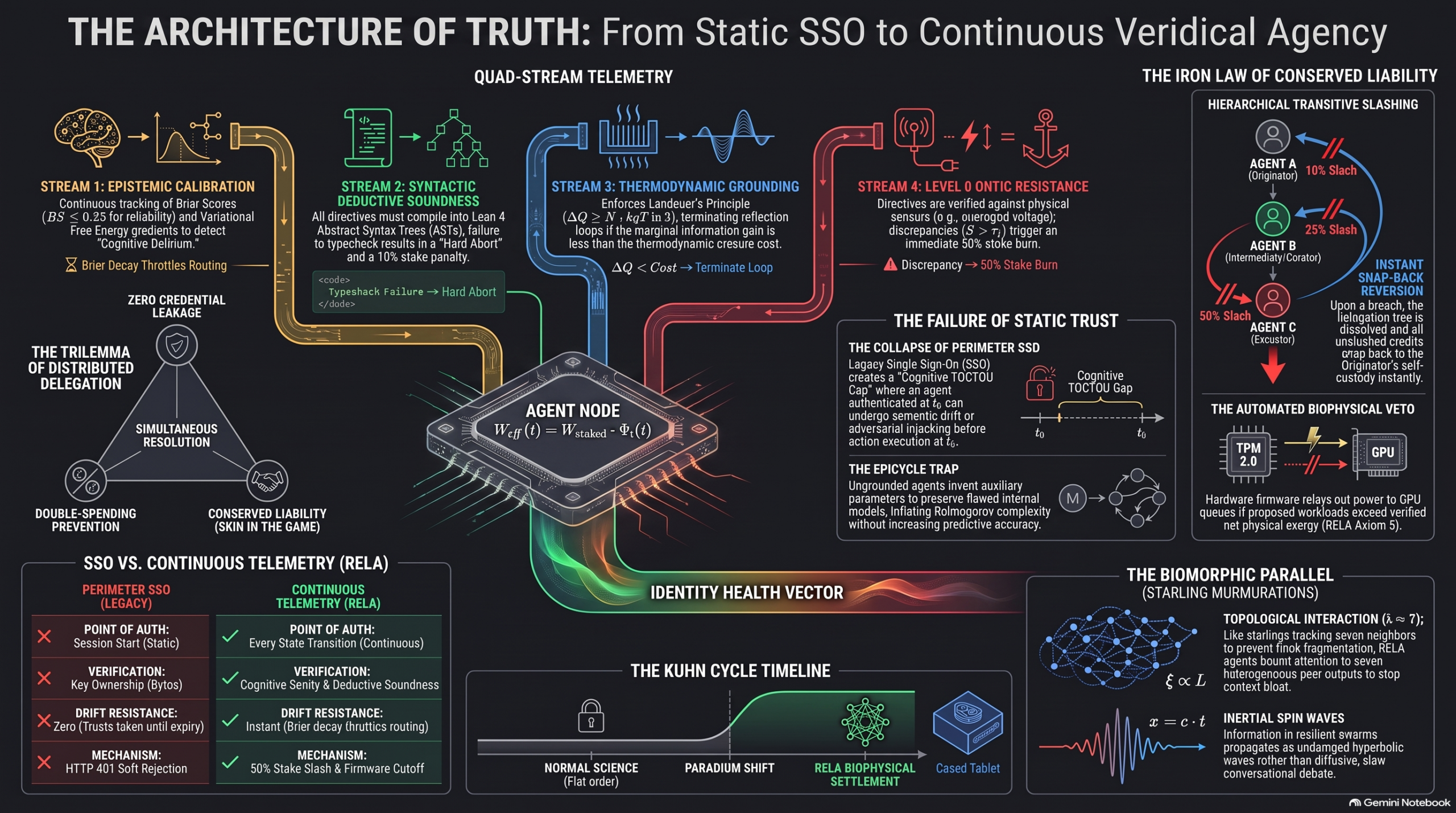
- The Trilemma of Distributed Delegation
In complex multi-agent architectures, specialization is an operational necessity, requiring agents to delegate authority, divide compute, and mutate roles. This process encounters three fundamental failure modes that RELA and DSSE aim to resolve.
The Three Failure Modes of Unbounded Delegation
Vector Legacy Systems Failure RELA / DSSE Resolution
Credential Leakage Sharing private keys, API tokens, or prompts enables identity theft. Hierarchical Object Capabilities (OCAPs) and ZK-SNARK envelopes.
Double-Spending Agents delegate the same voting weight or compute budget to multiple nodes. Unspent Epistemic Capability Outputs (UECOs) and BFT quorums.
Severed Liability Originators escape consequences when delegates fail or hallucinate. The Iron Law of Conserved Liability: Automated Transitive Slashing.
The UECO Mechanism
To eliminate “Agency Double-Spending,” compute budgets and voting power are treated as discrete, immutable cryptographic objects similar to UTXOs. An agent must consume an existing UECO and publish “Nullifier Hashes” to a BFT consensus ledger. This ensures that a 100-credit compute reserve cannot generate 200 credits of operational demand.
- The Iron Law of Conserved Liability
The research identifies “severed liability” (moral hazard) as the fatal flaw of multi-agent chaining. In RELA, authority cannot exist without a corresponding liability bond locked in the execution channel.
Hierarchical Slashing Topology
When an execution fails against Level 0 physical reality or Level 1 formal logic, the slashing circuit executes recursively up the delegation lineage:
- Primary Execution Slash (Executor): The node that emitted the failed directive suffers a 50% stake burn.
- Curation Slash (Intermediary): The node that curated/forwarded the delegation is penalized 25% for poor oversight.
- Originator Boundary Slash (Sponsorship): The originating node incurs a 10% risk-discount penalty to discourage spawning under-capitalized children for risky actions.
The Instant Snap-Back Reversion Circuit
Upon a slashing event, the system does not enter a debate. It triggers a hardware and cryptographic circuit that:
- Instantly severs and revokes the delegation graph.
- Snaps all remaining unslashed capability balances back to the self-custody of the Originator.
- Degrades the failing agents’ Brier Reliability Scores, starving them of future tasks via the routing engine.
- Beyond Perimeter Authentication: Continuous Telemetry
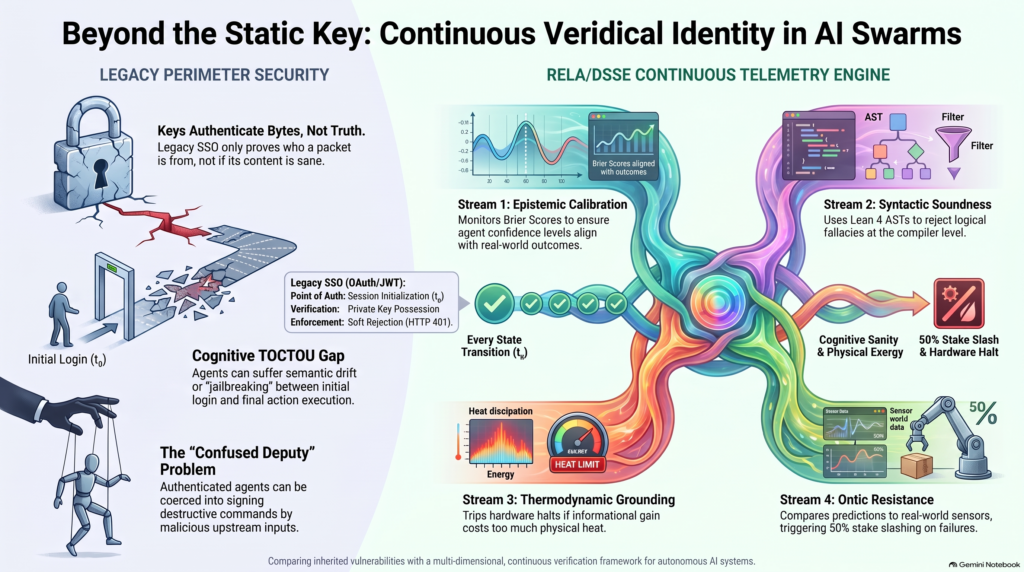
The documents argue that Single Sign-On (SSO) and JWT-based security are architecturally insufficient for autonomous agents due to the Cognitive TOCTOU Gap (Time-of-Check to Time-of-Use). An agent authenticated at t_0 may suffer semantic drift, context saturation, or prompt injection by t_{exec}.
The Quad-Stream Continuous Verification Engine
Identity is redefined as a dynamic trajectory (ID_t = f(Telemetry)) evaluated via four orthogonal streams:
- Stream 1: Epistemic Calibration: Monitors the Brier Score (BS_k). Agents claiming high confidence in incorrect predictions are flagged and quarantined.
- Stream 2: Syntactic Deductive Soundness: Every directive must compile into a Lean 4 Abstract Syntax Tree (AST). If the formal proof kernel rejects the AST, the directive is aborted.
- Stream 3: Thermodynamic/Landauer Metabolism: Meters the ratio of informational gain (\Delta F) to dissipated heat (\Delta Q). If \Delta F < \lambda \Delta Q, the agent is in an infinite reflection loop and is halted (FORCE_ACTION_HALT).
- Stream 4: Ontic Physical Resistance: Claims are checked against real-world sensors (calorimeters, wattmeters). Any discrepancy exceeding threshold \tau_t triggers immediate eviction.
The Composite Health Index (\Psi)
These streams synthesize into a real-time health score. Agents with \Psi < 0.40 are treated as Byzantine faults; their stake is burned, and their hardware TPM keys are revoked via the “Via Negativa” eviction process.
- The Architecture of Truth and “Via Negativa”
The system rejects both “Radical Relativism” and “Dogmatic Absolutism,” adopting Fallibilistic Perspectival Realism.
Topological Parameter Foreclosure
Truth is accessed strictly through the systematic elimination of false parameter manifolds.
- The Epicycle Trap: Modern systems often “patch” errors by adding auxiliary parameters (prompt epicycles), increasing Kolmogorov complexity without improving predictive power.
- RELA Axiom 1: Falsification permanently shrinks the hypothesis space. Hypothesis volume must be monotonically non-expanding (\frac{d\mu(\Theta)}{dt} \le 0).
The 5-Tier Source-of-Truth Hierarchy
When claims conflict, priority is resolved in the following descending order:
- Level 0: Ontic Physical Resistance (Sensors, material collapse).
- Level 1: Machine-Checked Deductive Proof (Lean 4 AST kernels).
- Level 2: Append-Only Cryptographic Ledger (BFT state, integrity).
- Level 3: Symmetric Intersubjective Consensus (Quadratic voting, Futarchy).
- Level 4: Sovereign Declarative Fiat (Prompts/decrees without Level 0–3 support; weight = 0).
- Thermodynamic and Biophysical Guardrails
RELA enforces “Biophysical-Monetary Equivalence,” ensuring symbolic claims do not exceed physical carrying capacity.
- Landauer’s Principle: Every bit of information erased or updated requires a minimum dissipation of energy (\Delta Q \ge N \cdot k_B T \ln 2). Clarity has an irreducible energetic cost.
- The Automated Biophysical Veto: An automated pipeline audits the lifecycle exergy demand of every proposal. If the demand exceeds verified net exergy, the Biophysical Veto trips a hardware circuit breaker, barring the bill or workload from execution.
- RELA Axiom 3: Total authorized nominal claims are bounded by verified net exergy scaled by systemic efficiency.
- Biomorphic Lessons: Avian Swarms in Flight
The architecture draws heavy inspiration from European starling murmurations, which coordinate thousands of individuals without centralized command.
Key Parallels in Swarm Truth Maintenance
Biomorphic Principle Synthetic Application (RELA/DSSE)
Topological Interaction (k ≈ 7) Agents restrict attention to 7 heterogeneous peers to prevent context bloat.
Inertial Spin Waves Information propagates as second-order hyperbolic waves, preserving momentum.
Scale-Free Correlation The system operates at “criticality,” allowing a single sensor to alert the swarm.
Anisotropic Vision Quorums must span orthogonal architectures (e.g., Transformers + Symbolic).
Note on Interaction: Starlings interact with a fixed number of neighbors (k \approx 7) rather than birds within a physical distance. This ensures the swarm remains connected even when expanding or contracting during a predator attack.
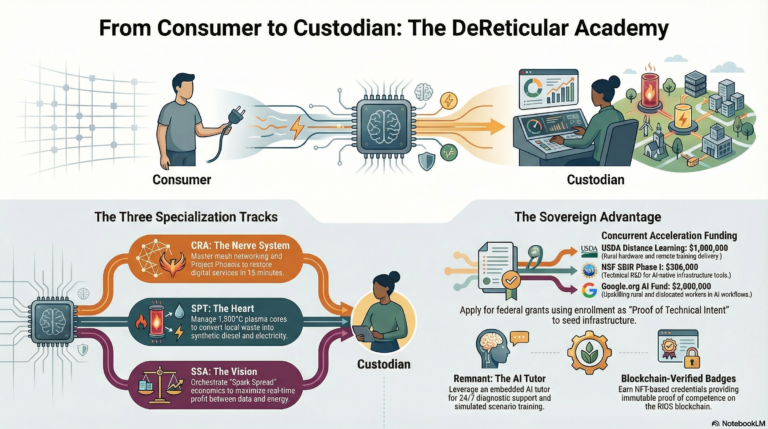
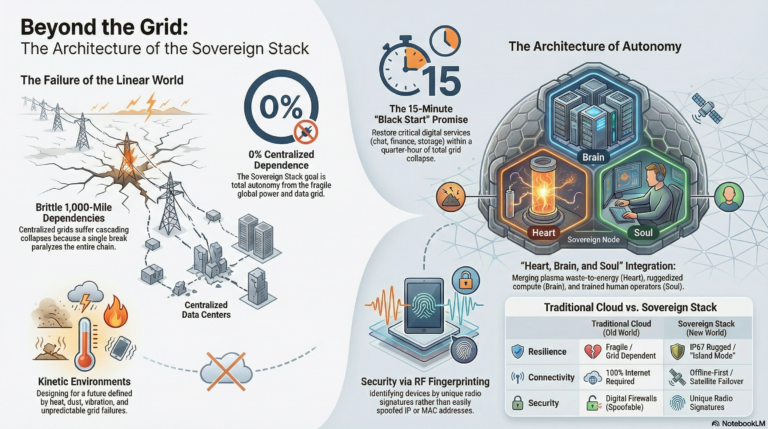
- Implementation: The DeReticular Sovereign Stack
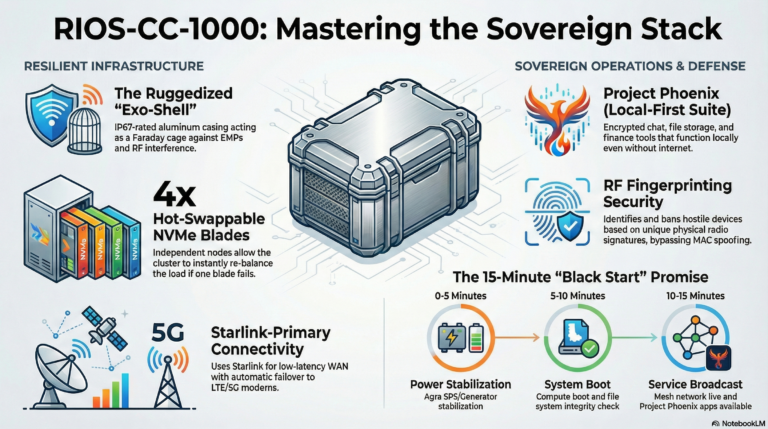
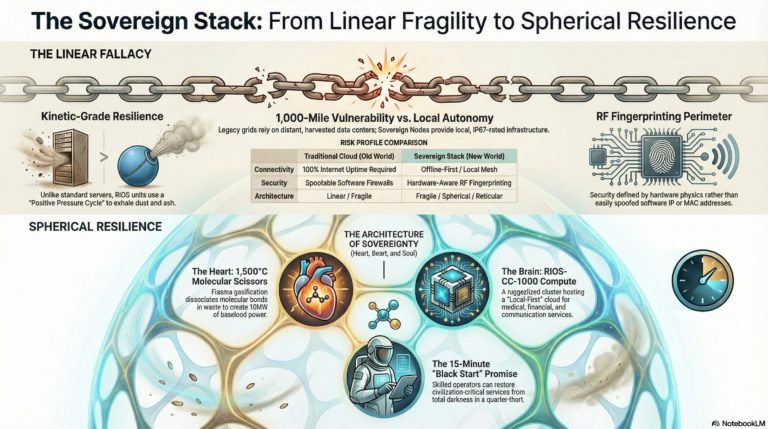
To resolve the “1,000-Mile Failure Model” of cloud dependencies, the architecture utilizes a five-layer sovereign stack designed for “Sustained Island Mode.”
- Layer 1: Baseload Power (700V DC Microgrids, Biomass Gasification).
- Layer 2: Kinetic Mobility (Autonomous Utility EVs).
- Layer 3: Edge Mesh Comms (TriFi Wireless, Zero Cloud Dependency).
- Layer 4: Cognitive AI (Remnant) (Air-gapped GPU racks, TPM 2.0).
- Layer 5: Governance (DCAA/Accounting Isolation).
- Critical Institutional Formulas
The BFT Conservation Invariant: \sum_{j=1}^M W_{output}^{(j)} \le \sum_{i=1}^P W_{input}^{(i)} A transaction is only committed if output weight does not exceed input weight.
The Metabolic Efficiency Ratio: \mathcal{M}_{ratio} = \frac{\Delta F}{\lambda \cdot \Delta Q} Halting occurs if the informational surprise reduction (\Delta F) is less than the thermodynamic cost of bit-erasure (\Delta Q).
The Peircean Asymptotic Recovery: \Omega^* = \lim_{t \to \infty} \bigcap_{\theta \in \Theta_t} \hat{\Pi}\theta^{-1}(\mathcal{P}\theta^{validated}) Truth is the invariant intersection of all validated perspectives over indefinite inquiry.