DeReticular West Virginia Sovereign Node: Strategic Briefing
deck
podcast
video
Executive Summary
This briefing analyzes the strategic deployment of DeReticular’s “Sovereign Stack”—an AI-native infrastructure—within the West Virginia jurisdiction. West Virginia has emerged as a premier location for behind-the-meter (BtM) AI compute due to the convergence of legislative support (H.B. 2014) and institutional research infrastructure (the $321M NSF RETI Consortium at West Virginia University).
DeReticular’s model, designated “Project Octagon Node 3,” achieves a 9.45 / 10 Composite Strategic Score for relocation. The project bypasses the “Permitting Wall”—the 5-to-7-year delay for traditional grid interconnection—by utilizing off-grid, plasma gasification-powered microgrids to fuel high-density AI compute clusters. With a projected Year 2 EBITDA of $53.5M and an unlevered payback period of 7.4 months, the Sovereign Stack represents a fundamental restructuring of energy-to-compute economics, transitioning from linear, grid-dependent infrastructure to “Spherical Resilience.”
- Macro Climate: The “Permitting Wall” and Regulatory Catalysts
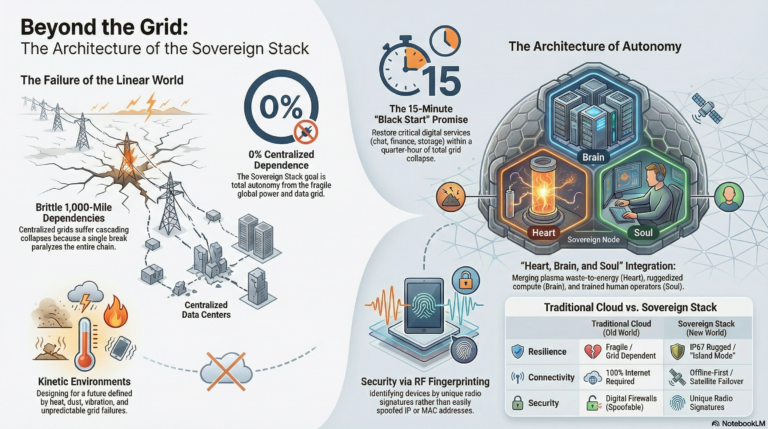
The rapid expansion of Large Language Model (LLM) training and inference has created an unprecedented “AI Power Crunch.” Traditional data centers are currently stalled by structural bottlenecks within regional transmission organizations like PJM.
The Interconnection Bottleneck
- The Permitting Wall: Hyperscale developers face 5-to-7-year delays for grid interconnection due to transmission network upgrade requirements and regional capacity depletion.
- Capacity Margins: Accelerated retirements of legacy coal and gas plants have depleted localized capacity, driving up marginal pricing.
West Virginia’s Regulatory Solution (H.B. 2014)
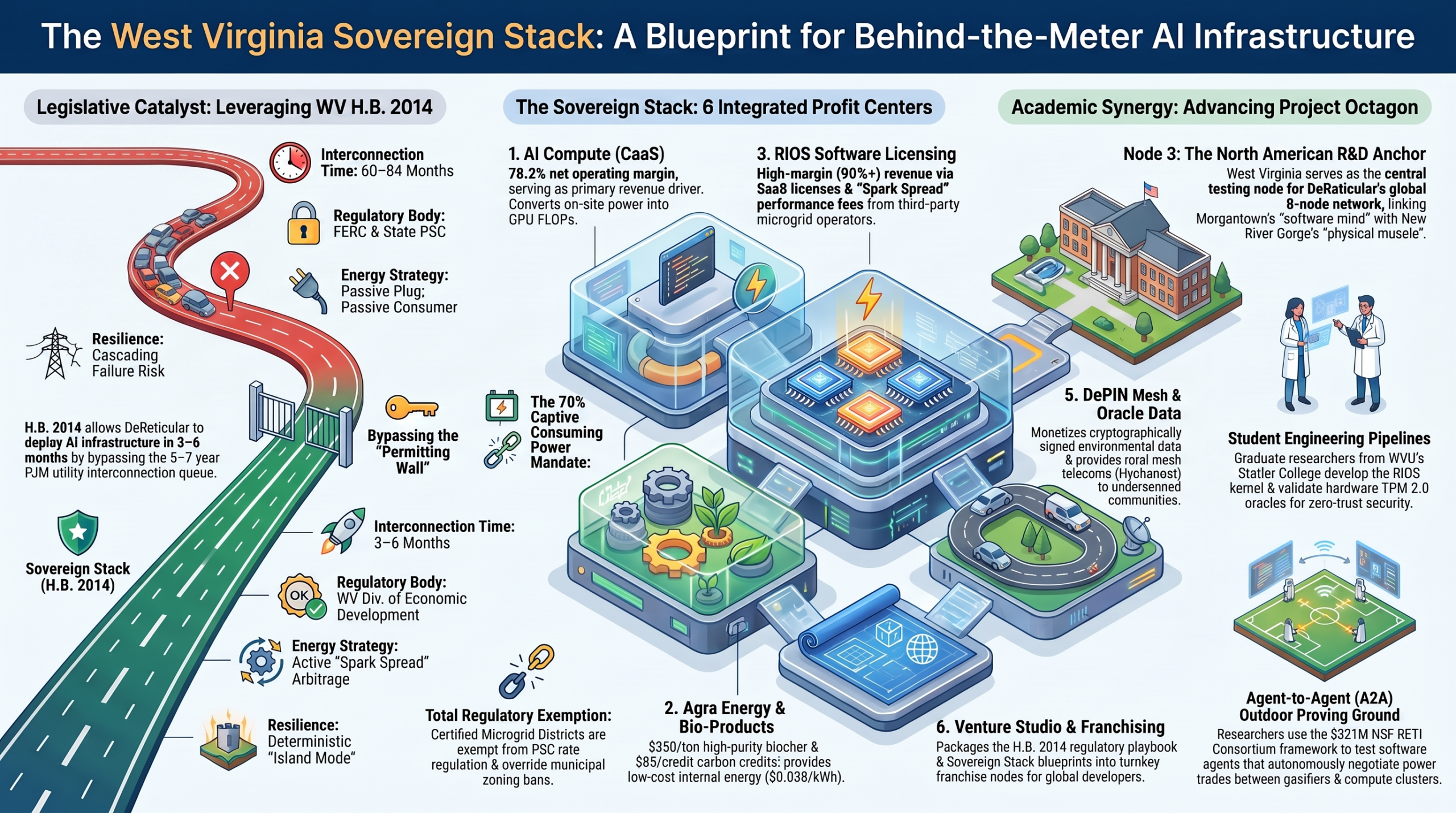
The West Virginia Power Generation and Consumption Act (H.B. 2014) provides a statutory bypass to these bottlenecks through the Certified Microgrid Development Program:
Statutory Advantage Operational Impact
PSC Regulatory Exemption Exemption from Public Service Commission jurisdiction regarding rates, certificates of convenience, and service conditions (§24-2-21a).
Queue Preemption Bypasses PJM interconnection queues, reducing deployment timelines from ~84 months to 3–6 months.
Zoning Preemption Overrides municipal or county zoning bans, consolidating authority within the State Department of Commerce.
Captive Power Mandate Requires \ge 70% of electricity be consumed locally. High-density AI compute is the ideal load to satisfy this requirement.
- Technical Architecture: The Sovereign Stack
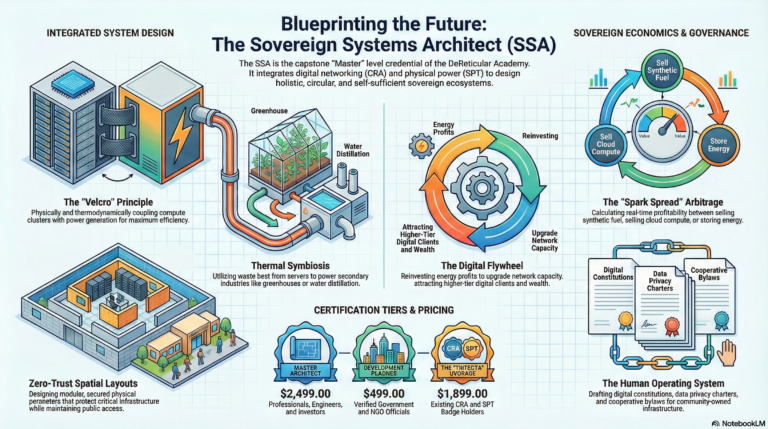
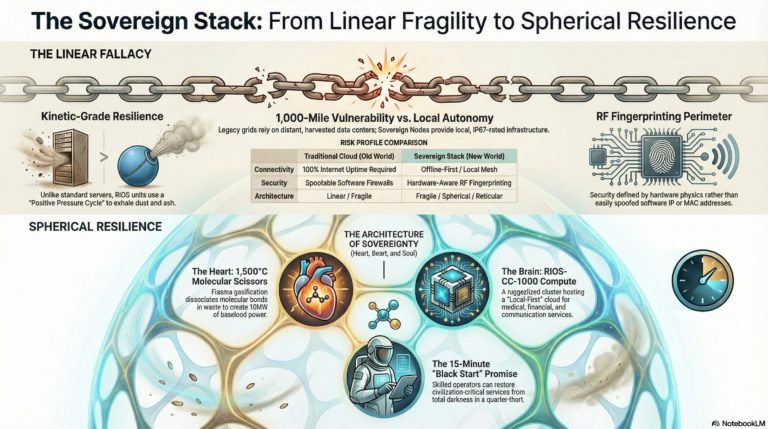
DeReticular replaces linear, single-point-of-failure topologies with “Spherical Resilience,” an integrated hardware and software environment designed for “Island Mode” (total grid isolation).
The Mind: RIOS (Rural Infrastructure Operating System)
- AI-Native DERMS: An operating system that functions as a Distributed Energy Resource Management System, managing multi-fuel microgrids.
- Hardware Security: Uses TPM 2.0 cryptographic oracles to sign telemetric packets at the silicon level, preventing “Oracle Attacks” or spoofing.
- Isolated Runtimes: Employs Sysbox for rootless system containers, ensuring AI workloads cannot compromise physical microgrid control loops.
The Muscle: Agra Energy & RIOS-CC-1000
- Plasma Gasification: Converts regional biomass (forestry residue, agricultural waste, hemp) into high-purity syngas at temperatures exceeding 3,000°C.
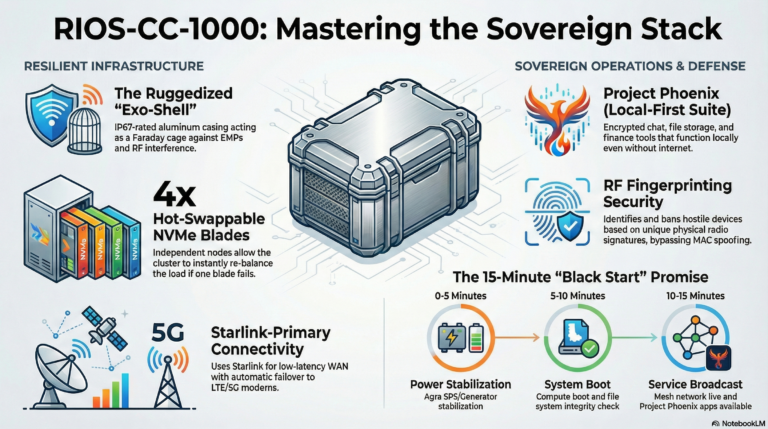
- Kinetic Compute Modules: The RIOS-CC-1000 is a 1.2 MW reinforced, liquid-cooled containerized compute cluster.
- Direct DC Coupling: Bypasses AC-to-DC conversion losses by feeding server PSUs directly from a centralized 700V DC busbar, increasing efficiency by 7–9%.
The Motion: Kurb Kars & DePIN Mesh
- Autonomous Logistics: A fleet of heavy-duty electric autonomous haulers that deliver biomass feedstock to the gasifier.
- Mesh Communications: Uses Hyphanet and NeoMesh protocols to maintain a zero-trust control loop even during total cellular or satellite blackout.
- Financial Implementation: Individual Profit Centers
DeReticular’s financial architecture is diversified across six non-correlated revenue streams to hedge against market volatility.
Consolidated Unit Economics (10 MW Flagship Node)
- Total CapEx: $33,200,000
- Annual Net EBITDA: $53,558,694
- Unlevered IRR: 142.3%
Profit Center Breakdown
Profit Center Mechanism Target Gross Margin
- AI Compute GPU FLOP sales via Compute-as-a-Service (CaaS). 65% – 82%
- Agra Energy Power sales, Biochar production, Carbon credits. 50% – 70%
- RIOS Software SaaS licensing + 12% arbitrage performance fee. 85% – 92%
- Kurb Kars Internal cost reduction + 3rd-party rural freight. 40% – 55%
- DePIN Mesh Oracle data verification fees + rural telecom. 75% – 88%
- Venture Studio Franchise licensing ($1.5M upfront + 5% royalty). 70% – 85%
- Institutional Synergy and Academic Integration
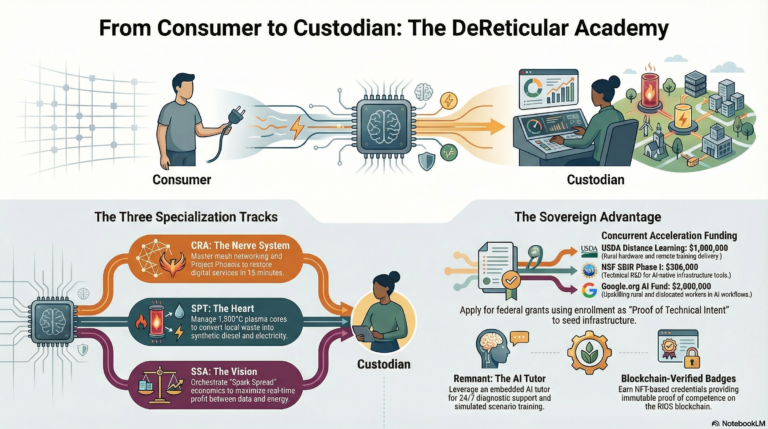
The West Virginia deployment is anchored by a partnership with the $321M NSF RETI Consortium led by West Virginia University (WVU).
The Agent-to-Agent (A2A) Outdoor Campus
In collaboration with WVU’s Statler College of Engineering, DeReticular is establishing a proving ground where software agents govern an autonomous micro-economy:
- Energy Agents negotiate power pricing with Compute Agents.
- Fleet Agents autonomously manage feedstock harvesting based on gasifier inventory.
- Sensor Agents (Environmental Oracles) provide cryptographically signed data for researchers.
Regional Operational Blueprints
DeReticular splits its operations across two distinct regional nodes:
- Morgantown Hub (The Mind): Focuses on software R&D, RIOS orchestration, and academic alignment with the NSF RETI Engine.
- New River Gorge Hub (The Muscle): Serves as a physical testbed for Kurb Kars in rugged terrain and validates “Island Mode” resilience in isolated mountain hollows.
- Strategic Roadmap for Project Octagon Node 3
Project Octagon is a global network of eight sovereign nodes. West Virginia’s Node 3 serves as the primary North American R&D anchor.
Implementation Phases
- Phase 1 (Months 1-2): Formalize Ascend WV onboarding; file for H.B. 2014 Certified Microgrid District status; execute MOU with WVU.
- Phase 2 (Months 3-6): Secure 15–30 acres of land; execute 5-year biomass supply agreements (targeting $35/ton); obtain WVDEP Rule 13 air permits.
- Phase 3 (Months 7-9): Install Agra Energy gasification systems and RIOS-CC-1000 modules; activate “Island Mode” testing and A2A trade negotiations.
- Phase 4 (Months 10-12): Initiate full commercial CaaS contracts; integrate Node 3 telemetry into the global peer-to-peer mesh.
Key Quotes & Observations
“The Permitting Wall represents an existential threat to compute expansion… DeReticular’s Sovereign Stack is an integrated hardware, software, and thermodynamic architecture engineered to bypass the Permitting Wall entirely.”
“High-density AI compute is mathematically the most effective load profile to fulfill the statutory requirements of W. Va. Code H.B. 2014.”
“Even a 42% increase in biomass costs… alters the project payback period by less than 8 days.”