Spherical Resilience: The Architecture of Decentralized Municipal Infrastructure
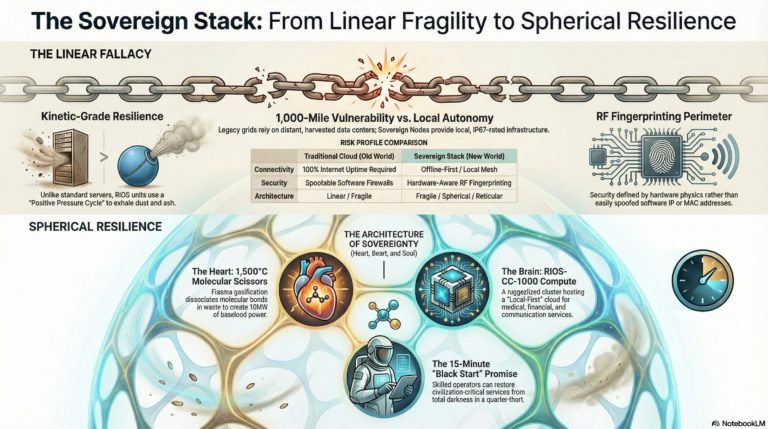
Transitioning from legacy linear infrastructure to spherical resilience shifts public services from fragile, single-path corridors to highly redundant, k-connected mesh graphs. By moving away from centralized corridors, regional communities can secure persistent utility, communication, and energy services.
1. The Graph Theory of Spherical Resilience
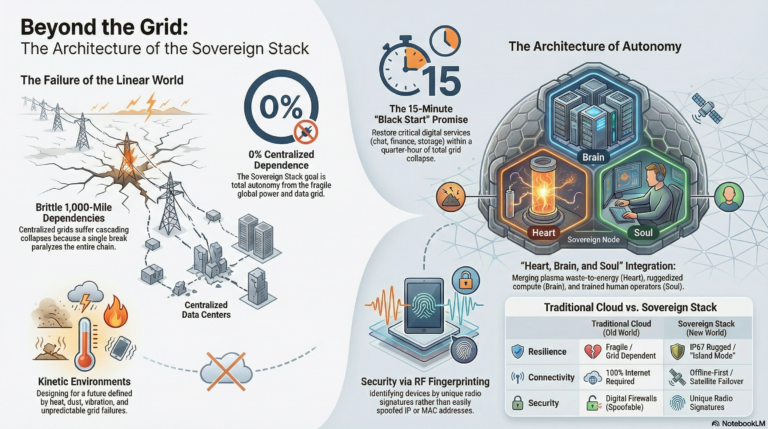
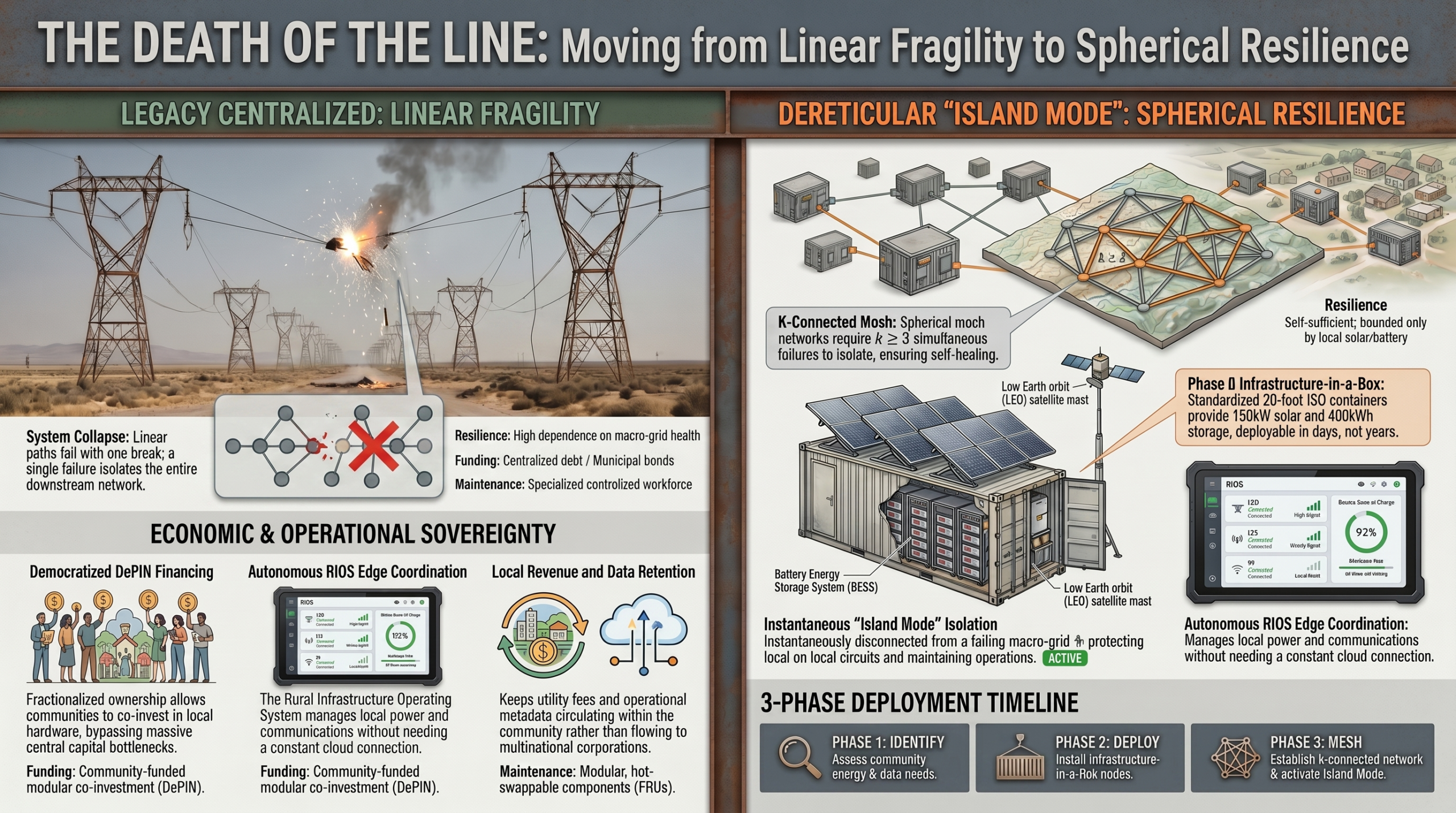
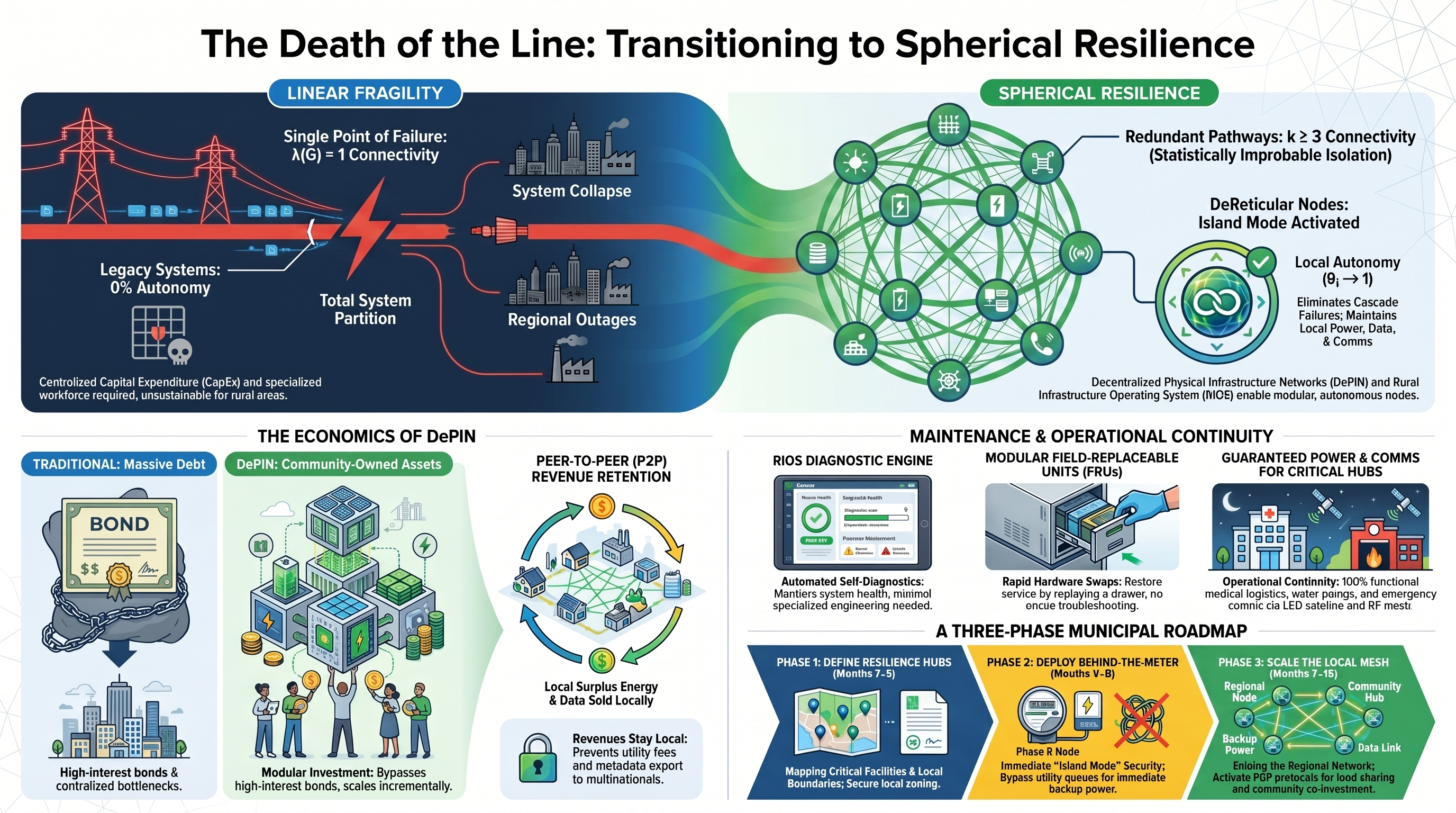
Traditional infrastructure is designed around linear concentration, which creates linear fragility. Mathematically, traditional utility networks are represented as a graph G=(V,E) where the edge connectivity is λ(G)=1. The shortest path d(u,v) between any two nodes relies on a single, non-redundant route. Under a random link failure rate p, the probability of a systemic partition is calculated as:Ppartition=1−(1−p)∣E∣As the geographical scale of the network grows (∣E∣→∞), the probability of partition approaches 1, making long-haul linear transmission systems statistically guaranteed to suffer downstream interruptions.
podcast
Spherical resilience models networks as k-vertex-connected and k-edge-connected graphs, where k≥3. The probability of any node vi becoming completely isolated is drastically reduced to:Pisolation=j=1∏kpjwhere pj is the failure probability of the j-th independent ingress/egress path. To isolate any single node or cluster, at least k independent paths must fail simultaneously.
Furthermore, spherical resilience prevents cascading failures. In traditional coupled networks, when a node vx fails, its load L(vx) redistributes to adjacent nodes. If this exceeds their operating capacity, a cascade failure occurs. The probability of cascading failure is:Pcascade∝i=1∏m(1−θi)where θi represents the local autonomy factor. Legacy networks suffer because θi≈0, as nodes cannot function without real-time synchronization signals or high-voltage reference lines from the centralized macro-grid. DeReticular’s architecture implements Island Mode, which triggers an internal control loop to set the autonomy factor θi→1 when upstream connectivity drops. By isolating local electrical and data systems via solid-state transfer switches and localized routing protocols, failures are bounded to the zone of origin, eliminating cascading system failure:θi→1limPcascade=0.
video
2. Shifting from Capital-Intensive CapEx to Modular DePIN Investments
Traditional municipal infrastructure requires massive upfront Capital Expenditures (CapEx) funded by sovereign debt, municipal bonds, or multi-billion-dollar utility conglomerates. This creates a central planning bottleneck that systematically deprioritizes low-density, rural, and semi-rural regions.
Decentralized Physical Infrastructure Networks (DePIN) shift this paradigm by democratizing funding, deployment, and operations through two main mechanisms:
- Capital Democratization & Co-Investment: Ownership of a physical node is fractionalized and represented on transparent, tamper-resistant ledgers. Local community members, agricultural cooperatives, and public-private partnerships can directly crowdsource capital to purchase and deploy modular infrastructure nodes, aligning local financial incentives with operational resilience.
- Modular Expansion (CapEx-to-OpEx Substitution): Instead of building an entire multi-megawatt centralized facility, a municipality can deploy a single “Phase 0” node to secure one critical facility (e.g., a water treatment plant). Adjacent nodes (for hospitals, emergency communication towers, or agricultural processing facilities) are added incrementally as funds become available, with each node increasing the network’s overall redundancy and k-connectedness.
- Microgrid-as-a-Service (MaaS): Local cooperatives, regional public-private partnerships, or institutional investors purchase the Phase 0 hardware assets and lease them to the municipality under long-term power purchase agreements (PPAs) or capacity service contracts. The municipality pays a predictable, fixed utility fee equivalent to—or lower than—their historical macro-utility expenditures, bypassing upfront CapEx hurdles. Over time, as surplus power or local network data is traded within the mesh, the municipality can purchase shares of the local node, eventually transferring complete asset ownership to the community.
3. Retaining Utility Revenue and Data Sovereignty Locally
Under centralized utility models, utility fees and operational metadata exit the community, flowing to multinational corporations or distant state capitals. The DeReticular model reverses this extraction:
- Local Management & Transactions: Localized data processing, telecommunication routing, and surplus energy generation are managed and transacted entirely locally.
- Peer-to-Peer (P2P) Trading: Surplus energy or compute cycles generated by a node can be traded peer-to-peer within the local mesh network, keeping economic value circulating within regional borders.
- Community Monetization: Local governments and agricultural cooperatives can monetize surplus energy and localized telecommunication capacity by selling them directly within their mesh networks. This prevents valuable transactional revenues from leaving the region.
4. Automated RIOS Diagnostics and Maintenance for Rural Operators
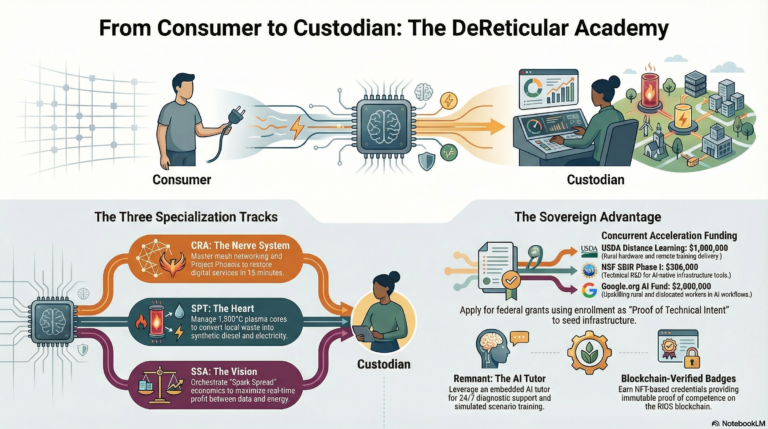
Rural municipalities face a significant deficit of advanced electrical, battery chemical, and edge-compute maintenance skills. To bridge this technical skills gap, DeReticular standardizes hardware and integrates intelligent automated diagnostics:
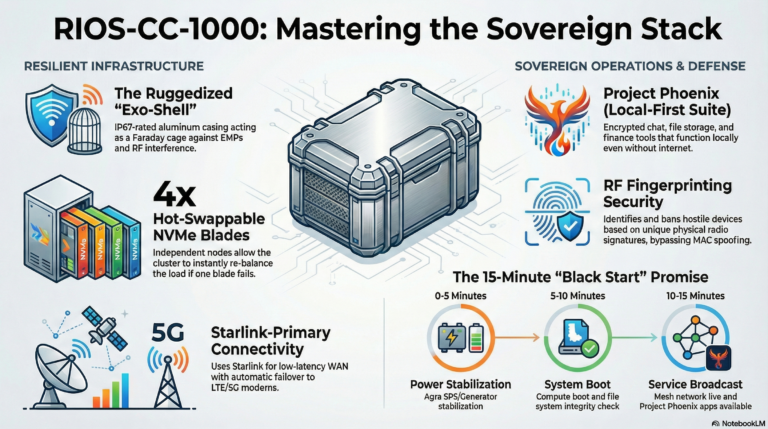
- Field-Replaceable Units (FRUs): Server racks, Battery Energy Storage System (BESS) modules, and solar controllers are designed as sealed, field-replaceable units (FRUs) inside the node chassis.
- RIOS Internal Diagnostics: When the Rural Infrastructure Operating System (RIOS) internal diagnostic engine detects a component anomaly (such as a failing inverter phase or a degrading battery cell string), it automatically issues an encrypted alert over a LEO satellite or RF mesh link.
- Simplified Maintenance Dispatch: Because of the FRU design, a regional technician can be dispatched to simply swap out the modular FRU drawer. This requires no complex onsite troubleshooting or specialized engineering expertise.
- Remote Over-the-Air (OTA) Support: The RIOS software stack supports remote OTA diagnostic support via satellite, further simplifying physical maintenance.
- Minimal Preventative Schedules: Preventative maintenance is limited to a biannual cycle consisting of cleaning solar arrays, testing the automated fire suppression systems, and verifying the state-of-charge capacity of the BESS. Technicians can easily replace components trained via DeReticular’s open-source manuals.
5. Three-Phase Deployment Timeline for Municipal Leaders
Municipal planners can deploy resilience hubs incrementally using a structured, three-phase approach designed to build system redundancy while minimizing upfront fiscal risk:
[Phase 1: Identify & Map] ---> [Phase 2: BTM Phase 0 Nodes] ---> [Phase 3: Mesh Scaling & P2P]
      (Months 1-3)                   (Months 4-6)                   (Months 7-18)
- Phase 1: Identify and Prioritize Resilience Hubs (Months 1–3): Leaders map regional critical facilities (such as water pumps, communication towers, and emergency shelters). They identify legacy interconnection points, local regulatory boundaries, and obtain necessary permits.
- Phase 2: Deploy Behind-The-Meter (BTM) Phase 0 Nodes (Months 4–6): Standard “Infrastructure-in-a-Box” units are installed directly behind facility service meters. During normal operations, they offset local loads without exporting power to the grid. This immediately establishes localized energy and telecommunications “Island Mode” security, bypassing lengthy utility connection reviews and interconnection backlogs.
- Phase 3: Scale the Local Mesh and P2P Network (Months 7–18): As multiple adjacent nodes are deployed, local DeReticular Mesh Network protocols are activated. Municipal assets are linked together to allow local data routing and load-sharing, incrementally scaling toward a fully k-connected, spherically resilient regional network.
6. Operational Continuity During Regional Disaster Events
When extreme weather anomalies, physical sabotage, or cyberattacks cause regional disasters, centralized grids and telecommunication networks suffer from systemic vulnerabilities. Under-resourced regions can lose banking access, telecom infrastructure, and cloud connectivity. DeReticular’s autonomous systems ensure operational continuity through several key mechanisms:
- Instantaneous Islanding: During grid anomalies or outages, a physical isolation switch triggers “Island Mode” within milliseconds, isolating the facility’s local electrical and data systems using solid-state transfer switches. This protects utility workers from hazardous line backfeeding while ensuring immediate localized resiliency.
- Edge-Autonomous Power Orchestration: The node operates reliably under air-gapped conditions. RIOS’s Autonomous Machine Coordination (AMC) engine assumes localized industrial control, implementing machine learning to balance generation from the 150 kW bifacial solar array, 400 kWh BESS, and 30 kW variable-speed hydrogen-ready thermal generator against critical municipal loads (e.g., maintaining water tower hydrostatic pressure while shedding non-essential residential circuits).
- Resilient Signal Fusion: The RIOS Signal Fusion Engine continuously monitors and evaluates signal-to-noise ratio, packet loss, jitter, and link cost across LEO satellite backhaul, local LTE transceivers, and long-range RF mesh interfaces. Packets are dynamically fragmented, prioritized, and routed over the optimal active interface.
- Peer-to-Peer Mesh Routing: Deployed nodes self-organize into a peer-to-peer network utilizing dynamic routing protocols (such as Babel or OLSRv2) where every node serves as an autonomous relay. If a node’s satellite uplink is damaged, it automatically routes telemetry and communications through adjacent nodes. Even if the entire region is physically isolated from upstream national backhauls, the local mesh retains 100% functionality for intranodal services, ensuring local telephony, municipal database synchronization, and emergency service dispatch operations remain uninterrupted.
- Offline Database State Engines: RIOS operates with localized, cryptographically verified database state engines. This ensures that administrative actions, local transactions, and access control lists remain fully functional even when disconnected from the global internet.