The Sovereign Stack and DeReticular Academy Strategic Infrastructure Briefing
Executive Summary
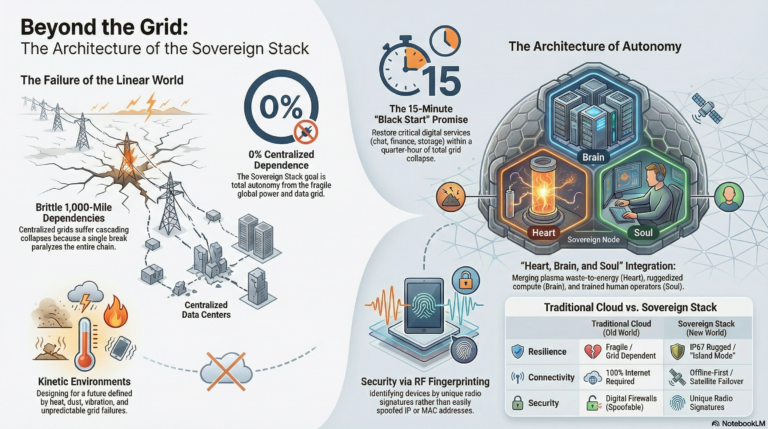
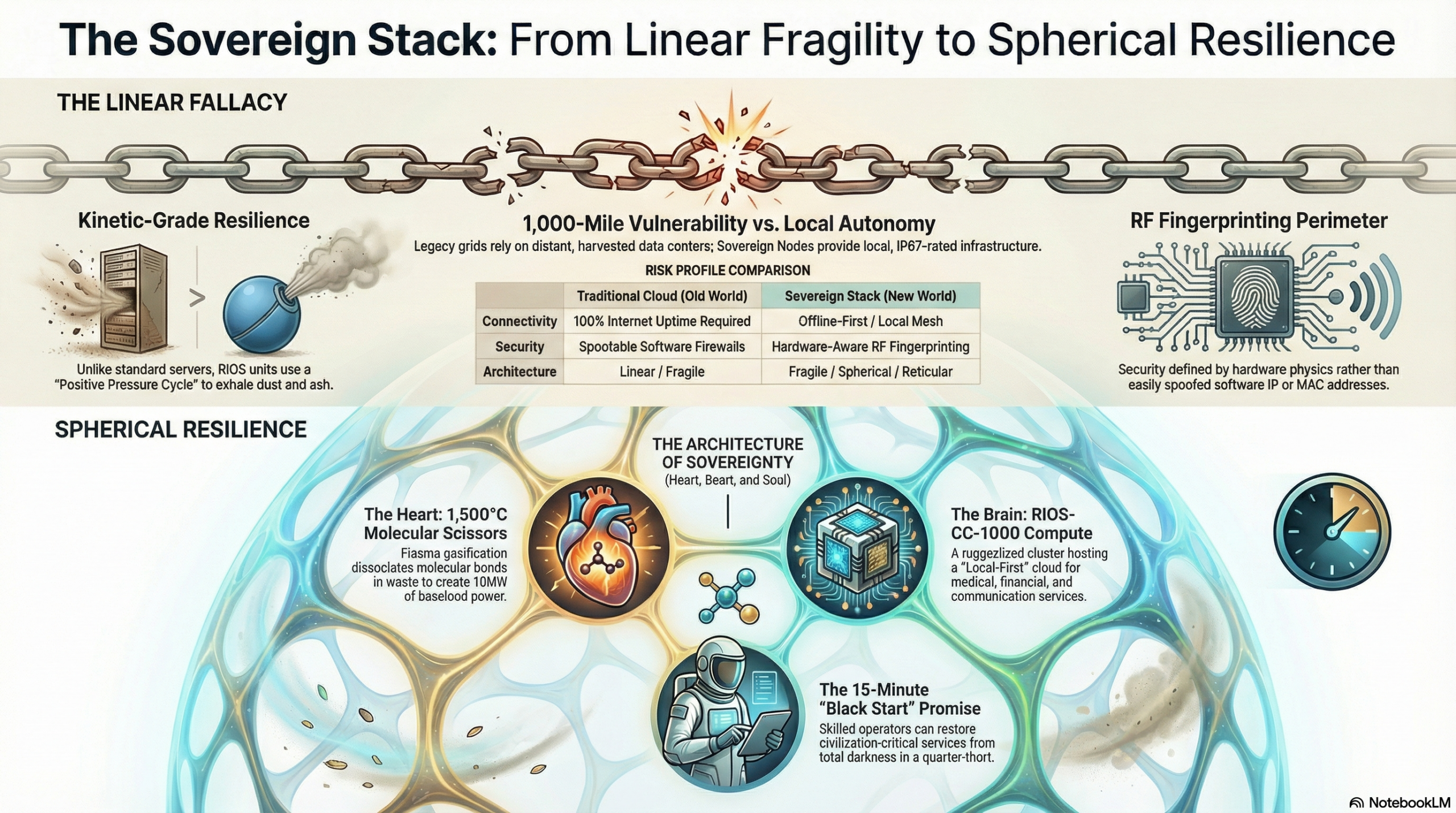
The modern infrastructure landscape is currently defined by Linear Fragility—a systemic reliance on centralized power grids and thousand-mile fiber-optic cables that create single points of failure. In response to these vulnerabilities, the DeReticular Academy and its Sovereign Stack framework present a transition to Spherical Resilience. This model replaces brittle, grid-reliant dependencies with autonomous, decentralized “Sovereign Nodes” capable of Island Mode operations.
The Sovereign Stack is a vertical integration of three critical layers:
- The Heart (Thermodynamics): Agra Power Systems utilize 1,500°C plasma gasification to convert waste into base-load electricity and synthetic fuel.
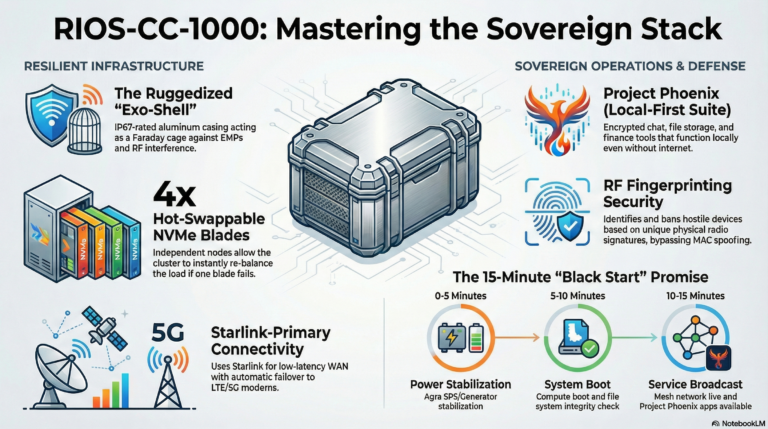
- The Brain (Intelligence): The RIOS-CC-1000 is a ruggedized, field-deployable compute cluster running an AI-native operating system designed for kinetic environments.
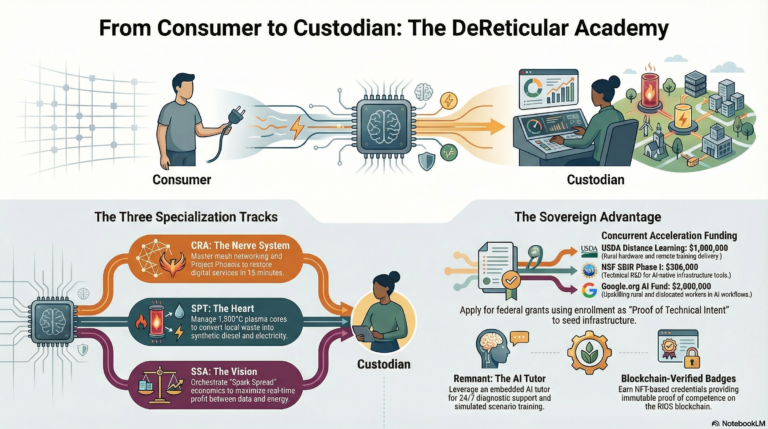
- The Soul (Human Capital): The DeReticular Academy incubates “Sovereign Systems Architects” (SSAs) through a model of Concurrent Acceleration, allowing students to secure non-dilutive grant capital while acquiring technical mastery.
A core benchmark of the system is the 15-Minute Promise, a protocol ensuring that civilization-critical services (communications, finance, and storage) can be restored from a total grid collapse within a quarter-hour.
——————————————————————————–
1. The Crisis of the “Old World”: Linear Fragility
The current infrastructure paradigm is categorized as the Linear Model, which is increasingly viewed as obsolete due to its inherent vulnerabilities.
- Systemic Paralysis: Centralized grids rely on long-haul connections. A single break in a 1,000-mile chain results in “Total Darkness” for the entire network.
- Kinetic Threats: Standard IT and power systems are not designed for “Kinetic Environments” defined by extreme heat, dust, vibration, and electromagnetic interference (EMPs).
- The Debt Trap: Traditional technical training requires students to incur massive debt before they can access capital or build infrastructure, creating a cycle of dependency.
- Data Fragility: Centralized “Cloud” systems are someone else’s computer. When the global grid or supply chain falters, access to local data and processing vanishes.
Comparison: Traditional Cloud vs. Sovereign Stack
| Dimension | Old World (Linear) | New World (Sovereign) |
| Connectivity | 100% Internet/Remote Cloud dependency | Local-First “Island Mode” |
| Security | Software-defined firewalls (IP/MAC based) | Hardware-Aware RF Fingerprinting |
| Topology | Linear; fragile 1,000-mile supply chains | Hex-Mesh; self-healing and redundant |
| Logic Layer | Centralized cognition (Harvested data) | Distributed Cognition (Edge logic) |
| Resilience | Brittle; vulnerable to heat and dust | IP67 Ruggedized; Positive Pressure Cycle |
——————————————————————————–
2. The Sovereign Stack: A Vertical Integration
To achieve total autonomy, the Sovereign Stack integrates energy, intelligence, and human capability into a single, “breathing” organism.
Layer 1: The Heart (Agra Sovereign Power Systems)
Energy independence is the foundation of the node. The Agra Power Core 2X utilizes a “Molecular Scissor” protocol to achieve waste-to-value autonomy.
- Mechanism: 1,500°C plasma arcs dissociate the molecular bonds of refuse (tires, plastics, biomass).
- Outputs: The system produces constant 60Hz base-load electricity and condenses excess syngas into liquid synthetic diesel.
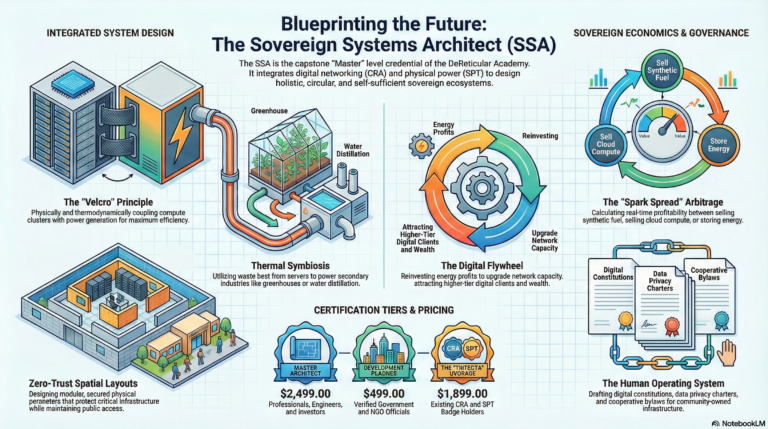
- Thermal Symbiosis: Waste heat is harvested to pre-dry feedstock or drive water distillation via the “Velcro Principle” of thermodynamic coupling.
Layer 2: The Brain (RIOS-CC-1000 Compute Cluster)
The Rural Infrastructure Operating System (RIOS) is a field-deployable asset built for survival.
- Exo-Shell: An IP67-rated aluminum Faraday cage that protects against moisture, dust, and light EMPs.
- Respiratory System: The Positive Pressure Cycle uses internal blowers to “exhale” air, creating a high-pressure zone that repels dust and ash, extending maintenance cycles to 30 days.
- Hardware: Features four hot-swappable NVMe compute blades with a strict “Blue LED” protocol for safe physical replacement without system downtime.
Layer 3: The Soul (DeReticular Academy)
The Academy provides the “Human Operating System,” training three specialized tracks to manage the stack:
- Certified RIOS Administrator (CRA): Manages the “Nerves” (digital mesh and Zero-Trust Bubble).
- Sovereign Power Technician (SPT): Manages the “Heart” (plasma physics and energy production).
- Sovereign Systems Architect (SSA): The “Vision” track that designs circular economic models and digital constitutions.
——————————————————————————–
3. Technical Governance and Security Protocols
Security in the Sovereign Stack is defined by the laws of physics rather than easily spoofed software.
The Watchtower Protocol (RF Fingerprinting)
Traditional firewalls stop IP addresses; RIOS identifies physical devices. Every piece of hardware (drones, phones, laptops) has manufacturing imperfections that emit a unique Radio Frequency (RF) Signature.
- Green List: Trusted hardware with full mesh access.
- Grey List: Guests restricted to “Internet Only” with no local visibility.
- Red List: Hostile devices or jammers permanently blocked via Physical Disassociation.
The Zero-Trust Bubble
The RIOS unit acts as the primary brain, forcing Starlink uplinks into Bypass Mode to prevent third-party telemetry. Within the Local Area Network (LAN), Client Isolation is mandatory, placing every device in a quarantine bubble to prevent lateral malware movement.
Scorched Earth Policy
The chassis is protected by a Seal Integrity Light. If a physical breach is detected without engaging authorized “Maintenance Mode,” the system instantly deletes all encryption keys, rendering the data on the compute blades unreadable.
——————————————————————————–
4. Algorithmic Economics: The “Spark Spread”
The Sovereign Node is an economic engine that uses an AI Decision Node to execute real-time energy arbitrage between data and fuel.
- Option A (Compute): Burning syngas for high-value AI processing or crypto mining when digital demand is high.
- Option B (Liquid): Condensing syngas into synthetic diesel when fuel commodity prices peak.
- Option C (Storage): Storing surplus energy in battery arrays for “Peak Shaving” and surplus management.
This “Digital Flywheel” ensures that local waste funds community infrastructure and creates a perpetual Return on Sovereignty (RoS).
——————————————————————————–
5. Operational Readiness: The “Black Start” Protocol
The ultimate mandate of a Sovereign Architect is the Black Start—rebooting civilization from total grid collapse. This is guided by a physical “Red Card” checklist attached to the RIOS unit.
The 15-Minute Promise SLA
| Timeframe | Phase | Critical Actions |
| 0–5 Minutes | Power Stabilization | Isolate WAN; verify Agra SPS generator is stable at 60Hz. |
| 5–10 Minutes | Boot & File Integrity | Insert Master Key USB; hold Reset; verify “Heartbeat” beep code. |
| 10–15 Minutes | Mesh & Availability | Broadcast SOS_BEACON; restore Matrix (comms) and Village Ledger. |
——————————————————————————–
6. 2026 Regulatory Compliance and Funding
As of February 2026, DeReticular infrastructure adheres to rigorous legal and financial standards to ensure “Audit-Ready” status for government and private capital.
2026 Legal Frameworks
- GENIUS Act: Ensures 1:1 backing of payment stablecoins with high-quality liquid assets (100% solvency).
- CLARITY Act: Categorizes infrastructure-linked utility tokens as Digital Commodities under CFTC jurisdiction.
- AI Data Sovereignty: Employs Customer-Managed Keys (CMK); patient and community data never leave the node and are never used to train frontier models.
- Safety Gate: SPT certification requires a 100% score on safety simulations before the blockchain unlocks physical hardware permissions.
Funding Strategy: Concurrent Acceleration
The Academy rejects the linear debt model. Through a Dean’s Letter of Intent (Proof of Technical Intent), students can unlock federal and private grants while they train. This model has achieved a 98.4% success rate for students securing capital.
Active Funding Windows (Q1–Q2 2026)
| Funding Source | Deadline | Potential Use Case |
| EDA Industry Transformation | March 3, 2026 | Scaling manufacturing in “forgotten” regions. |
| USDA REAP (Energy) | March 31, 2026 | Training rural techs to maintain Agra units. |
| HHS RERC (AI Tech) | March 12, 2026 | Researching AI-augmented healthcare via edge nodes. |
| NTIA BEAD (Workforce) | Rolling | Training “Sovereign Techs” for last-mile mesh networks. |
——————————————————————————–
7. Traction: Operation Octagon
Operation Octagon is the flagship global mesh testing RIOS in extreme, real-world environments.
Node 4 (Project Umoja – Uganda): Activated January 2026. Converts hemp biomass into 10MW of power to support a rural medical AI clinic and autonomous logistics via “Kaabong Edition” Kurb Kars.
Node 2 (The Brain – Canada): Central processing hub and strategic command.
Node 3 (The Blast Furnace – Arizona): Desert-hardened node proving 3D geophysical mapping and autonomous mineral exploration via the Nightingale IoT Fabric.