From Waste to Wealth The Journey of a Sovereign Closed-Loop System
1. The Foundation: Understanding the “Velcro” Principle
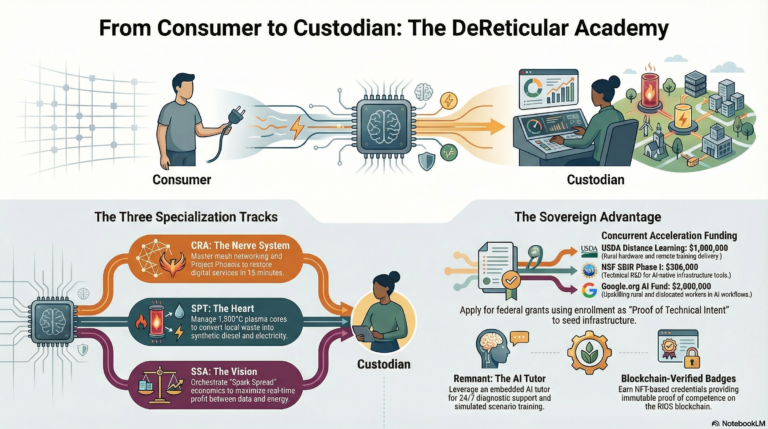
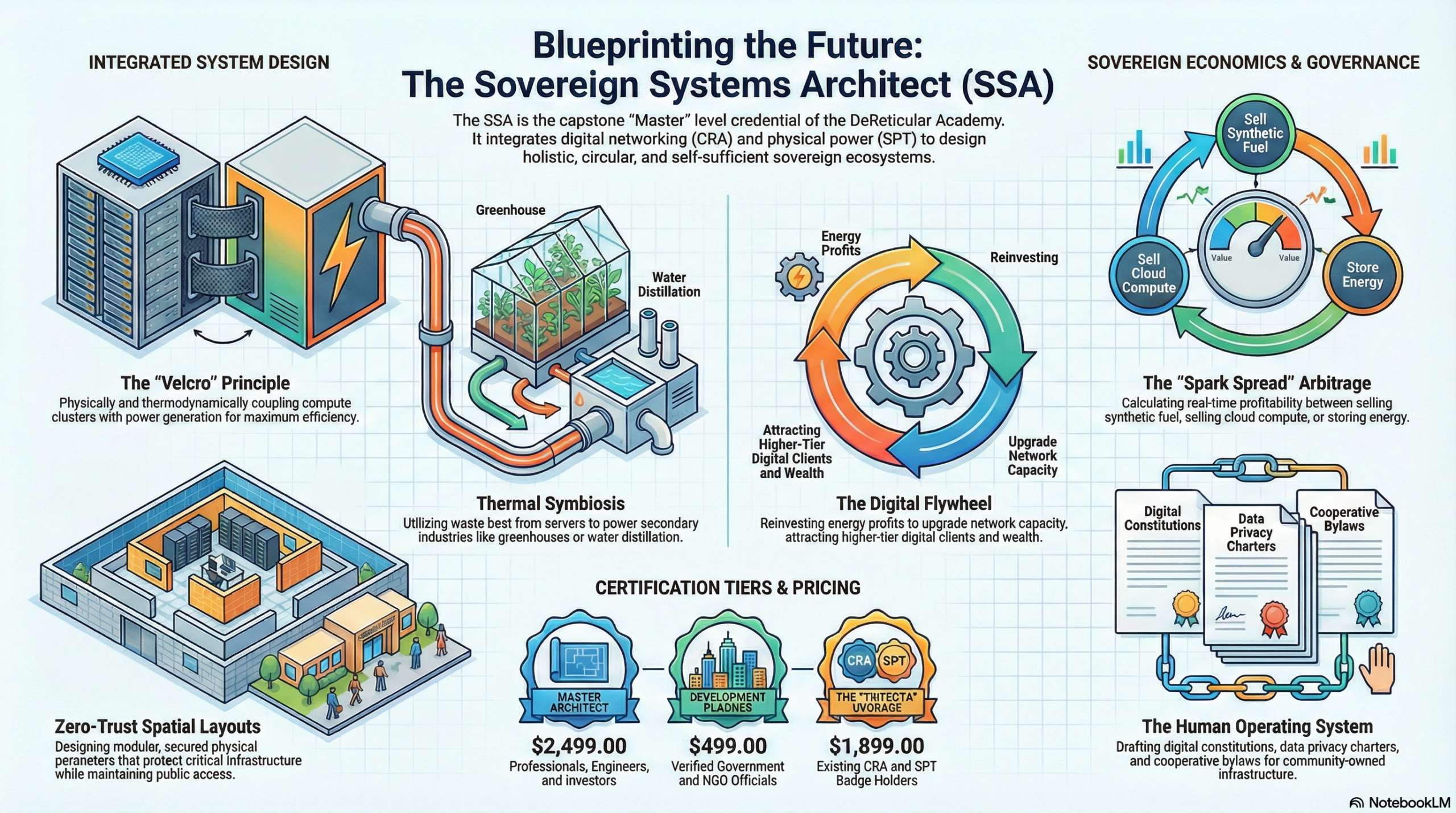
In the archaic paradigms of centralized infrastructure, energy generation and digital processing are treated as isolated silos. A Sovereign Systems Architect rejects this inefficiency. We operate on the “Velcro” Principle—the deliberate physical and thermodynamic System Coupling of digital networking (the DeReticular layer) and physical power generation (the Agra layer).
An Architect does not merely see “trash”—they see potential energy trapped in a low-entropy state, waiting for the intelligence of a sovereign design to liberate it. By “locking” the digital and physical stacks together, we ensure that data needs are met by local power, and power generation is optimized by the intelligence of data.
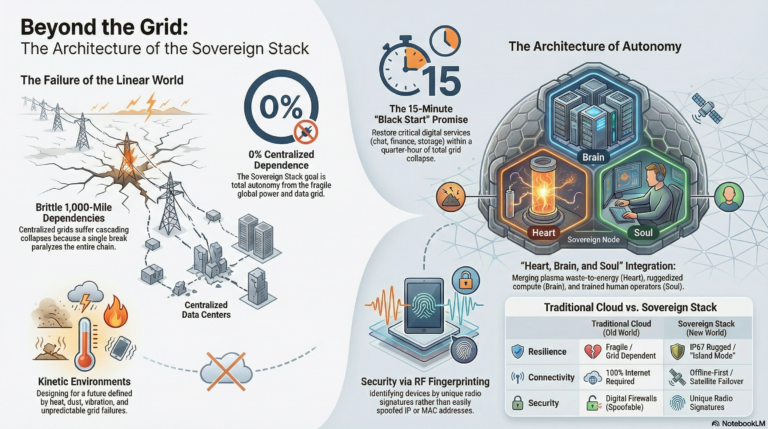
Engineering Sovereignty The practice of designing decentralized, distributed nodes that integrate power, data, and agriculture into a single, self-sufficient “stack.” It is the transition from dependence on failing centralized grids to the mastery of resilient, independent ecosystems capable of withstanding “Black Swan” events.
The journey toward this state of independence begins not with complex silicon, but with the raw materials the rest of the world has discarded as “waste.”
2. Step One: The Input – Harvesting Feedstock
The first stage of the cycle is the strategic collection of agricultural byproducts and waste streams. In our ecosystem, the concept of “garbage” is a failure of imagination. We view these materials as feedstock—the high-energy fuel required to maintain the system’s pulse.
To maintain peak efficiency, the Architect oversees a rigorous Pre-Processing phase: materials must be shredded, dried, and pelletized to ensure consistent reactor temperatures and optimal burn rates.
Valid Feedstock Materials:
- Biomass: Agricultural residues, wood chips, and organic waste from the local nexus.
- Plastics: High-density materials, specifically HDPE and LDPE.
- Carbon-Rich Industrial Waste: Specifically scrapped tires and other high-BTU rubber products.
By treating these inputs with technical precision, we prove that “waste is just misplaced energy.” Once sorted to remove contaminants like PVC or heavy metals, the feedstock is ready for a fundamental molecular transformation.
3. Step Two: The Conversion – The Agra Power Core 2X
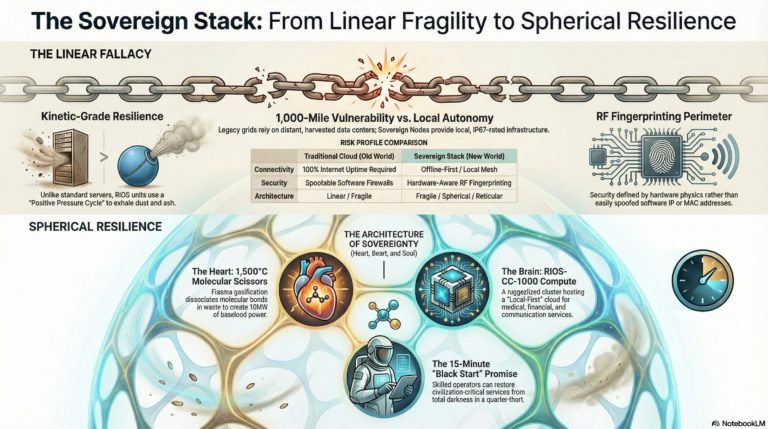
The heart of the physical system is the Agra Power Core 2X. This is not a mere incinerator; it is a laboratory-grade conversion engine utilizing Plasma Gasification. This process utilizes plasma torches to generate extreme temperatures that facilitate the dissociation of molecular bonds, breaking matter down to its elemental components. This is not “burning”; it is a transition of states governed by physics.
The Molecular Transformation:
- Dissociation: Feedstock is fed into the Power Core 2X, where molecular bonds are broken in an oxygen-starved environment.
- Syngas Creation: The reactor captures the resulting elemental mixture, creating a clean, high-energy “Syngas.”
- Refinement (Fischer-Tropsch Process): This syngas is processed to produce high-value Electricity or refined into synthetic diesel and naptha.
The electricity generated here is immediately routed to sustain the “nerve system” of the sovereign ecosystem.
4. Step Three: The Nerve System – Powering the RIOS-CC-1000
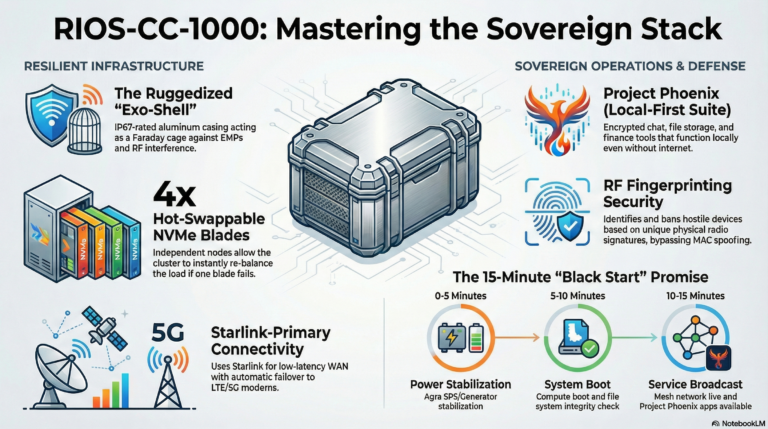
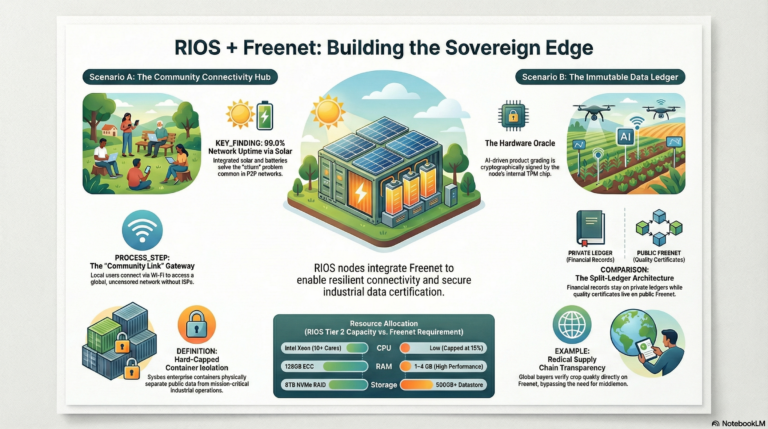
The electricity from the Agra unit feeds the RIOS-CC-1000 (Rural Infrastructure Operating System – Compute Cluster). This ruggedized, Linux-based kernel infrastructure serves as the digital foundation for the community, providing offline-first functionality that ensures the local ecosystem remains operational even if the global web falters.
The RIOS cluster manages the Zero-Trust Bubble, a security perimeter that protects the node through several key layers:
- Local Mesh Connectivity: Utilizing WiFi 6 and mesh dynamics to provide a self-healing network, secured by RF Fingerprinting to detect and isolate rogue devices.
- Sovereign Management Software: Running the agrivoltaic algorithms and sensor arrays that monitor the entire closed-loop system.
- The Data Vault: Encrypted, locally hosted storage that ensures community data—from financial ledgers to medical records—remains under local sovereignty.
Integration with Starlink provides essential satellite backhaul for global reach, but the cluster’s primary duty is local. As these servers process data, they produce a byproduct that the Architect treats as a primary asset: heat.
5. Step Four: Thermal Symbiosis – Repurposing “Waste Heat”
The RIOS-CC-1000 utilizes liquid cooling loops to manage thermal loads. Instead of venting this energy into the atmosphere, we route it to heat-rejection loads within the ecosystem. This is the mastery of Thermal Symbiosis.
Thermal Symbiosis: From Server to Industry
| Secondary Industry | Primary Benefit |
| Community Greenhouses | Maintains precise temperatures for year-round agrivoltaic production. |
| Water Distillation | Drives the evaporation-condensation cycle for potable water production. |
| Feedstock Drying | Optimizes the efficiency of the Agra reactor by removing moisture before gasification. |
6. Step Five: Closing the Loop – The Agricultural Nexus
The final connection is the Agricultural Nexus, where the secondary industries—supported by Agrivoltaics (the integration of solar/biomass with farming)—produce the very biomass that fuels the Agra unit. This completes the physical circle: the greenhouse yields food for the community and feedstock for the generator.
The Lifecycle Diagram: [Agra Power Core 2X] \rightarrow [Electricity] \rightarrow [RIOS Servers] \rightarrow [Waste Heat] \rightarrow [Greenhouse] \rightarrow [Biomass] \rightarrow [Agra Power Core 2X]
7. The Sovereign Economics: The “Digital Flywheel”
A Sovereign System is a wealth-generation engine. The Architect manages this through the Spark Spread—the real-time calculation of energy arbitrage. Using the Sovereign Arbiter tool, the Architect decides in real-time how to monetize every joule of energy produced.
The 4 Primary Revenue Streams:
- ISP/Cloud Subscriptions: Selling access to the local mesh and Sovereign Cloud seats.
- Synthetic Fuel Sales: Selling the synthetic diesel and naptha produced by the GTL process.
- Carbon Credits: Monetizing the diversion of waste from landfills into a clean-energy loop.
- Compute Leasing (Arbitrage): Choosing to mine cryptocurrency or lease compute power when energy costs are low and local demand is peaked.
This “Digital Flywheel” allows the system to reinvest profits into lower latency and higher power capacity, creating an anti-fragile economic state.
8. Conclusion: The Master Plan
The Sovereign Systems Architect does not just design a site; they blueprint the future. By managing entropy and designing “civilization-scale” organisms, the Architect ensures that self-sufficiency is the ultimate product. The Master’s Vision is one of absolute resilience—a world where every node is a fortress of data, energy, and life.
Student Checklist for Mastering the Loop:
- [ ] System Coupling: Can you precisely match the Agra Power Core 2X output to the RIOS-CC-1000 load?
- [ ] Molecular Mastery: Do you understand the Fischer-Tropsch process and bond dissociation?
- [ ] Thermal Integration: Have you designed a liquid cooling loop for a heat-rejection load?
- [ ] Economic Arbitrage: Can you use the Sovereign Arbiter to calculate the most profitable Spark Spread?
- [ ] Governance: Have you drafted the Digital Constitution and calculated the Return on Sovereignty (RoS)?